Menu

3D Printer Raise3D RMS220 Standard Bundle

3D Printer Raise3D RMS220 Standard Bundle
Free Training

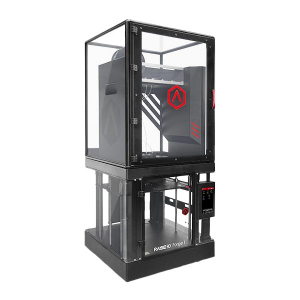
3D Printer Raise3D RMS220 Standard Package — SLS system for short-run production, featuring a swappable build unit and bundled cleaning station. It suits businesses scaling from prototyping to manufacturing. The compact footprint fits tight workshop layouts. Laser sintering with industrial-grade precision keeps the printer working batch after batch.

Key specs and benefits

  • Maximum throughput: up to 5 kg/day — Plan short-run production on a single machine at full capacity.
  • Scanning speed: 30,000 mm/s — A 75 W infrared fibre laser with a galvo system sinters each layer quickly.
  • Build volume: 220 × 220 × 350 mm — Batch several parts in one 17 L build.
  • Swap and Print: the Build Unit 220 cools externally to below 100 °C in 30 minutes, so you insert a second unit and the laser keeps working.
  • 4-zone IR heating with auto-calibration: it evens out temperature across the platform, which prevents warping in high-temperature plastics.
  • RFID material recognition: the printer identifies the loaded powder and adjusts parameters, which simplifies material tracking.
  • Cleaning Station C220-P: it combines powder separation, recovery and preparation, so hands-on time per print cycle falls to 20–45 minutes.

How the Raise3D RMS220 sinters parts

Speed, consistency and post-processing are the usual limits of additive manufacturing. The RMS220 addresses all three in one production system. A 75 W infrared fibre laser (1064 nm) and a high-precision galvanometer scan at up to 30,000 mm/s. An F-theta lens (a flat-field scanning lens) keeps the focus consistent across the work area.

The result is sharp edges, complex geometries and robust mechanical properties. Layer height ranges from 0.05 to 0.40 mm. Use 0.1–0.2 mm for greater stability. Print speed reaches 2.2 L/h at a packing density of 20% by weight.

Continuous workflow with Build Unit 220

Traditional SLS machines cool inside the printer, which leaves the laser idle. The modular design here centres on the Build Unit 220. Remove it when printing ends and let it cool outside the machine. It drops below 100 °C in 30 minutes.

Insert a second build unit and start the next batch at once. This "Swap and Print" routine keeps the laser busy and improves return on investment. Note that each Build Unit 220 weighs 62 kg, so plan handling accordingly.

Thermal control and material versatility

Dimensional accuracy in SLS depends on thermal stability. A 4-zone IR heating system with auto-calibration removes temperature fluctuations across the platform. That prevents the warping often seen with high-temperature plastics. Powder temperature reaches up to 220 °C, while platform and cylinder reach up to 180 °C.

The machine runs Raise3D PA12 for balanced mechanical performance. PA11 adds impact resistance. TPU90A and TPU86A cover flexible elastomer parts. Integrated RFID reads the loaded powder and sets parameters automatically.

The atmosphere can be air or nitrogen. An integrated nitrogen generator is built in, but it requires compressed air.

Post-processing with the cleaning station

SLS powder recovery is typically complex and messy. The Cleaning Station C220-P turns it into a clean, semi-automated workflow. It integrates powder separation, recovery and preparation. Hands-on time per print cycle drops to 20–45 minutes.

An adjustable armrest and transparent safety covers support the operator. A single operator can process over 50 kg of parts per shift. Total cost of ownership falls compared with traditional industrial SLS systems.

Software and connectivity

Job preparation runs in ideaMaker slicer software. It accepts STL, OBJ, 3MF, OLTP, STEP, STP, IGES and IGS files. Send jobs over Wi-Fi or LAN/Ethernet. A USB 3.0 port is also available. The printer has an 11.5-inch touchscreen, and the cleaning station has a 7-inch one.

Applications

  • Prototyping: sinters functional test parts that behave like final components before you commit to tooling.
  • Short-run manufacturing: swappable build units and up to 5 kg/day throughput keep batches moving.
  • Press-fit housings: tight tolerances at 0.05–0.40 mm layer height support parts that must fit precisely.
  • Medical guides: fine geometries and sharp edges suit patient-specific guide shapes.
  • Durable end-use components: PA11 provides impact resistance for parts under mechanical load.
  • Flexible parts: TPU90A and TPU86A elastomers produce elastic components on the same machine.

Compatibility and accessories

  • Powders: PA12 Black, PA11 Black and PA12 GB Black.
  • Elastomers: TPU90A and TPU86A, each in Black or White.
  • Open Material Programme (OMP): selected third-party materials, with an optional open material licence.

Package contents

  1. Printer with Build Unit 220
  2. Cleaning Station C220-P
  3. One-year warranty

Technical specifications

General system overview

ParameterValue
TechnologySelective Laser Sintering (SLS)
Maximum throughputup to 5 kg/day at full capacity
Build volume (W × D × H)220 × 220 × 350 mm (8.7 × 8.7 × 13.8 inches) / 17 L
Laser type75 W infrared fibre laser, wavelength 1064 nm
Scanning systemhigh-speed, high-precision galvo system with F-theta lens
Maximum scanning speed30,000 mm/s
Print speed2.2 L/h (at a packing density of 20% by weight)
Layer height0.05–0.40 mm (0.1–0.2 mm recommended for greater stability)

Temperature and environmental control

ParameterValue
Maximum powder temperature220 °C
Maximum platform temperature180 °C
Maximum cylinder temperature180 °C
Active coolingyes
Atmosphereair / nitrogen (integrated nitrogen generator in RMS220; requires compressed air)
Operating environmenttemperature 15–30 °C; humidity 30–70% RH without condensation

Hardware and physical dimensions

ParameterValue
RMS220 printer dimensions861 × 685 × 1560 mm (body); 861 × 685 × 1760 mm (with light tower)
RMS220 printer net weight283 kg (without powder or container)
Cleaning Station C220-P dimensions1238 × 823 × 1740 mm (body); 1384 × 823 × 1928 mm (incl. panel and light)
Cleaning Station C220-P net weight263 kg
Build Unit 220 dimensions536.5 × 333 × 1005 mm
Build Unit 220 net weight62 kg
Hopper capacity (printer)31.5 L (40 L with extension box)
Hopper capacity (cleaning station)20 L new powder / 20 L used powder

Software and controls

ParameterValue
Slicer softwareideaMaker
Supported input formatsSTL, OBJ, 3MF, OLTP, STEP, STP, IGES, IGS
User interface (printer)11.5-inch touchscreen (resolution 2560 × 1600)
User interface (cleaning station)7-inch touchscreen (resolution 1280 × 800)
Logic controllerRockchip RK3568 Arm Quad Cortex-A55 2 GHz
Motion controllerGigaDevice Arm Cortex-M4 200 MHz FPU
Operating systemLINUX

Materials

ParameterValue
Compatible powdersPA12 Black, PA11 Black, PA12 GB Black, TPU90A (Black/White), TPU86A (Black/White)
Open Material Programme (OMP)compatible with selected third-party materials; optional open material licence available
RFID material recognitionyes (both on the printer and the cleaning station)

Connectivity and power

ParameterValue
Printer input power200–240 VAC, 50/60 Hz, 230 VAC @ 15 A
Cleaning station power200–240 V @ 8 A or 100–120 V @ 16 A (includes external vacuum)
NetworkWi-Fi, LAN/Ethernet
InterfacesUSB 3.0 × 1, Ethernet × 1

Why buy the Raise3D RMS220 from EXPERT3D?

EXPERT3D supplies professional 3D equipment since 2012. We help businesses implement efficient additive manufacturing workflows. Your equipment comes with an official warranty. Authorised technical support is part of the service. As an official representative of Raise3D, we guarantee 100% authenticity, fair price, authorised service, and an official warranty.

Write a comment