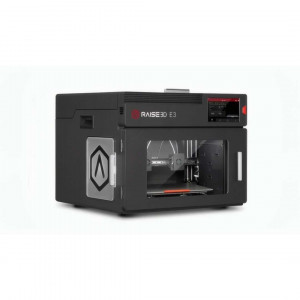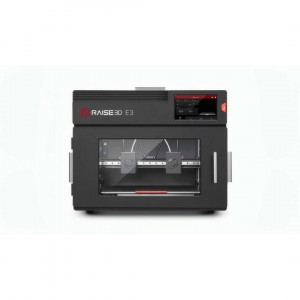


- Stock: In Stock
- Product code: 920372000002727605
- Weight Brutto: 98.20kg

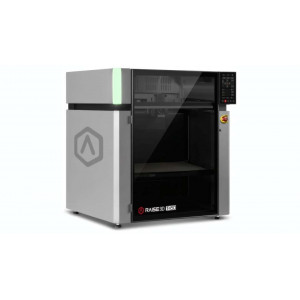
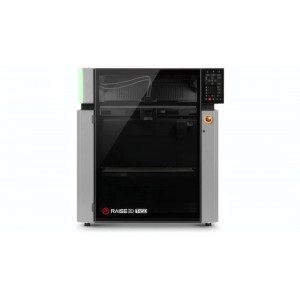
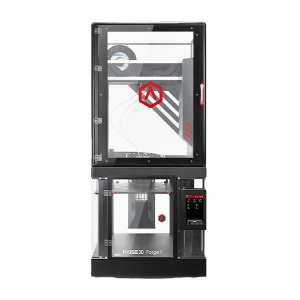
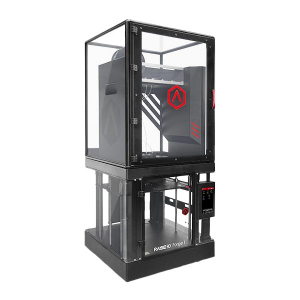
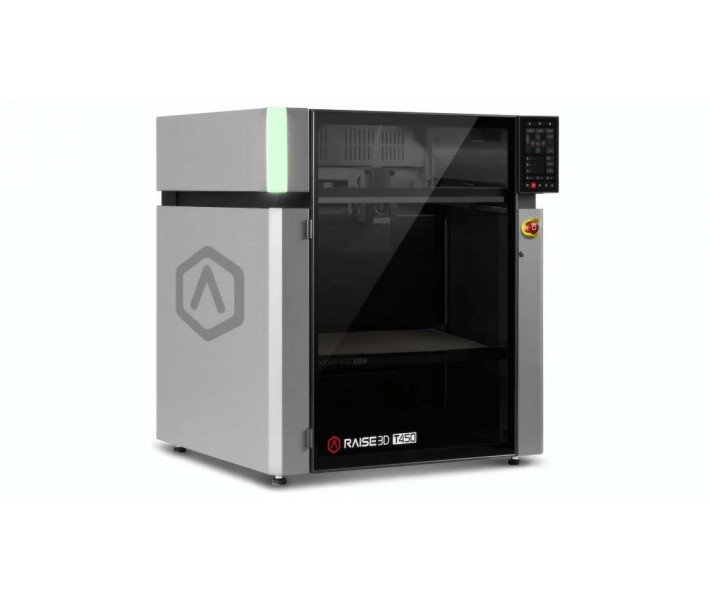
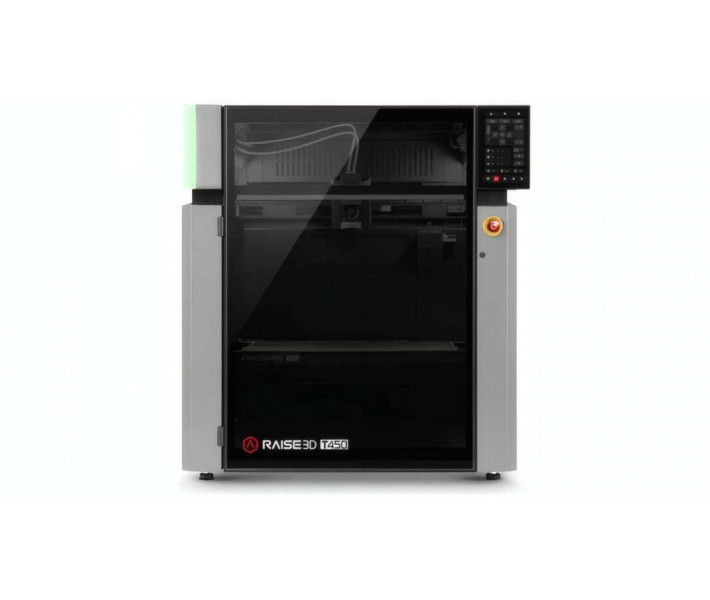
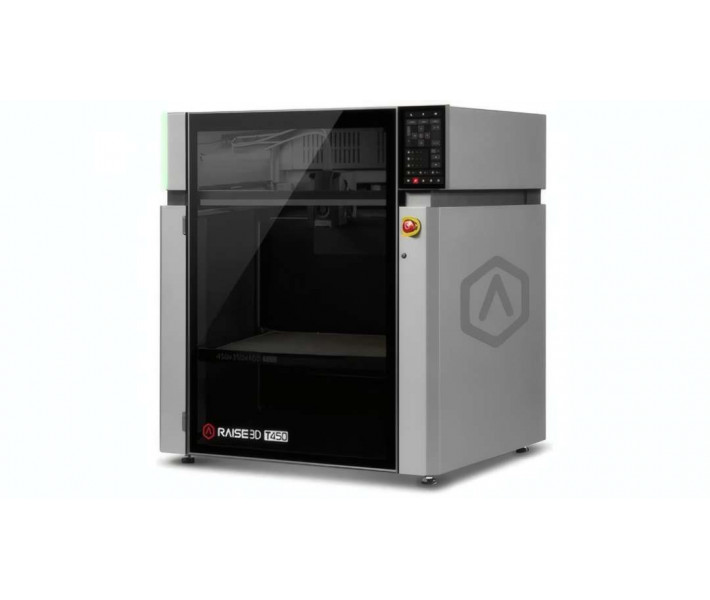
Raise3D T450 is an FFF printer for printing large foundry patterns and tooling. A tool or mould is printed whole, without splitting into sections and bonding seams. Two independent filament paths feed a single nozzle, which increases melt delivery. A closed chamber with active heating maintains the temperature during long jobs.
Key features and benefits
- Build volume: 450 × 350 × 400 mm — A suitable part of this size is printed whole, so there are no seams between sections to align and bond.
- Max. TwinFlow™ flow rate: 80 mm³/s — This is a test value: it was obtained with Hyper Speed ABS V2 at 250 °C, and the actual flow rate depends on the material and print profile.
- Max. nozzle temperature: 420 °C — The nozzle with a CuCrZr base and SiC tip works with compatible engineering and fibre-reinforced materials.
- One part instead of sections: whole-part printing eliminates adhesive joints, which can weaken under load, and removes seam finishing.
- High-flow mode: two filaments of the same material run into one nozzle, and the increased melt delivery can shorten print time in flow-limited areas.
- Autonomy for long jobs: two 2.5 kg spools provide up to 5 kg of material, and sensors alert you to filament run-out or a "spaghetti" failure.
The Raise3D T450 prints large parts as a single piece
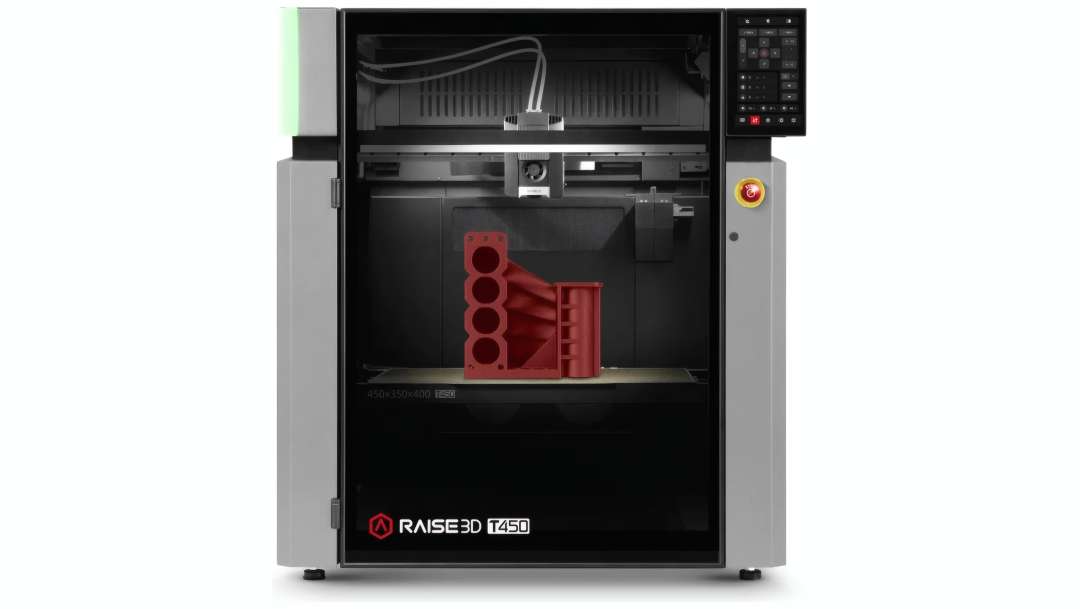
A large part often has to be split to fit the build area. The Raise3D T450 has a build volume of 450 × 350 × 400 mm, so suitable parts are produced whole. Single-piece printing removes adhesive joints, which can weaken under load. There are no seams to align.
For functional prototypes and testing, this approach is suitable without reservations. Parts are used as end-use components after the material, design and process have been verified. The larger build volume opens up full-size items. Examples are foundry patterns and spinal orthoses, as well as sculptures and drones. Whether a part fits whole depends on its dimensions, orientation and material. For wider, deeper or taller parts, consider the Raise3D T700.
TwinFlow™: two filament paths, one nozzle
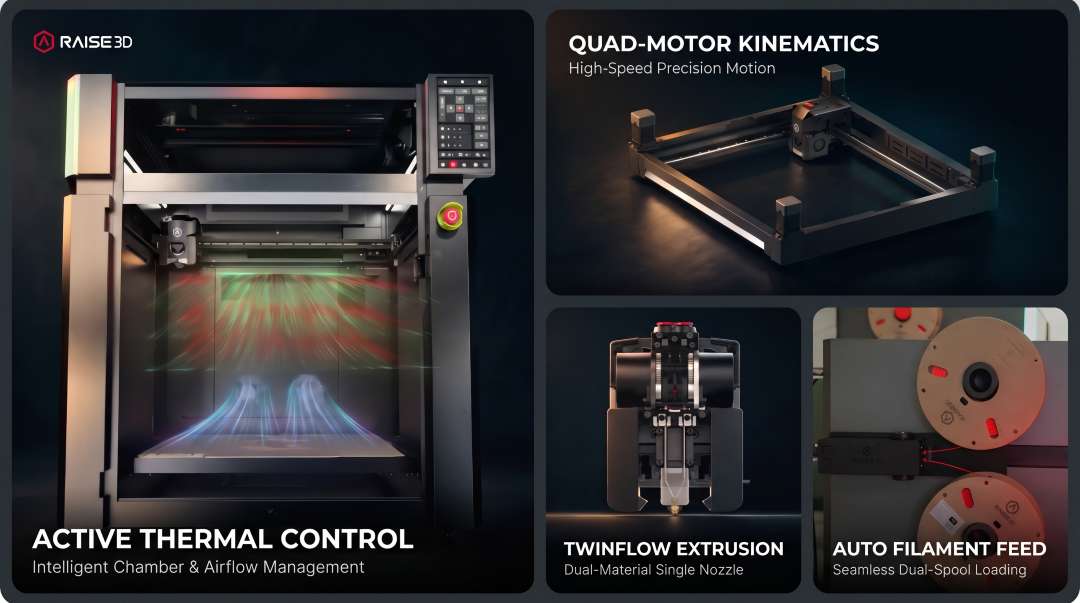
A faster toolhead does not by itself guarantee a faster finished part. Print time is affected by toolpath length and cooling. The ability of the hotend to melt and deliver material also matters. The bottleneck is melt delivery. TwinFlow™ is designed to improve delivery efficiency, which supports faster printing. The maximum print speed of the Raise3D T450 is 600 mm/s.
How it works
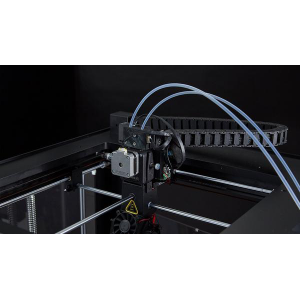
Two independent filament paths converge in a Y-shaped manifold and exit through a single nozzle. TwinFlow™ provides two modes: high flow and dual material. Two filaments with a diameter of 1.75 mm are used. Their combined cross-sectional area is theoretically equal to the area of a single round filament with a diameter of about 2.47 mm. This is only a comparison of areas. The system does not use a 2.47 mm filament.
High-flow mode
Two filaments of the same material are fed simultaneously through the shared nozzle. The increased melt delivery can shorten print time in flow-limited areas. The result depends on the material, the print profile and the part geometry.
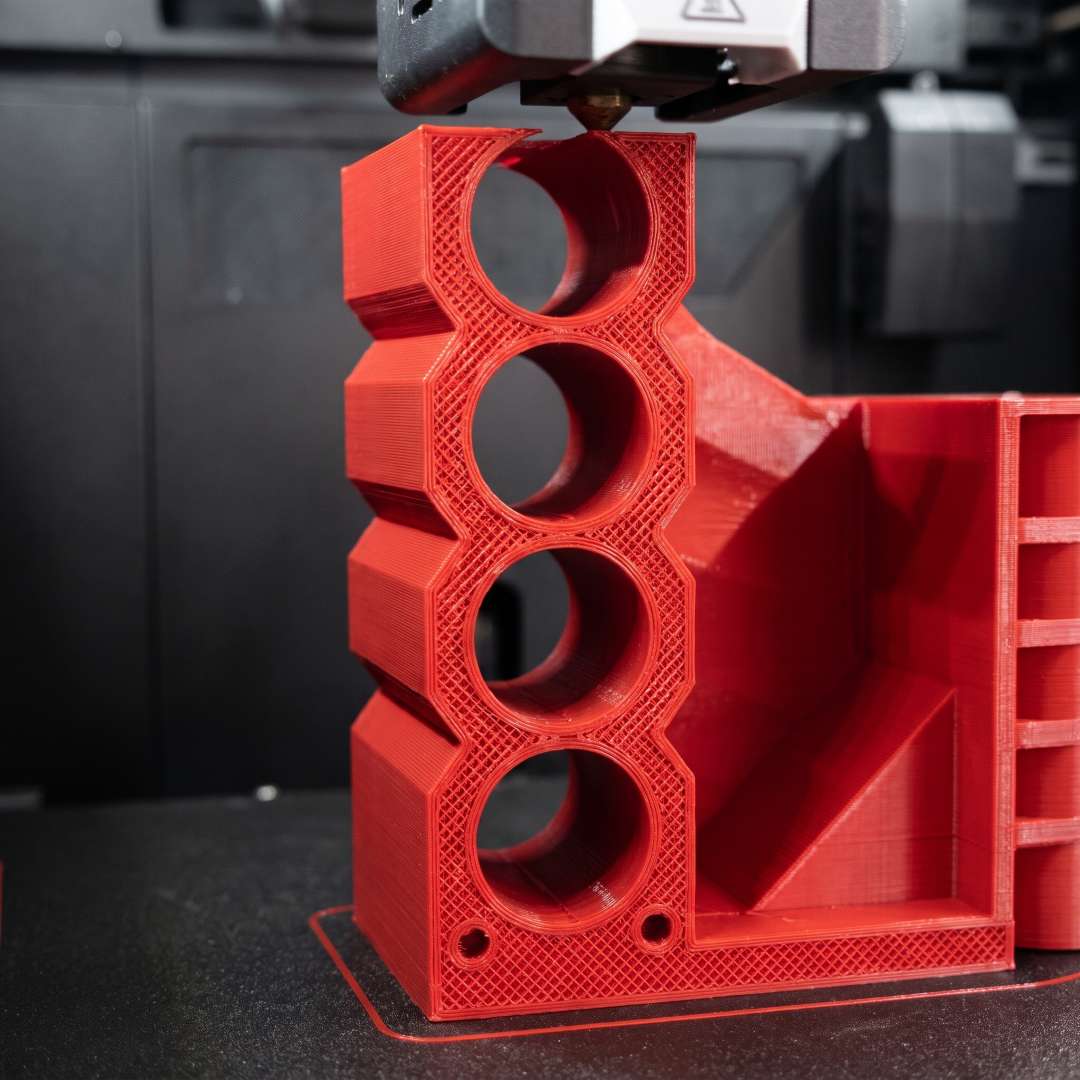
A maximum of 80 mm³/s was recorded with Hyper Speed ABS V2 at 250 °C and a 0.4 mm nozzle. The test structure is smooth, with a single outer wall. This is not a sustained value. It is neither a continuous flow rate nor one that applies universally to other materials.
Dual-material mode
In this mode, the two paths alternately feed different materials through a single nozzle. With verified material pairs and settings, this enables printing in two materials, in two colours, or with a compatible support material. The shared nozzle eliminates XY offset calibration between separate heads. Each process needs verification. Material compatibility, temperature windows, purging, switching behaviour and additional material consumption depend on the specific job.
RBP Metallurgy foundry pattern
For an RBP Metallurgy foundry pattern, the estimated print time fell from 53.9 h on the Pro3 HS to 17.7 h on the T450. On the Pro3 HS, the pattern was printed in four parts. That is 67.16% less, before assembly. The amount of material deposited is 37.88% lower, and the average extrusion speed is 96.09% higher. Assembly is no longer needed, along with alignment, bonding and seam finishing.
Design for long jobs
Large-format printing lasts for hours and requires all systems to work reliably. The T Series, to which the Raise3D T450 belongs, is engineered for such jobs: from motion and material feeding to monitoring. These systems work together.
Four motors
The CoreXY drive with four motors (4MD) is designed to improve stability over large travel areas. It reduces bulging at corners and uneven extrusion. The drive has four motors. The maximum toolhead acceleration is 30,000 mm/s². The result depends on the material, the model and the process settings.
Material supply
Two 2.5 kg spools provide up to 5 kg of total material supply for a long job. Calculate the supply in advance. Consumption includes the part itself, supports, purging and other needs. A larger prepared supply reduces the number of manual spool changes and idle periods, depending on the job and the feeding configuration.
Print monitoring
Sensors and cameras show the operator the print progress, the filament supply and the machine status. Depending on the model and the supported functions, the system detects certain failures, such as "spaghetti" or filament run-out. It alerts the operator or pauses the print. The specification also lists print recovery after power loss and detection of nozzle build-up.
File preparation and connectivity
Before printing, the model needs to be prepared and sent to the printer. For the Raise3D T450, slicing is done by the ideaMaker slicer, and the machine code is in GCODE format. The software supports Windows, macOS and Linux. The printer accepts STL, OBJ, 3MF and STEP files, and the full list of formats is given in the specification.
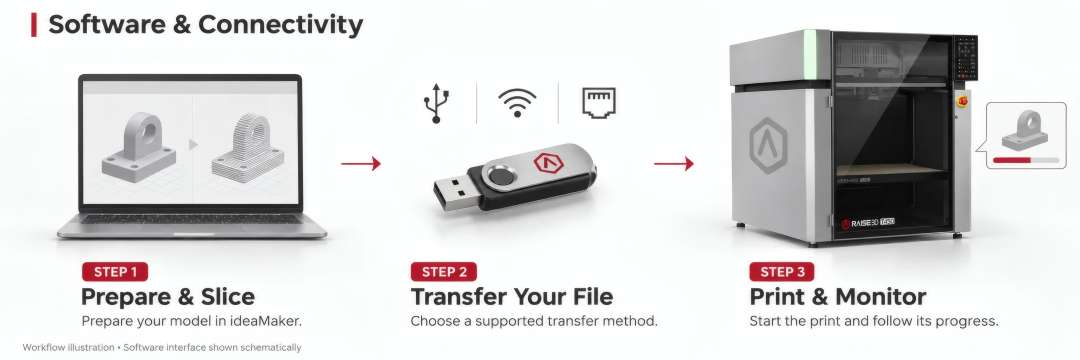
The file is transferred via USB, Wi-Fi or Ethernet. Wi-Fi works with the WPA, WPA2 and WPA3-PSK protocols. The printer has one USB 3.0 port and one Ethernet port. It is controlled from a 7-inch touchscreen with a resolution of 1024 × 600. The screen is touch-sensitive.
Temperature control for different materials
Different materials need different thermal conditions. The T Series combines chamber air control with a high-temperature hotend. This covers both large PLA prototypes and parts made of engineering materials. The chamber is adjusted to suit the material.
Chamber cooling
The electric top cover and air cooling remove excess heat when printing PLA. This helps maintain suitable conditions in the chamber, especially during long jobs. The cover is electrically driven. The design also includes a HEPA filter with activated carbon.
Chamber heating
Active chamber heating up to 70 °C helps stabilise the temperature when printing large ABS parts. A smaller temperature difference during cooling reduces the risk of warping and delamination. The result depends on the material, the part geometry and the process settings.
Build plate
The flexible double-sided PEI plate is heated up to 120 °C by a silicone heating mat. The printer levels the plate using a mesh with flatness detection. This way, surface unevenness is accounted for before a large part starts printing.
High-temperature hotend
The nozzle has a base made of a highly thermally conductive CuCrZr alloy and a solid wear-resistant SiC tip. This design promotes heat transfer, resists wear and supports compatible engineering and fibre-reinforced materials. The nozzle temperature reaches 420 °C. The Raise3D T450 is supplied with a 0.4 mm nozzle.
Nozzle temperature is only one of the compatibility factors. On its own, it does not determine whether a high-temperature material is suitable. PEEK printing on the T Series is limited to individual evaluations and experiments. Large-format PEEK printing is not supported.
Applications
The Raise3D T450 is best suited to tooling and fixtures, orthoses, moulds and foundry jobs. Whether a part is printed whole depends on its dimensions, orientation and material.
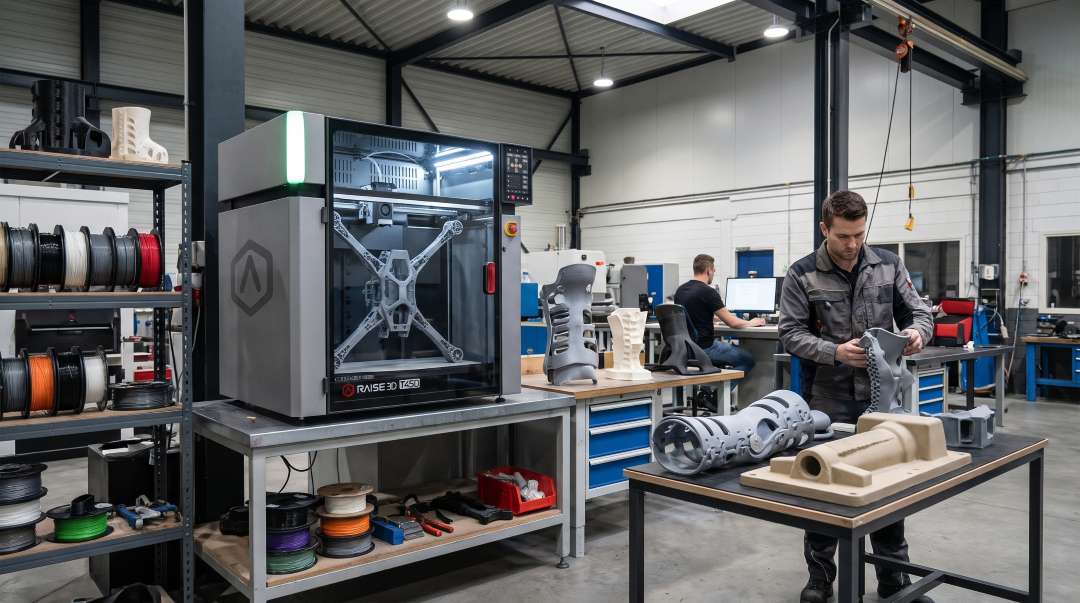
- Tooling and fixtures: printing whole jigs and templates within 450 × 350 × 400 mm removes the bonding of sections, and the material is chosen from the list of compatible Raise3D filaments.
- Orthoses and fitting models: large forms are printed with the standard 0.4 mm nozzle at a layer height of 0.2 mm without splitting into parts. This way, fit and dimensions are evaluated on a full-size model.
- Foundry patterns: RBP Metallurgy, estimated print time as a whole part: 17.7 h. On the Pro3 HS in four parts: 53.9 h, before assembly.
- Foundry cores: RBP Metallurgy, using Raise3D Pro2 printers, reduced core production from approximately three weeks to approximately three days, according to the company.
- Transport pallets: in the CATL example, the pallet weighed up to 8 kg, while the printed one weighed 2 kg; the production cycle lasted up to 40 days versus 10 days.
- Prototypes of drones and large items: sculptures and drone parts are printed with fewer segments, and the dual-material mode allows a compatible support material to be used.
Compatible materials and nozzles
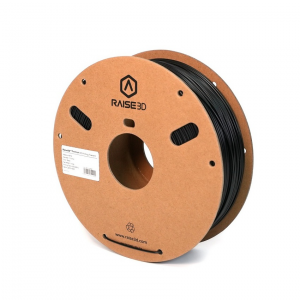
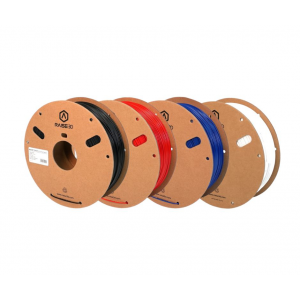
- Hyper Speed: PLA, PLA Pro, ABS, PETG CF, PET CF.
- Industrial: PPA CF, PET Support, PPS CF.
- Premium: PLA, ABS, ASA, PETG, TPU-95A.
- Coming soon: Industrial — PPA GF, PET CF, PET GF, PETG ESD, PPA Support; Premium — PVA+.
- Nozzles: 0.4 mm is installed by default, 0.6 mm is available as an option.
Technical specifications
General information
| Parameter | Value |
| Power supply | T450 (220 V): 200–240 VAC, 50/60 Hz, 230 V@10 A, T450 (110 V): 100–120 VAC, 50/60 Hz, 110 V@15 A |
| Raise3D material compatibility | Hyper Speed: PLA, PLA Pro, ABS, PETG CF, PET CF; Industrial: PPA CF, PET Support, PPS CF; Premium: PLA, ABS, ASA, PETG, TPU-95A; Coming soon (Industrial): PPA GF, PET CF, PET GF, PETG ESD, PPA Support; Coming soon (Premium): PVA+ |
Housing
| Parameter | Value |
| Build volume (W × D × H) | 450 × 350 × 400 mm |
| Printer dimensions (W × D × H) | 710 × 635 × 785 mm |
| Maximum outer packaging dimensions (W × D × H) | 880 × 772 × 1,076 mm |
| Weight | net 75.9 kg, gross (cardboard box only) 80 kg, gross (cardboard box with pallet) 98.2 kg |
| Frame material | Aerospace-grade aluminium alloy |
Extrusion
| Parameter | Value |
| Printing technology | Fused filament fabrication (FFF) |
| Print head system | TwinFlow™ (dual extrusion with a single nozzle and a Y-shaped manifold) |
| Print mode | Single extrusion, dual extrusion, high-flow dual extrusion |
| Nozzle diameter | 0.4 mm (default), 0.6 mm (available) |
| Nozzle type | Nozzle with a base made of a highly thermally conductive CuCrZr alloy and a solid wear-resistant SiC tip |
| Max. nozzle temperature | 420 °C |
| Filament diameter | 1.75 mm |
| Layer height | 0.2 mm (0.4 mm nozzle) |
| Print accuracy | IT11 grade (test filament: Raise3D Premium PLA) |
Speed
| Parameter | Value |
| Max. print speed | 600 mm/s |
| Max. toolhead travel speed | 1,500 mm/s (achieved at a max. toolhead acceleration of 10,000 mm/s²) |
| Max. toolhead acceleration | 30,000 mm/s² |
| Max. flow rate for the TwinFlow™ hotend (dual extrusion) | 80 mm³/s (test parameters: Raise3D Hyper Speed ABS V2, 250 °C, 0.4 mm nozzle, smooth structure with a single outer wall) |
Build plate and heated bed
| Parameter | Value |
| Build plate | Flexible double-sided PEI plate |
| Build plate levelling | Mesh levelling with flatness detection |
| Heated bed material | Silicone heating mat |
| Max. build plate temperature | 120 °C |
Chamber temperature control
| Parameter | Value |
| Active chamber heating | Yes |
| Max. chamber heating temperature | 70 °C |
| Electric top cover | Yes |
| Auxiliary heat dissipation module | Yes |
Printing environment
| Parameter | Value |
| Filter | HEPA filter with activated carbon |
| Operating ambient temperature | 15–30 °C, relative humidity 10–90%, non-condensing |
| Storage temperature | from -25 °C to +55 °C, relative humidity 10–90%, non-condensing |
Software
| Parameter | Value |
| Model slicing software (slicer) | ideaMaker |
| Supported file types | STL, OBJ, 3MF, OLTP, STEP, STP, IGES, IGS |
| Supported operating systems | Windows, macOS, Linux |
| Machine code type | GCODE |
Sensors and camera
| Parameter | Value |
| Live camera resolution | 1920 × 1080 |
| Nozzle camera resolution | 2592 × 1944 |
| Filament run-out sensor | Yes |
| Print recovery after power loss | Yes |
| Material flow detection | Yes |
| "Spaghetti" detection | Yes |
| Nozzle build-up detection | Yes |
Connectivity and network
| Parameter | Value |
| Connectivity | Wi-Fi, LAN, USB port, live camera |
| Ports | USB 3.0 × 1, Ethernet × 1 |
| Network | Wi-Fi, Ethernet |
| Wi-Fi protocol | WPA / WPA2 / WPA3-PSK |
Printer controller
| Parameter | Value |
| User interface | 7-inch touchscreen |
| Screen resolution | 1024 × 600 |
| Motion controller | STM ARM Cortex-M7 550 MHz DP-FPU |
| Logic controller | RK ARM Cortex-A55 Quad 2 GHz |
| Memory | 2 GB |
| Onboard flash memory | 32 GB |
| Operating system | Debian |
| Electric door lock | Yes |
| Neural processing unit (NPU) | Computing power up to 1 TOPS (INT8), support for mixed-precision computing INT8 / INT16 / FP16 / BFP16 |
Why buy the Raise3D T450 from EXPERT3D?
EXPERT3D has been supplying professional 3D equipment since 2012. Before purchase, we advise on the choice and configuration of the Raise3D T450. As an official Raise3D representative, we guarantee 100% authenticity and a fair price. We also provide authorised service and the manufacturer's official warranty. After the sale, we provide service support. Order spare parts and consumables on the website so that your printer is never idle. We deliver throughout Spain and the EU countries.