

- Stock: In Stock
- Product code: 920372000001150018
- Weight Brutto: 0.50kg
- SKU: 4270000746604

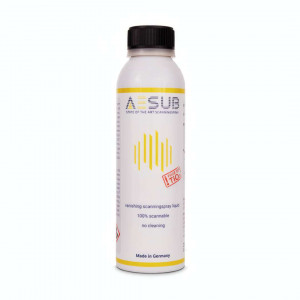
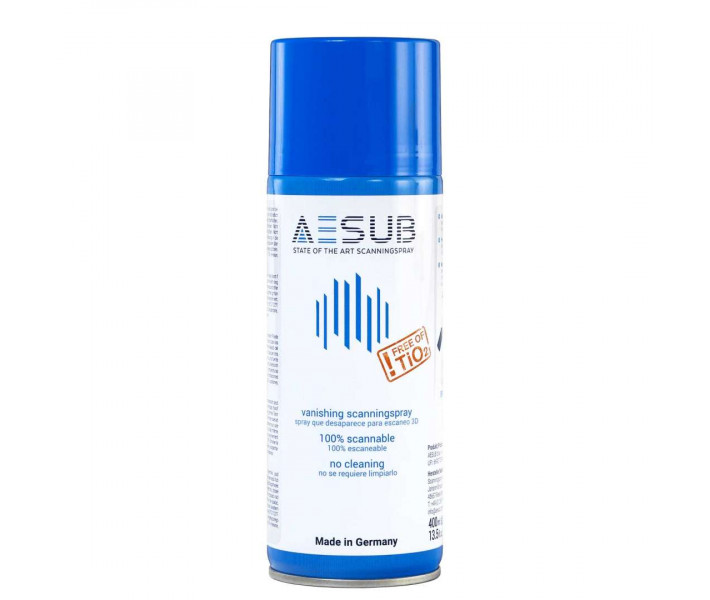
AESUB Blue is a self-sublimating optical scanning spray engineered for 3D metrology professionals, applying a uniform, pigment-free coating of 8–15 µm that evaporates automatically within hours — eliminating post-scan cleanup entirely and protecting sensitive laboratory environments from TiO2 contamination. Developed and certified by scanning specialists at Scanningspray Vertriebs GmbH in Germany.
| Volume | 400 ml |
|---|---|
| Layer thickness | 8–15 µm |
| Active scan window | 1–2 hours |
| Shelf life | 5 years |
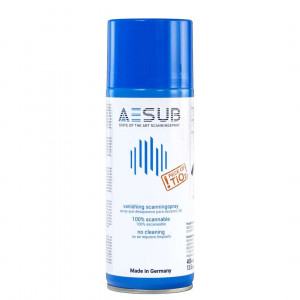
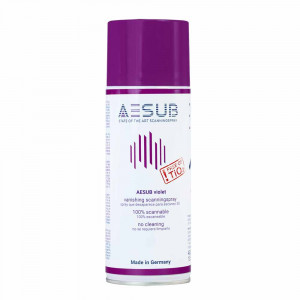
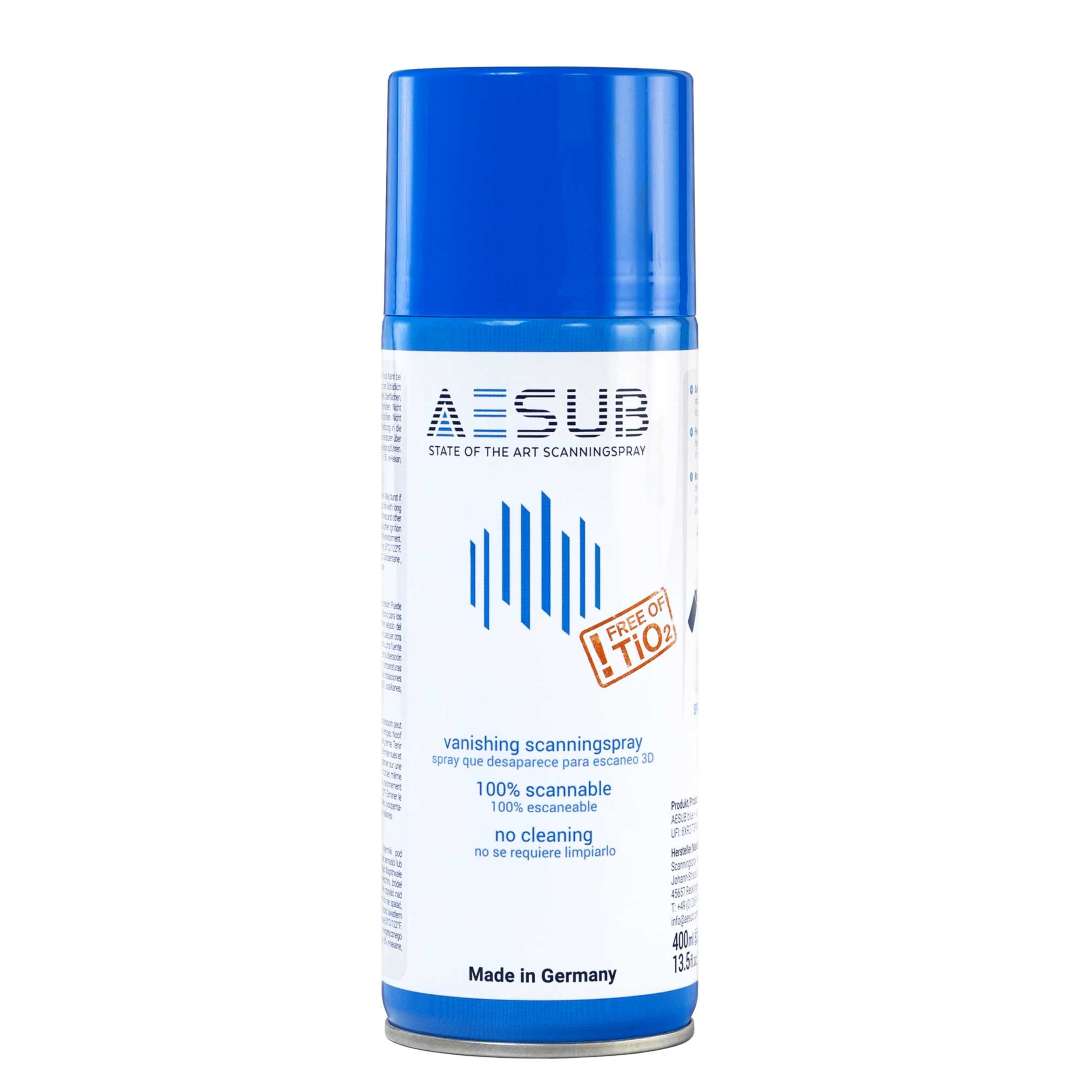
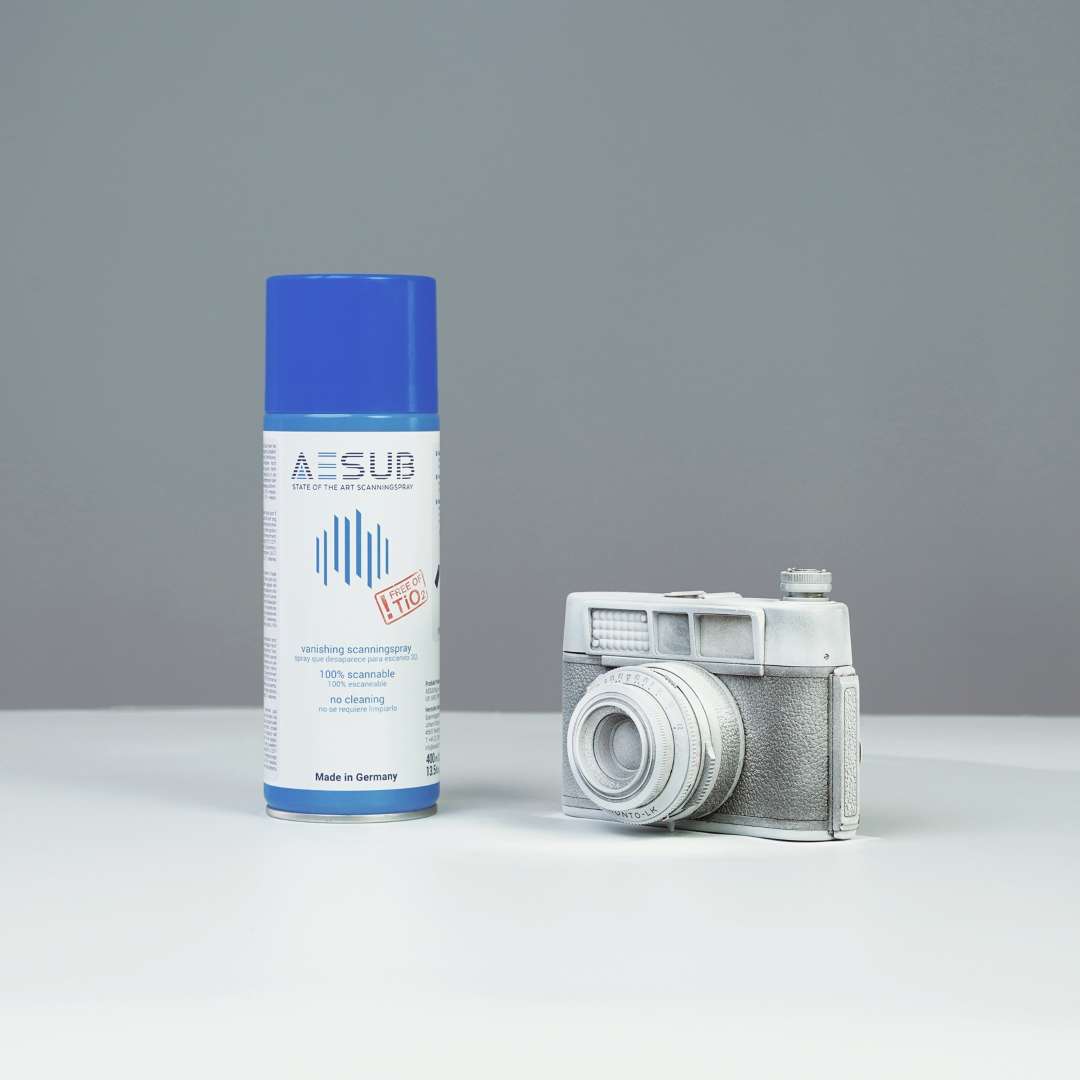
The blue 400 ml aerosol can pictured below delivers enough coverage for numerous scan sessions and is formulated without any pigments — a distinction that sets AESUB Blue apart from conventional matting sprays used in metrology.
Why Optical Scanning Requires Surface Preparation
Optical 3D scanners — whether structured-light, photogrammetry, or laser-based — depend entirely on controlled light reflection to capture surface geometry. Four conditions systematically prevent accurate data capture:
- Transparent surfaces: light passes through rather than reflecting back to the detector, making the geometry invisible to the scanner sensor
- Highly reflective or mirror-like parts: focused specular reflection overwhelms the sensor, capturing only a fraction of the actual surface
- Deep pockets and cavities: internal reflections between walls generate artefacts and corrupted point cloud data
- High-accuracy applications: colour differences, uneven texture, and inconsistent surface reflectance degrade measurement quality even on otherwise scannable surfaces
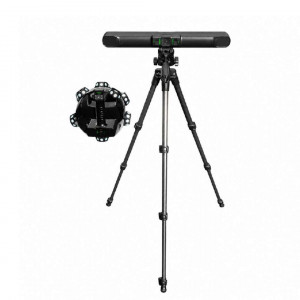
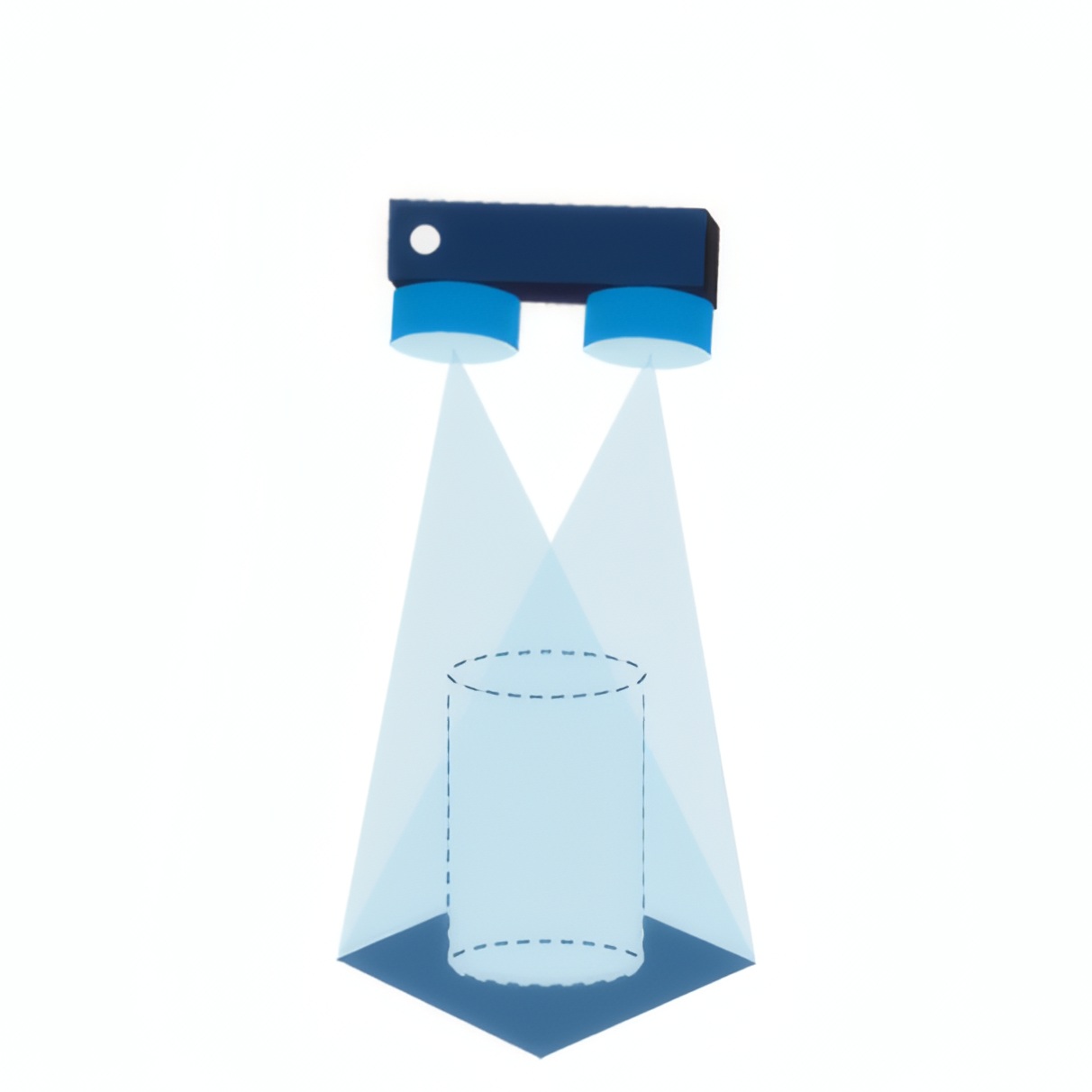
A matte, homogeneous white coating resolves all four scenarios simultaneously — providing the uniform diffuse reflection surface that optical measurement technology requires. The diagram below illustrates the dual-camera scanning principle and why consistent surface properties are critical to data quality.
Pigment-Free Formula: No Contamination Risk
Traditional scanning sprays rely on pigments — most commonly titanium dioxide (TiO2) — to create their matte white surface. These particles become airborne during application and contaminate scanner sensors, optical components, lab surfaces, and personnel. Objects typically must be transported to separate coating areas to protect clean-room environments.
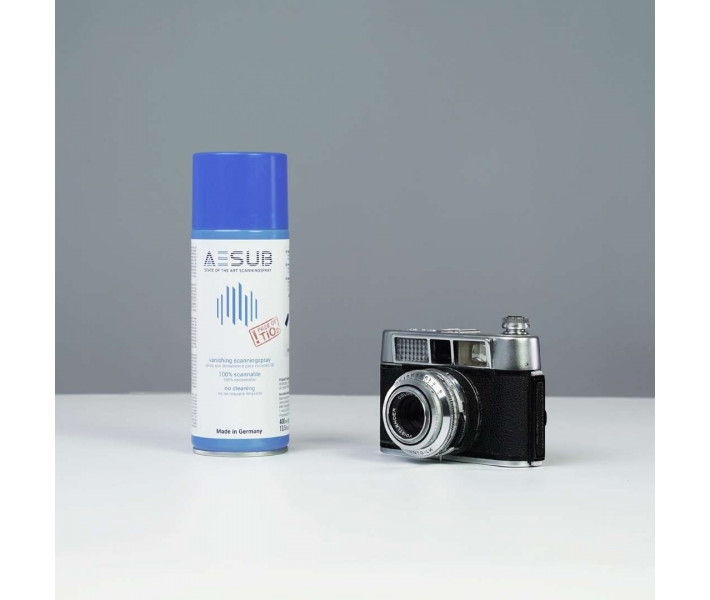
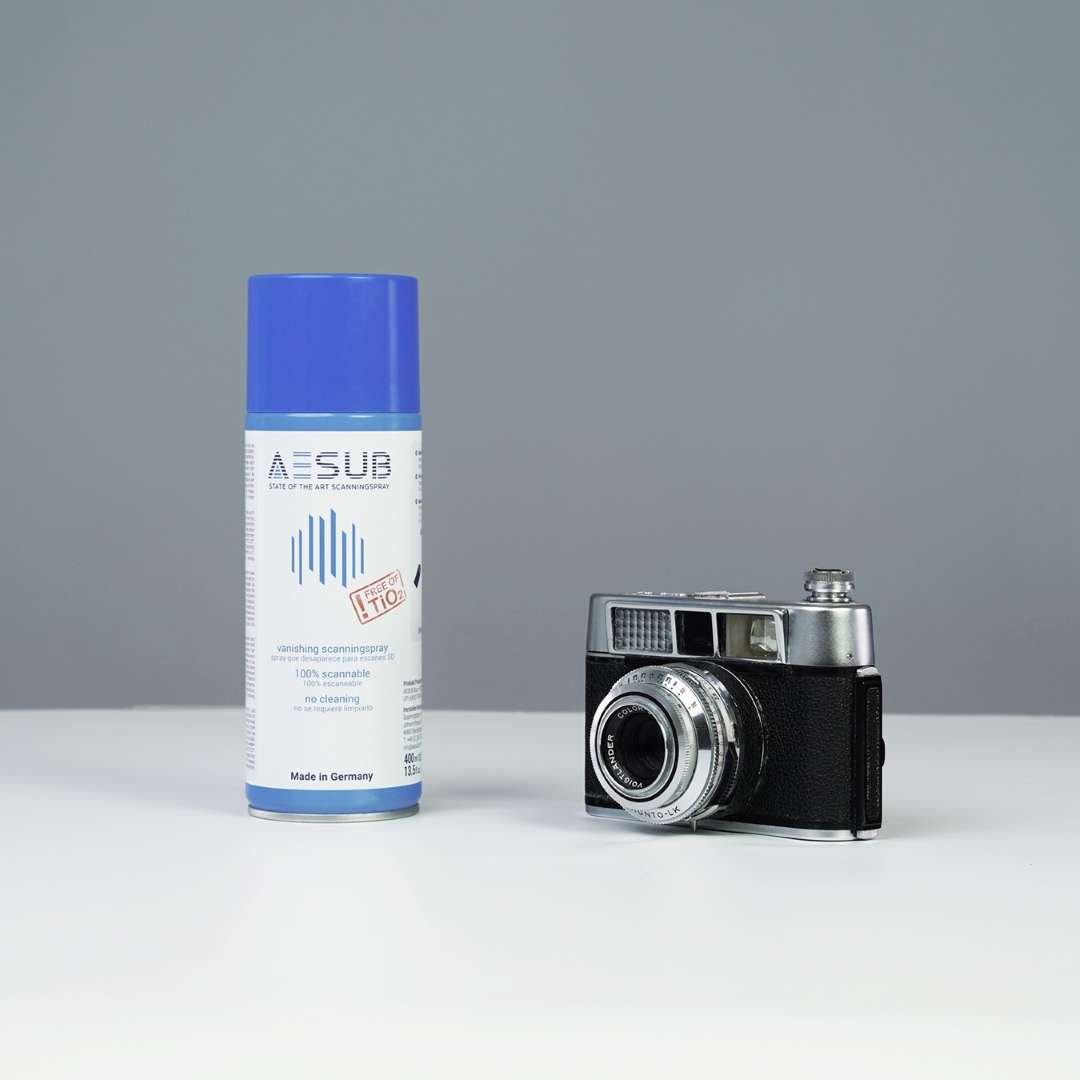
AESUB Blue contains no pigments whatsoever. Its spray dust does not damage sensitive scan equipment, and no pigment fallout reaches the surrounding environment. The spray can be applied directly at the scan location — inside a measurement room, on a production floor, or in a laboratory — with no protective measures against particulate contamination. The before-treatment state of a typical reflective object is shown below.
Application: Three Steps, No Cleanup
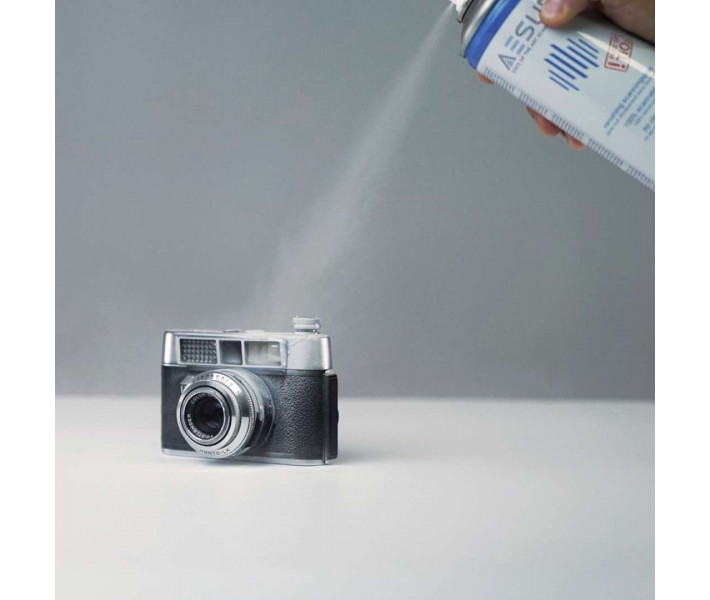
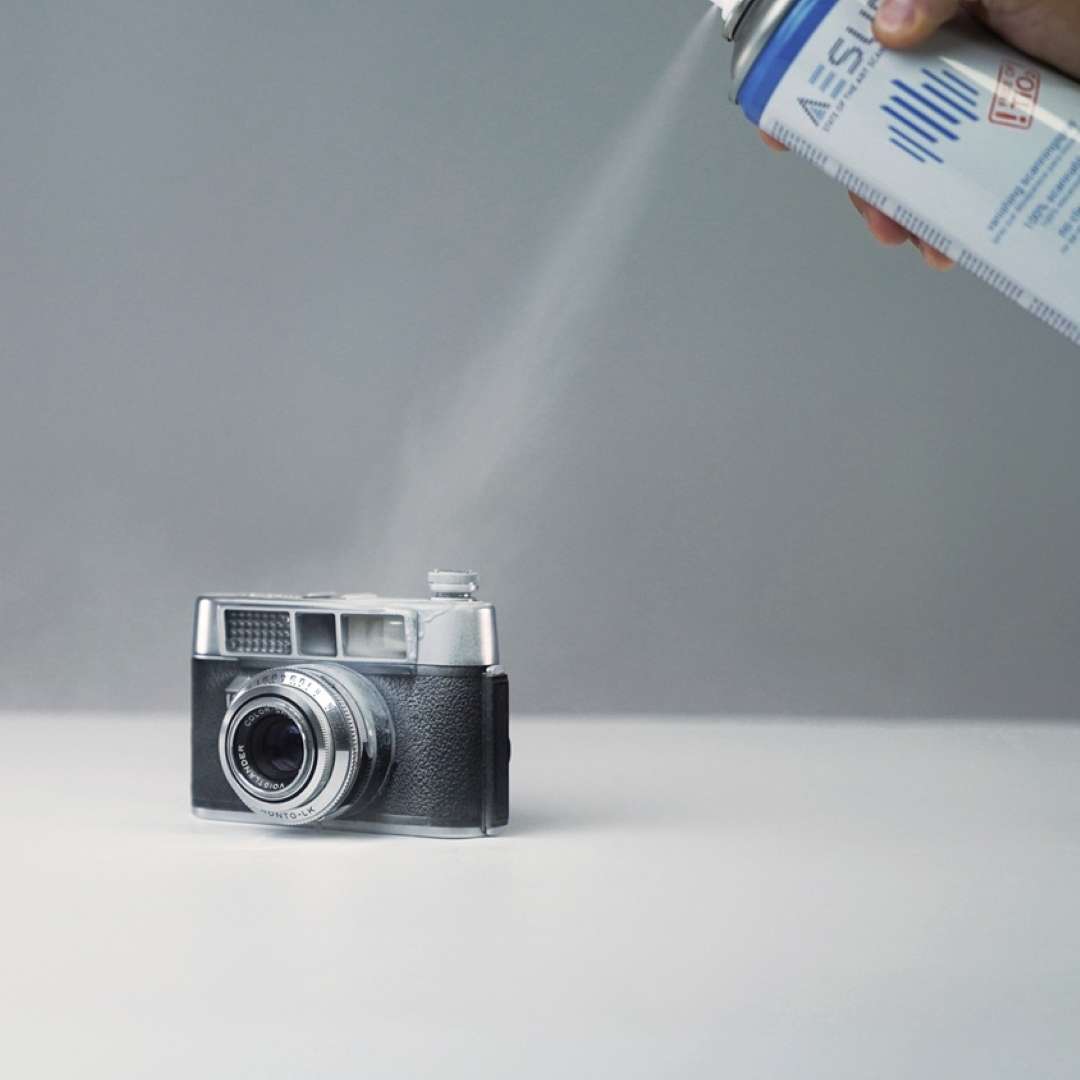
AESUB Blue is designed for a three-step workflow: Spray, Scan, Done. The spray is applied wet; the solvent component evaporates within seconds while the coating itself remains on the surface. Whiteness develops for a few additional seconds after application, confirming that sublimation has not yet begun.
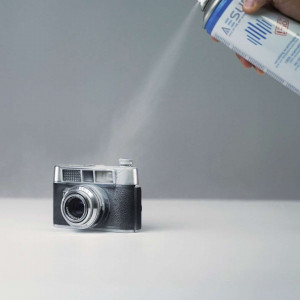
The image below captures the spray being applied to a reflective object — demonstrating the fine mist distribution that produces an even, homogeneous coating layer.
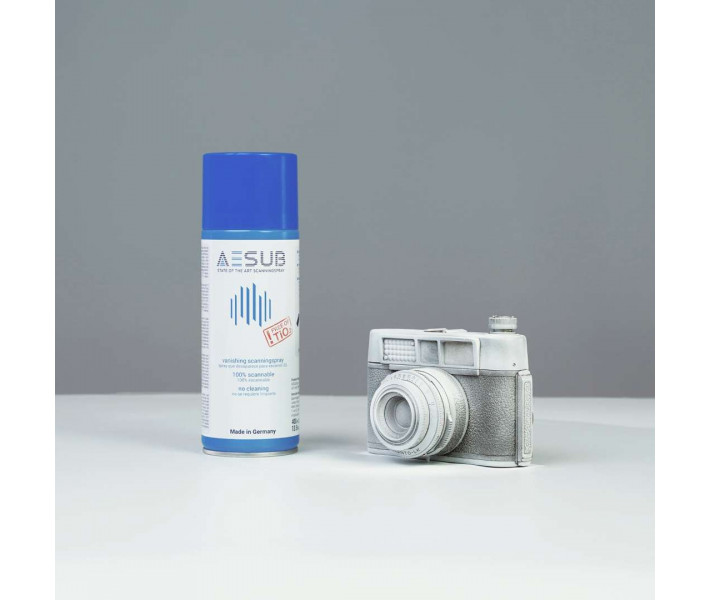
Once fully applied, the coating forms a consistent, dry-to-the-touch matte white surface. Reference target points adhere to the coating and remain stable throughout the scan session. The layer thickness of 8–15 µm is dimensionally negligible — it does not distort the measured geometry of the object.
The image below shows the same object after complete AESUB Blue coverage: the uniform, homogeneous matte finish immediately provides ideal conditions for optical measurement.
Tech Tip — Scanning Large or Complex Objects: When the object to be scanned exceeds a single scanner capture volume, divide the digitization into sections and spray each section only immediately before scanning it. This prevents premature sublimation in areas not yet captured and eliminates the need for re-application. Reference target points can be adhered to the AESUB Blue coating and will remain stable throughout the session. At ambient temperatures below 21 °C, sublimation naturally slows — use this extended working window strategically. Conversely, if faster coating removal is needed after scanning, increase the ambient temperature or direct a fan across the treated surfaces to accelerate sublimation.
How to Apply AESUB Blue
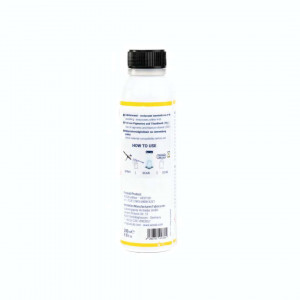
AESUB Blue follows a simple three-step application process: Spray, Scan, Done. The self-sublimating formula requires no post-scan cleaning and leaves no detectable residues.
Step 1 — Spray
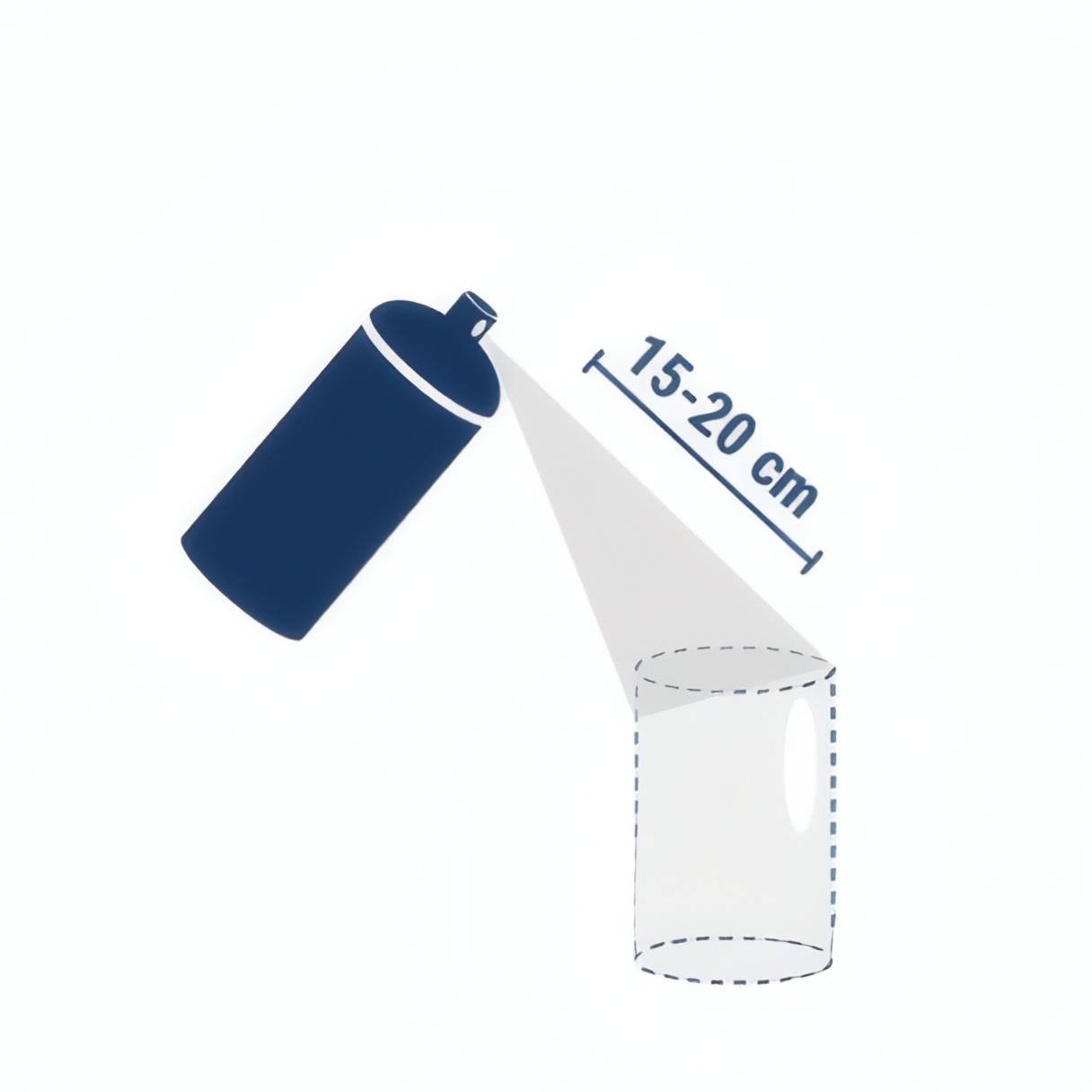
Hold the can 15–20 cm away from the object surface. Gently press the spray button and move the can using even, back-and-forth strokes at a consistent pace to achieve uniform coverage. Spray over the entire surface area to be scanned. If drop formation occurs or the coating remains wet for too long, increase the spraying distance or pace. Multiple passes increase layer thickness. The recommended ambient temperature for application is 21 °C.
The diagram below illustrates the correct 15–20 cm application distance for achieving a consistent, homogeneous coating layer.
Step 2 — Scan
Begin scanning as soon as the coating appears stable and uniformly white. Proceed with your standard scan workflow. The coating is dry to the touch, and reference target points adhere normally to the surface. Objects treated with AESUB Blue remain scannable for approximately 1–2 hours under standard conditions (21 °C, normal ventilation).
Step 3 — Done
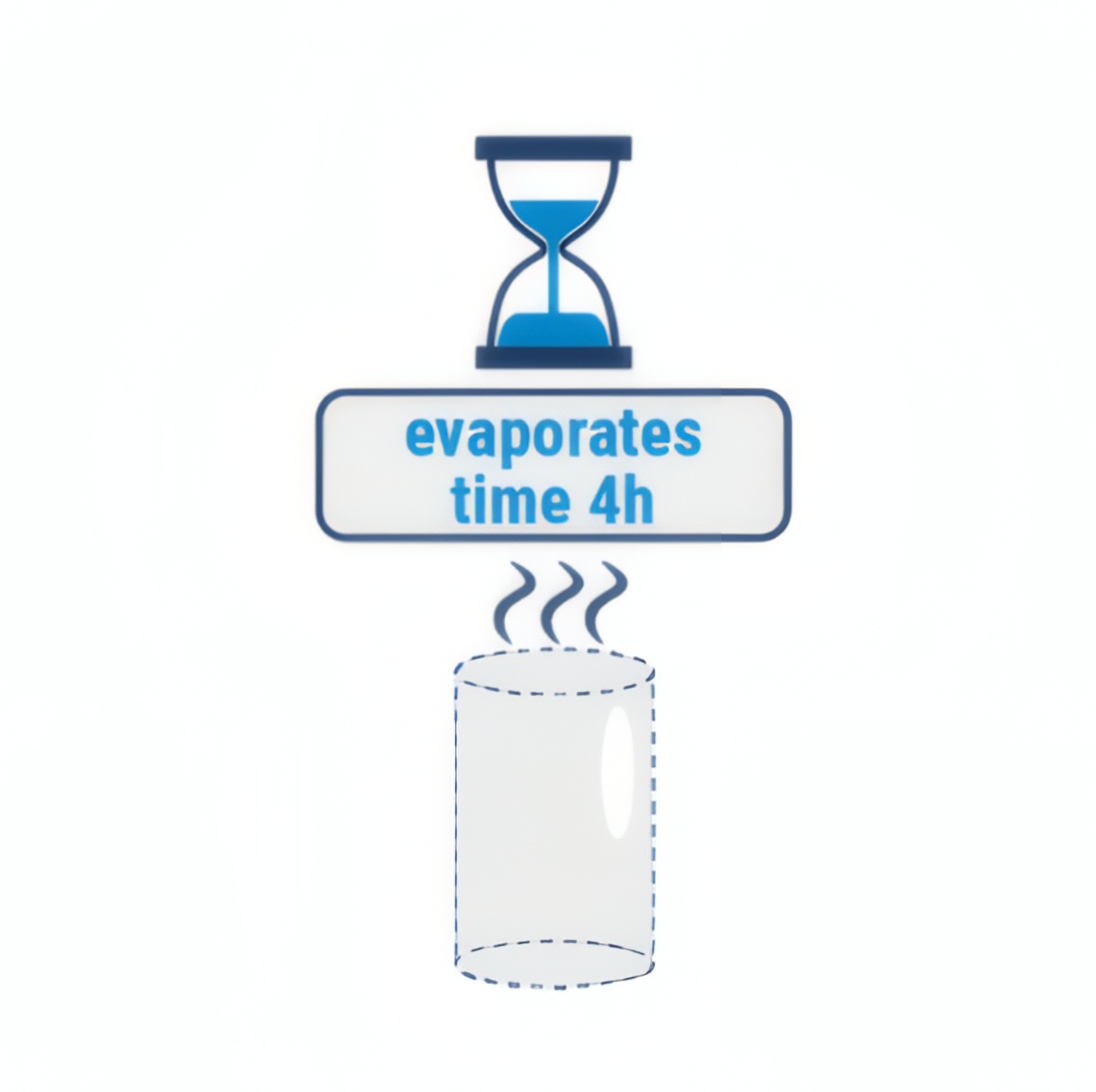
Once scanning is complete, no further action is required. The AESUB Blue coating sublimes autonomously, disappearing entirely without mechanical removal, wiping, or solvent cleaning. Total sublimation time varies depending on ambient temperature, airflow, surface geometry, material, and layer thickness.
The infographic below illustrates the sublimation timeline — under standard conditions, the coating fully evaporates within approximately 4 hours, returning the surface to its original state.
Frequently Asked Questions — AESUB Blue
When is scanning spray necessary for 3D scanning?
Scanning spray is required in four main scenarios: (1) transparent objects, where light passes through the surface instead of reflecting back to the scanner; (2) highly reflective or mirror-like parts, where focused specular reflection prevents the sensor from capturing the geometry; (3) objects with deep pockets or cavities, where internal reflections between walls generate scan artefacts; and (4) any application where maximum dimensional accuracy is needed, as surface colour differences and uneven reflectance degrade measurement quality even on otherwise scannable parts.
How long does the AESUB Blue coating remain active on the surface?
Objects treated with AESUB Blue remain scannable for approximately 1–2 hours under standard conditions. Total sublimation time depends on ambient temperature, airflow, surface geometry, material type, and layer thickness. At temperatures below 21 °C sublimation slows, potentially extending the scan window beyond 4 hours. Higher temperatures and ventilation accelerate the process. Scan time can always be extended by re-applying AESUB Blue to areas where sublimation has already begun.
Does AESUB Blue leave residues on the scanned object after sublimation?
Independent laboratory analysis certifies that approximately 10 ng/cm² of substance remains on the surface after complete sublimation when applied at 1–2 mg/cm². This level is neither optically recognizable nor detectable by surface metrology instruments. The independent analysis characterizes AESUB Blue as residue-free within the scope of the analytical methods applied.
Can AESUB Blue be used in laboratories and around optical scanning equipment?
Yes. AESUB Blue is completely free of pigments and TiO2, eliminating the contamination risk associated with conventional matting sprays. Unlike pigmented products, AESUB Blue can be applied directly at the scan location — in a measurement room, production environment, or laboratory — with no risk of airborne pigment particles damaging sensitive optical sensors or contaminating instruments, surfaces, and personnel.
Technical Specifications of AESUB Blue 400 ml
Product Properties
| Volume | 400 ml |
|---|---|
| Type | Self-sublimating vanishing scanning spray |
| Layer thickness | 8–15 µm |
| Residue after sublimation | ~10 ng/cm² (analytically residue-free) |
| Pigment content | Pigment-free (TiO2-free) |
| Composition | Agent, propellant, solvent |
Application
| Recommended spray distance | 15–20 cm |
|---|---|
| Recommended ambient temperature | 21 °C (69.8 °F) |
| Application technique | Even back-and-forth strokes |
| Scan-ready condition | Stable, uniform white coating |
Performance
| Active scan window | 1–2 hours |
|---|---|
| Sublimation time | Up to ~4 hours (condition-dependent) |
Storage
| Optimal storage temperature | 18–21 °C (64.4–69.8 °F) |
|---|---|
| Maximum storage temperature | 50 °C (122 °F) |
| Shelf life | 5 years |
| Storage conditions | Dry, no direct sunlight |
What's in the Box
- 1× AESUB Blue 400 ml aerosol spray can
Why Choose EXPERT3D?
EXPERT3D has been a trusted specialist in 3D technology since 2012, supplying professional scanning consumables and accessories with expert guidance and fast delivery across Spain. Our team has hands-on experience across the full range of 3D scanning and metrology products — helping professionals in automotive, aerospace, engineering, and industrial design select the right product at the best price €.