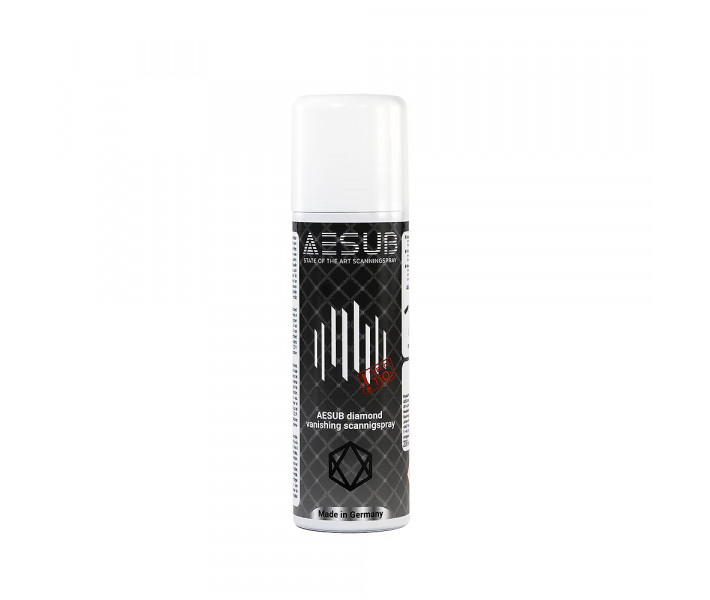
- Stock: In Stock
- Product code: 920372000001145337
- Weight Brutto: 0.50kg
- SKU: 4260753410891

AESUB Diamond is a self-vanishing scanning spray developed specifically for the jewellery industry and precision small-part metrology, formulated entirely without pigments or titanium dioxide. It deposits a 2 µm homogeneous matte coating that enables optical 3D scanners to capture transparent, reflective, and deeply recessed surfaces — then evaporates on its own in approximately 30 minutes, with no cleaning step required.
| Coating Layer Thickness | 2 µm |
|---|---|
| Sublimation Time | ~30 min (environment-dependent) |
| Coverage per Can | 4–6 m² |
| Pigment / TiO2 Content | None — pigment-free & TiO2-free |
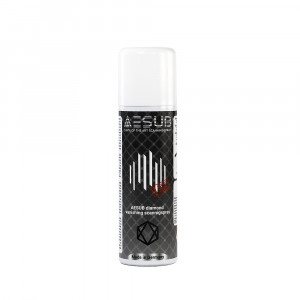
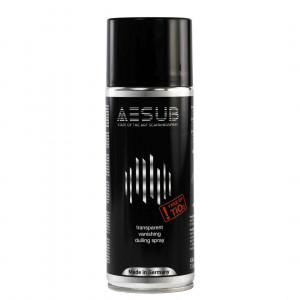
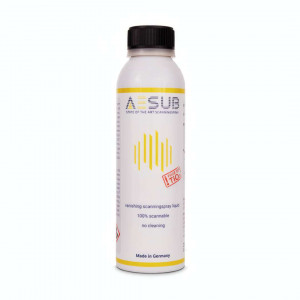
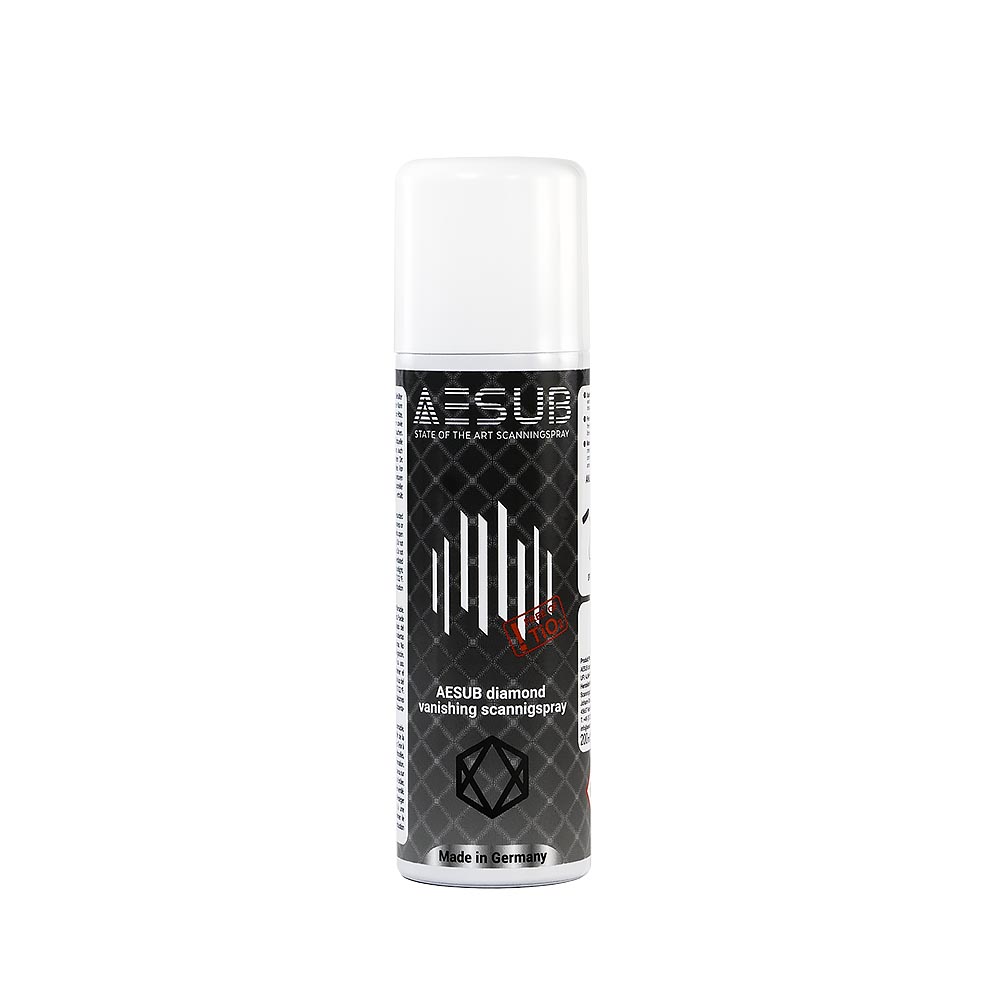
The image below shows the AESUB Diamond 400 ml aerosol can — the black diamond-pattern label and the "Made in Germany" stamp visible at the base confirm the product's origin and authentic formulation.
Why Optical Metrology Demands a Matting Agent
Structured-light and photogrammetry scanners operate by projecting a pattern of light onto a surface and reading the reflection back into the sensor. Three surface conditions routinely defeat this principle: transparency (light passes through rather than reflecting), specular reflectivity (light bounces away at a sharp angle, never reaching the sensor), and deep recesses (multiple wall reflections corrupt the fringe pattern). A well-applied matting spray resolves all three.
Pigment-Free & TiO2-Free: What This Means in Practice
Conventional chalk-based scanning sprays deposit titanium dioxide particles. Those particles shed and migrate — contaminating scanner lenses, reference targets, and the operator's workspace. Over time, TiO2 build-up on camera optics degrades measurement accuracy and forces unscheduled maintenance intervals.
AESUB Diamond contains no pigments and no TiO2. The active matting ingredient fully sublimes: it transitions directly from solid to vapour without leaving particulate residue. Scanner optics, calibration artefacts, and delicate jewellery surfaces remain uncontaminated. For workshop environments where dozens of rings and pendants are digitised daily, the productivity gain is immediate and measurable.
Optimised for Small, Intricate Geometry
At 2 µm coating thickness, AESUB Diamond is the thinnest-layer scanning spray in the AESUB line. That matters when you are measuring ring band profiles, stone settings, or engraved hallmarks: a thicker spray would blur fine detail and introduce dimensional offset. With AESUB Diamond, the physical geometry of the part is preserved within the measurement uncertainty of the scanner itself.
- Rings, bangles, and necklace pendants — scanning on the bench without repositioning to a clean room
- High-precision investment castings — filigree walls and undercuts captured without artefacts
- Miniature mechanical components — screws, springs, watch parts
- Artwork and antique objects — no risk of residue on precious surfaces
- Optical metrology reference parts — dimensional verification without coating-induced error
Scan Window and Sublimation Timeline
After the solvent carrier flashes off (within seconds of application), the coating remains scannable for approximately 10–15 minutes. This window is sufficient for most jewellery scanning workflows. If additional scan passes are required, individual areas can be re-sprayed without affecting already-captured data. Full sublimation completes in roughly 30 minutes under standard lab conditions (21 °C, moderate airflow). Higher temperatures and increased air circulation accelerate the process; cold surfaces or enclosed cavities extend it.
Application Method
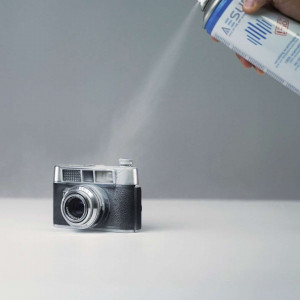
Correct spray technique is the single biggest variable in coating quality. The guide below shows the recommended standoff distance — maintaining the correct gap between the nozzle and the workpiece ensures the atomised droplets arrive at the surface as a fine mist rather than wet droplets that pool and run.
Hold the can at 5–10 cm from the surface (or use the supplied extension tube for even finer control on very small objects). Apply with smooth, continuous back-and-forth strokes. The coating appears white and slightly wet immediately after application; the solvent flashes off within seconds, leaving the matte white layer ready to scan. Avoid stopping the can in one position — this causes pooling and uneven layer thickness.
Technical Specifications of the AESUB Diamond 400 ml
Coating Properties
| Product Type | Vanishing / sublimating scanning spray |
|---|---|
| Layer Thickness | 2 µm |
| Coating Appearance | Thin, homogeneous, matte white |
| Pigment Content | None — pigment-free |
| TiO2 Content | None — TiO2-free |
| Reference Point Adhesion | Yes — reference targets adhere to coating |
Performance & Timing
| Scan Window (usable time) | ~10–15 min |
|---|---|
| Full Sublimation Time | ~30 min (dependent on temperature, airflow, surface) |
| Coverage per Can | 4–6 m² |
| Post-Scan Cleaning Required | No |
Application Parameters
| Recommended Spray Distance | 5–10 cm (extension tube for finer application) |
|---|---|
| Recommended Ambient Temperature | 21 °C (69.8 °F) for optimal results |
| Application Method | Smooth back-and-forth strokes; apply "wet" |
Storage & Shelf Life
| Optimal Storage Temperature | 18–21 °C |
|---|---|
| Minimum Shelf Life | 5 years |
| Storage Conditions | Dry place, away from direct sunlight |
| Maximum Storage Temperature | 50 °C (pressurised container — do not exceed) |
Safety & Classification
| GHS Classification | Aerosol 1 (H222, H229), STOT SE 3 (H336) |
|---|---|
| Signal Word | Danger |
| Propellant | Butane / propane / isobutane blend |
| Ventilation Required | Yes — ensure adequate ventilation during use |
| Origin | Made in Germany |
What's in the Box
- AESUB Diamond vanishing scanning spray — 400 ml aerosol can
- Extension tube for precision fine-area application
How to Apply AESUB Diamond Scanning Spray
This procedure describes the complete workflow for preparing a jewellery or small-part workpiece with AESUB Diamond, scanning it, and allowing the coating to vanish without any cleaning step.
Step 1: Prepare the Workpiece
Place the jewellery item or small part on a stable scanning fixture. Ensure the ambient temperature is close to 21 °C for optimal coating behaviour. The workpiece does not need to be chemically cleaned beforehand — surface oils do not prevent adhesion of the sublimating coating.
Step 2: Shake and Apply the Spray
Shake the AESUB Diamond can for a few seconds. Hold it 5–10 cm from the surface and press the button with light, even pressure. Apply using smooth back-and-forth strokes to achieve a uniform matte-white coating across the entire area to be scanned. For very small or intricate pieces, attach the extension tube for finer spray control. Avoid dwelling in one spot, which causes droplet pooling.
Step 3: Wait for Solvent Flash-Off
The propellant and solvent evaporate within seconds of application, leaving the dry matte coating. Wait until the surface appears uniformly white and completely dry before beginning the scan. If drops or wet patches appear, increase the spraying distance or speed of stroke.
Step 4: Scan the Part
Proceed with your normal 3D scanning workflow. The coating remains fully scannable for approximately 10–15 minutes. Reference point targets adhere reliably to the coating surface. If the scan session extends beyond this window, re-spray affected areas as needed.
Step 5: Allow Full Sublimation — No Cleaning Required
After scanning, set the part aside. The AESUB Diamond coating sublimates completely within approximately 30 minutes under standard conditions (21 °C, normal lab airflow). To accelerate the process, direct a small fan at the part or gently warm the surface with a hair dryer. No solvents, cloths, or ultrasonic baths are needed.
Does AESUB Diamond leave any residue on jewellery?
No. AESUB Diamond is pigment-free and TiO2-free. The active matting compound sublimes — it transitions directly from solid to vapour — leaving zero particulate residue on the workpiece, the scanner optics, or the surrounding environment. This is the fundamental difference from conventional chalk-based scanning sprays.
How long does the coating stay scannable before it vanishes?
The coating remains fully scannable for approximately 10–15 minutes after application. Full sublimation of the coating completes in about 30 minutes under standard conditions (21 °C, moderate airflow). Higher temperatures and increased air circulation shorten both windows; cold surfaces and enclosed recesses extend them.
Will AESUB Diamond affect dimensional accuracy of the scan?
The coating thickness is 2 µm per applied layer. For most photogrammetry and structured-light scanners operating in the 0.01–0.1 mm accuracy range, a single 2 µm layer is well below the instrument's measurement noise floor and does not introduce measurable dimensional offset. Multiple layers increase thickness proportionally, so minimal application is recommended for highest-accuracy work.
Is AESUB Diamond safe to use on gold, silver, and gemstone surfaces?
AESUB Diamond is formulated for maximum material compatibility and is designed specifically for the jewellery industry. However, material compatibility for specific alloys, plating types, or gemstone treatments cannot be universally guaranteed. The manufacturer recommends performing a compatibility check on a non-critical test area before applying to valuable pieces. Full details are available in the Safety Data Sheet at aesub.com.
How much surface area does one 400 ml can cover?
One 400 ml can of AESUB Diamond covers approximately 4–6 m² of surface area at a single-layer application thickness of 2 µm. For jewellery pieces where individual items measure only a few cm², a single can represents hundreds of individual scanning preparations.
Why Choose EXPERT3D?
EXPERT3D has specialised in 3D scanning technology and metrology consumables since 2012 — over a decade of hands-on experience advising research institutions, industrial quality labs, and professional jewellery ateliers across Spain and Europe. We provide pre-sales technical guidance on spray selection (AESUB product line comparison, coverage estimations for your workflow volume), delivery coordination, and post-sale support backed by direct manufacturer contacts. Contact us to discuss your specific scanning application and current stock availability.