- Stock: In Stock
- Product code: 920372000001145352
- Weight Brutto: 0.50kg
- SKU: 4270002323599

AESUB Transparent is a self-vanishing anti-reflective scanning spray formulated for optical 3D digitisation of glossy, reflective, transparent, and colour-critical surfaces. A single application deposits a 15–20 µm matte coating that sublimates completely within approximately 1 hour, preserving full colour information while eliminating surface reflections — with no post-scan cleaning required. Manufactured in Germany, free of TiO₂ and pigments.
| Layer Thickness | 15–20 µm |
|---|---|
| Stable Scanning Window | ~1 h (re-spray individual contours if needed) |
| TiO₂ / Pigment Content | None — pigment-free formula |
| Post-Scan Cleaning | Not required — coating sublimates automatically |
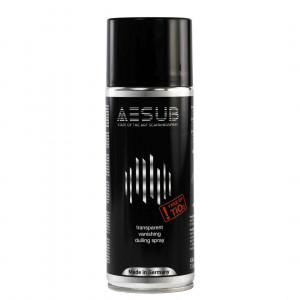
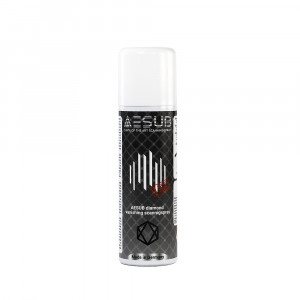
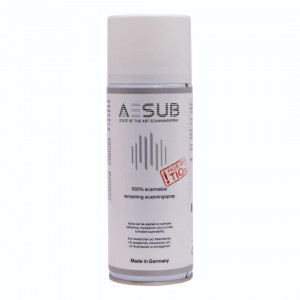
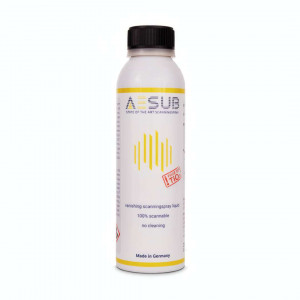
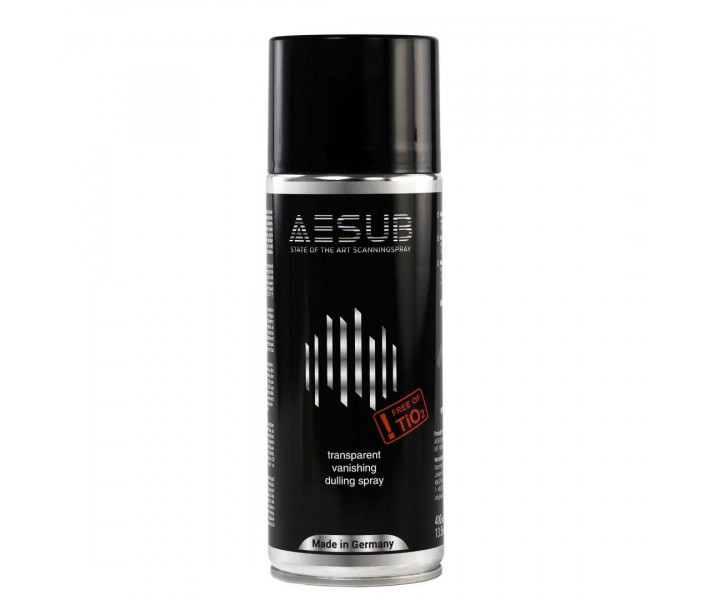
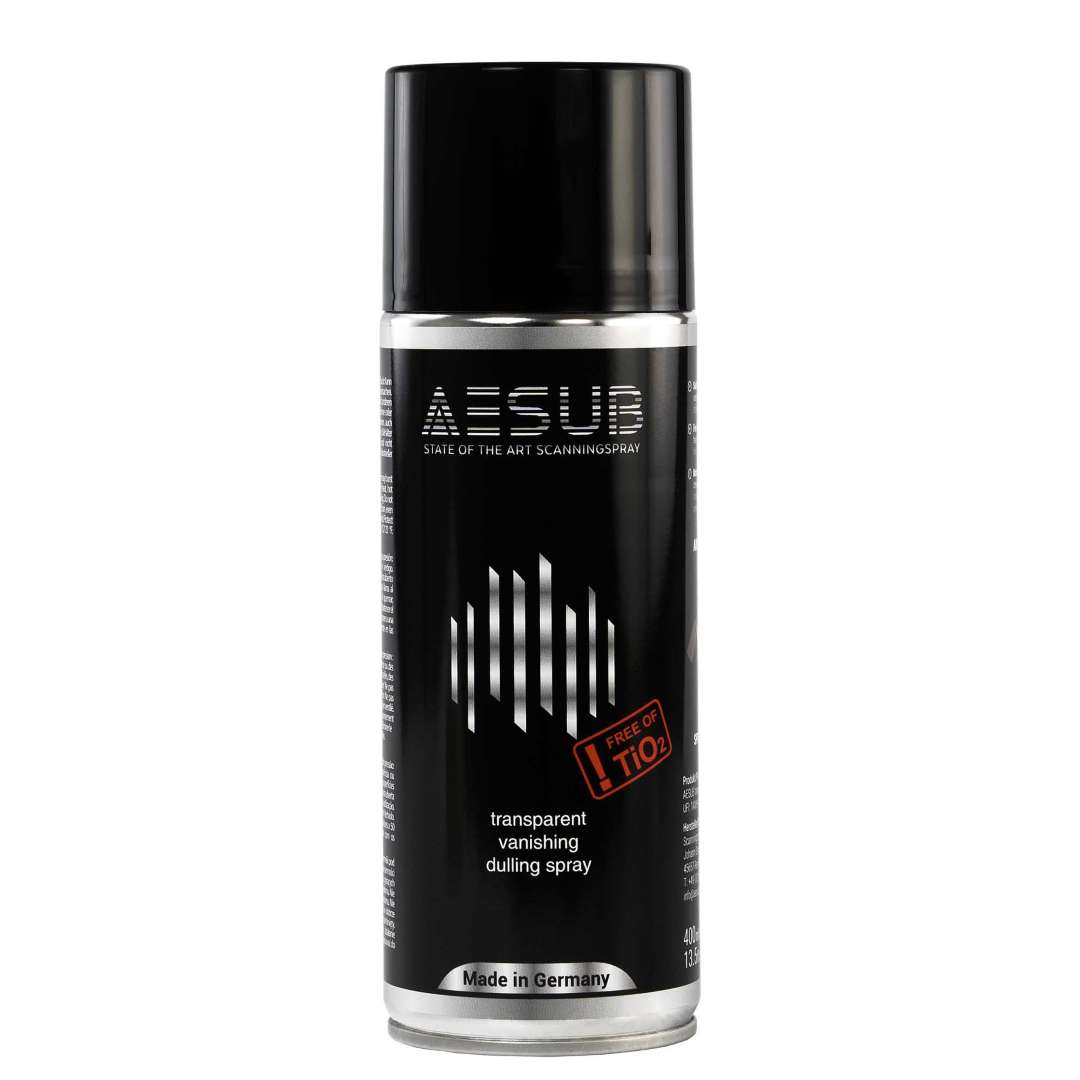
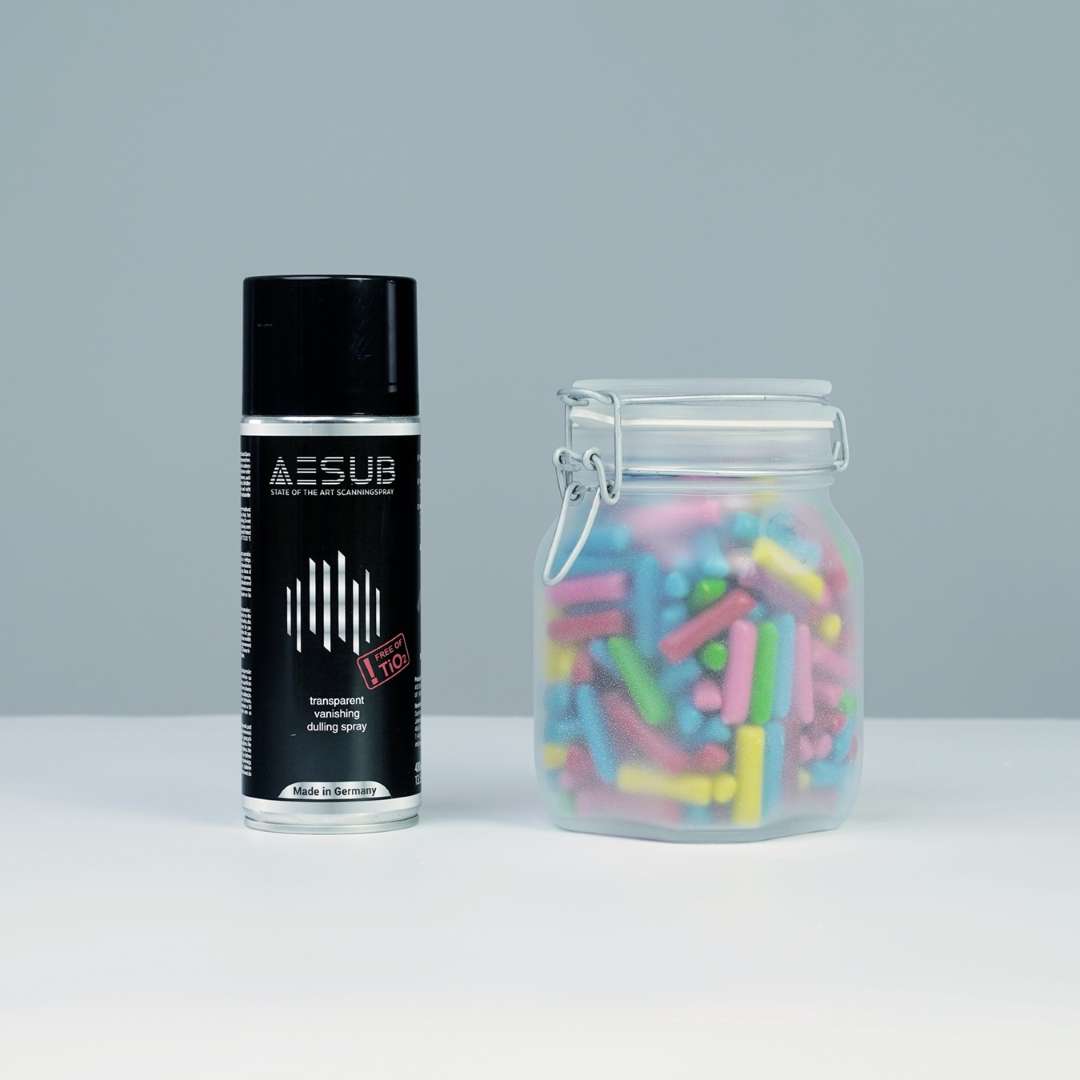
The close-up product shot below shows the AESUB Transparent can with its distinctive black label, "Free of TiO₂" badge, and "Made in Germany" marking — the same labelling you will find on every unit supplied by EXPERT3D.
Why Optical Scanners Fail on Bare Surfaces — and How AESUB Transparent Fixes It
Structured-light and photogrammetry scanners project patterns onto a surface and read the reflected signal. Four surface conditions break this chain completely: transparent materials (light passes through rather than reflecting back), mirror-like finishes (specular reflection bypasses the detector), deep pockets and undercuts (cross-reflections create artefacts), and strong colour or texture variation (uneven optical response distorts point cloud accuracy). AESUB Transparent addresses all four scenarios with a single spray.
The coating works by introducing a thin, uniform, diffuse-scatter film over the object. Because the film is TiO₂-free and contains no inorganic pigments, the active ingredient — cyclododecane — sublimates from solid phase directly into vapour, leaving analytical-grade residue levels of approximately 10 ng/cm². That residue is below the detection threshold of surface metrology instruments.
Colour Capture Without Compromise
Traditional white scanning sprays whiteout surface colour entirely — useful for pure geometry acquisition, but unusable when colour texture data is required. AESUB Transparent forms a translucent matte film rather than an opaque white coat. The gloss is broken, reflections are suppressed, yet underlying colours remain readable by the scanner's camera system. A coloured automotive tail light, branded product packaging, or painted aerospace component can be digitised for both geometry and colour simultaneously.
Pigment-Free Formula Protects Sensitive Equipment
Conventional TiO₂-based sprays shed white particulate during and after application. In production environments and metrology laboratories, this pigment dust settles on scanner lenses, reference markers, calibration artefacts, and PCB-level components. AESUB's pigment-free formula eliminates this contamination vector entirely — the aerosol cloud disperses as propellant vapour, not particle spray. This matters most in inline scanning cells and cleanroom-adjacent workflows where contamination events trigger full equipment decontamination protocols.
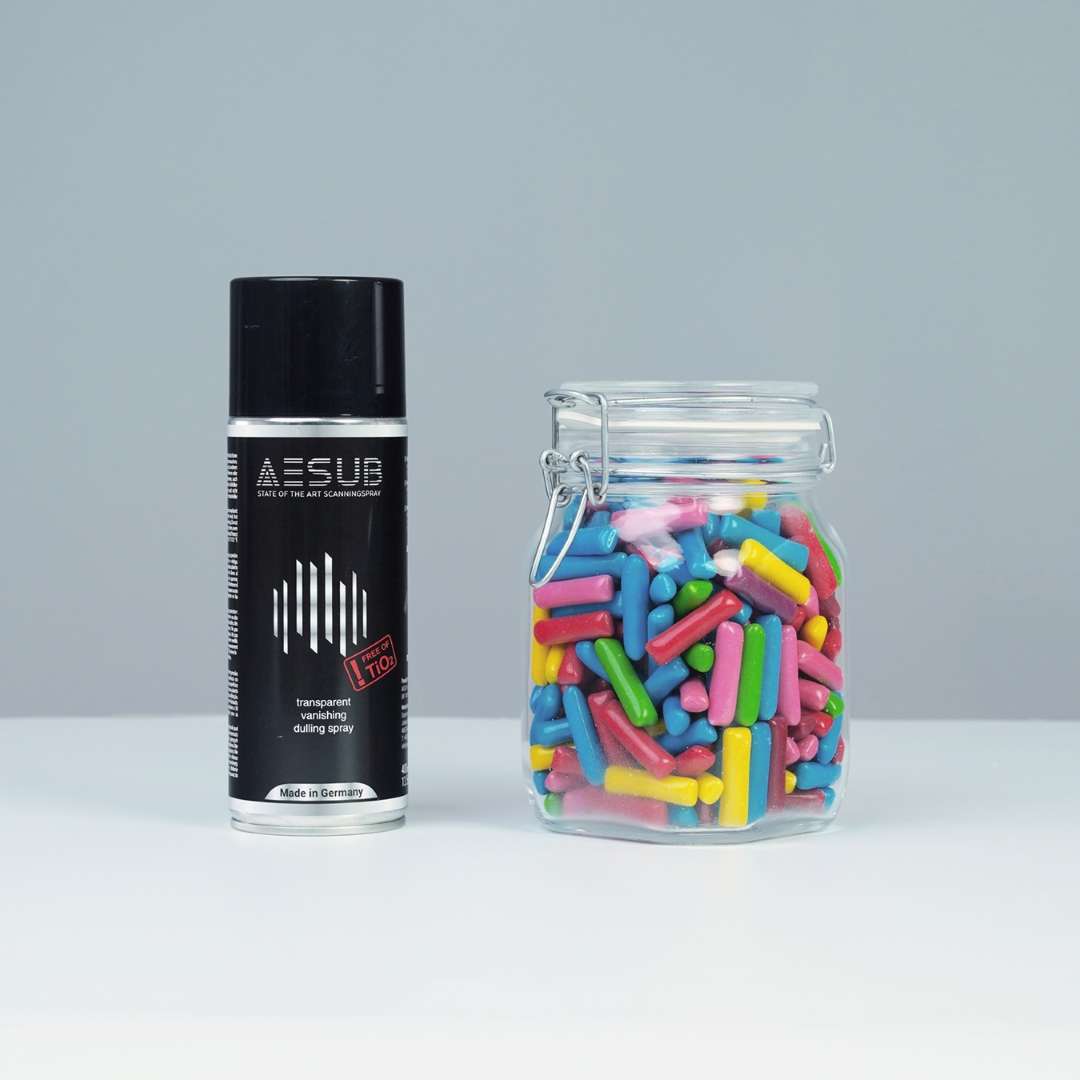
The image below shows the AESUB Transparent 400 ml can alongside a glass jar filled with colourful candy. The jar surface is completely clear at this stage — before any spray has been applied — demonstrating the challenge: highly transparent surfaces scatter zero usable light back to the scanner detector.
Application Workflow: Spray, Scan, Done
The sequence is straightforward. Hold the can 15–20 cm from the surface and apply even back-and-forth strokes at a consistent pace. The solvent carrier evaporates within seconds of landing, leaving the cyclododecane film dry to the touch. The recommended ambient temperature during application is 21 °C. Once the coating reaches uniform whiteness — typically 10–30 seconds — scanning can begin immediately.
The image sequence below illustrates the spray-on step: AESUB Transparent being applied directly onto the glass jar surface at the correct 15–20 cm standoff distance.
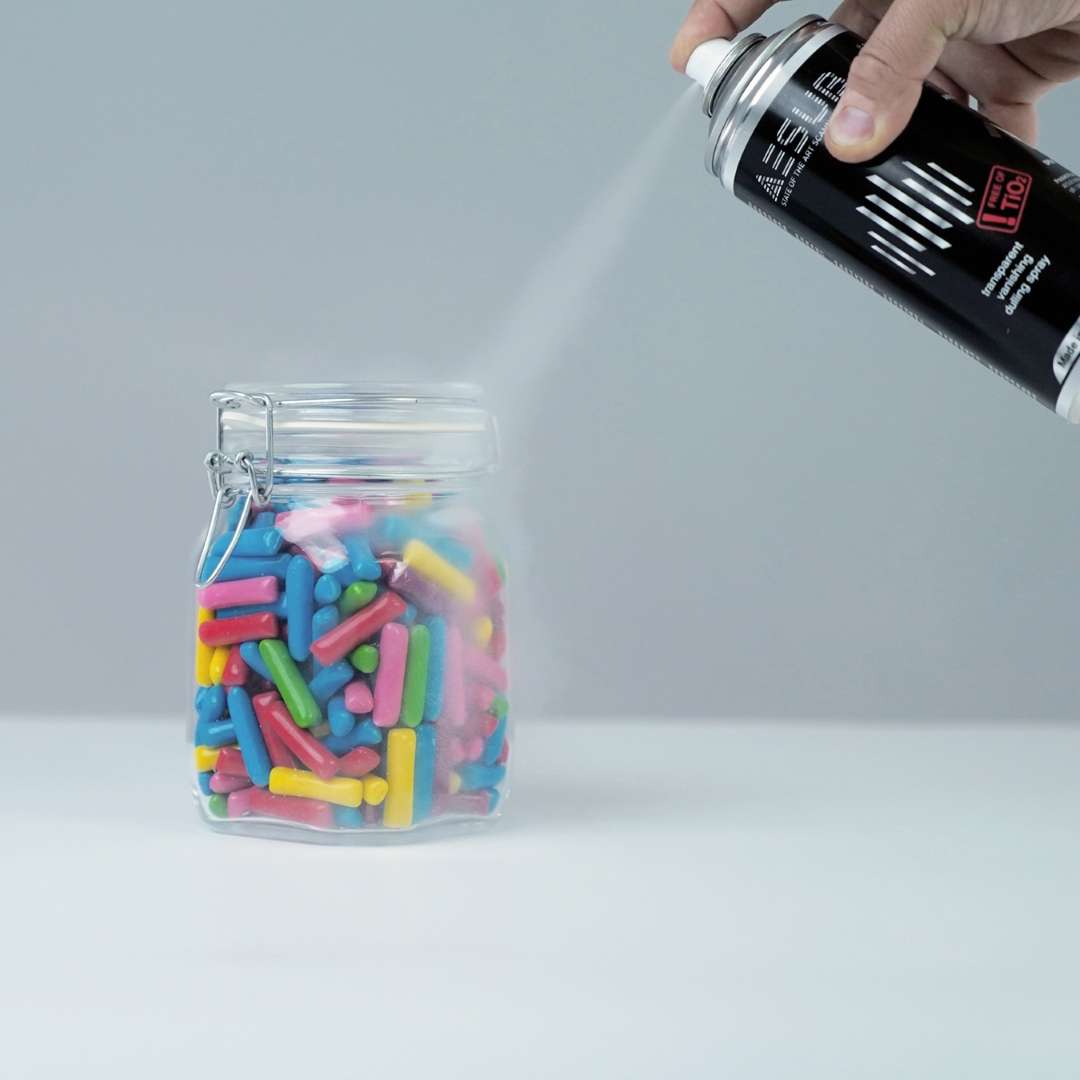
After application, the glass jar's surface transforms from fully transparent to evenly matte — the scanner can now read surface geometry with full accuracy. The result is visible in the comparison shot below: same jar, same candy contents, fully scannable surface.
Sublimation Factors
Sublimation rate is influenced by four variables. Higher ambient temperature and active airflow (fan or ventilation) accelerate evaporation. Deep pockets, grooves, and undercuts retain the film longer than exposed flat faces. Thicker coats (multiple passes) extend the sublimation window — useful when longer scan sessions are planned. If faster removal is needed, a heat gun or hairdryer at low setting directed at the coated surface cuts sublimation time significantly.
Technical Specifications of the AESUB Transparent 400 ml
Product Identity
| Product Name | AESUB transparent — vanishing scanning spray |
|---|---|
| Manufacturer | Scanningspray Vertriebs GmbH, Recklinghausen, Germany |
| Volume | 400 ml |
| Country of Origin | Germany |
| TDS Revision | 01/2023 |
Coating Performance
| Layer Thickness | 15–20 µm (user-dependent) |
|---|---|
| Coating Appearance | Translucent matte film — colour values remain visible |
| Texture | Thin, homogeneous, dry to the touch |
| Reference Marker Adhesion | Yes — reference points stick on the coating |
| Stable Scanning Window | ~1 h (re-spray individual contours as needed) |
Sublimation & Residue
| Vanishing Mechanism | Sublimation (solid → vapour, no liquid phase) |
|---|---|
| Post-Scan Cleaning Required | No |
| Analytically Quantified Residue | ~10 ng/cm² (below surface metrology detection threshold) |
| Acceleration Methods | Higher temperature (e.g. hairdryer), increased airflow (fan) |
Formula & Compatibility
| TiO₂ Content | None — TiO₂-free |
|---|---|
| Pigment Content | None — pigment-free |
| Active Ingredient | Cyclododecane |
| Propellant | Butane / propane / isobutane mixture |
| Material Compatibility | Optimised; contains solvents — verify on sensitive materials before use |
Application Parameters
| Recommended Application Distance | 15–20 cm |
|---|---|
| Recommended Ambient Temperature | 21 °C (69.8 °F) |
| Application Technique | Even back-and-forth strokes at consistent pace; applied "wet" |
Storage & Safety
| Shelf Life | 5 years |
|---|---|
| Optimal Storage Temperature | 18–21 °C (64.4–69.8 °F) |
| Maximum Storage/Exposure Temperature | 50 °C (122 °F) |
| Storage Conditions | Dry, no direct sunlight, away from ignition sources |
| Flash Point | -88.6 °C (calculated, referring to mixture component) |
| UN Transport Number | UN 1950 (Aerosols, flammable — ADR/IMDG/ICAO) |
| GHS Hazard Classification | Aerosol 1 (H222, H229); STOT SE 3 (H336) |
Applicable Industry Sectors
| Primary Use Case | 3D scanning, photogrammetry, optical metrology |
|---|---|
| Industry Sectors | Automotive, aerospace, engineering, tooling, architecture, digital archiving, reverse engineering, R&D, inline scanning, film & photography |
How to Apply AESUB Transparent for 3D Scanning
This procedure describes the correct spray–scan–sublimate workflow for AESUB Transparent on glossy, reflective, or transparent scan objects.
Step 1: Prepare the Environment
Work in a well-ventilated area at approximately 21 °C. Remove food, drink, and sensitive equipment from the immediate spray zone. Keep the can away from open flames and ignition sources — the propellant is flammable.
Step 2: Shake and Position the Can
Shake the AESUB Transparent can thoroughly before use. Hold it 15–20 cm from the surface. A closer distance builds up liquid droplets; a greater distance reduces coating density and evenness.
Step 3: Apply the Coating
Press the spray button gently and move the can across the surface in even, overlapping back-and-forth strokes at a consistent pace. The coating is applied wet — the solvent evaporates within seconds, leaving a dry matte film. Continue until the entire scan surface is covered uniformly. Whiteness increases for a few seconds after application.
Step 4: Scan the Object
Begin scanning as soon as the coating appears stable and uniformly matte. Proceed with your standard scan workflow. The stable window is approximately 1 hour. If individual contours lose definition before the scan is complete, re-spray those areas only.
Step 5: Allow Sublimation — No Cleaning Required
After scanning, set the object aside in a ventilated space. The cyclododecane coating sublimates to vapour on its own, leaving the object in its original condition. No solvent wipe-down, no scrubbing, and no residue visible to the eye or detectable by surface metrology instruments. To accelerate sublimation, apply gentle heat (hairdryer) or direct a fan at the coated surface.
Will AESUB Transparent damage sensitive scan equipment?
No. Because AESUB Transparent contains no TiO₂ and no inorganic pigments, it produces no particle dust during application. The aerosol cloud is composed of propellant vapour and solvent that evaporate immediately, not pigment particles that settle on lenses, calibration artefacts, or electronic components. This is the primary reason professional metrology labs and inline scanning cells choose AESUB Transparent over conventional white sprays.
Can I scan coloured or textured parts and retain colour data?
Yes. Unlike opaque white sprays, AESUB Transparent forms a translucent matte film that breaks surface gloss without masking colour. The scanner's camera system can still read the underlying colour values of the object through the thin 15–20 µm coating. This makes it suitable for digitising branded packaging, painted parts, coloured lenses, and any scan target where geometry and colour texture are required simultaneously.
How long does the coating last before it disappears?
Experience shows the coating remains fully scannable for approximately 1 hour under standard conditions (21 °C, moderate airflow). Higher temperatures and increased ventilation shorten sublimation time; cold environments below 15 °C or deep surface pockets can extend it beyond 4 hours. Individual contours that sublimate early can be re-sprayed without affecting areas that are still coated.
Does AESUB Transparent leave any residue on the scanned object?
Independent laboratory analysis confirmed residue levels of approximately 10 ng/cm² after full sublimation. This quantity is neither optically recognisable nor detectable with surface metrology instruments. The manufacturer characterises AESUB Transparent as residue-free within the scope of the analytical methods used. Note that complete sublimation cannot be formally guaranteed; refer to the full residue analysis report at aesub.com/dl/ for detailed data.
Is AESUB Transparent compatible with all scanner types and materials?
AESUB Transparent is suitable for structured-light scanners, laser scanners, photogrammetry systems, and film/photography setups. The formula is designed for optimised material compatibility. However, it contains solvents — users should verify compatibility on sensitive plastics, rubber compounds, or coated surfaces before full application. Refer to the safety data sheet at aesub.com/dl/ for full composition details.
Why Choose EXPERT3D?
As an official representative of AESUB, we guarantee the best price, authorized service, and official warranty. EXPERT3D has specialised in advanced 3D scanning technology and metrology consumables since 2012 — more than a decade of hands-on experience selecting and supporting professional-grade products across research institutions, industrial metrology labs, and aerospace R&D teams in Spain and across Europe. We provide pre-sales technical consultation, fast delivery coordination throughout Spain and the EU, and post-sale support backed by direct manufacturer contacts. Contact us to discuss volume pricing, compatibility questions, or to request a sample for your specific application.