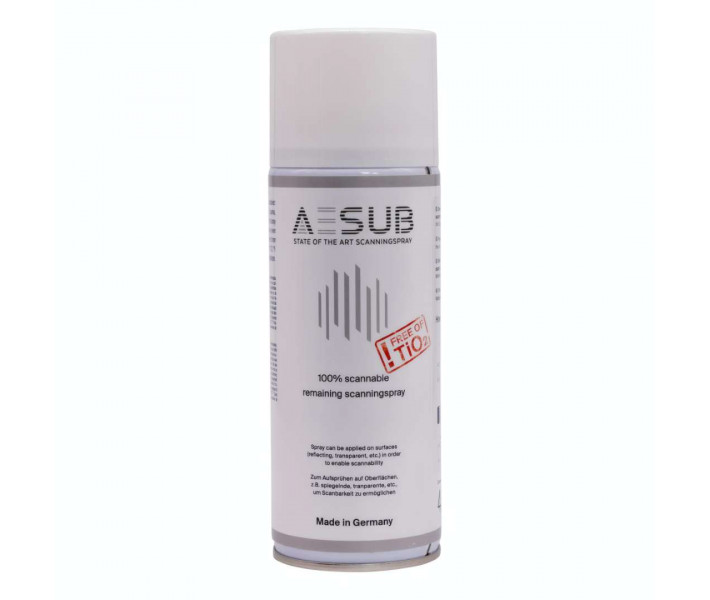
- Stock: In Stock
- Product code: 920372000001557424
- Weight Brutto: 0.50kg
- SKU: AESW101

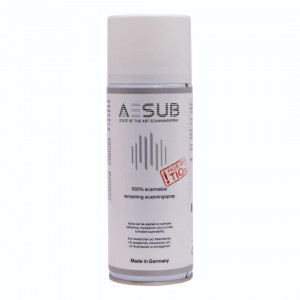
AESUB White is a permanent 3D scanning spray engineered by scanning specialists for optical metrology, reverse engineering, and industrial digitisation, delivering a ~7 µm homogeneous matte coating on any surface — transparent, reflective, or deep-pocket — without titanium dioxide (TiO2), the compound flagged as a potential inhalation carcinogen by the European Chemicals Agency.
| Average Layer Thickness | ~7 µm |
|---|---|
| TiO2-Free Formula | Yes — no titanium dioxide nano particles |
| Shelf Life | 5 years |
| Ideal Application Temperature | 21 °C |
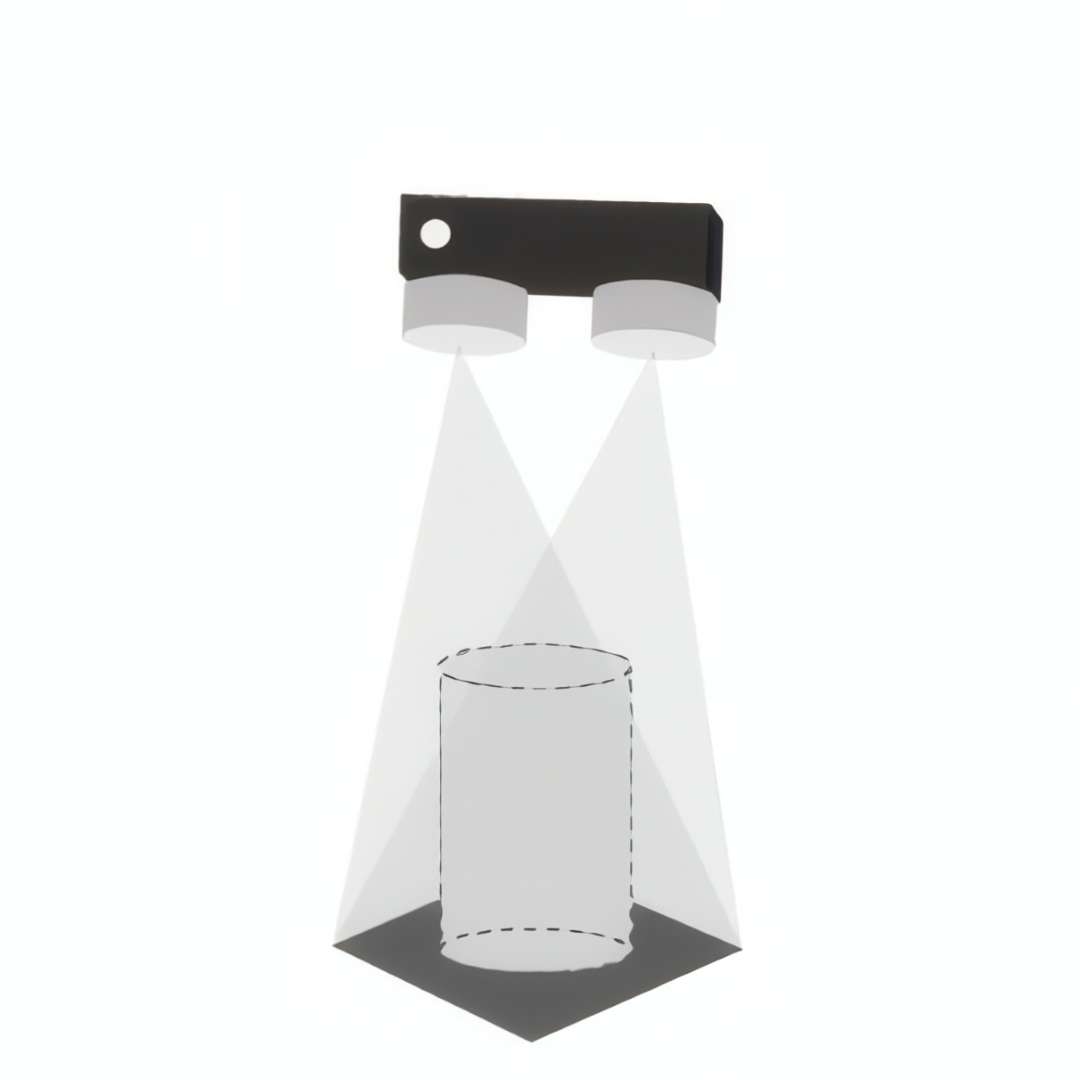
The diagram below illustrates the core optical principle that makes matting spray indispensable in 3D metrology: structured-light and photogrammetry sensors project beams onto the object and rely on diffuse reflection returning to their cameras. Without a matte coating, transparent surfaces transmit the light and reflective surfaces scatter it away, leaving the sensor with incomplete data.
Why Surface Preparation Decides Scan Quality
Even the most capable structured-light or photogrammetry scanner fails on four common surface classes: transparent parts (glass, acrylic), mirror-finish metals, deep-pocket geometries with inter-reflection artefacts, and multi-material assemblies where colour contrast creates inconsistent reflectivity. AESUB White addresses all four simultaneously. A single coat normalises surface reflectance, eliminates inter-reflections, and produces the uniform white reference that calibrated colour-to-depth algorithms expect.
~7 µm: Thin Enough to Preserve Tolerances
Traditional chalk-based sprays build layers of 15–25 µm, displacing dimensional features by a measurable amount and invalidating tight-tolerance measurements. AESUB White applies a coating averaging just 7 µm, thin enough to keep measurement error within acceptable bounds for most industrial metrology workflows. The pigments are distributed through a solvent carrier: the solvent evaporates within seconds after application, leaving a dry, stable white layer ready to scan without waiting.
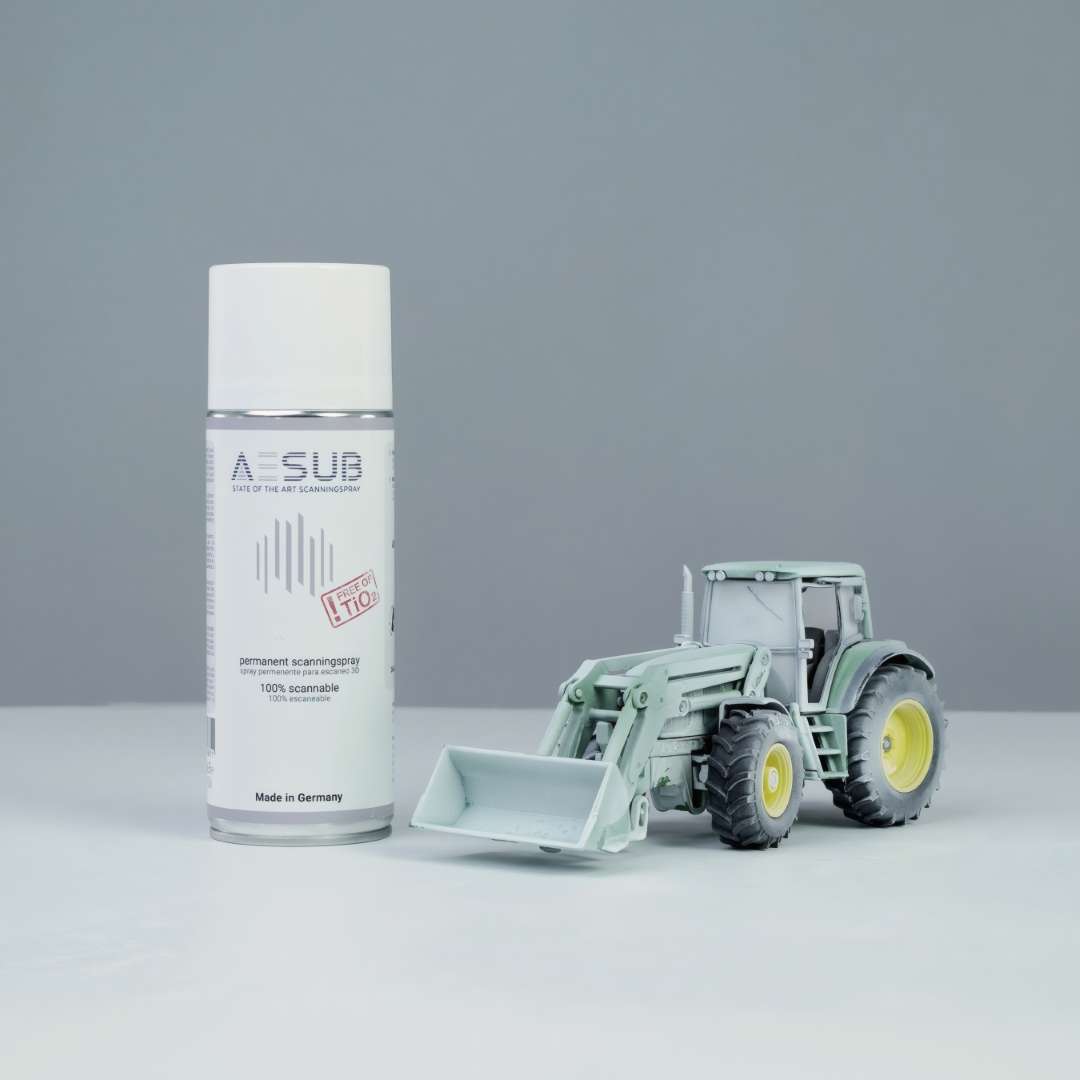
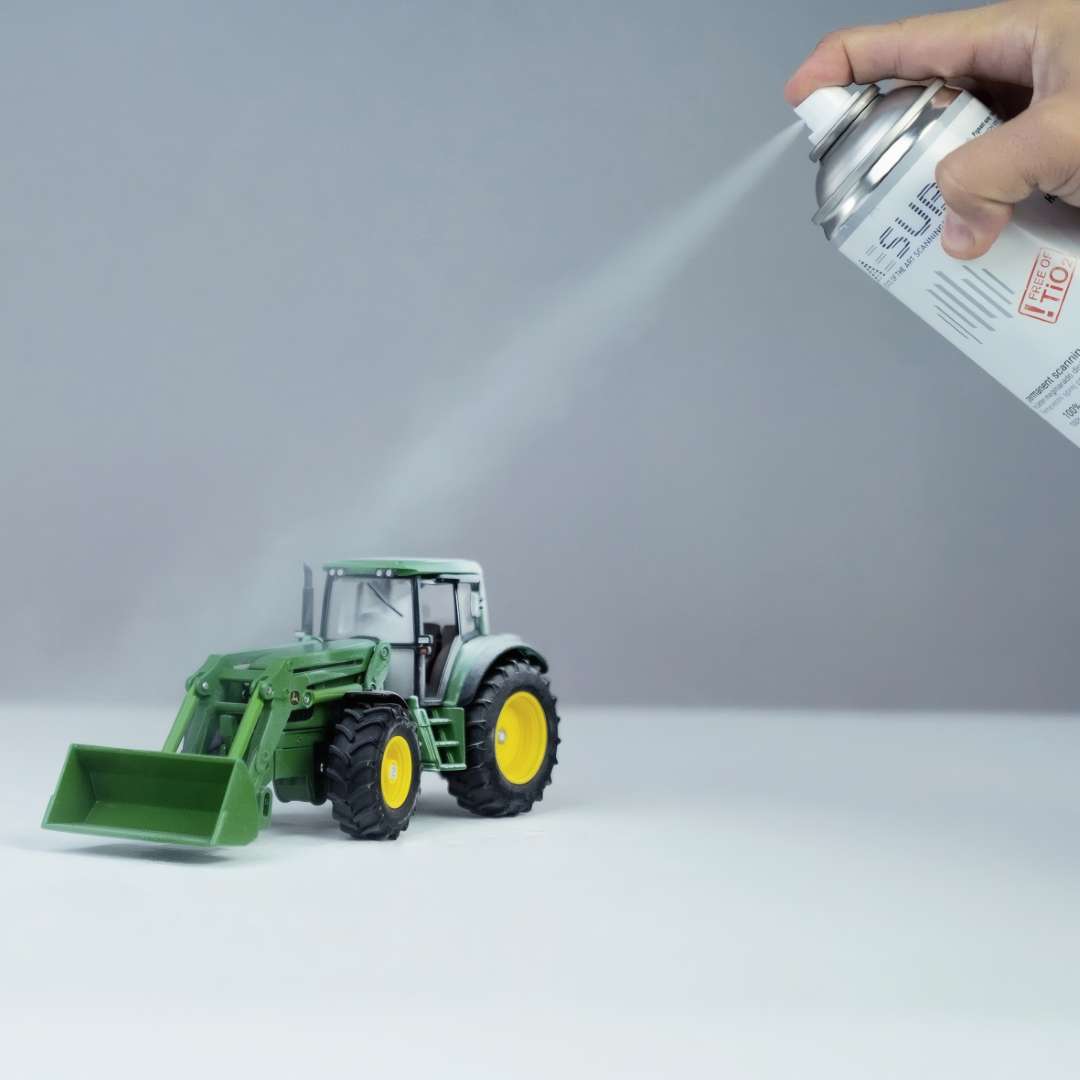
The photograph below shows an AESUB White can next to a tractor model after coating — the uniform matte-white finish across complex geometry with deep pockets, fine detail, and mixed materials illustrates the coating's consistent surface coverage.
TiO2-Free: Safer Chemistry for Lab Environments
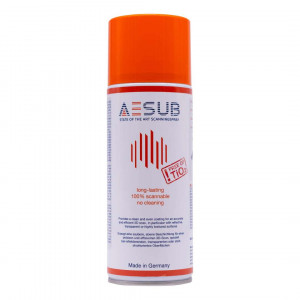
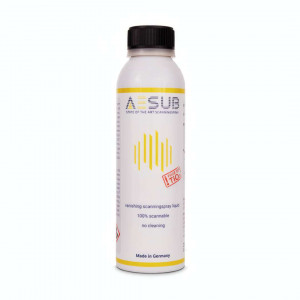
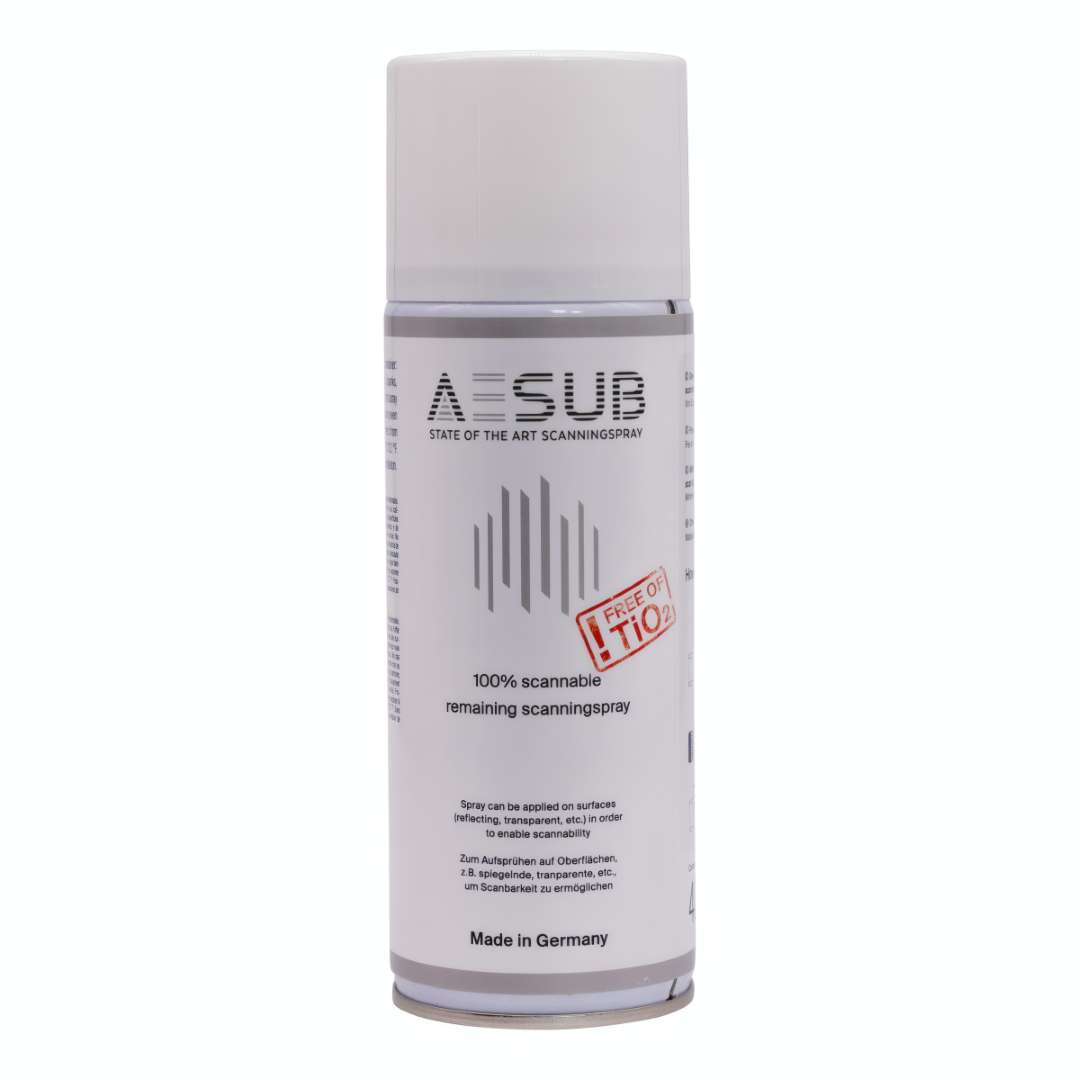
Many conventional scanning sprays use titanium dioxide as the primary whitening pigment. In 2022 the European Chemicals Agency (ECHA) formally classified TiO2 powder and spray preparations as suspected carcinogens via inhalation. AESUB White eliminates TiO2 entirely, substituting an alternative pigment system that delivers equivalent or superior optical contrast while removing the inhalation hazard associated with nano-particle TiO2. The can label clearly displays the "Free of TiO2" certification stamp — visible in the product photograph below.
Application: 15–20 cm Distance for a Flawless Coat
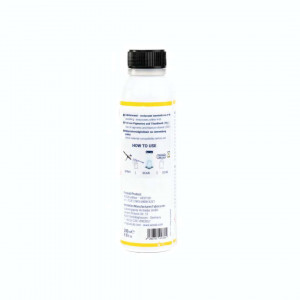
Correct application technique determines coating consistency. Hold the can at a distance of 15–20 cm from the surface, shake until the ball rattle is clearly audible, and use overlapping back-and-forth strokes at a steady pace. Pausing at any single point concentrates pigment and creates visible pooling. The illustration below shows the recommended spray geometry.
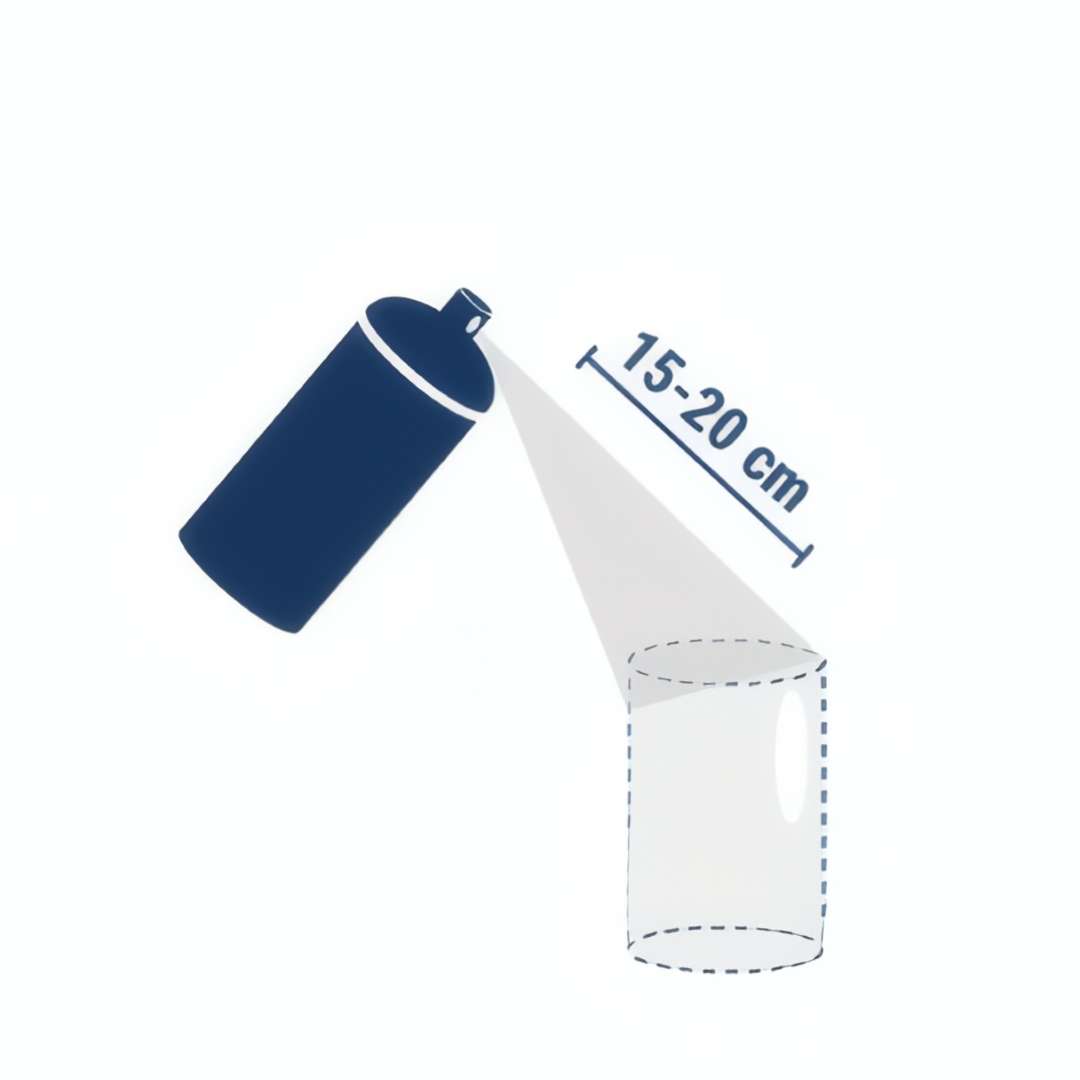
The action shot below captures the spray being applied to the tractor model at the correct working distance, producing an even cone of mist across the entire front fascia in a single pass.
Post-Scan Cleaning: Soft Brush + Water
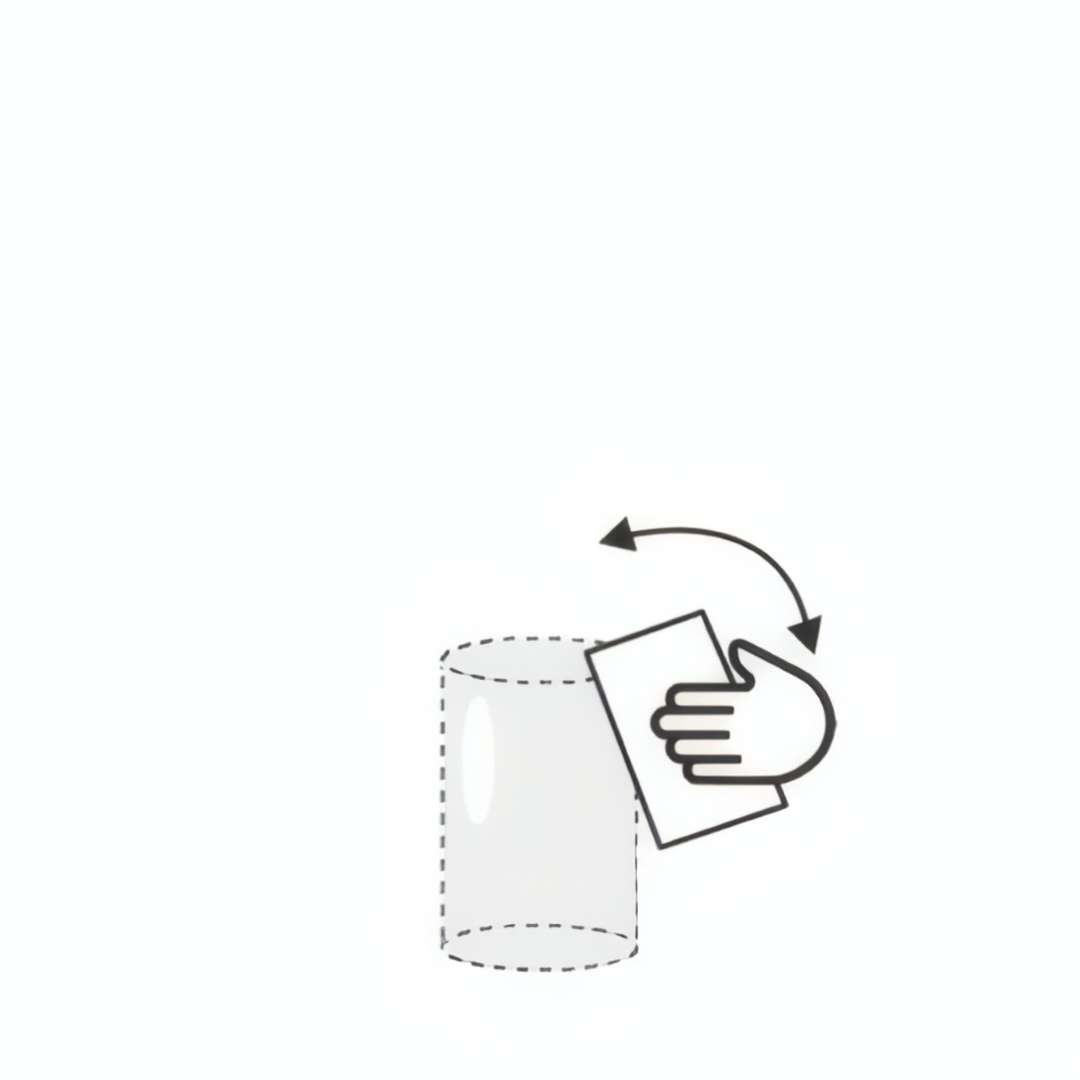
As a permanent spray, AESUB White coating will not self-remove after scanning. Coated parts require post-scan cleaning or disposal. The cleaning procedure is straightforward: use a soft-bristle brush with water, then wipe with a clean towel. No aggressive solvents are needed. The illustration below depicts the wiping motion required to remove the dried pigment layer.
Industry Applications
AESUB White is qualified for optical digitisation across the full spectrum of industrial and research sectors:
- Automotive body and powertrain component scanning
- Aerospace inspection and reverse engineering
- Energy sector turbine and pressure-vessel metrology
- Architectural surveying and digital archiving
- Plastic design, art, and cultural heritage digitisation
- Research and development, inline scanning, process monitoring
- Surface inspection and measurement services
Technical Specifications of the AESUB White 400 ml
Coating Properties
| Spray Type | Permanent scanning spray |
|---|---|
| Average Layer Thickness | ~7 µm (user application dependent) |
| Coating Homogeneity | Consistent and very homogeneous |
| Optimised Contrast Values | Yes — for optical scanning applications |
| TiO2 (Titanium Dioxide) | Free of TiO2 nano particles |
| Post-Scan Removal | Manual cleaning required (soft brush + water) |
| Material Compatibility | Contains solvents — verify compatibility before use |
Application Parameters
| Recommended Spray Distance | 15–20 cm |
|---|---|
| Ideal Ambient Temperature | 21 °C (69.8 °F) |
| Application Method | Even back-and-forth strokes at consistent pace |
| Scan Ready | As soon as coating is stable and white (solvent evaporates in seconds) |
Storage & Packaging
| Net Volume | 400 ml |
|---|---|
| Shelf Life | 5 years |
| Optimal Storage Temperature | 18–21 °C (64.4–69.8 °F) |
| Storage Conditions | Dry, no direct sunlight |
| Maximum Storage Temperature | 50 °C (pressurised container) |
| Country of Manufacture | Germany |
Composition (Active Components)
| Propellant | Butane / propane / isobutane mixture |
|---|---|
| Solvent | Bioethanol |
| Pigment System | Pigments — TiO2-free formulation |
| Flammable Content | 90.71 % by mass (aerosol classification) |
Safety & Regulatory
| GHS Classification | Aerosol 1 (H222, H229), STOT SE 3 (H336) |
|---|---|
| Signal Word | Danger |
| UN Number | UN 1950 (Aerosols) |
| Regulatory Compliance | REACH (EC) No. 1907/2006; GHS Rev. 6 |
| Carcinogenicity | Shall not be classified as carcinogenic |
| PBT / vPvB Assessment | Does not contain PBT/vPvB substance ≥ 0.1 % |
What's in the Box
- AESUB White permanent scanning spray — 400 ml aerosol can (×1)
How to Apply AESUB White Scanning Spray
Step-by-step procedure for applying AESUB White to prepare a surface for optical 3D scanning. Follow these four steps to achieve a consistent, scan-ready matte coating.
Step 1: Shake
Hold the can upright and shake vigorously until a loud rattling noise is clearly audible from the mixing ball inside. This ensures the pigment is fully re-dispersed through the solvent and propellant before application.
Step 2: Spray
Position the can 15–20 cm from the object surface. Press the nozzle gently and move the can in steady, overlapping back-and-forth strokes across the entire surface to be scanned. Maintain consistent pace — do not pause over any single point. If drop formation occurs, increase distance or pace slightly. The ideal ambient temperature is 21 °C. Repeat passes only when required, as each additional pass increases layer thickness. Keep the spray away from scanner optics and sensitive equipment; AESUB White is permanent and will contaminate nearby surfaces.
Step 3: Scan
The solvent in AESUB White evaporates within a few seconds of application. Once the coating appears uniformly white and dry, proceed with the 3D scan using your scanner's standard workflow. No additional waiting time is required.
Step 4: Clean
After scanning is complete, remove the permanent pigment coating using a soft-bristle brush combined with water, then wipe dry with a clean towel. No aggressive solvents are required. Parts that cannot be cleaned may be disposed of according to local waste regulations (waste code 16 05 04).
What is the difference between AESUB White and a vanishing spray?
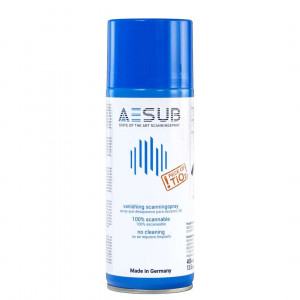
AESUB White is a permanent spray: the pigment coating remains on the object after scanning and must be manually cleaned off with a soft brush and water. Vanishing sprays (such as AESUB Blue) use a sublimating coating that evaporates automatically within minutes, leaving no residue and eliminating any risk of pigment contamination to scanners or the lab environment. Choose AESUB White when permanence, cost efficiency, or specific coating durability is required; choose a sublimating spray when sensor proximity or contamination risk is a concern.
Why is AESUB White free of titanium dioxide (TiO2)?
The European Chemicals Agency (ECHA) has associated TiO2 nano particles in spray form with potential carcinogenic risks through inhalation. AESUB White was formulated with an alternative pigment system that achieves equivalent optical contrast and coating homogeneity without using TiO2, making it a safer choice for operators working in enclosed lab environments on a regular basis.
How thick is the AESUB White coating layer?
The average layer thickness of AESUB White is approximately 7 µm, depending on application technique. This is significantly thinner than traditional chalk-based sprays, which typically deposit 15–25 µm and can distort tight-tolerance measurements. Multiple passes increase thickness proportionally, so a single even coat is recommended for precision metrology applications.
On which surface types can AESUB White be applied?
AESUB White is designed for transparent parts (glass, acrylic, plastics), highly reflective metal surfaces, parts with deep pockets causing inter-reflection artefacts, and any multi-material assembly where colour or reflectance variation degrades scan quality. Material compatibility cannot be guaranteed for all substrates; users should verify compatibility on a test area before full application, as the formulation contains solvents.
How long can AESUB White be stored and what are the storage requirements?
AESUB White has a shelf life of five years when stored correctly. The optimal storage temperature range is 18–21 °C in a dry location away from direct sunlight. As a pressurised aerosol, the can must never be exposed to temperatures exceeding 50 °C and must not be pierced or incinerated, even when empty.
Why Choose EXPERT3D?
EXPERT3D has specialised in advanced 3D technology and scanning solutions since 2012 — over a decade of hands-on experience selecting and supporting professional-grade consumables, scanners, and metrology tools across research institutions, universities, and industrial quality departments throughout Spain and Europe. As an official representative of AESUB, we guarantee the best price, authorized service, and official warranty. Our team provides pre-sales technical consultation and helps you identify the right scanning spray — permanent or sublimating — for your application. Contact us to discuss your workflow requirements and current stock availability.