
- Stock: In Stock
- Product code: 920372000001150359
- Weight Brutto: 1.00
- SKU: 32101

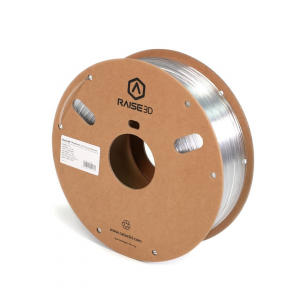
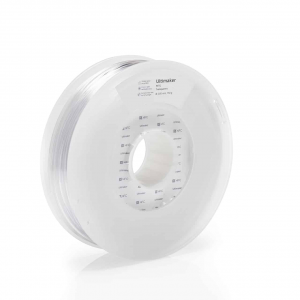
Bambu Lab PETG Translucent Filament, 1 kg, Without Spool, Clear is a specially formulated PETG filament engineered for high light transmittance, outdoor weather resistance, and clean, low-maintenance extrusion across open and enclosed printer configurations. Its optimised chemistry addresses stringing, nozzle adhesion, and moisture-related defects — the three most common failure modes with standard PETG — while delivering a glass-like aesthetic that ranges from tinted translucent to near-transparent depending on wall count and printing parameters.
| Specification | Why it matters |
|---|---|
| Filament Diameter Tolerance: 1.75 mm ± 0.03 mm | Tighter diameter consistency reduces pressure fluctuations in the hotend, yielding more uniform layer widths and minimising under- or over-extrusion mid-print. |
| Nozzle Temperature Range: 230–270 °C | A 40 °C operating window accommodates everything from fine detail work at lower temperatures to maximum flow transparency at 260–270 °C, without requiring a separate filament profile per machine. |
| Impact Strength (X-Y, unnotched): 37.4 ± 3.3 kJ/m² | High impact toughness means printed enclosures, clips, and outdoor brackets resist cracking under shock loads — a significant mechanical advantage over brittle alternatives like PLA. |
| Net Weight / Format: 1 kg, spoolless | No spool means direct compatibility with Bambu Lab's AMS refill workflow and reusable spool systems, reducing plastic waste and lowering total cost per kilogram. |
- Optimised anti-stringing formula: the chemical tuning of this filament reduces nozzle weeping and clumping during travel moves, so long prints retain clean surfaces without extensive post-processing.
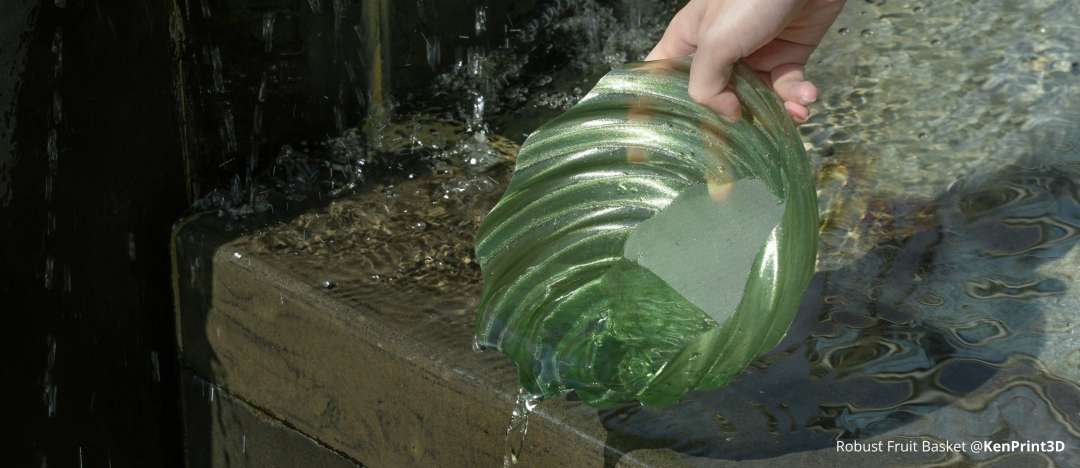
- Water and UV resistance: printed parts maintain structural and optical integrity in prolonged outdoor exposure — weatherproofing that standard PETG grades do not reliably deliver.
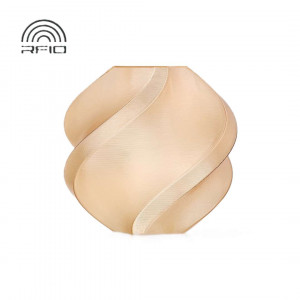
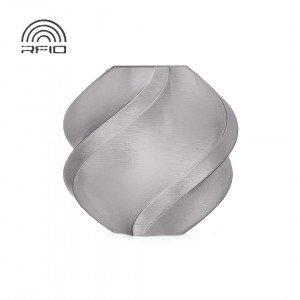
- AMS RFID integration: embedded RFID tags allow Bambu Lab's Automatic Material System to read and apply all print parameters automatically, eliminating manual profile entry entirely.
- Minimal warping across printer types: anti-warp performance on both open-frame and enclosed machines expands the range of usable hardware without requiring a heated enclosure as a prerequisite.
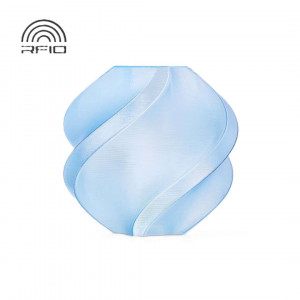
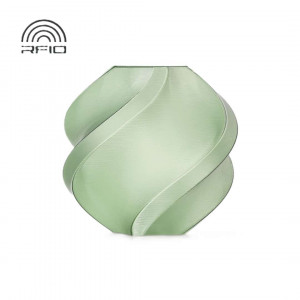
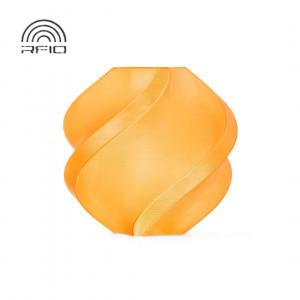
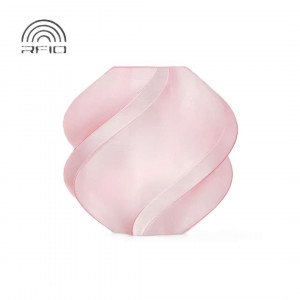
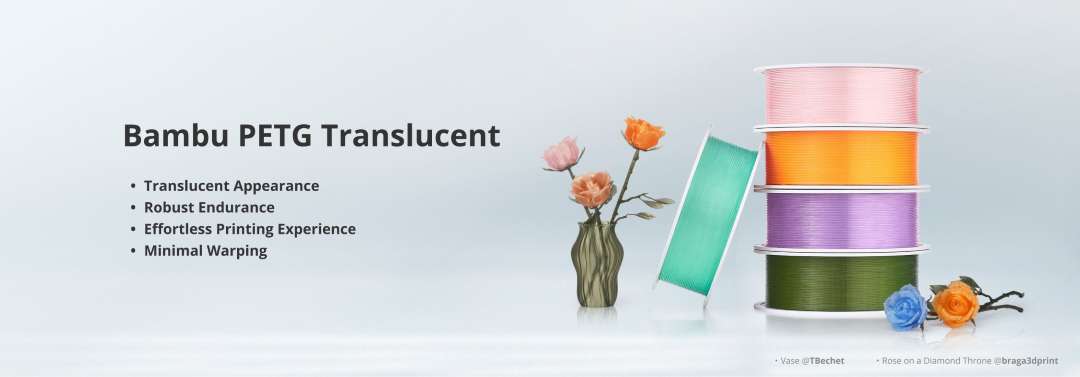
- Eight colour variants with light-mixing capability: blending wall loops of different colours and thicknesses creates gradient and stained-glass light effects not achievable with opaque materials.
Technology and Operating Principle
PETG (polyethylene terephthalate glycol) is an amorphous co-polyester — the glycol modification lowers crystallinity compared with standard PET, producing a material with higher transparency and reduced brittleness. Because PETG does not form ordered crystalline regions in the way semi-crystalline polymers such as PLA do, light scattering at grain boundaries is minimised, which is why Bambu Lab PETG Translucent achieves superior light transmittance relative to translucent PLA grades. Transparency depth is governed by layer height, wall count, nozzle temperature, and flow ratio: thinner layers and higher temperatures allow adjacent lines to fuse more fully, reducing the micro-gaps that scatter incident light.
The filament's RFID chip stores the complete Bambu Lab-validated parameter set. When loaded into a compatible AMS unit, the printer reads nozzle temperature, bed temperature, cooling profile, and retraction values automatically. This removes the risk of operator error when switching between materials and ensures that the print starts from a fully optimised baseline every time.

Construction and Material Properties
Mechanical Robustness
The Young's modulus in the X-Y plane reaches 1,420 ± 160 MPa, giving printed parts a stiffness comparable to injection-moulded general-purpose PETG. Bending strength of 68 ± 3 MPa (X-Y) and impact strength of 37.4 ± 3.3 kJ/m² (unnotched, ISO 179) classify this material as tough rather than merely rigid — it flexes before fracturing, which is critical for snap-fit assemblies and functional housings. Z-axis values are predictably lower (Young's modulus 1,230 ± 140 MPa; tensile strength 29 ± 3 MPa) due to inter-layer bonding being the mechanical weak point in FDM, but remain serviceable for most load-bearing applications.
The glass transition temperature of 70 °C and Vicat softening point of 79 °C (ISO 306) define the maximum continuous service temperature. Parts should not be exposed to prolonged heat above approximately 65–68 °C in loaded conditions, as the heat deflection temperature under 1.8 MPa (ISO 75) sits at 68 °C. For unloaded decorative or light-duty applications the 74 °C figure (0.45 MPa load) applies instead.
Weather and Chemical Resistance
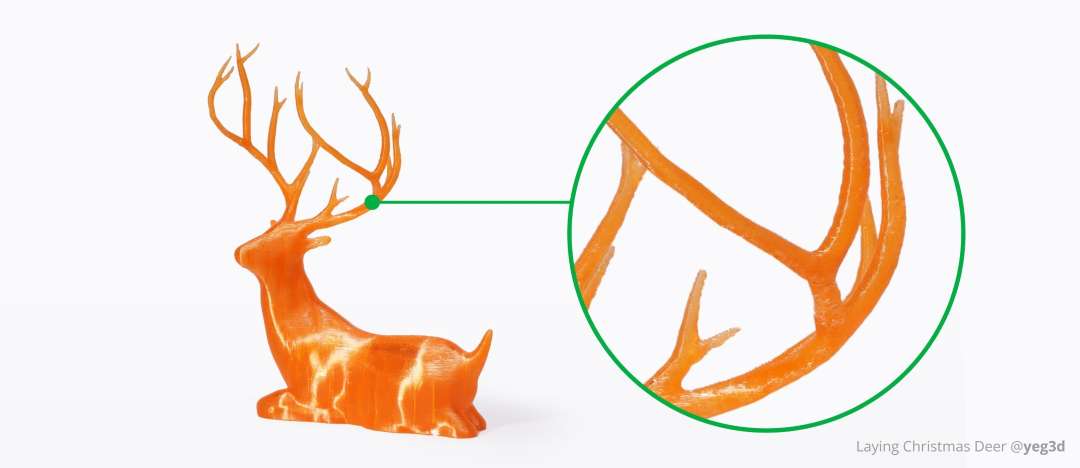
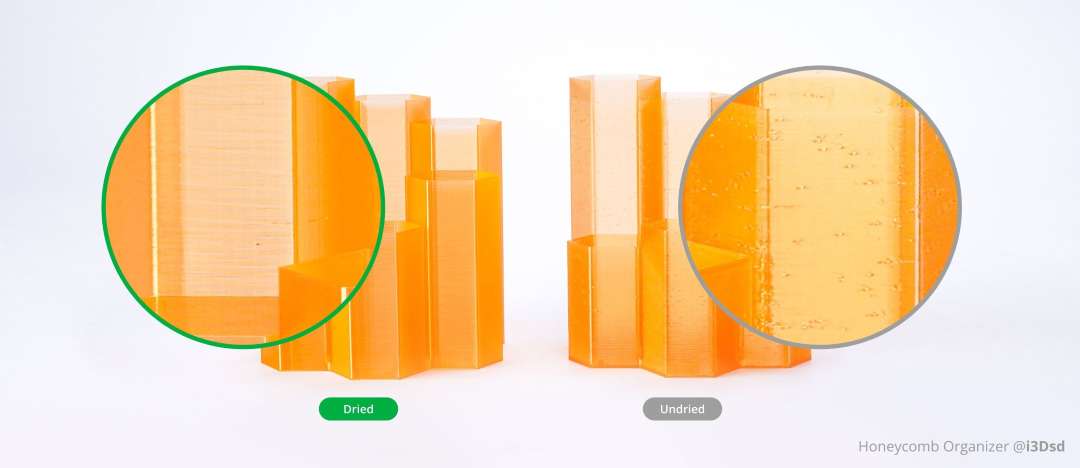
Prolonged UV exposure degrades many polymers by breaking polymer backbone bonds, causing yellowing and embrittlement. The Bambu PETG Translucent formulation includes UV stabilisation that maintains optical and structural properties under outdoor conditions. Water resistance is inherent to the PETG chemistry — the material is insoluble in water and resistant to most oils and greases (confirmed by Bambu Lab testing). It is not resistant to strong acids, alkalis, or certain organic solvents, so parts should not be used in direct contact with those reagents. Chemical stability is confirmed as stable under normal storage and handling conditions. The saturated water absorption rate of just 0.30% (at 25 °C, 55% RH) is low for a polyester, but still sufficient to cause print defects if the filament is stored unsealed — see the Printing Tips section for drying guidance.
Translucency and Optical Performance
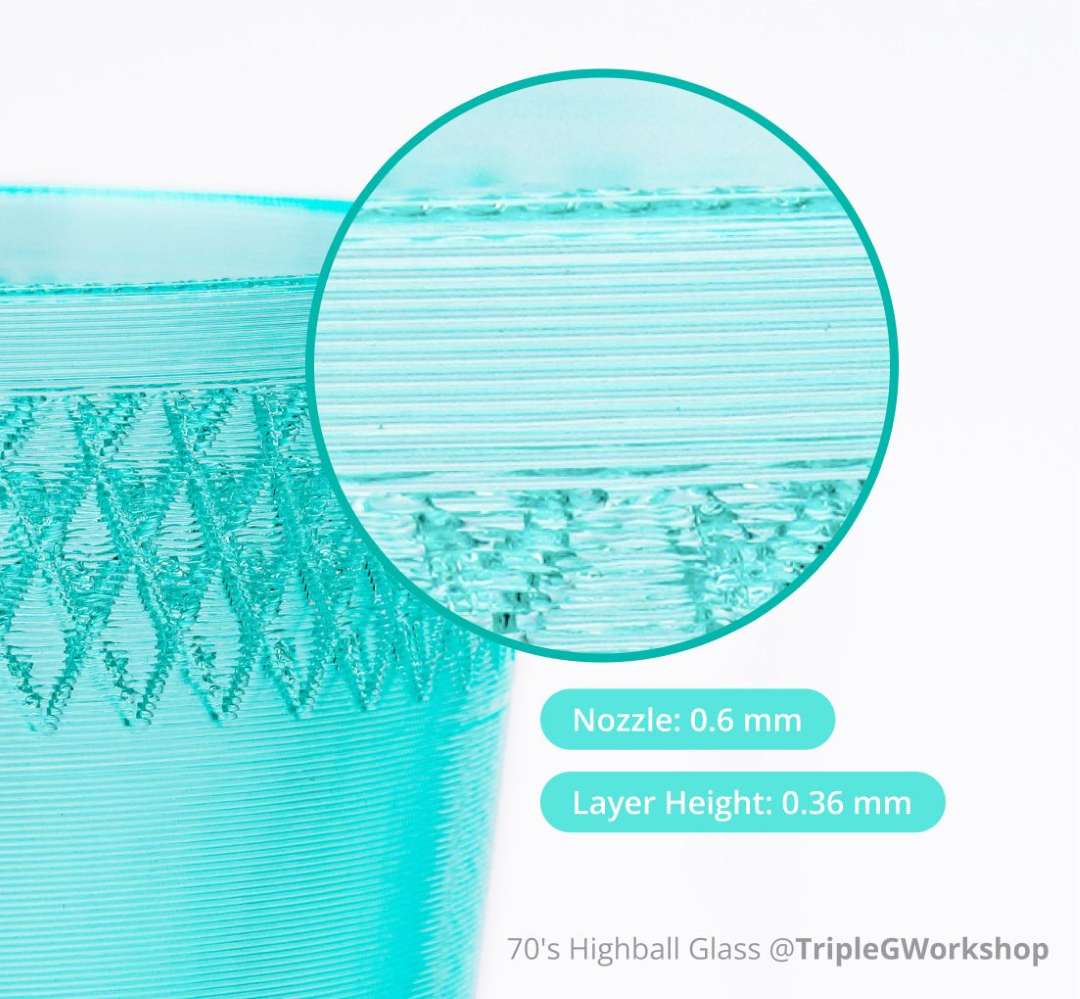
Achieving near-transparent prints with FDM requires managing every optical interface between adjacent extrusion lines. Key parameters are nozzle temperature (higher temperatures improve inter-line fusion), flow ratio (slightly elevated values reduce micro-voids), wall count (single-wall structures transmit the most light), and cooling (reduced fan speed allows lines to bond more homogeneously). A 0.8 mm nozzle deposits wider lines, reducing the total number of seams per unit width and thereby improving bulk light transmittance. A 0.4 mm nozzle is practical for detail work but produces more scattering seams at a given wall thickness. Bambu Lab provides downloadable pre-configured 3MF profiles for 0.4 mm, 0.6 mm, and 0.8 mm nozzles on the X1C to simplify the parameter optimisation process.
Software and Automation
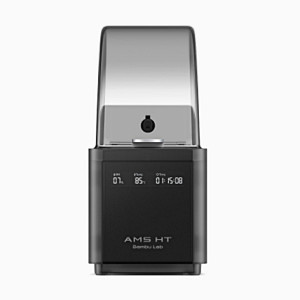
Every spool of Bambu Lab PETG Translucent Filament, 1 kg, Without Spool, Clear ships with an RFID chip pre-loaded with Bambu Lab's validated slicing parameters. When the filament is inserted into any AMS Series unit — AMS Lite, AMS, AMS 2 Pro, or AMS HT — the printer reads the chip and populates nozzle temperature, bed temperature, cooling fan speed, retraction length, and retraction speed fields without requiring user input. Multi-colour or multi-material prints using a mix of PETG Translucent shades also benefit from this system: each spool is identified individually, and the slicer can display the exact hex colour code for visual preview in Bambu Studio. The filament is fully compatible with Bambu Studio's filament management module, and the preset 3MF transparency profiles can be imported directly to further streamline transparent print workflows.

Safety and Handling
The material is classified as odourless during printing and presents no skin hazard under normal handling conditions. PETG is flammable; combustion produces water and carbon oxides. Adequate ventilation in the print area remains good practice, as with all FDM materials. The filament requires drying before use — the recommended condition is 65 °C for 8 hours in a blast (forced-air convection) drying oven, or 75–85 °C for 12 hours on the X1 Series heatbed. Moisture absorbed during storage causes rapid vaporisation inside the hot nozzle, leading to bubbling, surface pitting, stringing, and reduced structural strength. Once dried, the filament must be stored sealed with desiccant at below 20% relative humidity. A microwave or domestic kitchen oven is not suitable for drying due to uneven heat distribution. Annealing finished PETG Translucent prints is not recommended: the material offers very limited property improvement from annealing, while geometrically complex parts risk visible deformation at the 60–70 °C annealing temperature.
Colour Availability
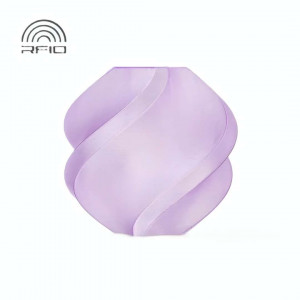
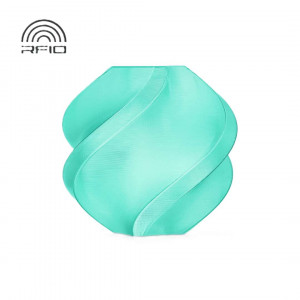
Eight colour variants are available in the PETG Translucent range, each defined by a consistent hex reference for colour-accurate preview in Bambu Studio and reliable multi-colour blending workflows. Wall thickness and layer height shift each colour's apparent depth and saturation, enabling a broad palette of light effects from a single spool or from combined AMS-fed prints.
| Colour Name | Hex Code |
|---|---|
| Translucent Gray | #8E8E8E |
| Translucent Light Blue | #61B0FF |
| Translucent Olive | #748C45 |
| Translucent Brown | #C9A381 |
| Translucent Teal | #77EDD7 |
| Translucent Orange | #FF911A |
| Translucent Purple | #D6ABFF |
| Translucent Pink | #F9C1BD |
Applications
- Decorative lighting and lampshades: the material's light transmittance allows LED light to diffuse evenly through printed walls, producing gradient glow effects that vary with wall count — ideal for custom lamp shades, night-light covers, and architectural accent pieces.
- Outdoor signage and enclosures: UV resistance and waterproof construction mean printed signs, sensor housings, and protective covers maintain appearance and structural integrity without requiring paint or lacquer coatings.
- Product design and visual prototyping: translucent parts reveal internal geometry and light behaviour in physical mock-ups, enabling designers to evaluate aesthetics and light interaction before committing to production tooling.
- Functional containers and fluidics: water resistance and oil/grease resistance make this filament suitable for printed vessels, funnels, tubing interfaces, and other parts that contact liquids, where PLA would absorb moisture and degrade.
- Artistic and sculptural prints: multi-colour translucent layer blending, achievable through AMS multi-material printing, enables stained-glass-style artistic objects, figurines with colour-gradient features, and architectural scale models with realistic glazing effects.
- Consumer product customisation: phone stands, keyboard keycaps, cosmetic packaging prototypes, and display cases all benefit from the clean surface finish and colour variety without the surface cracking risk associated with brittle transparent materials.
- Educational and scientific models: transparent or semi-transparent anatomical models, geological cross-sections, and fluid-flow demonstration parts gain interpretability from translucency that opaque filaments cannot provide.
Compatibility of the Bambu Lab PETG Translucent Filament
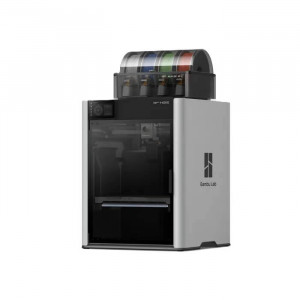
- AMS Systems: compatible with all AMS Series units (AMS Lite, AMS, AMS 2 Pro, AMS HT); RFID auto-configuration supported.
- Build Plates (Recommended): Cool Plate SuperTack, Smooth PEI Plate, Textured PEI Plate.
- Hotend — Recommended: Hardened Steel Nozzle 0.4 mm / 0.6 mm / 0.8 mm; Stainless Steel Nozzle 0.4 mm.
- Hotend — Not Recommended: Stainless Steel Nozzle 0.2 mm.
- Adhesion Aids: Bambu Liquid Glue or standard glue stick recommended for bed adhesion.
- Printer Configuration: compatible with both open-frame and enclosed Bambu Lab printers; closed enclosures (chamber temperature 35–50 °C) recommended for optimal dimensional stability.
- Slicing Software: Bambu Studio (with native RFID filament profile recognition); downloadable pre-configured 3MF profiles available for X1C with 0.4 mm, 0.6 mm, and 0.8 mm nozzles.
Technical Specifications of the Bambu Lab PETG Translucent Filament, 1 kg, Without Spool, Clear
Basic Information
| Parameter | Value |
| Material | PETG Translucent |
| Diameter | 1.75 mm |
| Diameter Tolerance | ± 0.03 mm |
| Net Filament Weight | 1 kg |
| Spool Material | ABS (temperature resistance 70 °C) |
| Spool Size | Diameter: 200 mm; Height: 67 mm |
Recommended Printing Settings
| Parameter | Value |
| Drying Settings before Printing | Blast Drying Oven: 65 °C, 8 h, X1 Series Printer Heatbed: 75–85 °C, 12 h |
| Printing and Storage Humidity | < 20% RH (Sealed with desiccant) |
| Nozzle Size | 0.2, 0.4, 0.6, 0.8 mm |
| Nozzle Temperature | 230–270 °C |
| Build Plate Type | Engineering Plate, High Temperature Plate, or Textured PEI Plate |
| Bed Surface Preparation | Glue |
| Bed Temperature | 65–75 °C |
| Cooling Fan | 0–60% |
| Printing Speed | < 220 mm/s |
| Retraction Length | 0.8–1.4 mm |
| Retraction Speed | 30–60 mm/s |
| Chamber Temperature | 35–50 °C |
| Max Overhang Angle | ~70° |
| Max Bridging Length | ~30 mm |
Specimen Printing Conditions
| Parameter | Value |
| Nozzle Temperature | 255 °C |
| Bed Temperature | 70 °C |
| Printing Speed | 150 mm/s |
| Infill Density | 100% |
Physical Properties
| Parameter | Testing Method | |
| Density | ISO 1183 | 1.25 g/cm³ |
| Melt Index | 230 °C, 2.16 kg | 11.7 ± 1.5 g/10 min |
| Melting Temperature | DSC, 10 °C/min | 228 °C |
| Glass Transition Temperature | DSC, 10 °C/min | 70 °C |
| Crystallization Temperature | DSC, 10 °C/min | N/A |
| Vicat Softening Temperature | ISO 306, GB/T 1633 | 79 °C |
| Heat Deflection Temperature (1.8 MPa) | ISO 75 | 68 °C |
| Heat Deflection Temperature (0.45 MPa) | ISO 75 | 74 °C |
| Saturated Water Absorption Rate | 25 °C, 55% RH | 0.30% |
Mechanical Properties
| Parameter | Testing Method | |
| Young's Modulus (X-Y) | ISO 527, GB/T 1040 | 1,420 ± 160 MPa |
| Young's Modulus (Z) | ISO 527, GB/T 1040 | 1,230 ± 140 MPa |
| Tensile Strength (X-Y) | ISO 527, GB/T 1040 | 33 ± 4 MPa |
| Tensile Strength (Z) | ISO 527, GB/T 1040 | 29 ± 3 MPa |
| Breaking Elongation Rate (X-Y) | ISO 527, GB/T 1040 | 8.2 ± 1.3% |
| Breaking Elongation Rate (Z) | ISO 527, GB/T 1040 | 5.2 ± 0.9% |
| Bending Modulus (X-Y) | ISO 178, GB/T 9341 | 1,610 ± 130 MPa |
| Bending Modulus (Z) | ISO 178, GB/T 9341 | 1,520 ± 110 MPa |
| Bending Strength (X-Y) | ISO 178, GB/T 9341 | 68 ± 3 MPa |
| Bending Strength (Z) | ISO 178, GB/T 9341 | 55 ± 4 MPa |
| Impact Strength (X-Y, unnotched) | ISO 179, GB/T 1043 | 37.4 ± 3.3 kJ/m² |
| Impact Strength (X-Y, notched) | ISO 179, GB/T 1043 | 8.6 ± 2.1 kJ/m² |
| Impact Strength (Z) | ISO 179, GB/T 1043 | 7.2 ± 1.8 kJ/m² |
Other Physical and Chemical Properties
| Parameter | Value |
| Odour | Odourless |
| Composition | PETG |
| Skin Hazards | No hazard |
| Chemical Stability | Stable under normal storage and handling conditions |
| Solubility | Insoluble in water |
| Resistance to Acid | Not resistant |
| Resistance to Alkali | Not resistant |
| Resistance to Organic Solvents | Not resistant to some organic solvents |
| Resistance to Oil and Grease | Resistant to most kinds of oil and grease |
| Flammability | Flammable |
| Combustion Products | Water, carbon oxides |
| Odour of Combustion Products | Odourless |
Accessory Compatibility
| Accessory | Recommended | |
| Build Plate | Cool Plate SuperTack, Smooth PEI Plate, Textured PEI Plate | — |
| Hotend | Hotend with Hardened Steel Nozzle 0.4 mm / 0.6 mm / 0.8 mm, Hotend with Stainless Steel Nozzle 0.4 mm | Hotend with Stainless Steel Nozzle 0.2 mm |
| Glue | Bambu Liquid Glue, Glue Stick | — |
Available Colour Variants
| Colour Name | Hex Code |
| Translucent Gray | #8E8E8E |
| Translucent Light Blue | #61B0FF |
| Translucent Olive | #748C45 |
| Translucent Brown | #C9A381 |
| Translucent Teal | #77EDD7 |
| Translucent Orange | #FF911A |
| Translucent Purple | #D6ABFF |
| Translucent Pink | #F9C1BD |
Why buy the Bambu Lab PETG Translucent Filament, 1 kg, Without Spool, Clear from EXPERT3D?
EXPERT3D has supplied professional 3D printing equipment and materials across Spain and the EU since 2012, with a technical team that works exclusively in additive manufacturing. When you order the Bambu Lab PETG Translucent Filament, 1 kg, Without Spool, Clear from EXPERT3D, you benefit from expert pre-sales consultation to confirm nozzle, AMS, and build plate compatibility for your specific Bambu Lab printer configuration; official warranty coverage and authorised after-sales service directly through the Bambu Lab partner network; fast delivery throughout Spain and across the EU with tracked dispatch; post-sale operator support including guidance on drying protocols, slicing profiles, and transparency optimisation; flexible financing and leasing options for larger orders or recurring supply agreements; and a consistently stocked catalogue of Bambu Lab consumables, spare nozzles, desiccant packs, and AMS accessories. As an official representative of Bambu Lab, EXPERT3D guarantees 100% product authenticity, fair market pricing, authorised service, and a full official manufacturer warranty on every item.