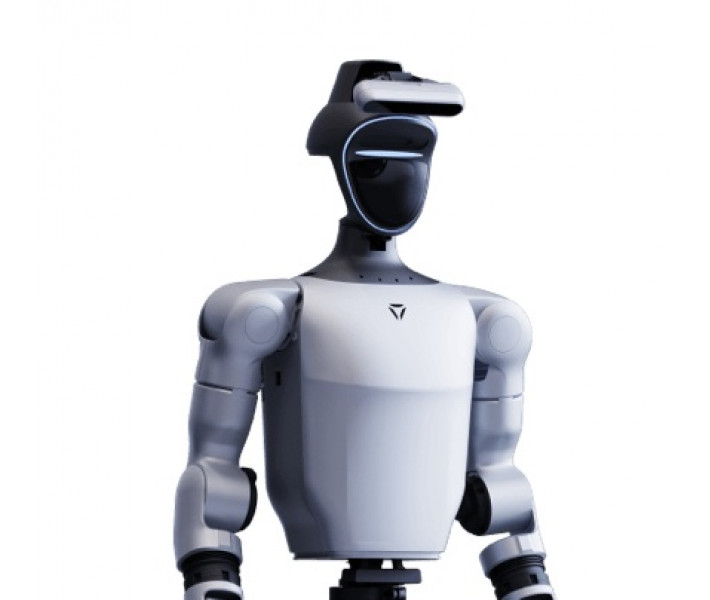


- Stock: In Stock
- Product code: 920372000001147287
- Weight Brutto: 68.00kg
- SKU: G1-COMP-EDU

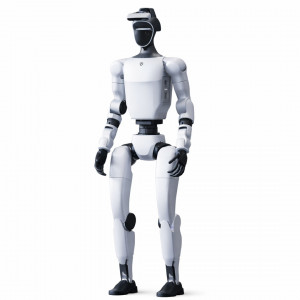
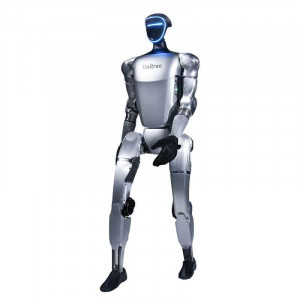
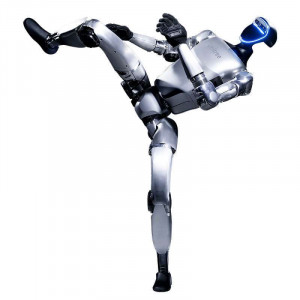
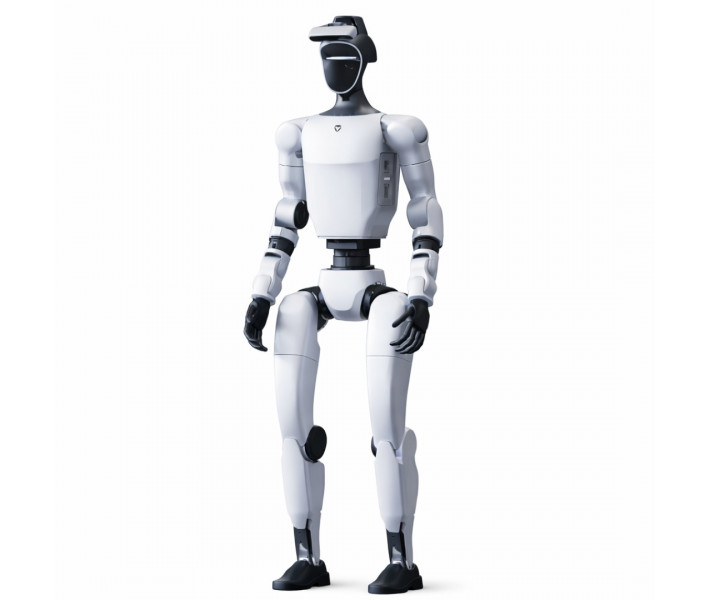
Unitree G1-Comp EDU is a full-size bipedal humanoid robot built for competitive robotics and university research programmes. It combines a human-scale frame with force-controlled dexterous hands for match and lab use alike. Standing about 130 cm tall and weighing around 35 kg, it runs entirely on electric actuation. Onboard AI compute processes perception and control decisions locally, in real time.
| Specification | Value | Why it matters |
|---|---|---|
| Total Degrees of Freedom | 37 | Enables human-like range of motion for agile bipedal walking and manipulation tasks. |
| Maximum Knee Torque | 120 N.m | Provides the joint strength needed for gait recovery and RoboCup-level locomotion speeds. |
| AI Computing Module | NVIDIA Jetson Orin NX — 100 TOPS | Runs perception, YOLO11 detection, and control policies onboard without cloud latency. |
| Battery Life | ~2 h (9,000 mAh, quick-release) | Supports full match or test-session runtime with tournament-ready battery swaps. |
- Dual-encoder joints on every axis deliver reliable Sim2Real policy transfer and stable joint states even under mechanical backlash.
- Dex3-1 dexterous hands with 10 g to 2,500 g force sensing allow precise grasping of both delicate objects and standard competition equipment.
- An open software stack (ROS, Isaac Gym, MuJoCo) lets existing lab code bases and sensor pipelines port with minimal rework.
- A quick-release 9,000 mAh battery supports fast swaps between matches or test sessions rather than lengthy downtime.
The G1-Comp EDU's operating principle rests on an all-electric drivetrain paired with dual-encoder feedback on every joint, removing the hydraulics and pneumatics common to older bipedal designs. Internal wiring runs through hollow joint structures, so no external cables interfere with fast footwork or ball contact during a match.
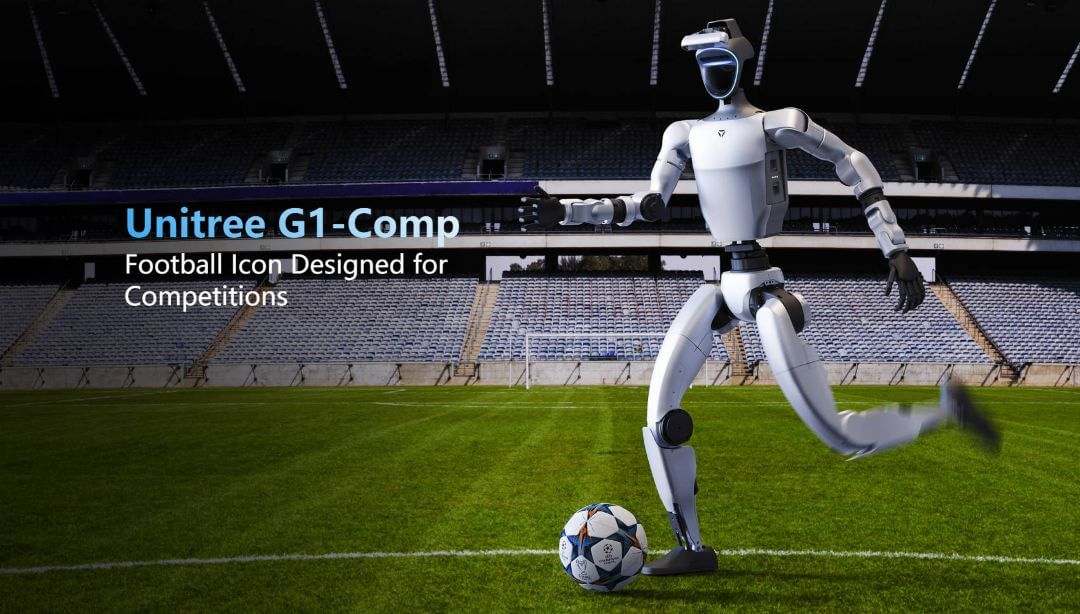
Competition-Built Body: 130 cm, 35 kg, Ready to Move
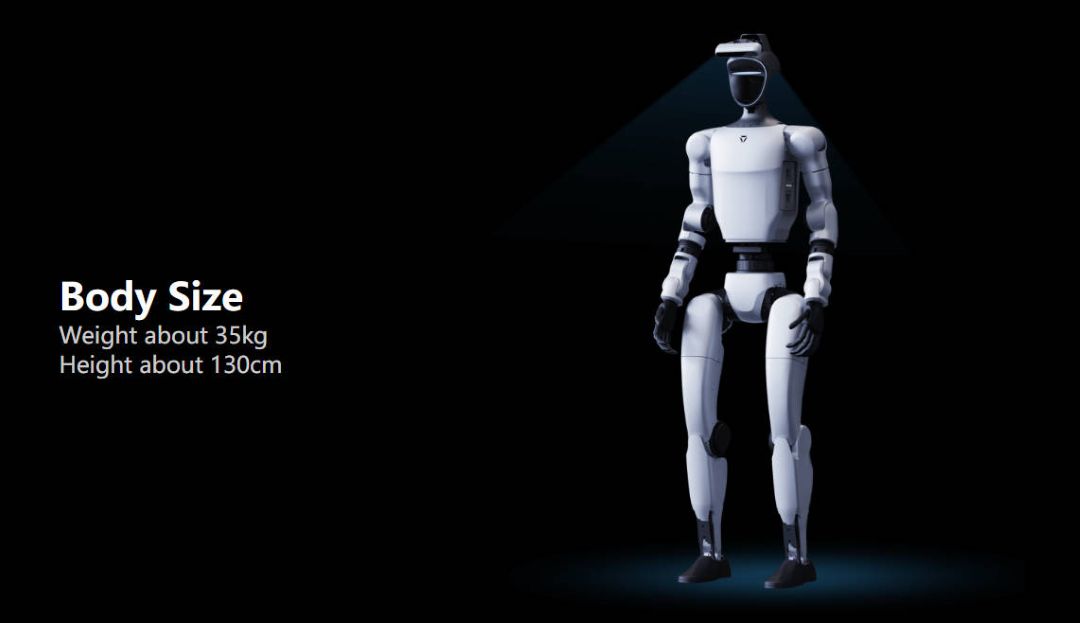
At 1,320 × 450 × 200 mm standing and folding to 690 × 450 × 300 mm for transport, the G1-Comp EDU occupies the physical envelope of a small adult. It weighs approximately 35 kg with its battery installed, and the all-electric drivetrain keeps the power-to-weight ratio favourable for dynamic movement. Unitree's proprietary hollow-shaft motors drive every joint, with wiring routed internally to eliminate snag points.
The standing and folded footprints below confirm how the frame compresses for transport between competition venues and research labs.
37 Degrees of Freedom: Human-Like Movement Architecture
The G1-Comp EDU ships with 37 total degrees of freedom in its EDU configuration; the base platform architecture supports 25 to 45 configurable DoF across legs, waist, arms, and head. The bundled Dex3-1 hands add 7 DoF per hand, plus 2 optional wrist DoF per arm. Each leg alone articulates across 6 DoF (Hip 3, Knee 1, Ankle 2), giving the gait the hip roll, yaw, and pitch range needed for agile walking, side-stepping, and disturbance recovery.
Extra-Large Joint Range of Motion
Compared with many academic humanoid platforms, the G1-Comp offers an unusually wide angular envelope. The waist rolls across Z±155°, X±45°, and Y±30°; the knee flexes from 0° to 165°; hip pitch spans ±154°. These ranges support crouching, reaching, and dynamic weight-shifting manoeuvres that constrained-DoF robots cannot execute.
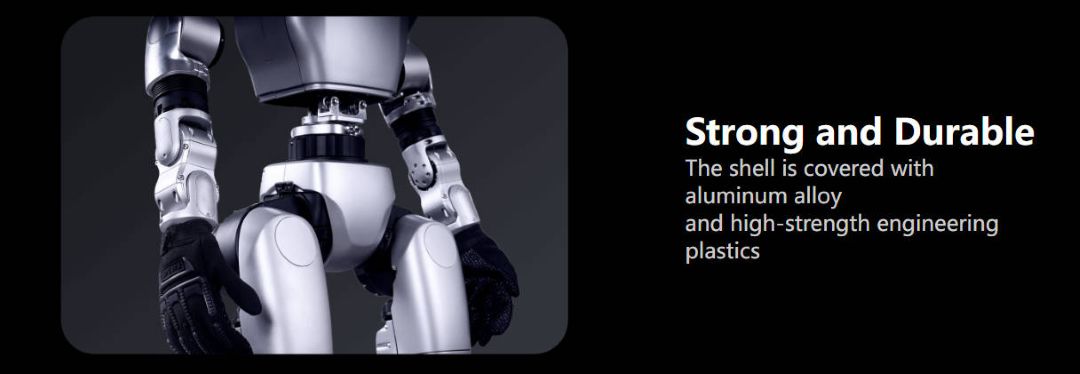
The aluminium-alloy and engineering-plastic shell, pictured below, absorbs these impact loads without adding unnecessary mass to the kinematic chain.
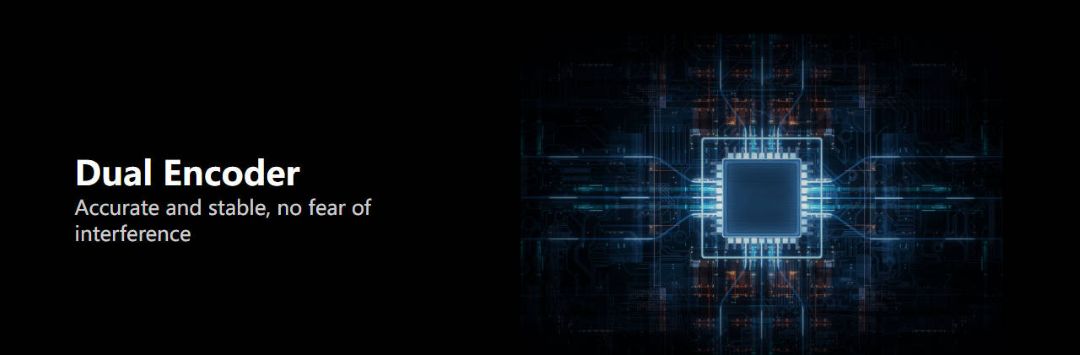
Dual-Encoder Precision on Every Joint
Position accuracy under load is a persistent challenge for high-DoF humanoids. The G1-Comp addresses this with a dual-encoder system on every joint — one sensor on the motor rotor, a second on the output shaft. This redundant feedback loop keeps joint-state readings accurate under mechanical backlash or external interference, supporting reliable Sim2Real policy transfer from Isaac Gym or MuJoCo to the physical robot.
The diagram below shows how rotor- and shaft-side sensors combine into a single stable joint-state reading.
Locomotion Performance: 2 m/s Bipedal Gait
The onboard motion-control stack delivers a peak locomotion speed of 2 m/s, fast enough for standardised RoboCup soccer match formats. The controller is tuned for competitive match conditions, maintaining gait stability under ball-contact perturbations and lateral crowding from opposing robots.
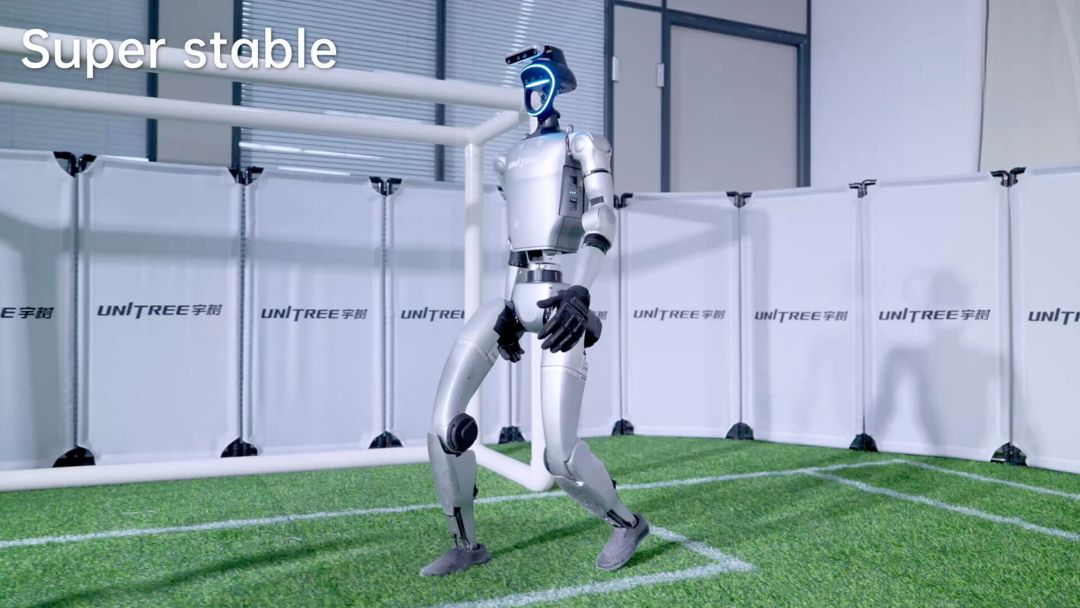
Super-Stable Balance Control
Balance control determines whether a match robot stays upright or ends up on the turf. The G1-Comp's control system absorbs unexpected pushes and uneven surface variations without breaking gait continuity.
The frame below shows the robot mid-stride with its centre of mass correctly projected over the support polygon.
Omnidirectional Walk
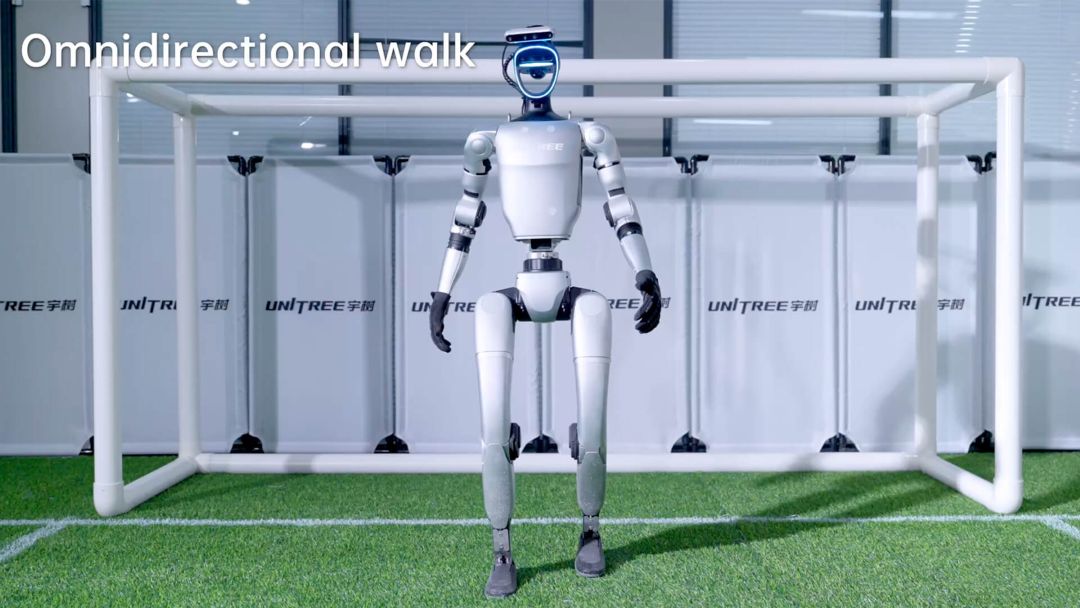
Beyond straight-line locomotion, the G1-Comp supports omnidirectional walking: translating laterally, rotating in place, and changing heading without stopping. This is essential for goal-side repositioning in football, and equally useful for inspection or manipulation tasks in obstacle-rich research environments.
Lateral steps and in-place rotation let the robot reposition near the goal without breaking stride, shown here on an indoor pitch.
Dex3-1 Dexterous Hands: Force-Controlled Manipulation
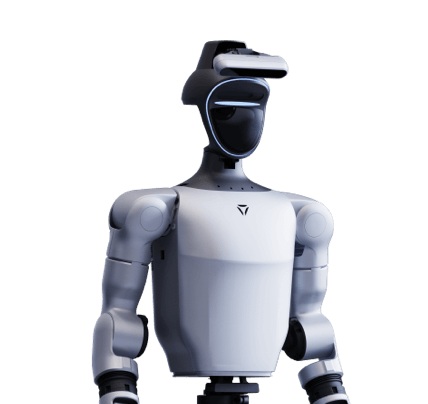
Unlike many competition humanoids that ship with passive grippers, the G1-Comp EDU includes a pair of Dex3-1 three-finger dexterous hands as standard equipment. Each hand provides 7 active degrees of freedom: the thumb contributes 3 DoF, and the index and middle fingers each contribute 2 DoF. The force-sensing array spans 10 g to 2,500 g, enabling grasp of both delicate objects and standard competition equipment. Operating voltage is 12–58 V, drawn directly from the robot's power bus. An optional tactile sensor array upgrade is available for research workflows requiring skin-level contact feedback.
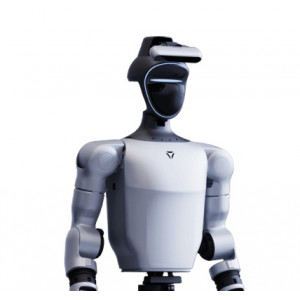
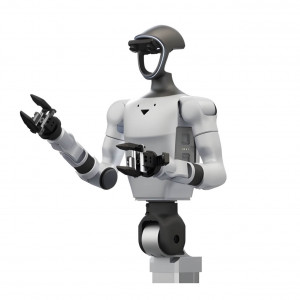
The portrait below shows the complete system — the helmet-mounted depth camera, bimanual arm configuration, and Dex3-1 hands that give the platform its distinctly humanoid character.
NVIDIA Jetson Orin NX: 100 TOPS for On-Board AI
The dedicated development computing unit — an NVIDIA Jetson Orin NX — provides 100 TOPS of AI inference alongside an 8-core Arm Cortex-A78AE CPU clocked up to 2 GHz, 16 GB of unified memory, and 1,024 NVIDIA Ampere GPU cores. All inference, perception, and control decisions run on-board in real time rather than offloading to the cloud. A separate Unitree-proprietary stack handles low-level motor control and stays inaccessible to end users, preserving motion-control integrity while leaving the Jetson environment fully open for custom development.
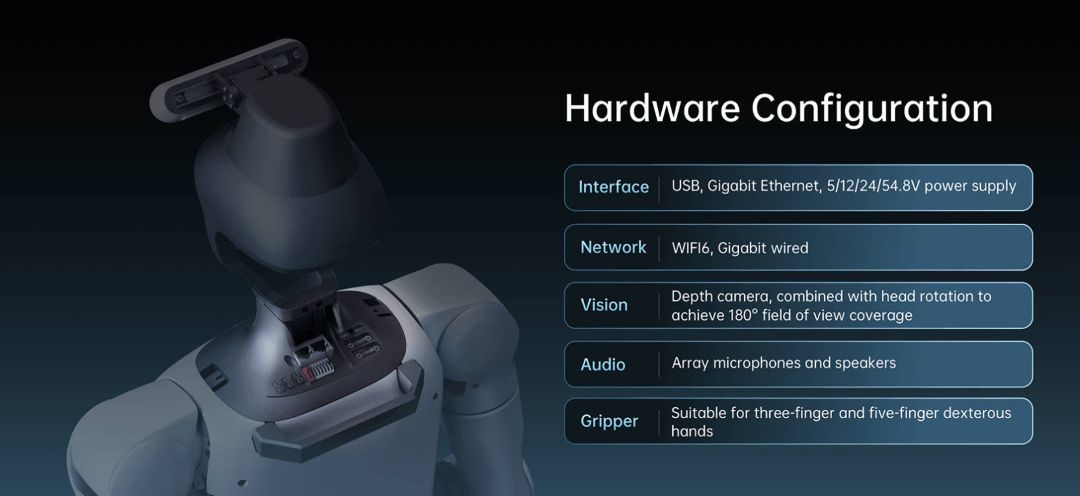
Hardware Interface Configuration
The right-side panel exposes a hardware interface for secondary development: USB Type-C ports supporting USB 3.0 and USB 3.2 host modes at 5 V / 1.5 A, dual Gigabit Ethernet RJ45 ports for high-bandwidth sensor feeds, and multi-voltage power rails at 5 V, 12 V, 24 V, and 54.8 V. The depth-camera system uses an Intel RealSense D455, combined with 2-DoF head rotation, to reach 180° field-of-view coverage. The 4-microphone array applies noise reduction and echo cancellation for reliable voice-command reception in noisy competition environments.
The image below maps the full interface configuration across the side panel.
Open Development Ecosystem
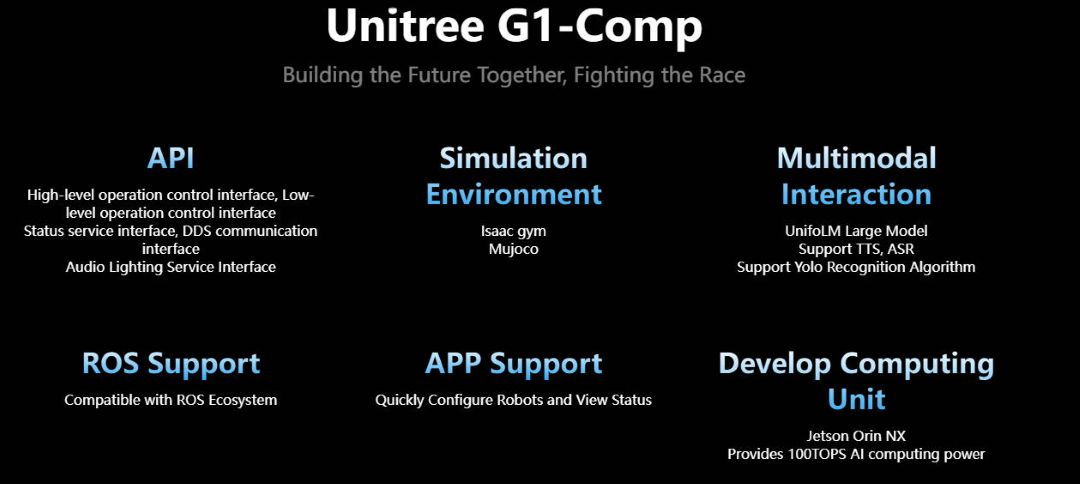
Beyond raw compute, the G1-Comp EDU ships with a software stack spanning six pillars: a multi-level API layer (high-level, low-level, DDS, audio/lighting); simulation environments in Isaac Gym and MuJoCo; multimodal interaction via the UnifoLM large language model with TTS and ASR support; ROS ecosystem compatibility; a mobile APP for rapid configuration; and the Jetson Orin NX as the development computing unit. ROS compatibility means existing lab code bases, sensor drivers, and visualisation pipelines port with minimal rework.
The diagram below maps all six pillars of the development ecosystem in one view.
RoboCup SDK: Sim2Real from Training to Competition
The dedicated RoboCup SDK bridges policy training and match-day deployment through three specialised API layers. The Visual Recognition API exposes the built-in YOLO11 real-time object-detection network, identifying ball position, goal orientation, and teammate or opponent locations. The Spatial Positioning API combines monocular geometric positioning with binocular depth positioning for accurate metric pose estimates on the pitch. The Motion Control API translates these visual and positional inputs into valid locomotion and manipulation commands.
Training is supported by the unitree_rl_gym reinforcement-learning framework, which integrates Isaac Gym and MuJoCo for physical simulation. Parallel environment count, random seed, and maximum iterations are all configurable. The documented Sim2Sim → Sim2Real pipeline lets teams iterate in simulation before deploying policies on the physical robot.
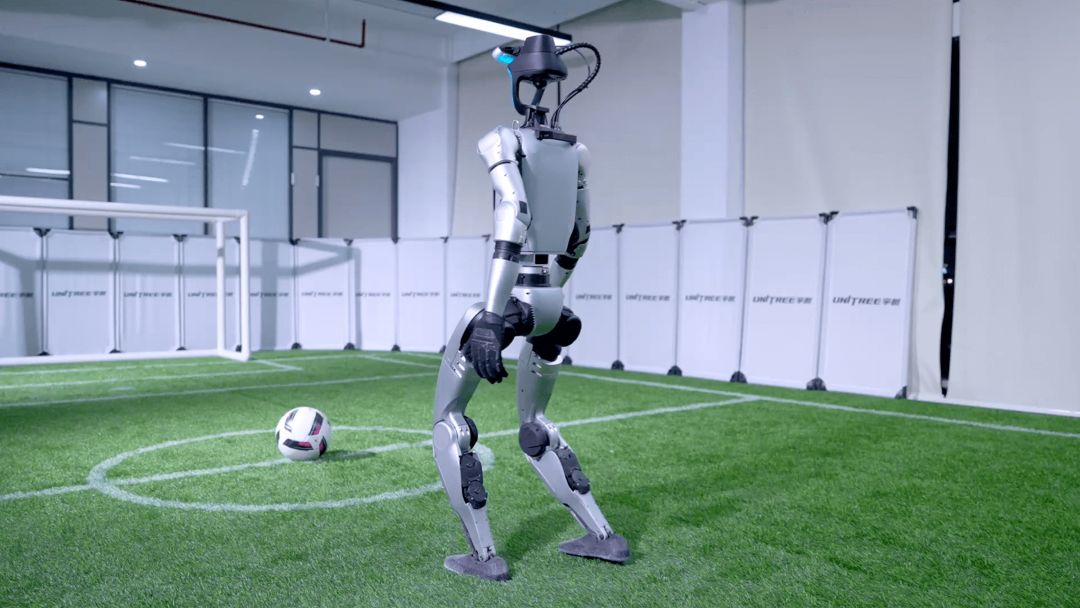
Below, a trained football-approach behaviour executes on the physical robot during hardware-in-the-loop validation.
Tech Tip: When transitioning a trained policy from Isaac Gym to the physical G1-Comp, enable sim-to-real domain-randomisation presets for terrain friction (μ = 0.4–1.2) and motor delay (5–20 ms). These ranges reflect the variability observed on artificial-turf competition surfaces; training without domain randomisation produces policies that degrade sharply on first physical roll-out.
9,000 mAh Smart Battery: ~2 Hours of Continuous Operation
The G1-Comp runs on a 9,000 mAh, 13-string lithium battery delivering approximately 2 hours of operational autonomy under mixed-activity conditions. Quick-release mechanics allow battery swaps in seconds rather than minutes, useful in tournament settings with limited turnaround between matches. The charger operates at 54 V / 5 A, and OTA firmware updates keep motion-control and SDK components current without a physical laptop connection.
The graphic below summarises the roughly two-hour runtime alongside the quick-change and fast-charging support.

Applications
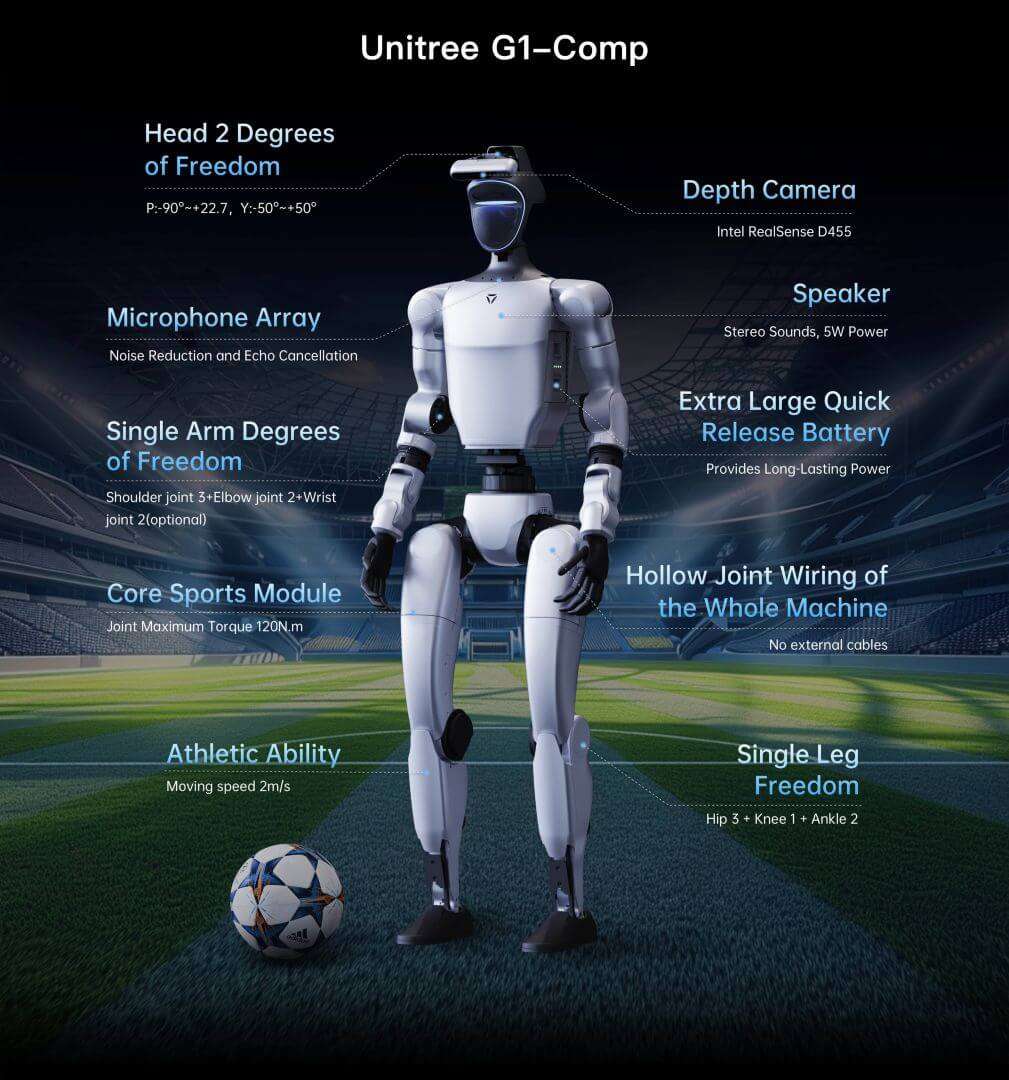
The annotated hardware map below applies across the use cases listed: head DoF, depth camera, microphone array, core sports module, and quick-release battery all factor into task suitability.
- RoboCup-class soccer competitions: The 2 m/s locomotion speed, omnidirectional walk, and YOLO11-based ball and goal detection support standardised match formats.
- University robotics research: Full Isaac Gym and MuJoCo simulation support, plus the unitree_rl_gym framework, let labs iterate on Sim2Real transfer without hardware risk.
- Manipulation and grasping studies: Dex3-1 hands with 10 g to 2,500 g force sensing support experiments from delicate object handling to equipment manipulation.
- Computer vision and perception research: The Intel RealSense D455 depth camera plus 3D LiDAR provide combined visual and spatial input streams for perception algorithm development.
- Human-robot interaction studies: The 4-microphone array and UnifoLM multimodal stack support voice-command and dialogue research in noisy environments.
- Custom on-robot AI development: The open NVIDIA Jetson Orin NX module, isolated from low-level motion control, lets developers deploy custom inference workloads without risking gait stability.
Technical specifications of the Unitree G1-Comp EDU
Mechanical Dimensions
| Parameter | Value |
|---|---|
| Model | G1 Comp |
| Height × Width × Thickness (standing) | 1,320 × 450 × 200 mm |
| Height × Width × Thickness (folded) | 690 × 450 × 300 mm |
| Weight (with battery) | ~35 kg |
| Shell Material | Aluminium alloy + high-strength engineering plastics |
| Calf + Thigh Length | 0.6 m |
| Arm Span | ~0.45 m |
Degrees of Freedom
| Parameter | Value |
|---|---|
| Total DoF — G1-Comp EDU configuration | 37 |
| Total DoF — base platform range | 25–45 (configurable) |
| Single Leg DoF | 6 (Hip 3 + Knee 1 + Ankle 2) |
| Waist DoF | 1 + optional 2 additional |
| Single Arm DoF | 5 (Shoulder 3 + Elbow 2) |
| Head DoF | 2 |
| Single Hand DoF — Dex3-1 (included) | 7 + optional 2 wrist DoF (Thumb 3 + Index 2 + Middle 2) |
Joint Performance
| Parameter | Value |
|---|---|
| Maximum Torque — Knee Joint | 120 N.m |
| Arm Maximum Load | ~3 kg |
| Maximum Locomotion Speed | 2 m/s |
| Joint Encoder Type | Dual encoder (rotor + output shaft) |
| Full Joint Hollow Electrical Routing | Yes — no external cables |
| Cooling System | Local air cooling |
Joint Movement Range
| Parameter | Value |
|---|---|
| Waist Joint Range | Z±155°, X±45°, Y±30° |
| Knee Joint Range | 0–165° |
| Hip Joint Range | P±154°, R -30–+170°, Y±158° |
| Wrist Joint Range | P±92.5°, Y±92.5° |
| Head Joint Range | P: -90°–+22.7°, Y: -50°–+50° |
Computing & AI
| Parameter | Value |
|---|---|
| Basic Computing Power | 8-core high-performance CPU |
| Development Computing Module | NVIDIA Jetson Orin NX |
| AI Performance | 100 TOPS |
| Jetson CPU | Arm Cortex-A78AE, 8 cores, up to 2 GHz |
| Jetson GPU | 1,024 NVIDIA Ampere architecture CUDA cores |
| Jetson Memory | 16 GB unified memory |
Sensors & Perception
| Parameter | Value |
|---|---|
| Depth Camera | Intel RealSense D455 (180° FOV with head rotation) |
| 3D LiDAR | Yes — 360° horizontal FOV, 59° vertical |
| Microphone Array | 4-mic array with noise reduction and echo cancellation |
| Speaker | 5 W stereo |
Connectivity & Interfaces
| Parameter | Value |
|---|---|
| WiFi | WiFi 6 |
| Bluetooth | Bluetooth 5.2 |
| Wired Network | Gigabit Ethernet ×2 (RJ45) |
| USB Interfaces | USB 3.0 Type-C ×3, USB 3.2 / DP1.4 Type-C ×1 |
| Power Rails (developer-accessible) | 5 V, 12 V, 24 V, 54.8 V |
Power & Battery
| Parameter | Value |
|---|---|
| Power Supply | 13-string lithium battery |
| Smart Battery Capacity | 9,000 mAh (quick-release) |
| Charger | 54 V / 5 A |
| Battery Life | ~2 h |
Dex3-1 Three-Finger Dexterous Hand
| Parameter | Value |
|---|---|
| Total DoF per Hand | 7 active (Thumb 3 + Index 2 + Middle 2) |
| Force Sensing Range | 10–2,500 g |
| Operating Voltage | 12–58 V |
| Thumb Joint Angles | 0°–+100°, -35°–+60°, -60°–+60° |
| Index and Middle Finger Angles | 0°–+90°, 0°–+100° |
| Tactile Sensor Arrays | Optional — 9 array sensors per hand |
Software & Development
| Parameter | Value |
|---|---|
| Simulation Environments | Isaac Gym, MuJoCo |
| Reinforcement Learning Framework | unitree_rl_gym (Sim2Sim + Sim2Real) |
| Visual Recognition API | YOLO11 real-time object detection |
| Spatial Positioning API | Monocular + binocular depth positioning |
| Motion Control API | Translates decision signals into locomotion/manipulation commands |
| Mobile APP | Rapid configuration and control |
| ROS Compatibility | Yes |
| Multimodal Interaction | UnifoLM large language model with TTS/ASR |
| OTA Updates | Over-the-air firmware updates |
Why buy the Unitree G1-Comp EDU from EXPERT3D?
EXPERT3D supplies professional 3D equipment since 2012. Our team offers pre-sales consultation to match the G1-Comp EDU configuration to your research or competition programme, backed by an official warranty and authorized after-sales service. Delivery is available across the EU, alongside post-sale support and operator training for new platform users. Flexible financing options can also be arranged for research institutions and teams. As an official representative of Unitree, we guarantee 100% authenticity, fair price, authorized service, and an official warranty.