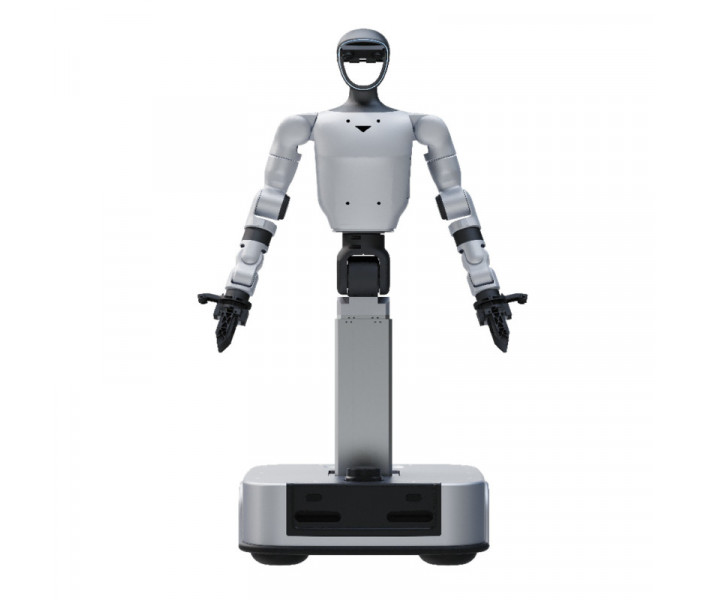


- Stock: In Stock
- Product code: 920372000001145462
- Weight Brutto: 80.00kg
- SKU: G1-D-Flagship

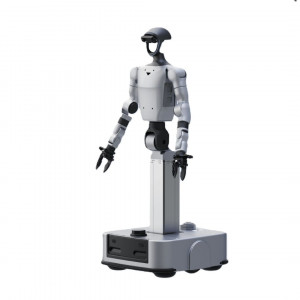
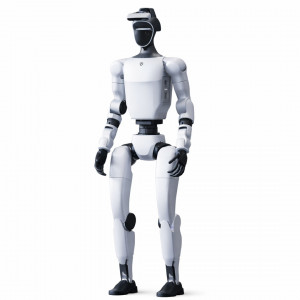
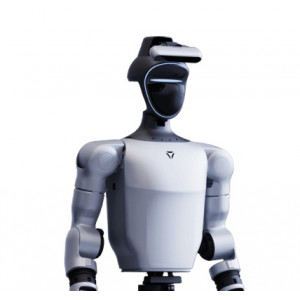
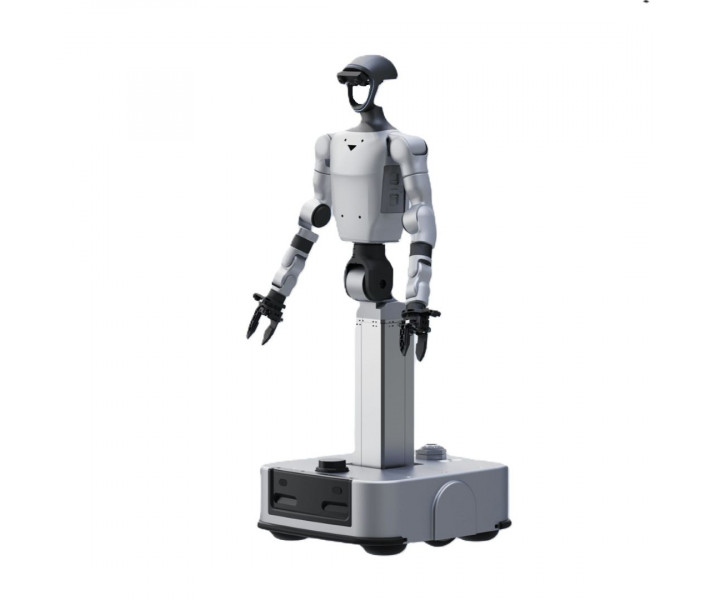
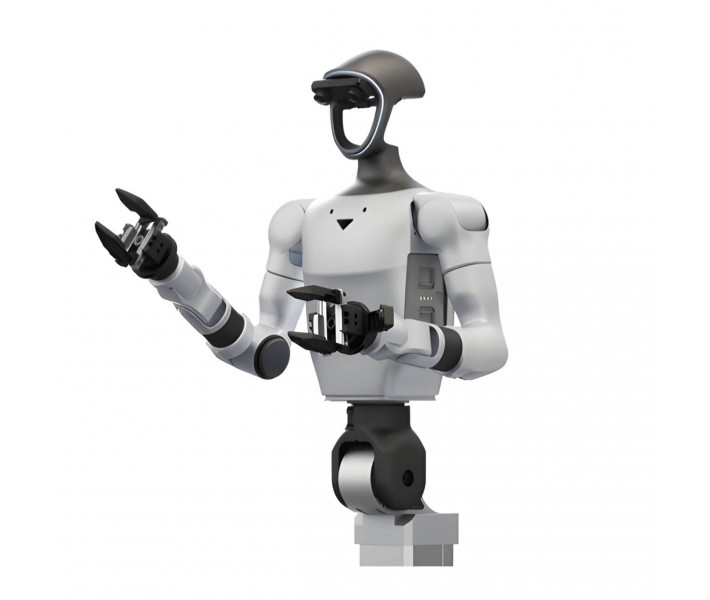
Unitree G1-D Flagship is a wheeled humanoid service robot designed for continuous retail and logistics deployment. Dual 7 DoF arms and a modular end-effector ecosystem enable dexterous, task-specific manipulation. The differential-drive chassis eliminates bipedal balancing overhead, redirecting engineering effort toward perception and manipulation. Weighing approximately 80 kg, it delivers a single-arm payload of ~3 kg and a reach of ~0.45 m.
| Specification | Why it matters |
|---|---|
| Adjustable Height Range: 1260–1680 mm (max reach ~2 m) | Lets one robot service floor-level and overhead shelf tasks without repositioning the chassis. |
| AI Computing Module: NVIDIA Jetson Orin NX — 100 TOPS | Runs perception and decision-making on-board, without relying on a cloud round-trip. |
| Chassis Battery Life: ~6 h (30 Ah integrated battery) | Covers a full operational shift before the robot needs to return to its charging dock. |
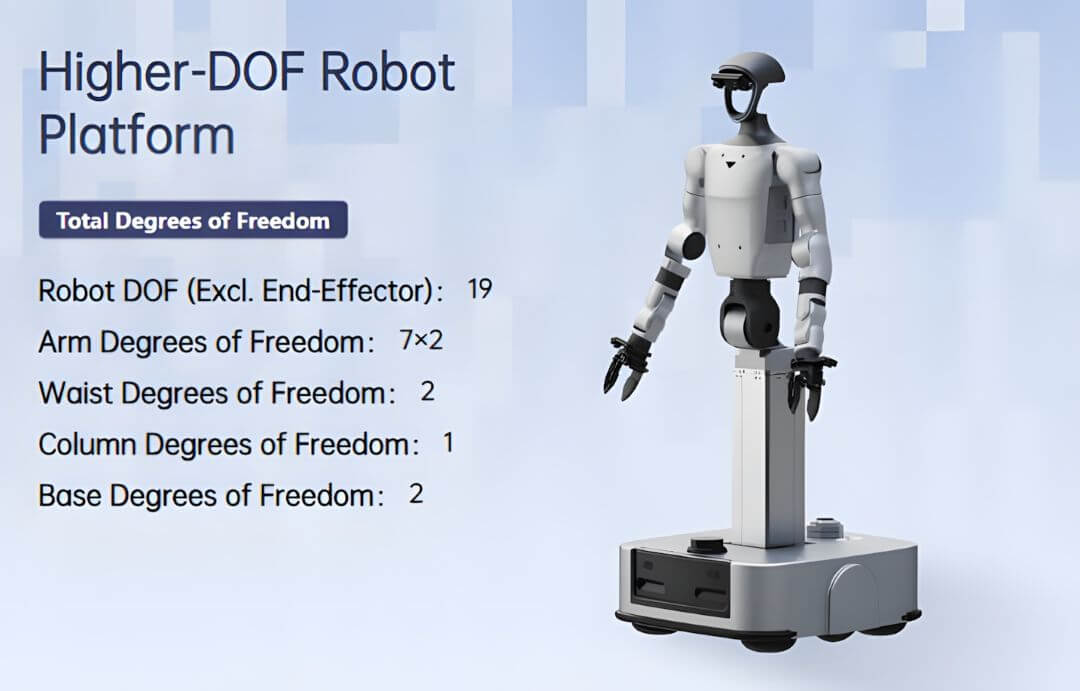
| Total DoF (excl. end effector): 19 (7×2 arms + 2 waist + 1 column + 2 base) | Matches the kinematic capability of a standalone collaborative robot arm, in a mobile package. |
- 7 DoF per arm: enables continuous null-space wrist reorientation without shifting the end effector, useful in confined shelving or bench spaces.
- Modular end-effector ecosystem: the same chassis can be reconfigured for parallel gripping, non-tactile dexterous grasping, tactile-feedback grasping, or five-finger manipulation.
- Wheeled differential-drive base: removes bipedal stabilisation complexity, so the arms and perception stack get the engineering and compute budget instead.
- Onboard SLAM with REST API: supports autonomous route planning, POI marking, and unattended return-to-dock without operator intervention.
Unlike fully bipedal humanoids that spend engineering budget on dynamic balance, the G1-D Flagship redirects that effort into arm capability and task intelligence. The wheeled chassis removes bipedal stabilisation complexity, letting the upper body focus on manipulation and perception.
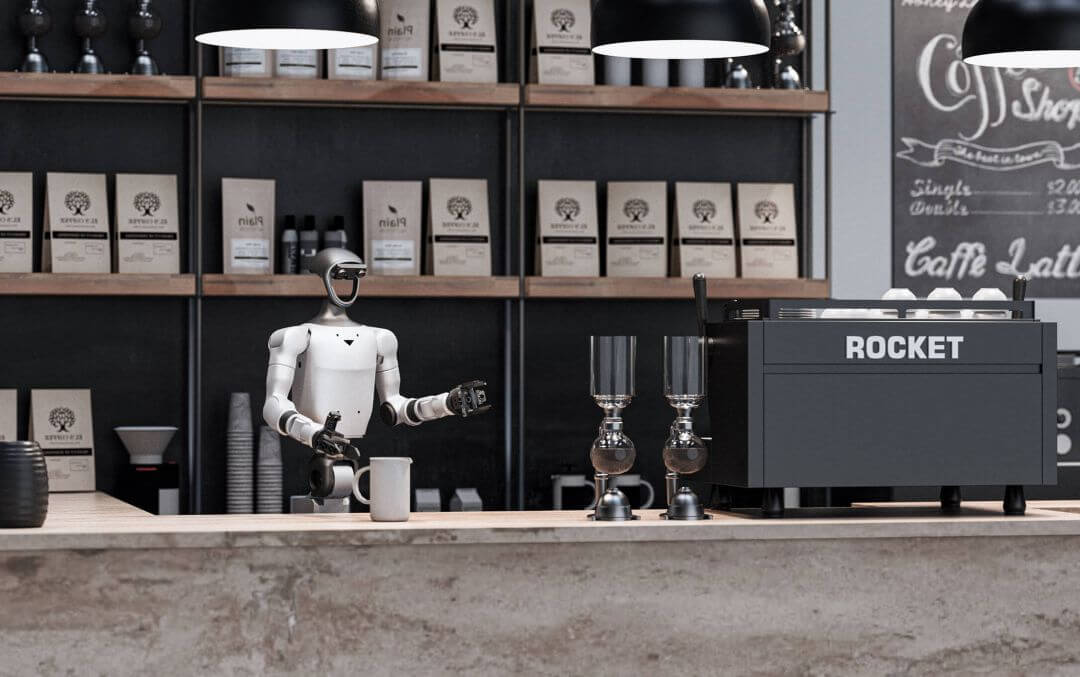
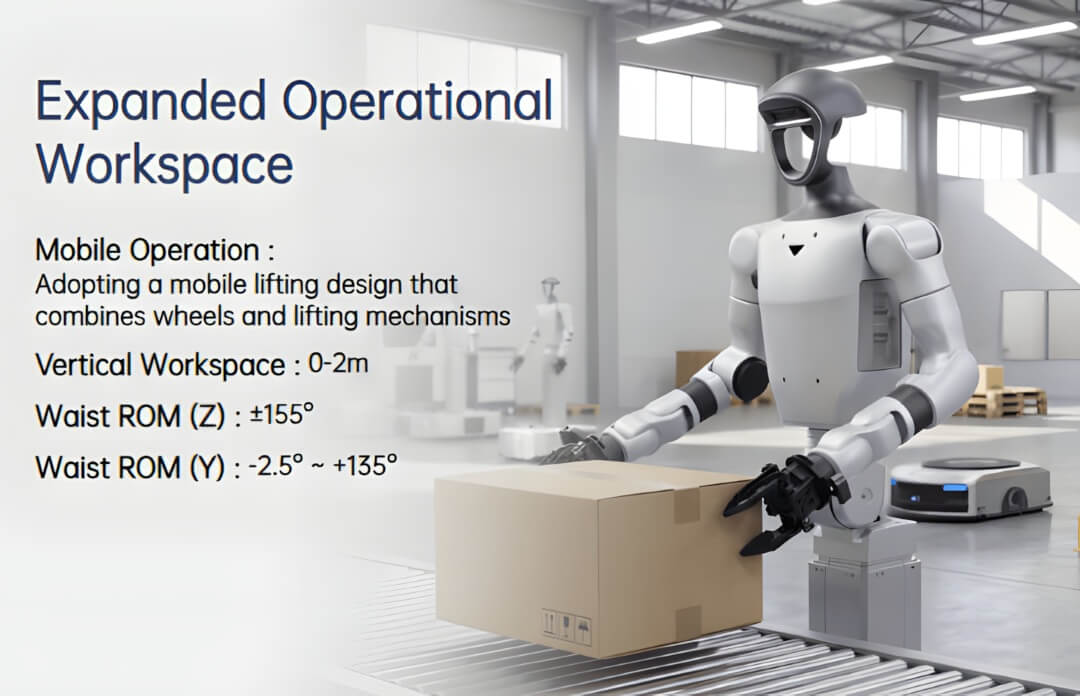
Telescoping Column: From Floor Level to a 2 m Working Envelope
The most consequential mechanical choice in the G1-D's design is its telescoping lifting column. It travels 450 mm of vertical stroke at up to 60 mm/s, controlled to 1 mm positioning accuracy. At minimum height the robot stands 1260 mm tall — compact enough for floor-level tasks and standard doorways. At maximum extension it reaches 1680 mm, pushing the arm workspace up to ~2 m above the ground.
The waist simultaneously articulates across Z ±155° and Y -2.5° to +135°, letting the arms sweep from below the chassis to well above head height without repositioning the base.
7 DoF Arms and a Modular End Effector Ecosystem
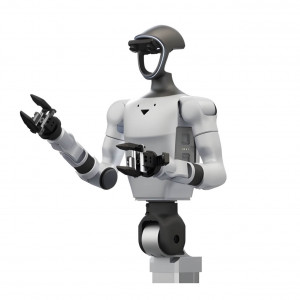
Each arm carries 7 active degrees of freedom: shoulder pitch, shoulder roll, shoulder yaw, elbow, wrist roll, wrist pitch, and wrist yaw. Seven-DoF arms allow continuous null-space motion — the robot reorients the wrist without moving the end effector, which matters in confined workspaces. With a single-arm payload of ~3 kg and a reach of ~0.45 m, the arms handle object weights typical of retail, food service, logistics, and light assembly.
The end effector is not fixed. Four hardware options are available: a 2-finger force-controlled gripper for general handling, a 3-finger dexterous hand without tactile sensing, a 3-finger dexterous hand with tactile sensing for contact-feedback tasks, and a 5-finger dexterous hand for the most human-like manipulation.
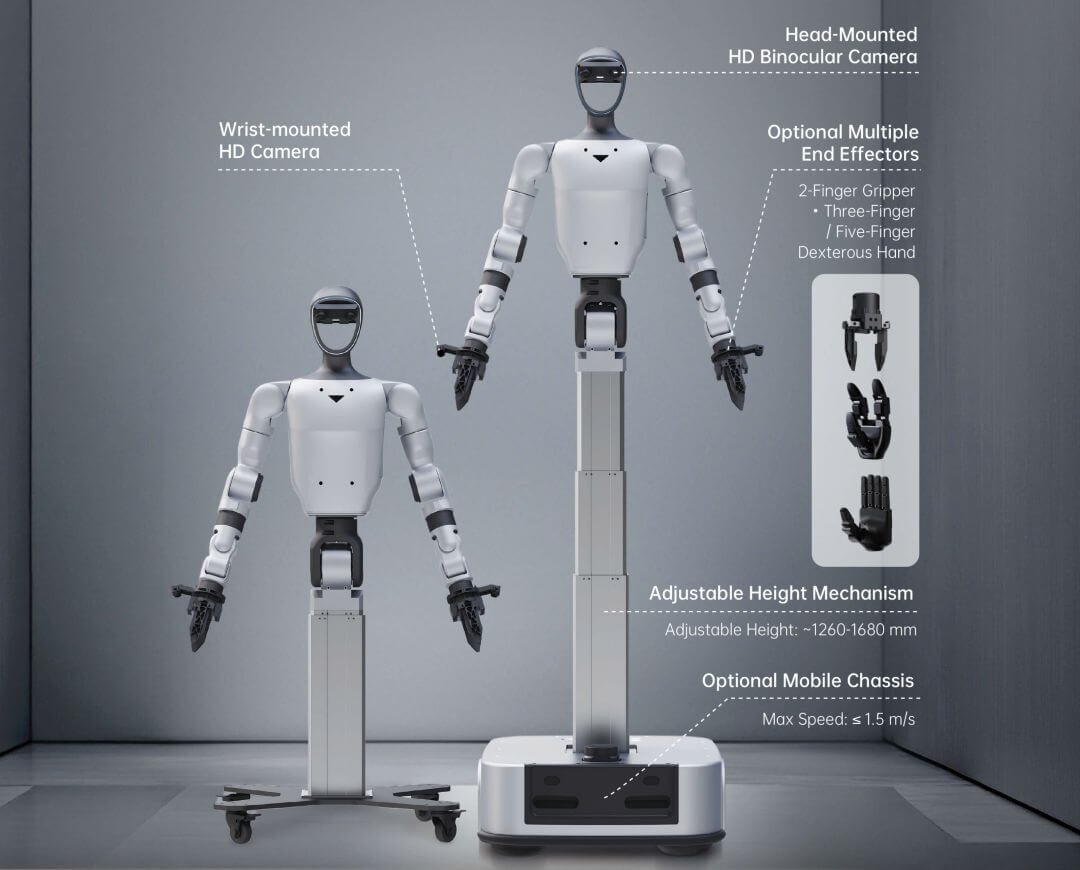
19 DoF Platform: The Kinematic Architecture Explained
The body's 19 total degrees of freedom (excluding end effectors) are distributed with deliberate precision. The arms account for 14 DoF (7 per arm), matching the redundancy found in professional collaborative arms. Two waist DoF — Z-axis rotation and Y-axis pitch — let the torso twist and bend independently of chassis heading. One column DoF handles vertical adjustment; two base DoF cover the chassis's forward/backward velocity and yaw. Adding a 2-finger gripper to each arm raises the total to 21 DoF.
Lower-Latency Control: VR Teleoperation and Precision Positioning
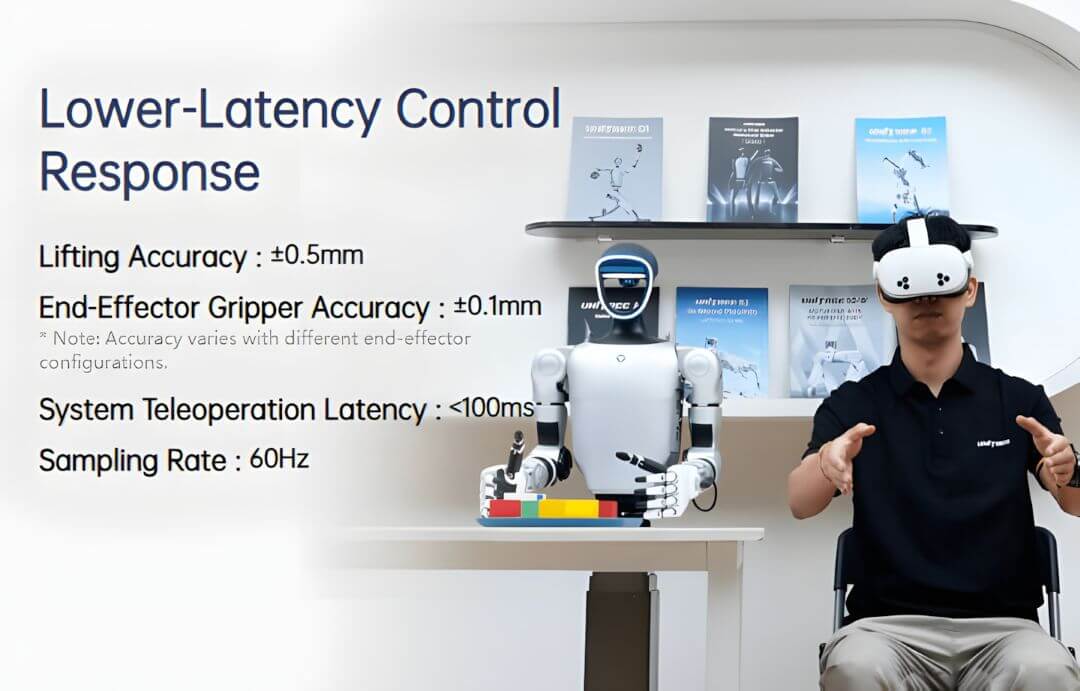
High-fidelity teleoperation is the primary mechanism for collecting demonstration data that trains autonomous policies. The G1-D's control pipeline delivers system teleoperation latency below 100 ms with a 60 Hz sampling rate — fast enough for an operator wearing a VR headset to maintain embodiment during manipulation. Column positioning accuracy under VR teleoperation reaches ±0.5 mm; end-effector gripper accuracy is ±0.1 mm, varying with the configuration fitted. These tolerances matter for picking small components, inserting connectors, or folding flexible materials.
Wheeled Chassis and Autonomous SLAM Navigation
The mobile base uses a differential drive with two independent wheels, supporting 360° in-place rotation and a maximum travel speed of 1.5 m/s. Onboard sensors include a 3D LiDAR, two depth cameras, two physical collision sensors, and two low-obstacle detection sensors — a suite that lets the robot map its surroundings, localise itself, avoid dynamic obstacles, and return autonomously to its charging station. Navigation runs through a SLAM service exposed via REST API, with support for points of interest, virtual walls, forbidden zones, and multi-point route sequencing. The integrated 30 Ah battery powers the chassis for approximately 6 h before docking is required.
End-to-End AI Platform: From Data Acquisition to Deployed Policy
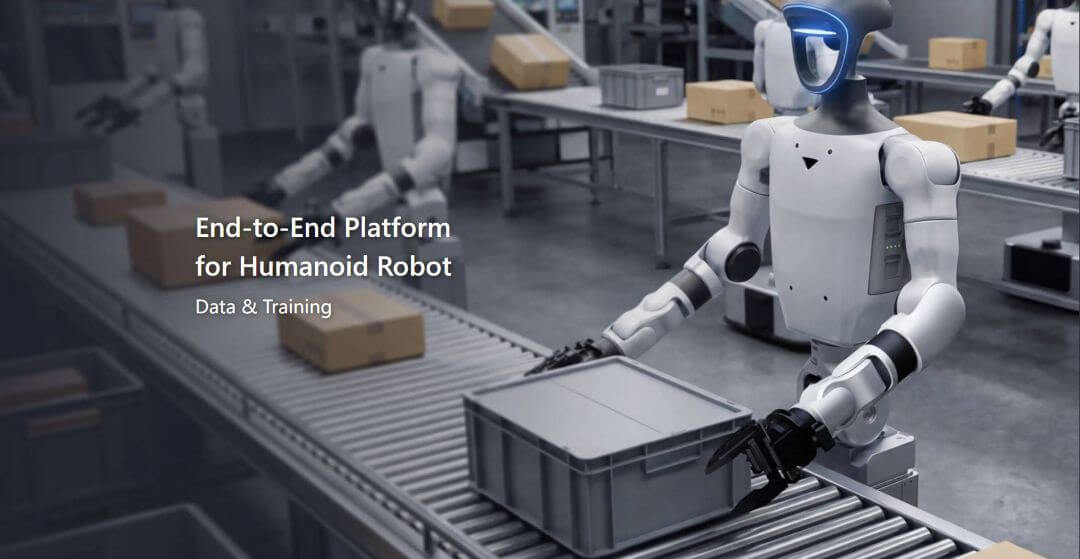
The G1-D is the physical execution node of a complete embodied AI development stack. Unitree's platform integrates a streamlined data acquisition pipeline, a model training and inference environment, and the UnifoLM-WMA-0 world-model–action architecture. The pipeline standardises collection across robot platforms using visual template management, one-click task generation, high-concurrency scheduling for hundreds of robots, and 24/7 continuous collection, feeding directly into mainstream training formats.
UnifoLM-WMA-0: World-Model–Action Architecture
The training layer supports distributed training with up to 90 % GPU utilisation, integration with open-source models including PI and GROOT, one-click deployment, and a high-fidelity simulation environment for policy evaluation before physical rollout. At its core is UnifoLM-WMA-0, Unitree's open-source world-model–action architecture spanning multiple robot embodiments. It runs in two modes: a decision-making mode that predicts future physical interactions to guide policy execution, and a simulation mode that generates synthetic training data from motion inputs. The full Sim2Real pipeline covers architecture selection, training configuration, real-time monitoring, parameter editing, simulation testing, and deployment.
Applications
- Retail restocking: the robot navigates store aisles, identifies shelf positions with onboard cameras, and restocks products without human assistance.
- Food service: the arms manage espresso equipment and food-handling tasks that require careful object handling and repeatable positioning.
- Warehouse and logistics: the column reaches conveyor and rack heights, letting a single unit handle boxes across multiple shelf levels.
- Industrial and data-centre inspection: the platform navigates crowded aisles, extends its column to rack height, and applies controlled force for equipment checks and cable management.
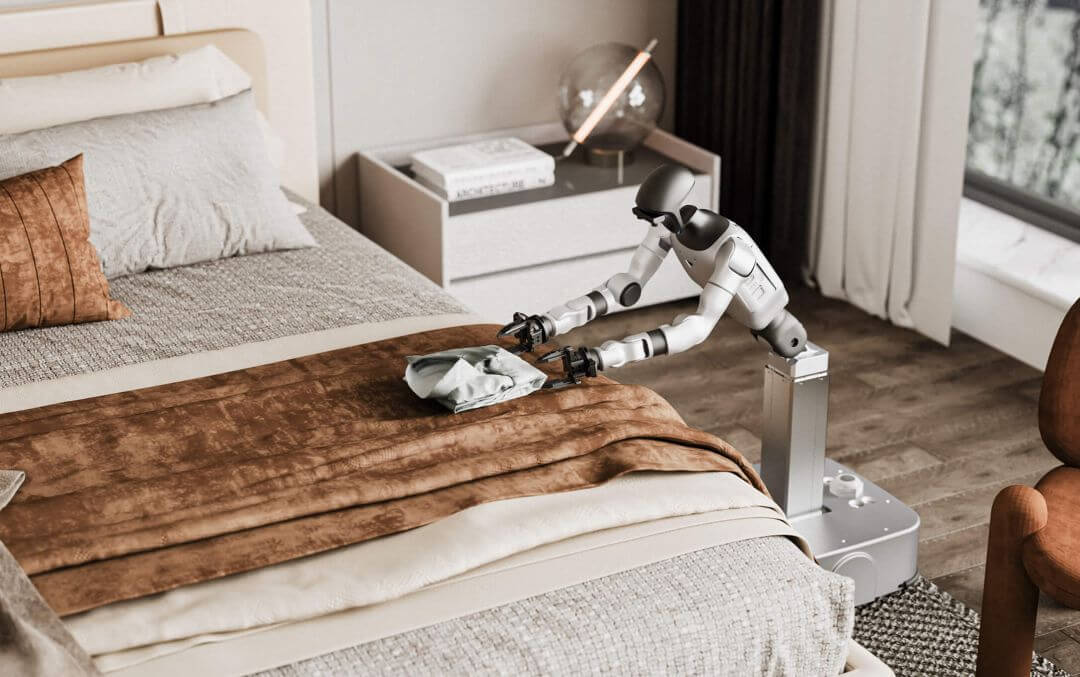
- Domestic and light-assembly tasks: precise arm manipulation supports tasks such as folding at bed height or handling small assembly components.
- Demonstration data collection: VR teleoperation with sub-millimetre accuracy makes the platform suited to generating training data for autonomous policies.
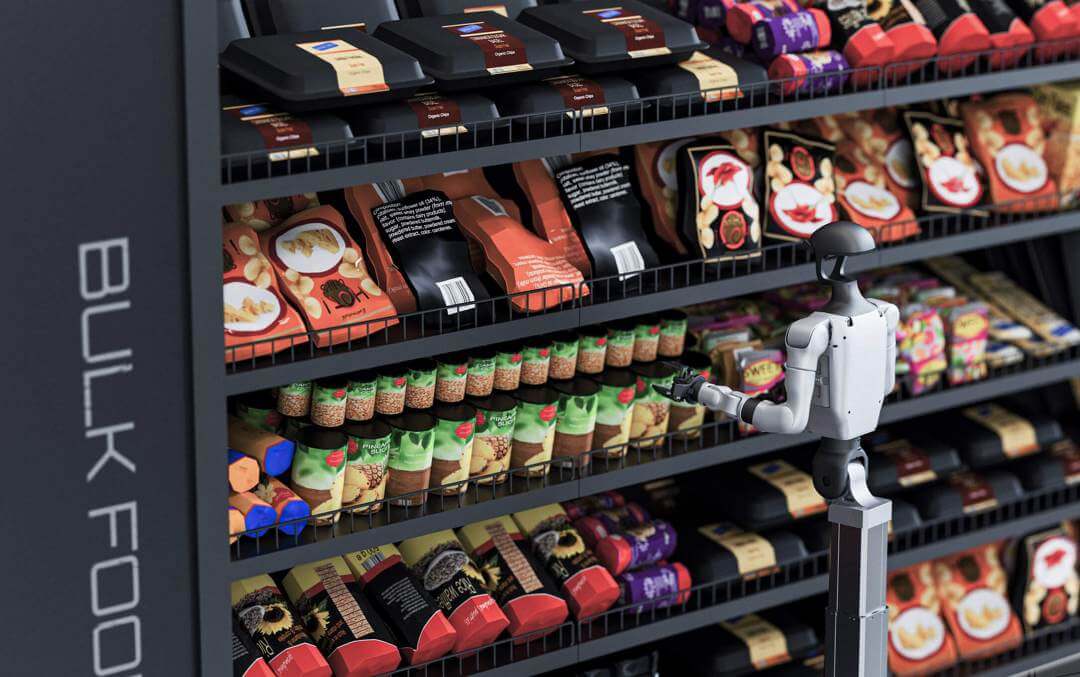
The image below shows the G1-D handling packaged goods on a bulk food shelf, a task that demands accurate object identification and controlled force application.
In data-centre contexts, the ability to navigate narrow aisles and extend the column to rack height makes the platform viable for maintenance and inspection work.

Compatibility of the Unitree G1-D Flagship
- End Effector Options: 2-finger force-controlled gripper, 3-finger dexterous hand (no tactile sensing), 3-finger dexterous hand (with tactile sensing), 5-finger dexterous hand.
Technical specifications of the Unitree G1-D Flagship
Mechanical Dimensions
| Parameter | Value |
| Model | G1-D Flagship |
| Overall Dimensions (Min. Column Height) | ~1260 × 525 × 570 mm |
| Overall Dimensions (Max. Column Height) | ~1680 × 525 × 570 mm |
| Total Weight (incl. battery) | ~80 kg |
| Cooling System | Local air cooling |
Degrees of Freedom
| Parameter | Value |
| Total DoF (excl. End Effector) | 19 |
| Single Arm DoF (excl. End Effector) | 7 |
| Waist DoF | 2 |
| Column DoF | 1 |
| Base DoF | 2 |
| Total DoF with 2-Finger Gripper ×2 | 21 (19 + 1 per gripper × 2) |
Arm Performance
| Parameter | Value |
| Max. Single Arm Payload | ~3 kg |
| Arm Reach (excl. End Effector) | ~0.45 m |
| End Effector Options | 2-Finger Gripper, 3-Finger Dexterous Hand (No Tactile), 3-Finger Dexterous Hand (With Tactile), 5-Finger Dexterous Hand |
Column & Waist Range of Motion
| Parameter | Value |
| Column Lifting Travel | 450 mm |
| Column Lifting Speed | Max. 60 mm/s |
| Column Lifting Accuracy (general) | 1 mm |
| Lifting Accuracy (VR teleoperation) | ±0.5 mm |
| Max. Working Height | ~2 m |
| Waist Joint Range — Z-axis | ±155° |
| Waist Joint Range — Y-axis | -2.5° to +135° |
Chassis Performance
| Parameter | Value |
| Chassis Dimensions (L × W × H) | 570 × 525 × 197 mm |
| Drive Type | Differential drive — supports 360° in-place rotation |
| Maximum Mobility Speed | 1.5 m/s |
| Chassis Sensors | LiDAR ×1, Depth Camera ×2, Physical Collision Sensor ×2, Low-Obstacle Detection Sensor ×2 |
Computing & AI
| Parameter | Value |
| Basic Computing Power | 8-core high-performance CPU |
| High-Performance Computing Module | NVIDIA Jetson Orin NX 16 GB (100 TOPS) |
Sensors & Perception
| Parameter | Value |
| Head HD Binocular Camera | ×1 — FOV: H 115°, V 80°, D 125° — Resolution: 3840 × 1200 |
| Wrist HD Camera | ×2 — FOV: H 130°, V 60°, D 160° — Resolution: 1920 × 1080 |
| Base LiDAR | ×1 |
| Base Depth Camera | ×2 |
| Physical Collision Sensor (Base) | Present |
| Low-Obstacle Detection Sensor (Base) | Present |
Audio & Interaction
| Parameter | Value |
| Microphone Array | 4-mic linear array, 20 mm spacing |
| Speaker | 8 Ω 3 W (5 W peak) |
| RGB Light Strip | 256 colors |
| ASR (Speech Recognition) | Local offline model |
| TTS (Text-to-Speech) | Local offline synthesis — Chinese & English |
Connectivity
| Parameter | Value |
| WiFi | WiFi 6 |
| Bluetooth | Bluetooth 5.2 |
Control & Teleoperation
| Parameter | Value |
| System Teleoperation Latency | <100 ms |
| Sampling Rate | 60 Hz |
| End-Effector Gripper Accuracy | ±0.1 mm (varies with end-effector configuration) |
Power & Battery — Upper Body
| Parameter | Value |
| Upper Body Power Supply | Battery or direct cable connection |
| Upper Body Battery Capacity (quick-release) | 9000 mAh |
| Upper Body Battery Life | ~2 h |
| Upper Body Charger | 54 V / 5 A |
Power & Battery — Chassis
| Parameter | Value |
| Chassis Power Supply | Battery / charging station |
| Chassis Battery Capacity (integrated) | 30 Ah |
| Chassis Battery Life | ~6 h |
| Chassis Charging Station | 51 V / 10 A |
Software & Development
| Parameter | Value |
| SDK | unitree_sdk2 (based on G1 SDK) |
| SLAM Navigation | Yes — REST API, supports POIs, virtual walls, forbidden zones, multi-point routes |
| AI World Model | UnifoLM-WMA-0 (open-source) |
| Supported Open-Source Models | PI, GROOT and community datasets |
| Distributed GPU Training Utilisation | Up to 90 % |
| Video Streaming | ZMQ / WebRTC (head binocular camera) |
Why buy the Unitree G1-D Flagship from EXPERT3D?
EXPERT3D supplies professional 3D equipment since 2012. As an official representative of Unitree, we guarantee 100 % authenticity, fair price, authorized service, and an official warranty. Our team provides expert pre-sales consultation to help configure the right column, end-effector, and computing options for your workflow. Delivery is available across the EU and Spain, backed by post-sale support and operator training. Financing and leasing options are available for qualifying deployments, along with spare parts and accessories for the platform.