

- Stock: In Stock
- Product code:
- Weight Brutto: 30.00kg

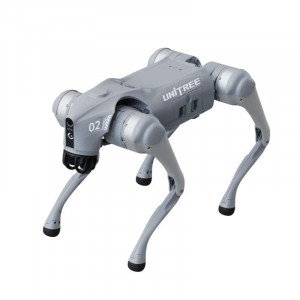
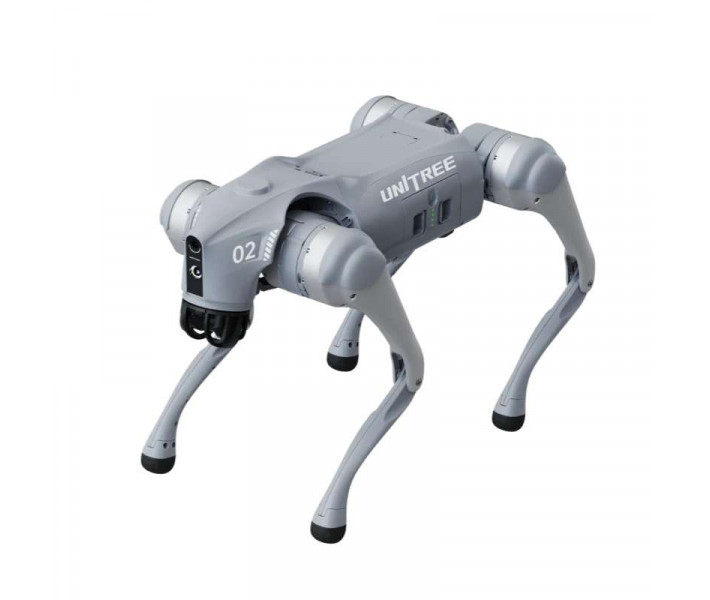
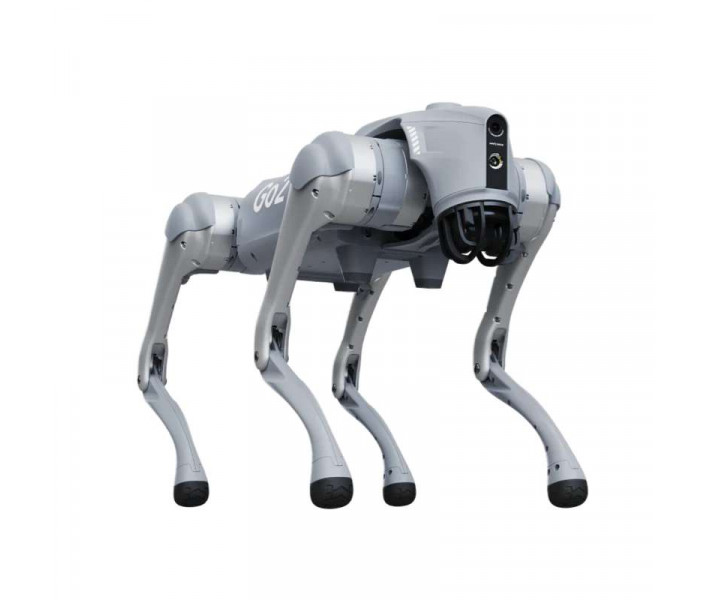
The Unitree Go2 EDU ENT U1 is a professional quadruped robot designed for field inspection, perimeter security, and university research, integrating Unitree's self-developed 4D LiDAR L2 with a 360° × 96° hemispherical field and 0.05 m minimum detection distance. Twelve aluminium-alloy joint motors deliver 45 N·m peak torque, a top speed of 5 m/s in Rage Mode, and terrain capability spanning 40° ramps and 16 cm steps. The ENT U1 payload layer adds dual 1080P wide-angle cameras, a 30 W / 3,000 lm spotlight, red/blue warning lights, and a digital voice broadcast reaching 500–800 m.
| Specification | Why it matters |
|---|---|
| Peak Joint Torque: ~45 N·m | Clears 16 cm steps and 40° ramps — steeper than most standard stairways — without reducing sensor or communication load. |
| 4D LiDAR L2 Coverage: 360° × 96°, min 0.05 m | Detects obstacles essentially at the robot's own feet, catching furniture legs, curbstones, and low cables that defeat conventional 2D scanners. |
| Battery Life: ~2–4 h (15,000 mAh) | Sustains continuous patrol or inspection rounds across a full shift without mid-mission recharging. |
| Voice Broadcast Range: 500–800 m | Delivers real-time verbal warnings or recorded alerts across a full perimeter from a single deployment position. |
The Go2 EDU ENT U1 solves a gap that most quadruped platforms leave open: it combines research-grade development access with a professional inspection payload in a single integrated chassis. The 4D LiDAR L2, full DDS/ROS2 SDK, and optional NVIDIA Jetson Orin serve university labs and R&D teams. The ENT U1 spotlight, dual-channel 1080P imaging, and 800 m voice broadcast serve perimeter security and emergency-response reconnaissance — both on the same hardware, simultaneously.
Unitree Go2 EDU ENT U1: Locomotion and Motor Architecture
Motor Architecture and Thermal Management
Every joint is driven by an aluminium-alloy precision motor with internal cable routing through hollow joint shafts and a dedicated heat-pipe cooler per joint. Routing cables internally eliminates snagging on rocks, stairs, or vegetation — a design detail that determines reliability in unstructured outdoor environments. Peak torque of 45 N·m at the largest joint translates directly into terrain capability: the platform clears steps of 16 cm and handles ramp angles up to 40°.
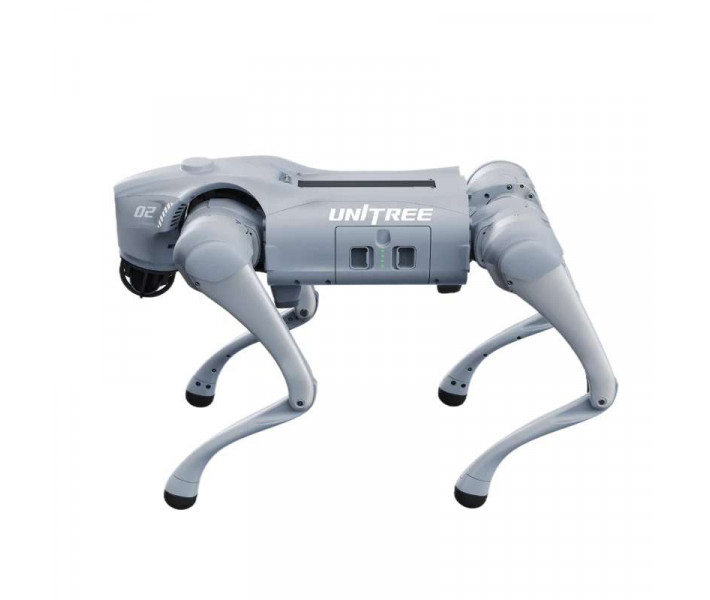
The articulation envelope supports both extreme terrain and confined indoor spaces. Body roll spans -48° to +48°, thigh pitch from -200° to +90°, and shank from -156° to -48°. This range allows the robot to compress from a standing footprint of 70 × 31 × 40 cm into a crouched transport posture of 76 × 31 × 20 cm — fitting through standard doorways and vehicle cargo areas without disassembly.
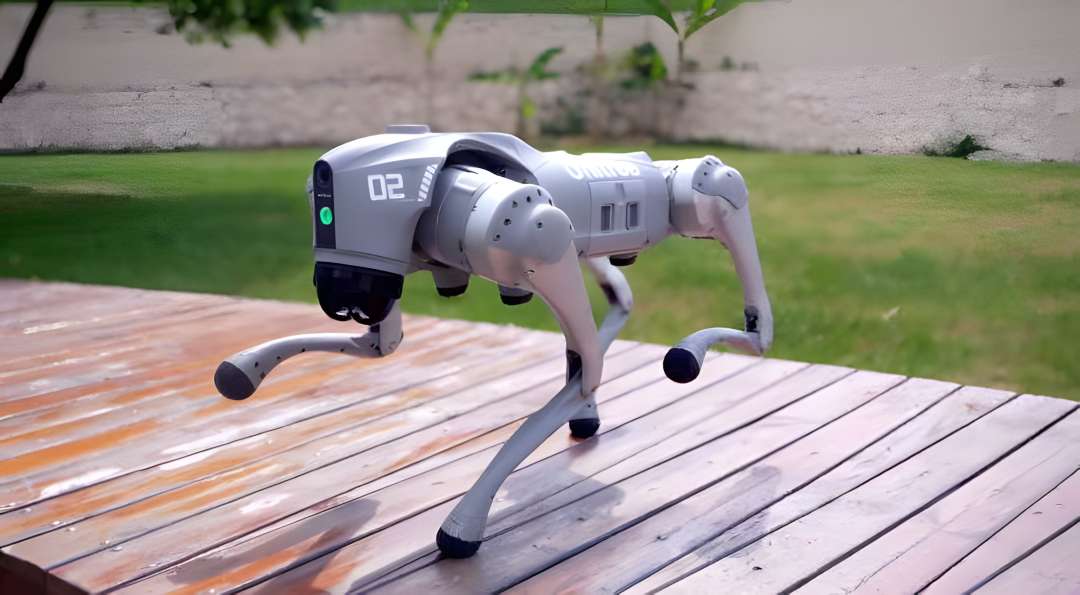
The image below captures the Go2 EDU mid-sequence on a wet wooden outdoor deck, a real-world demonstration of the 12-motor kinematics and real-time balance recovery that define its locomotion architecture.
Rage Mode: Full Motor Potential at 5 m/s
Standard operation runs the platform at up to 3.7 m/s with full sensor fusion active. Rage Mode unlocks the joint motors to their hardware ceiling, reaching approximately 5 m/s with sharper steering response and stable gait across gravel, sloped terrain, and artificial turf. The 8-core high-performance CPU handles concurrent locomotion, perception, and 4G communication without thermal throttling — essential for uninterrupted patrol duty.
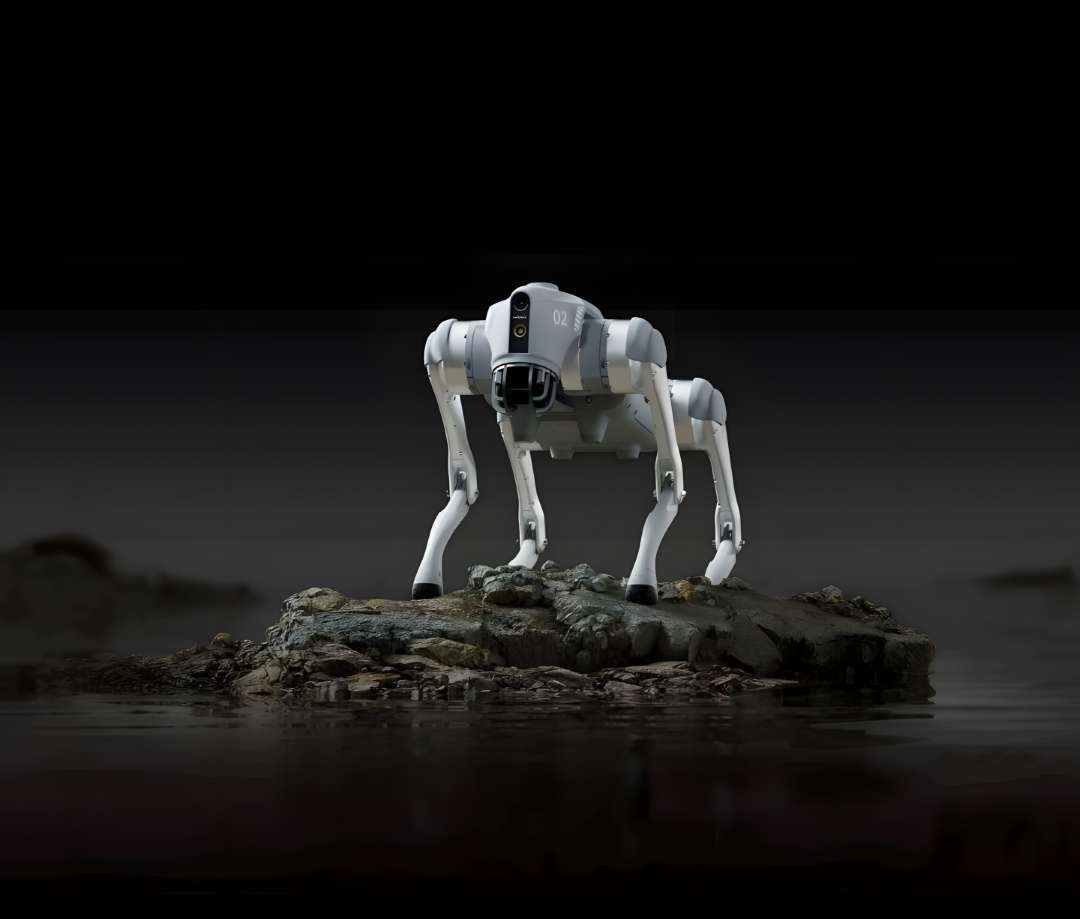
Multi-terrain balance is demonstrated below: the robot stands balanced on a submerged wet rock, confirming the foot-contact force sensing that continuously modulates ground reaction forces.
4D LiDAR L2: Hemispherical Perception and Autonomous Navigation
Unitree's self-developed 4D LiDAR L2 sweeps a 360° horizontal × 96° vertical field, creating a near-spherical point cloud with a floor-level minimum detection distance of 0.05 m. The robot detects objects essentially at its own feet — furniture legs, curbstones, and low-lying cables that would blind conventional 2D laser sensors.
ISS 2.0: 50% Better Positioning, 30 m Follow Range
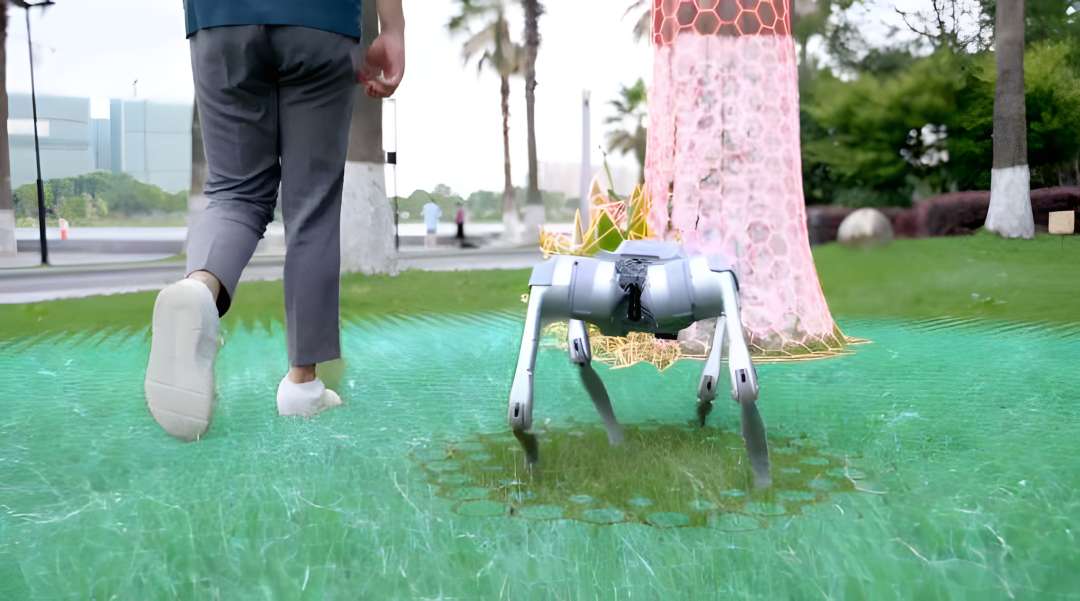
The ISS 2.0 Intelligent Side-Follow System uses wireless vector positioning technology to achieve a 50% improvement in planar positioning accuracy versus the previous generation, with a reliable operator-tracking radius exceeding 30 m in open environments. The UWB tag houses a 3-axis accelerometer and gyroscope IMU, providing attitude data that supplements the LiDAR obstacle-avoidance stack. The combined result is that the device shadows its operator through narrow corridors, uneven outdoor paths, and partially obstructed passages without manual steering input.
The image below shows the ISS 2.0 intelligent side-follow system active outdoors, with a visualised terrain-detection overlay mapping the operator's environment in real time.
SLAM: Map, Locate, Navigate Autonomously
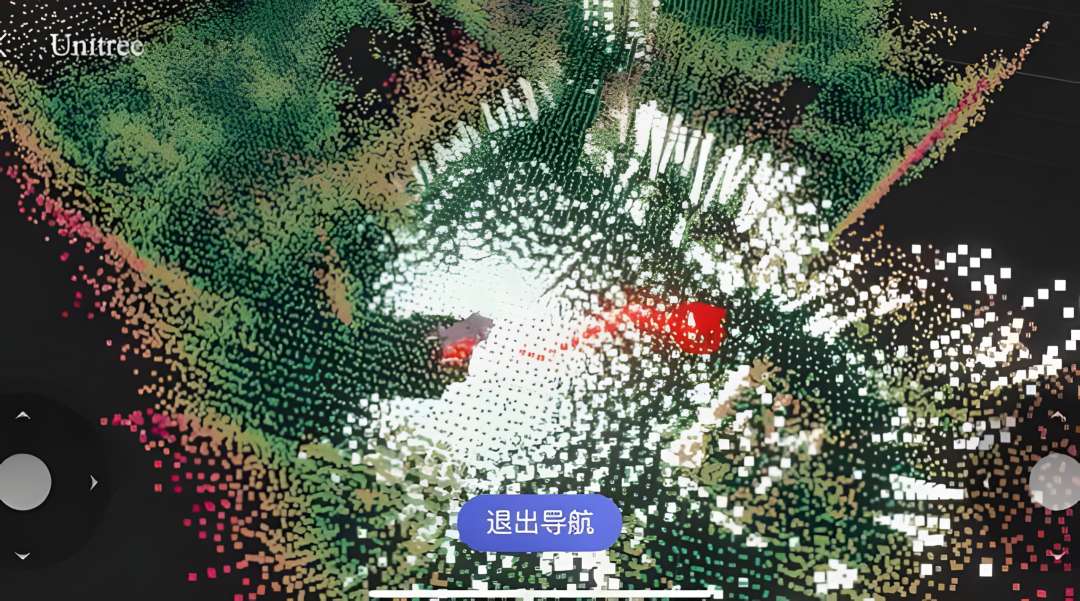
The onboard software stack delivers a complete three-stage SLAM pipeline. Mapping generates a persistent 3D voxel environment model; positioning resolves the robot's pose within that map; the navigation module then plans and executes a collision-free path to any target waypoint. Using the dedicated mobile app, an operator constructs a 3D LiDAR point-cloud map of a site, marks waypoints, and the robot traverses them independently, adapting gait to terrain changes detected in real time.
The smartphone display below shows the Unitree app rendering a real-time, colourised 3D LiDAR voxel map of an outdoor environment — built entirely on-device from L2 sensor data.
ENT U1 Inspection Payload
Dual 1080P Imaging, 30 W Spotlight, and Warning Lights
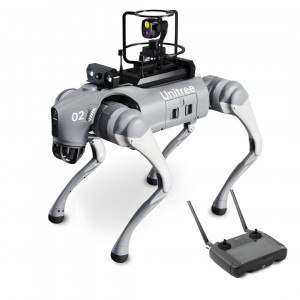
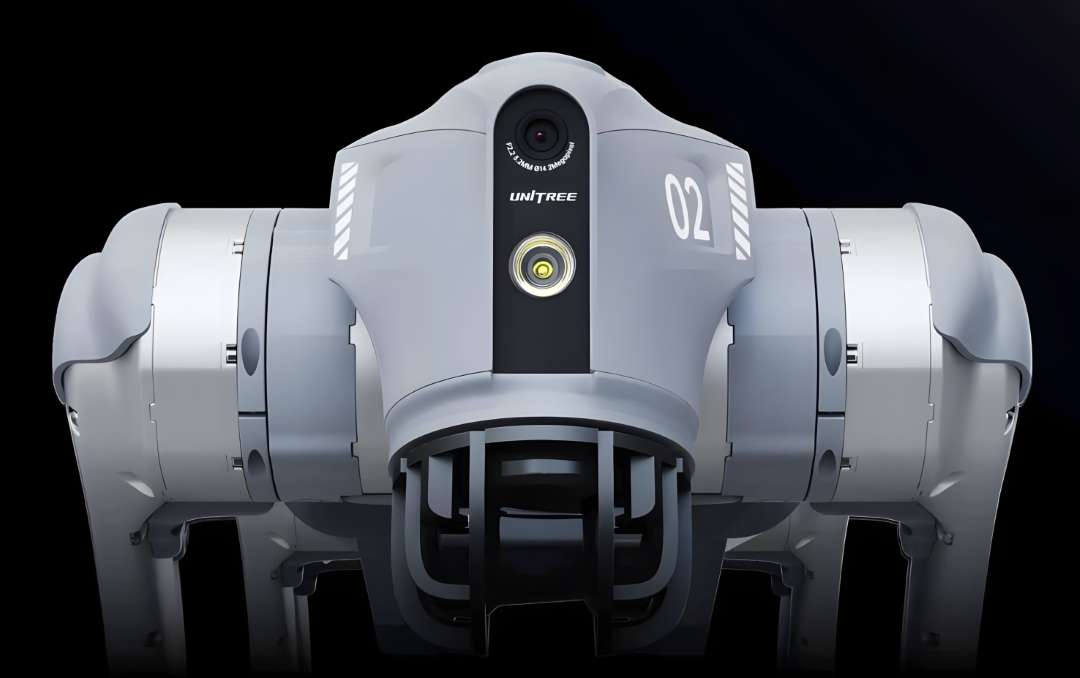
The ENT U1 configuration transforms the research platform into a field-deployable inspection and patrol unit. The module mounts a dual 1080P wide-angle camera system (FOV 120°) with four high-brightness fill lights, replacing the standard depth camera with a broadcast-grade imaging solution. Video transmits at 1080P HD with latency as low as 180 ms over the 5.8G primary link; a standard network-port input simultaneously supports dual-channel 1080P streaming.
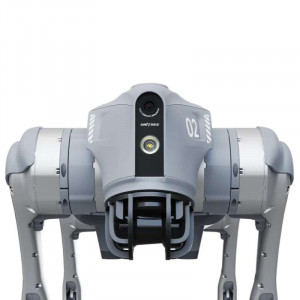
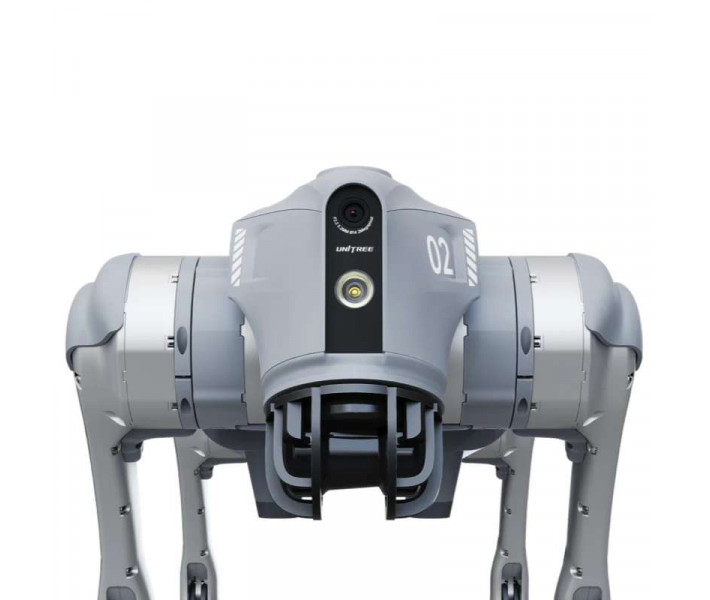
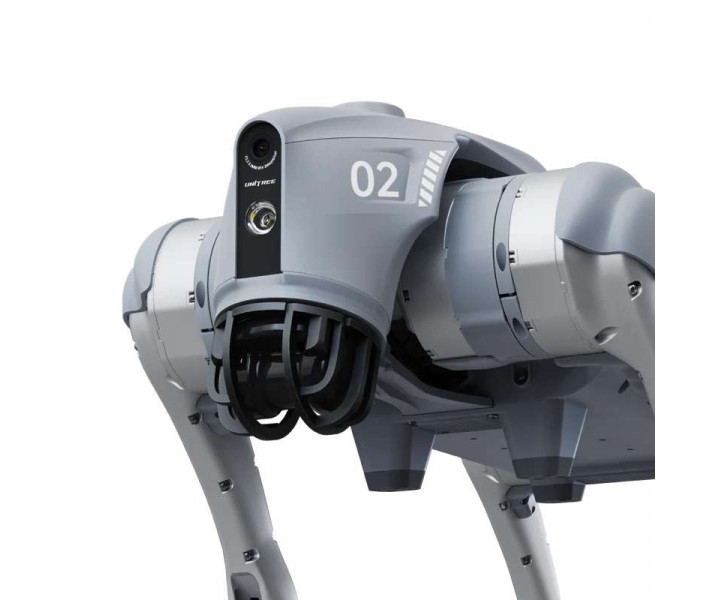
The 30 W spotlight delivers 3,000 lm, illuminating inspection targets in complete darkness. The red/blue police warning system (10 W) supports constant illumination, burst flash, alternating red-blue, and brightness-adjustable continuous modes. The close-up below shows the Go2 EDU's front sensor cluster — the wide-angle camera and front LED that anchor both the baseline navigation system and the ENT U1's enhanced imaging payload.
Digital Voice Broadcast and Dual Communication Link
The ENT U1 integrates a digital encoding/decoding voice broadcast system with a speaker propagation range of 500–800 m. Operator functions include real-time voice alerts, recorded audio playback, upload, and text-to-speech — all controllable from the explosion-proof screen remote controller. The primary link runs on 5.8G digital telemetry (integrated video and control), with a full 4G all-network connection as automatic backup to maintain reachability if the primary radio link is disrupted.
Open Development Platform
unitree_sdk2: DDS, ROS2, C++, Python
The EDU platform exposes a full secondary-development environment via DDS middleware (C++ and Python) with a native ROS2 interface and adaptive RMW. Available service layers cover low-level motor and IMU data, high-level motion control (speed, trajectory tracking, gait switching, obstacle avoidance), GST image streaming, radar point-cloud and altitude-map retrieval, full SLAM services, and UWB positioning. Existing ROS2 packages, sensor drivers, and visualisation pipelines transfer to the device with minimal rework — a significant time saving for university labs and R&D teams.
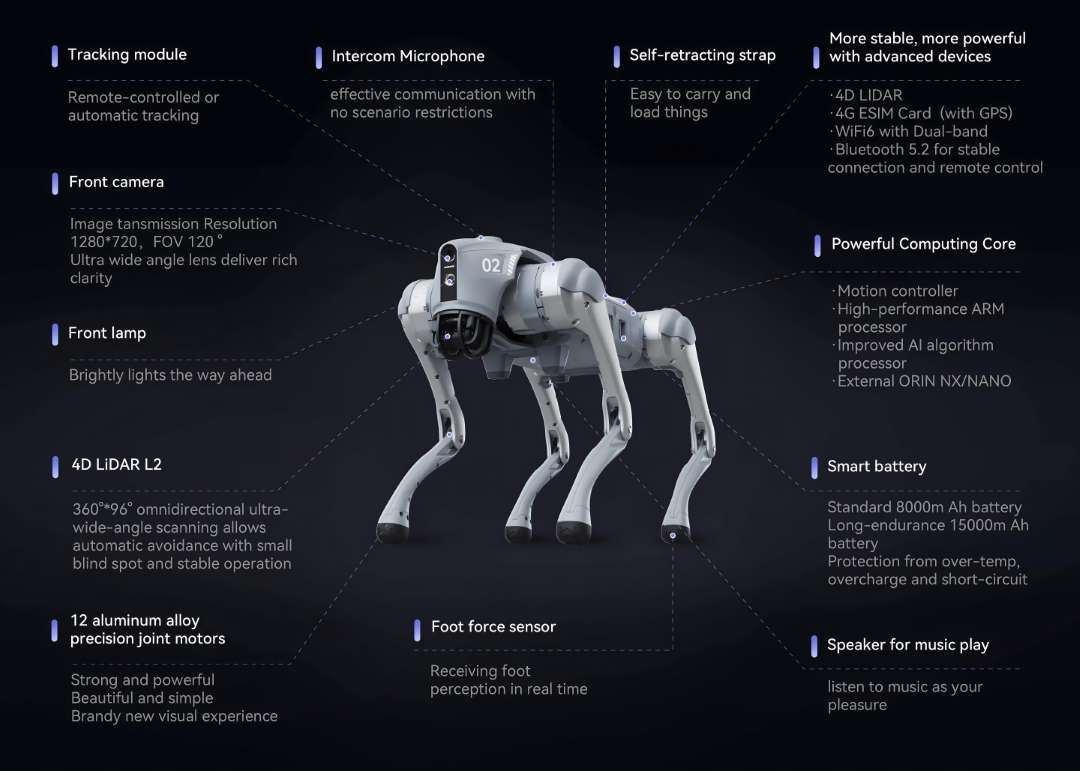
For compute-intensive workloads, an optional NVIDIA Jetson Orin NX or Nano expansion module delivers 40–100 TOPS of AI inference, slotting into the robot's expansion bay without external cabling changes. The annotated hardware diagram below maps the complete component layout: the UWB tracking module, intercom microphone, front camera, 4D LiDAR L2, 12 joint motors, foot-end force sensor, computing core, and the long-endurance smart battery — all integrated into the ~15 kg chassis.
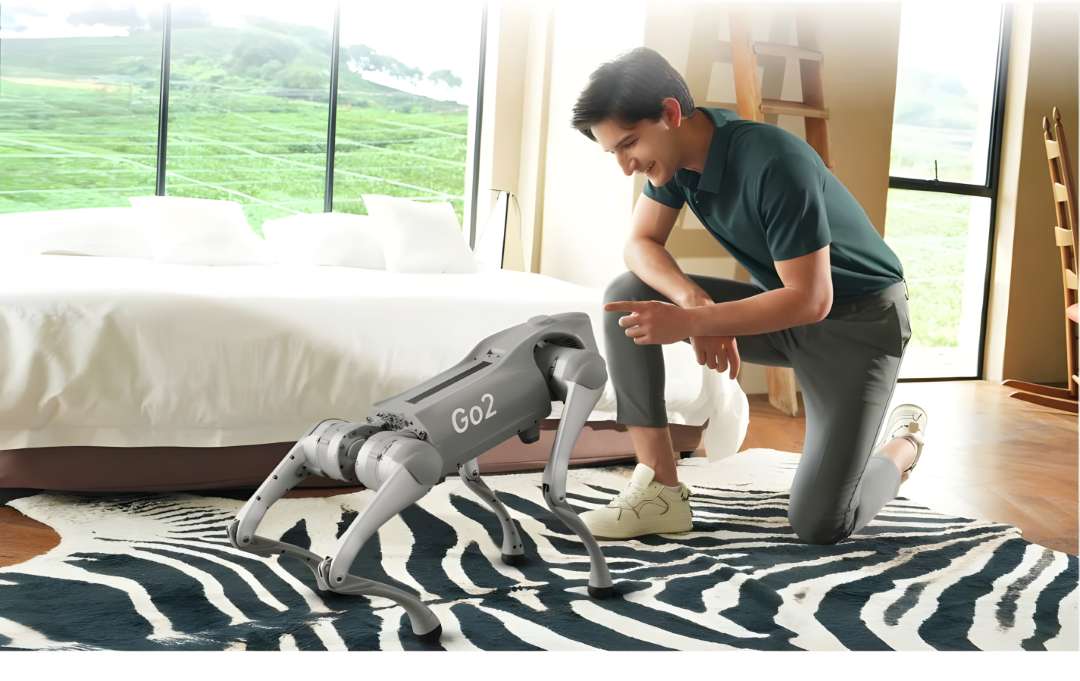
Voice interaction, graphical programming, OTA firmware updates, and offline motion commands (sitting, stretching, dancing, forward somersaults, multiple gait modes) are all available without custom code. The image below shows a researcher engaging directly with the robot at close range — a scene that reflects the platform's approachable interaction model.
Applications
- Perimeter security: the robot autonomously patrols a mapped site perimeter, broadcasting audio warnings up to 800 m and streaming dual-channel 1080P video to a remote operator over the 5.8G / 4G dual link.
- Industrial site inspection: the 30 W / 3,000 lm spotlight and 120° wide-angle cameras allow detailed inspection of equipment, pipework, and signage in low-light or night conditions.
- Emergency-response reconnaissance: the robot enters hazardous or post-incident areas ahead of personnel, mapping the environment with the L2 LiDAR and relaying live video with a latency of ≤180 ms.
- University robotics research: the full DDS/ROS2 SDK and optional NVIDIA Jetson Orin NX/Nano (40–100 TOPS) give research teams a production-grade platform for locomotion, SLAM, and AI inference experiments.
- Autonomous waypoint patrol: an operator maps a site via the mobile app, sets waypoints, and the robot executes continuous rounds independently — adapting gait to terrain changes in real time.
- Search and tracking: ISS 2.0 wireless vector positioning with >30 m follow range lets the robot shadow an operator or subject through narrow corridors and obstructed outdoor paths without manual steering.
Technical specifications
Mechanical Dimensions
| Parameter | Value |
| Dimension (standing) | 70 × 31 × 40 cm |
| Dimension (crouching) | 76 × 31 × 20 cm |
| Weight (with battery) | ~15 kg |
| Shell Material | Aluminium alloy + high-strength engineering plastics |
Electrical Parameters
| Parameter | Value |
| Voltage | 28–33.6 V |
| Maximum Working Power | ~3,000 W |
Performance Parameters
| Parameter | Value |
| Payload (typical / max) | ~8 kg (MAX ~12 kg) |
| Speed (normal / max) | 0–3.7 m/s (MAX ~5 m/s) |
| Max Step Height | ~16 cm |
| Max Climb Angle | 40° |
| Basic Computing Power | 8-core high-performance CPU |
Joint Parameters
| Parameter | Value |
| Maximum Joint Torque | ~45 N·m |
| Aluminium Joint Motors | 12 |
| Range of Motion — Body | -48° ~ +48° |
| Range of Motion — Thigh | -200° ~ +90° |
| Range of Motion — Shank | -156° ~ -48° |
| Intra-Joint Electrical Routing | Yes |
| Joint Heat-Pipe Cooler | Yes |
Sensors and Perception
| Parameter | Value |
| 4D LiDAR | Unitree L2 — 360° × 96° FOV, min detection 0.05 m |
| Wireless Vector Positioning (UWB) | Yes — ISS 2.0, centimetre-level plane positioning |
| Front Camera | 1280 × 720, FOV 120° |
| Depth Camera | Yes (included in EDU; replaced by ENT U1 dual camera in this config) |
| Foot-End Force Sensor | Yes |
Connectivity
| Parameter | Value |
| WiFi | WiFi 6 dual-band |
| Bluetooth | Bluetooth 5.2 / 4.2 / 2.1 |
| 4G Module | Yes (with GPS) — supports 43 European countries |
Battery and Power
| Parameter | Value |
| Smart Battery Capacity | 15,000 mAh (long-endurance) |
| Battery Life | ~2–4 h |
| Charger | 33.6 V / 9 A (fast charge) |
| Charging Pile Compatibility | Yes |
Features and Development
| Parameter | Value |
| Voice Function | Yes (offline voice interaction, commands, intercom, music) |
| ISS 2.0 Intelligent Side-Follow | Yes — 50% positioning upgrade, >30 m range |
| Secondary Development | Yes — full DDS (C++ / Python), ROS2 interface |
| SLAM Services | Yes — mapping, positioning, autonomous navigation |
| High-Performance Module (optional) | NVIDIA Jetson Orin NX / Nano — 40–100 TOPS |
| OTA Firmware Updates | Yes |
| Graphical Programming | Yes |
| 3D LiDAR Mapping (App) | Yes |
ENT U1 — Screen Remote Controller
| Parameter | Value |
| Display | 5.5" 1080P highlight LCD touchscreen |
| OS / RAM / Storage | Android 9.0 / 2 GB RAM / 16 GB |
| Dimensions (antenna retracted) | 189 × 138 × 41 mm |
| Weight | 850 g |
| Battery Capacity | 10,200 mAh 7.4 V 2S lithium |
| Fast Charging | PD 20 W |
| Charge Time | 5 h (20 W fast charge) |
| Operating Endurance | 13 h |
| Interfaces | USB-A (charging), Type-C (firmware / file transfer), SIM card slot |
ENT U1 — Dual Camera Module
| Parameter | Value |
| Camera Module Dimensions | 106 × 25 × 41 mm |
| Camera Field of View | 120° |
| Camera Module Weight | 108 g |
| Power Consumption | 3 W |
| Searchlight Power / Luminous Flux | 8 W / 120–140 lm |
ENT U1 — Inspection Payload
| Parameter | Value |
| Main Spotlight | 30 W / 3,000 lm |
| Warning Lights | Red/blue, 10 W — constant, burst, alternating, adjustable modes |
| Video Transmission | 1080P HD, latency ≤180 ms, 5.8G primary link |
| Voice Broadcast Range | 500–800 m |
| Communication Architecture | 5.8G primary + 4G full-network backup (auto-failover) |
Warranty
| Parameter | Value |
| Warranty Period | 12 months |
What's in the box
- Unitree Go2 EDU robot (full assembly with 15,000 mAh long-endurance battery)
- ENT U1 dual 1080P camera module with 4 fill lights (installed)
- ENT U1 30 W spotlight and red/blue warning light system (installed)
- ENT U1 digital voice broadcast system (installed)
- 5.5" Android 9.0 screen remote controller (explosion-proof, 10,200 mAh)
- 33.6 V / 9 A fast charger
Why buy the Go2 EDU ENT U1 from EXPERT3D?
EXPERT3D has specialised in advanced robotics and 3D technology since 2012 — more than a decade of hands-on experience selecting, deploying, and supporting professional-grade platforms in research institutions, universities, and industrial R&D teams. Our team provides expert pre-sales technical consultation and configuration assistance, including ENT U1 payload setup and SDK onboarding. We offer official warranty coverage and authorised after-sales service for every unit we supply. Delivery is coordinated across Spain and Europe. We also support post-sale operator training and integration of the platform into existing inspection or research workflows. As an official representative of Unitree, we guarantee 100% authenticity, fair pricing, authorised service, and a valid manufacturer warranty. Contact us to discuss your specific application requirements and current availability.