

- Stock: In Stock
- Product code: 920372000001161097
- Weight Brutto: 75.00kg
- SKU: G1-U10-EDU

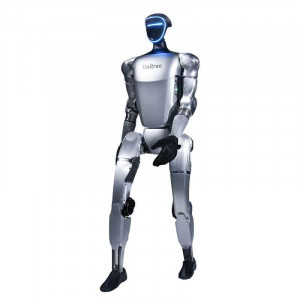
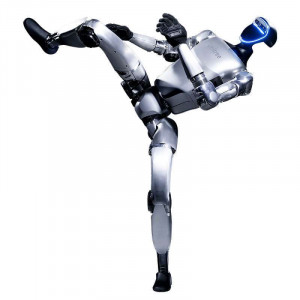
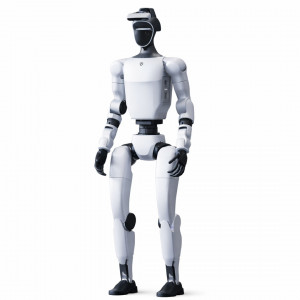
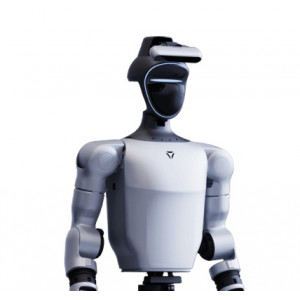
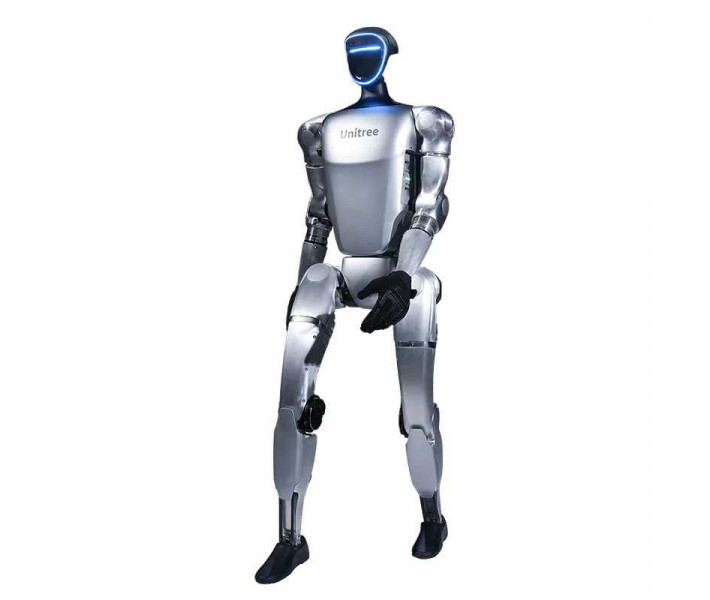
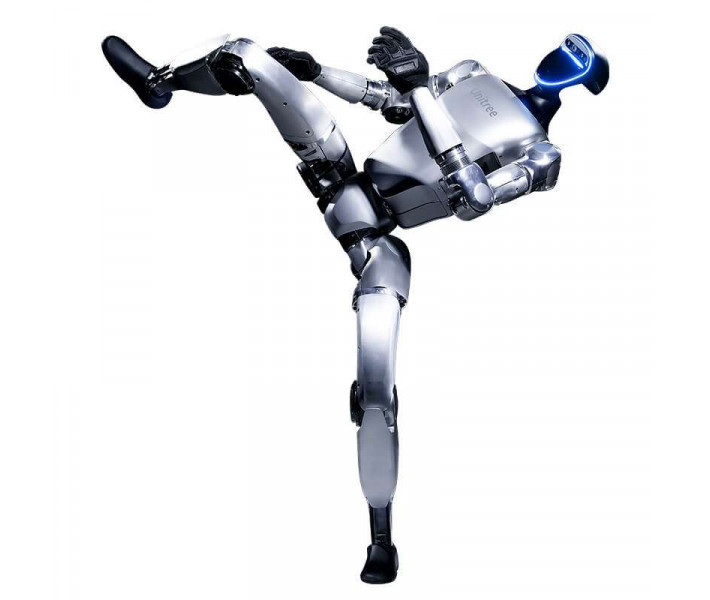
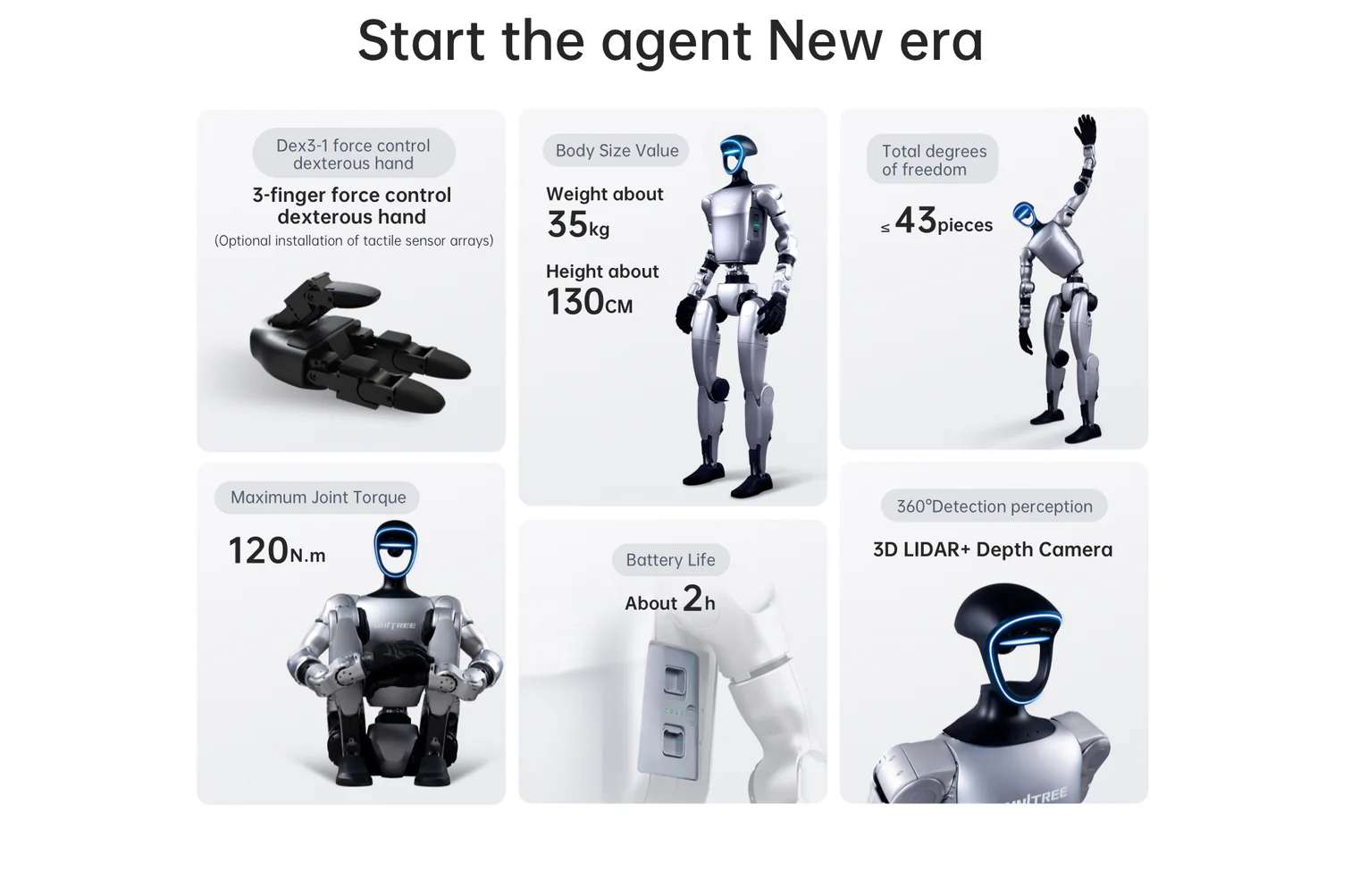
The Unitree G1-U10 EDU is a full-scale research humanoid robot engineered for AI-driven imitation learning, advanced manipulation research, and autonomous agent development. It features 37 degrees of freedom, a peak joint torque of 120 N·m, dual Dex3-1 three-finger force-controlled dexterous hands with tactile sensor arrays, and an NVIDIA Jetson Orin NX high-performance compute module within a 35 kg+ biped frame capable of 2 m/s locomotion speed.
| Specification | Value | Why it matters |
|---|---|---|
| Total Degrees of Freedom | 37 | Suprahuman kinematic flexibility enables complex whole-body manipulation and dynamic locomotion within a single standardised platform. |
| Maximum Knee Joint Torque | 120 N·m | Industrial-grade power output drives agile gait transitions and precise end-effector positioning during contact tasks. |
| Dex3-1 Dexterous Hands | 7 active DoF per hand + tactile sensor arrays (9 sensors per fingertip) | Force-controlled grasping with real-time tactile feedback enables precision pinch and power grip tasks in imitation-learning workflows. |
| Development Computing | NVIDIA Jetson Orin NX (8-core CPU, 1,024-core GPU, 16 GB RAM) | On-board edge AI inference at 918 MHz GPU speed supports live reinforcement learning and large-model reasoning without external cloud dependency. |
Key Benefits: The G1-U10 EDU combines research-grade capability with production-ready integration. Dual encoders per joint at 500 Hz closed-loop frequency, industrial-grade crossed roller bearings with sub-milliradian backlash, and full hollow joint wiring (no external cables) provide the mechanical precision and reliability required for long-duration autonomy trials. 360° environmental perception via LIVOX-MID360 3D LiDAR and Intel RealSense D435i depth camera, paired with a GPT-based voice assistant and four-microphone noise-cancellation array, enables multimodal interaction and robust navigation in unstructured environments.
Kinematic Architecture and Joint Design
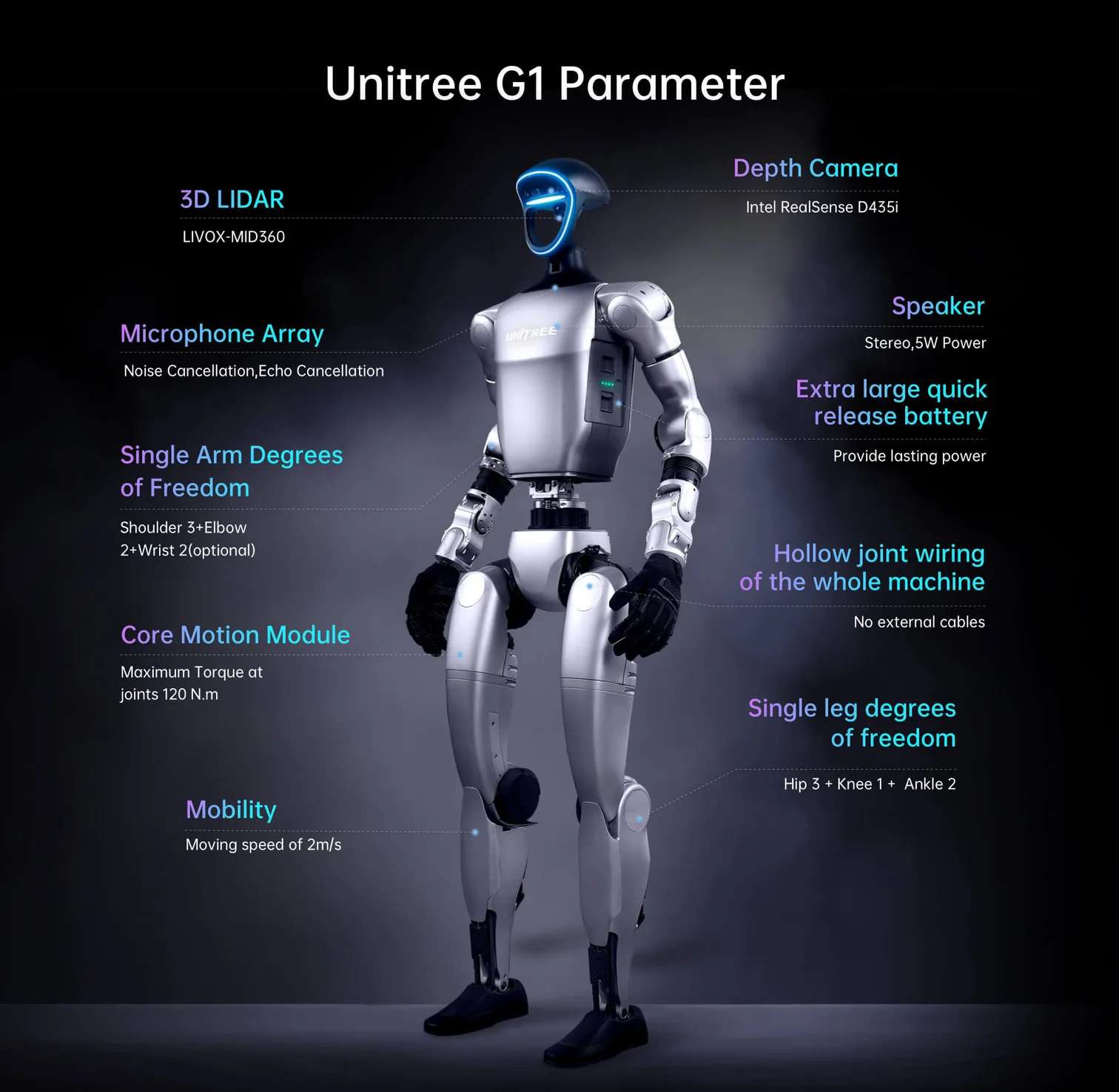
The G1-U10 EDU distributes its 37 degrees of freedom across a carefully balanced kinematic chain: six per leg (Hip 3 + Knee 1 + Ankle 2), five per arm (Shoulder 3 + Elbow 2), up to three at the waist (one fixed plus two optional parallel joints), and seven per Dex3-1 dexterous hand. Every joint is driven by a low-inertia high-speed internal rotor PMSM — a permanent magnet synchronous motor chosen for its fast torque response and efficient heat dissipation.
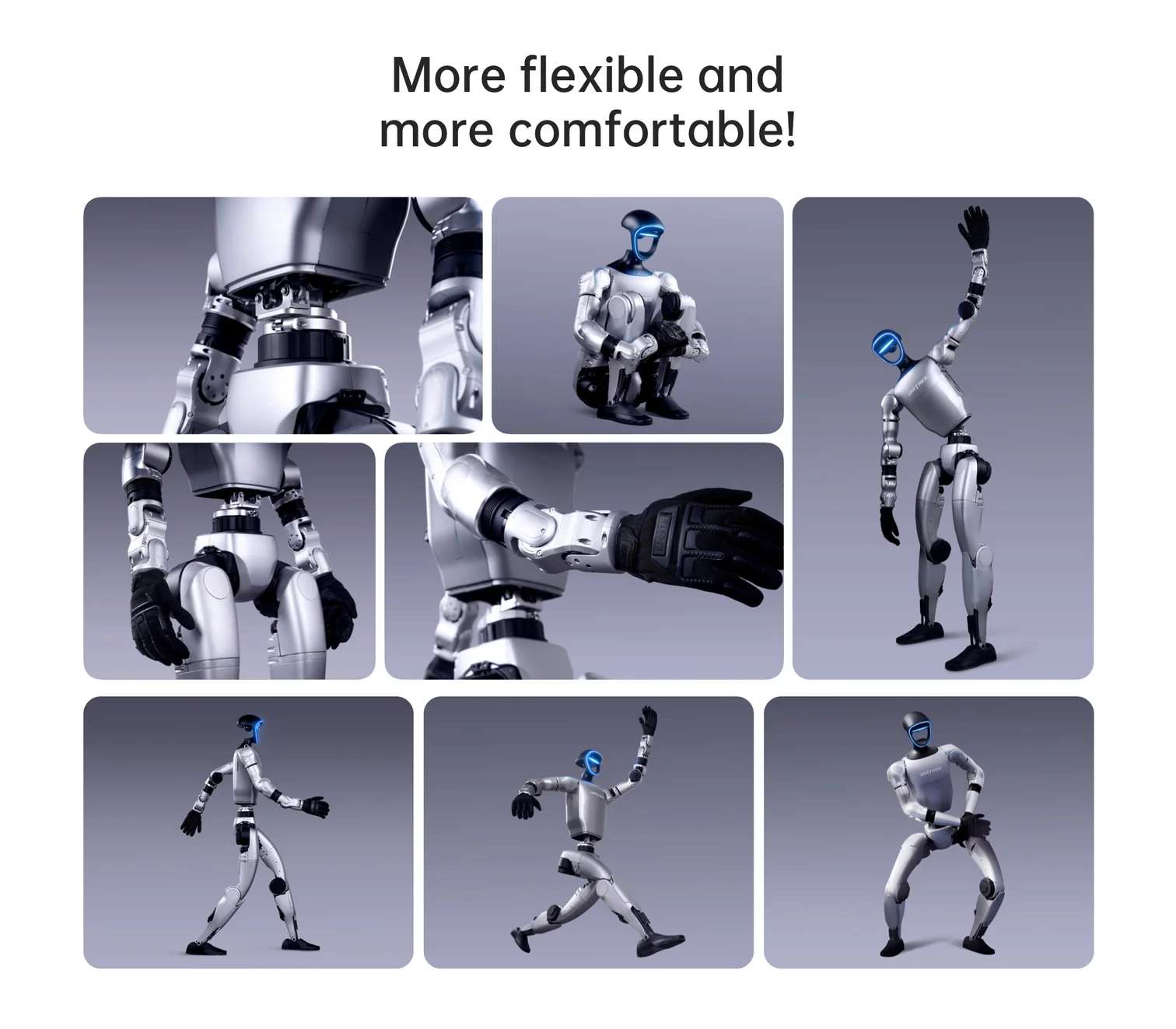
The joint angular range is genuinely suprahuman in several axes. The waist rotates ±155° on the Z-axis with additional X ±45° and Y ±30° articulation. The hip reaches Pitch ±154°, Roll −30° to +170°, and Yaw ±158°. Even the wrist delivers Pitch ±92.5° and Yaw ±92.5°. This extra-large range of motion is not cosmetic — it is the mechanical prerequisite that makes dexterous whole-body manipulation and agile locomotion tasks physically feasible on a single hardware platform.
Output stages use industrial-grade crossed roller bearings, chosen for high radial load capacity and sub-milliradian backlash, critical in manipulation experiments requiring precise end-effector positioning. Dual encoders per joint provide position and velocity feedback at 500 Hz closed-loop frequency, underpinning the force-position hybrid control that allows the G1-U10 EDU to handle compliant contact tasks.
Dex3-1 Force-Controlled Dexterous Hands and Tactile Sensing
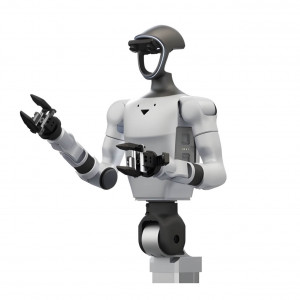
The U10 EDU configuration's most significant differentiator is the inclusion of two pre-installed Dex3-1 force-controlled dexterous hands, each carrying 7 active degrees of freedom. The thumb contributes 3 DoF (joint angles: 0°~+100°, −35°~+60°, −60°~+60°), while the index and middle fingers contribute 2 DoF each (0°~+90°, 0°~+100°). This asymmetric design mirrors the human hand's thumb-opposition biomechanics, enabling precision pinch grasps alongside broad power grasps.
The U10 EDU ships with tactile sensor arrays fitted to every fingertip — 9 pressure sensors per fingertip in a 3×3 array across six contact surfaces per hand, with a sensing range of 10 g to 2,500 g. Controlled at 24 V rated voltage via RS485, the Dex3-1 publishes real-time force and position data to the DDS middleware on the rt/dex3/(left|right)/state topic, fully accessible from the development PC (PC2, IP: 192.168.123.164). Optional wrist DoF (+2 per arm) can extend manipulation reach even further.
360° Environmental Perception: LiDAR and Depth Camera Fusion
The robot's head carries two complementary sensors that form the foundation of autonomous navigation and scene understanding. The LIVOX-MID360 3D LiDAR provides omnidirectional 360° horizontal scanning with a 59° vertical field of view, publishing high-resolution point cloud data at 10 Hz to the DDS topic rt/utlidar/cloud_livox_mid360. Its solid-state omnidirectional scanning eliminates the mechanical rotation of traditional spinning LiDARs, improving reliability in vibration-heavy locomotion environments. The Intel RealSense D435i depth camera adds binocular infrared stereo depth, a global-shutter RGB stream, and a 6-axis IMU — with depth frames and IMU data independently available via the librealsense2 SDK or ROS2 driver.
A four-microphone array with noise cancellation and echo cancellation pairs with a 5 W stereo speaker and an onboard GPT-based voice assistant (wake word: "Hello Robot") for natural multi-turn dialogue interaction. The integrated RGB LED strip communicates operating state in real time: solid blue for motion control, orange for damping, yellow for debug mode, and red for fault conditions.
Dual-Processor Compute Architecture and AI Integration
The EDU version ships with two independent compute units sharing the same chassis. PC1 runs Unitree's proprietary motion-control service and is not exposed to developers — it is the closed real-time controller managing all joint states at 500 Hz. PC2 is the full development platform: a NVIDIA Jetson Orin NX module featuring 8 × Arm® Cortex®-A78AE cores at 2 GHz, a 1,024-core NVIDIA Ampere GPU with 32 fifth-generation Tensor Cores (918 MHz peak), 16 GB LPDDR5X unified memory, and 2 TB SSD.
This PC2 (IP: 192.168.123.164) is reachable over Gigabit Ethernet and supports unitree_sdk2 (C++ and Python), ROS2 Foxy/Humble, DDS pub/sub, and SLAM navigation services. OTA firmware updates are pushed automatically over WiFi 6. For teams requiring large-model inference at the edge, an optional Thor Backpack module based on the Jetson T5000 (2,070 TFLOPS FP4, 128 GB LPDDR5X, 2,560-core Blackwell GPU) can be retrofitted without hardware modification to the base chassis.
Applications
- University Robotics Research: The G1-U10 EDU provides a production-ready platform for imitation learning, reinforcement learning, and end-to-end policy training. Its 500 Hz joint feedback loop, tactile dexterous hands, and open unitree_sdk2 enable teams to rapidly prototype complex manipulation and navigation algorithms without custom hardware integration.
- AI and Machine Learning Development: The on-board NVIDIA Jetson Orin NX with 1,024-core GPU and UnifoLM framework supports live inference of large vision-language models and diffusion-based motion planning. Teams can validate real-world performance of sim-to-real transfer before deploying to production systems.
- Industrial Automation and Flexible Manipulation: The 120 N·m peak torque, 3 kg arm payload, and compliant force control via dual encoders at 500 Hz enable whole-body manipulation tasks in unstructured factory and warehouse environments. The 2 m/s walking speed and 2-hour battery life support extended autonomous missions.
- Embodied AI and Autonomous Agents: Multimodal perception (3D LiDAR + depth camera + RGB + microphone array) combined with low-latency compute and GPT-based voice interaction enables development of embodied agents that learn from human demonstration and natural language instruction.
- Post-Processing and Inspection: The dexterous hands and precise joint control allow the G1-U10 EDU to perform pick-and-place, surface inspection, and material handling tasks in environments where fixed automation is too rigid or expensive.
Compatibility
- Dex3-1 Dexterous Hand Compatibility: Both hands are pre-installed; optional wrist DoF (+2 DoF per arm) can be retrofitted without modification. Tactile sensor arrays (9 sensors per fingertip) are factory-integrated.
- Optional Hardware Modules: Thor Backpack (Jetson T5000, 128 GB RAM, 2,560-core GPU) can be body-mounted for enhanced AI inference without chassis redesign. Waist fastener kit included for mechanical locking of optional waist DoF during development.
- Software Frameworks: unitree_sdk2 (C++ / Python), ROS2 Foxy/Humble, Cyclone DDS, and librealsense2 SDK for sensor drivers. SLAM and navigation service with open API provided.
What's in the box
- 1× Unitree G1-U10 EDU Humanoid Robot with dual Dex3-1 force-control dexterous hands (tactile sensor arrays pre-installed)
- 1× Smart Battery — 9,000 mAh, 13-string lithium-ion, quick-release
- 1× Charger — 54 V / 5 A
- 1× Handheld Manual Controller
- 1× Waist Fastener Kit (Fixing Part 1, Fixing Part 2, 2× M5 screws, Allen wrench) — for locking optional waist DoF during development
- Product documentation and warranty card
Technical specifications of the Unitree G1-U10 EDU
Mechanical Dimensions
| Parameter | Value |
|---|---|
| Height × Width × Thickness (Standing) | 1,320 × 450 × 200 mm |
| Height × Width × Thickness (Folded) | 690 × 450 × 300 mm |
| Weight (with battery) | Approx. 35 kg+ |
| Calf + Thigh Length | 0.6 m |
| Arm Span | Approx. 0.45 m |
| Walking Speed | 2 m/s |
Joint Architecture
| Parameter | Value |
|---|---|
| Total Degrees of Freedom | 37 (G1-U10 EDU configuration) |
| Single Leg Degrees of Freedom | 6 (Hip 3 + Knee 1 + Ankle 2) |
| Waist Degrees of Freedom | Up to 3 (1 base + optional 2 additional) |
| Single Arm Degrees of Freedom | 5 (Shoulder 3 + Elbow 2) |
| Single Hand Degrees of Freedom (Dex3-1) | 7 active + 2 optional wrist DoF |
| Joint Output Bearing | Industrial-grade crossed roller bearings (high precision, high load capacity) |
| Joint Motor Type | Low-inertia high-speed internal rotor PMSM (permanent magnet synchronous motor) |
| Maximum Knee Joint Torque | 120 N·m |
| Arm Maximum Load | Approx. 3 kg |
| Joint Encoder | Dual encoder per joint |
| Full Joint Hollow Electrical Routing | Yes — no external cables |
Joint Range of Motion
| Parameter | Value |
|---|---|
| Waist Joint — Z-axis (Yaw) | ±155° |
| Waist Joint — X-axis (Roll) | ±45° |
| Waist Joint — Y-axis (Pitch) | ±30° |
| Knee Joint | 0° ~ 165° |
| Hip Joint — Pitch | ±154° |
| Hip Joint — Roll | −30° ~ +170° |
| Hip Joint — Yaw | ±158° |
| Wrist Joint — Pitch | ±92.5° |
| Wrist Joint — Yaw | ±92.5° |
Dex3-1 Dexterous Hand (per hand, EDU configuration)
| Parameter | Value |
|---|---|
| Total Active DoF | 7 (Thumb 3 + Index 2 + Middle 2) |
| Thumb Joint Angles | 0°~+100°, −35°~+60°, −60°~+60° |
| Index & Middle Finger Joint Angles | 0°~+90°, 0°~+100° |
| Tactile Sensor Arrays | Yes — 9 sensors per fingertip (3×3 array, 6 contact locations per hand) |
| Pressure Sensing Range | 10 g – 2,500 g |
| Rated Operating Voltage | 24 V (range: 12–58 V) |
| Control Interface | RS485 via DDS topic rt/dex3/(left|right)/cmd |
Computing and Intelligence
| Parameter | Value |
|---|---|
| Motion Control Unit (PC1) | 8-core high-performance CPU (proprietary, closed system) |
| Development Unit (PC2) — Model | NVIDIA Jetson Orin NX |
| Development Unit — CPU | 8 × Arm® Cortex®-A78AE, 2 GHz |
| Development Unit — GPU | 1,024-core NVIDIA Ampere, 32 Tensor Cores, 918 MHz |
| Development Unit — RAM | 16 GB LPDDR5X unified memory |
| Development Unit — Storage | 2 TB SSD |
| Development Unit — IP Address | 192.168.123.164 |
| AI / Inference Framework | UnifoLM (Unified Robot Large Model); supports imitation and reinforcement learning |
| OTA Firmware Updates | Yes — Upgraded Intelligent OTA |
| Secondary Development SDK | Yes — unitree_sdk2 (C++ / Python), ROS2 Foxy / Humble, DDS (Cyclone DDS) |
Sensing
| Parameter | Value |
|---|---|
| 3D LiDAR | LIVOX-MID360 — 360° H × 59° V FOV, 10 Hz point cloud |
| Depth Camera | Intel RealSense D435i — binocular IR (global shutter), RGB, 6-axis IMU |
| Microphone Array | 4-mic array — Noise Cancellation, Echo Cancellation |
| Speaker | 5 W stereo |
| Voice Assistant | GPT-based — wake word "Hello Robot", multi-turn dialogue (firmware ≥ 1.3.0) |
| Status LED Strip | RGB 256-colour — indicates operating mode in real time |
Connectivity
| Parameter | Value |
|---|---|
| Wireless | WiFi 6, Bluetooth 5.2 |
| Ethernet (shoulder ports) | 2× RJ45 GbE (1000 BASE-T) |
| USB-C Ports | 3× USB-C (USB 3.0 host, 5 V/1.5 A each) + 1× Alt Mode USB-C (USB 3.2 + DP 1.4) |
| Power Output Ports (shoulder) | VBAT 58 V/5 A, 24 V/5 A, 12 V/5 A |
| I/O | GPIO (UART, I2C, GPIO) — 6 configurable pins |
Power System
| Parameter | Value |
|---|---|
| Battery Type | 13-string lithium-ion (smart battery, quick-release) |
| Battery Capacity | 9,000 mAh |
| Charger | 54 V / 5 A |
| Battery Life | Approx. 2 h |
| Cooling System | Local air cooling |
General
| Parameter | Value |
|---|---|
| Manual Controller | Yes — included |
| Warranty Period | 2 years |
| Delivery Lead Time | 30–60 days (subject to production schedule) |
How to start up the Unitree G1-U10 EDU (suspension method)
The recommended first startup procedure uses a protective suspension rack to safely boot the G1-U10 EDU from a hanging position before it touches the ground. Follow these steps in order to ensure a stable, safe initialisation.
Step 1 — Secure the robot to the protective rack
Hang the G1-U10 EDU on a protective suspension rack. Ensure the hook is properly engaged so the robot hangs freely with legs in a natural downward position and no weight resting on the feet.
Step 2 — Insert the battery pack
Slide the smart battery into the side battery slot. Pay attention to the insertion direction — do not force it. A clear audible "click" confirms that the quick-release latch has engaged and the battery is locked in.
Step 3 — Place the body in a natural hanging position
After hanging, allow the G1 to rest in its natural posture with arms and legs hanging freely. No manual joint adjustment is needed at this stage.
Step 4 — Power on the battery
Short-press the battery power switch once, then long-press for more than 2 seconds to power on. Wait approximately 1 minute for the full boot sequence to complete.
Step 5 — Confirm successful initialisation
Initialisation is complete when you hear the ankle joints strike their limit stops. Wait an additional 30 seconds, then press L2 + B on the remote controller to enter damping mode. Press L2 + UP to enter the ready (preparatory) stance.
Step 6 — Lower to the ground
Slowly lower the suspension rope until both feet make full contact with the ground. Press R2 + A on the remote controller to activate motion control. The robot will begin gait adjustment and stand autonomously.
Step 7 — Release the suspension hook
Once the G1 is standing stably and not oscillating, fully release the suspension hook. Use the left and right joysticks to control locomotion. Press START on the remote controller to toggle between standing and walking states.
Frequently asked questions
Does the G1-U10 EDU support external docking stations?
No. The NVIDIA Jetson Orin NX development computing unit is built directly into the EDU robot body. External GPU docking stations are not supported. For teams requiring significantly higher AI inference throughput, the optional Thor Backpack module (Jetson T5000, 2,070 TFLOPS FP4) is available as a body-mounted upgrade.
What programming interfaces and languages does the G1-U10 EDU support?
The G1-U10 EDU supports C++ and Python via the unitree_sdk2 library, ROS2 (Foxy and Humble tested), and direct DDS messaging using Cyclone DDS. Developers can access the secondary PC (PC2, IP: 192.168.123.164) over Ethernet or SSH from any Ubuntu 20.04/22.04 machine. Low-level joint control runs at 500 Hz. A SLAM and navigation service with an open API is provided for indoor environment mapping.
Can the Dex3-1 dexterous hands be used during running or high-intensity locomotion?
It is not recommended. During development with the Dex3-1 hands installed, avoid running gaits, balance-challenge tests, and any high-acceleration motion sequences. The shoulder motors can be given a slight outward offset to prevent mechanical interference between the dexterous hand and the torso. Always ensure the robot's motion envelope does not create collisions between the hand geometry and the main body structure.
What is the emergency stop procedure if the robot behaves unexpectedly?
At any time, pressing L2 + B on the remote controller immediately switches the G1 to damping mode, removing all active balance control and causing the robot to sink to a supported position. This emergency-stop combination remains active even in debug mode. When using SDK-based development, always verify that the robot is in debug mode (L2 + R2) before sending custom motion commands to prevent conflicting instructions with the built-in motion-control service.
What is the actual battery life and can the battery be swapped in the field?
The 9,000 mAh 13-string lithium-ion smart battery provides approximately 2 hours of operation under typical research workloads. Battery life will vary depending on locomotion intensity, compute load, and ambient temperature. The battery uses a quick-release side-slot mechanism, making field swaps straightforward — no tools required. A full charge cycle uses the included 54 V / 5 A charger.
Why buy the Unitree G1-U10 EDU from EXPERT3D?
EXPERT3D has been a trusted specialist in advanced robotics and automated manufacturing technology since 2012, serving research institutions, universities, and industrial teams across Spain and the EU. As an official representative of Unitree, we guarantee 100 % authenticity, fair pricing, authorised service, and an official warranty on every G1-U10 EDU sold. Our technical team provides pre-sales configuration consulting, import and customs handling, on-site commissioning support, and post-sales service for the full Unitree product range. The G1-U10 EDU is a complex system — our engineers can advise on network configuration, SDK environment setup, motion control verification, and development workflow so your team reaches productive operation as quickly as possible. We maintain a stock of consumables and spare parts to support long-term field deployment. Delivery is available with lead time of 30–60 days subject to Unitree production schedule.