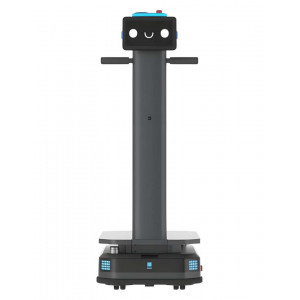

- Stock: In Stock
- Product code: 920372000001145522
- Weight Brutto: 140.00kg
- SKU: 10251-000002

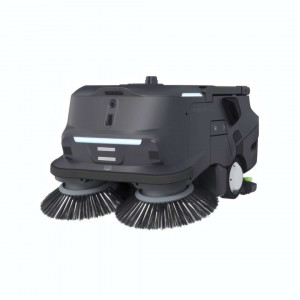
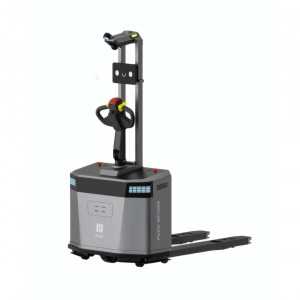
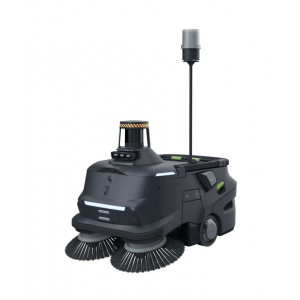
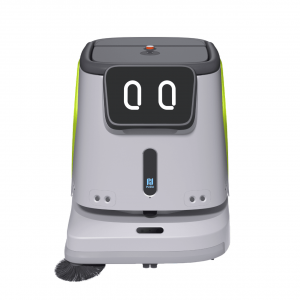
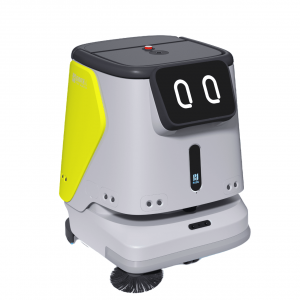
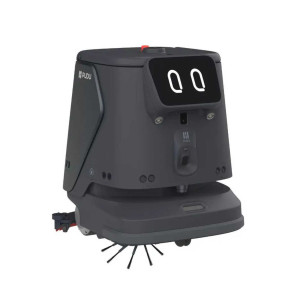
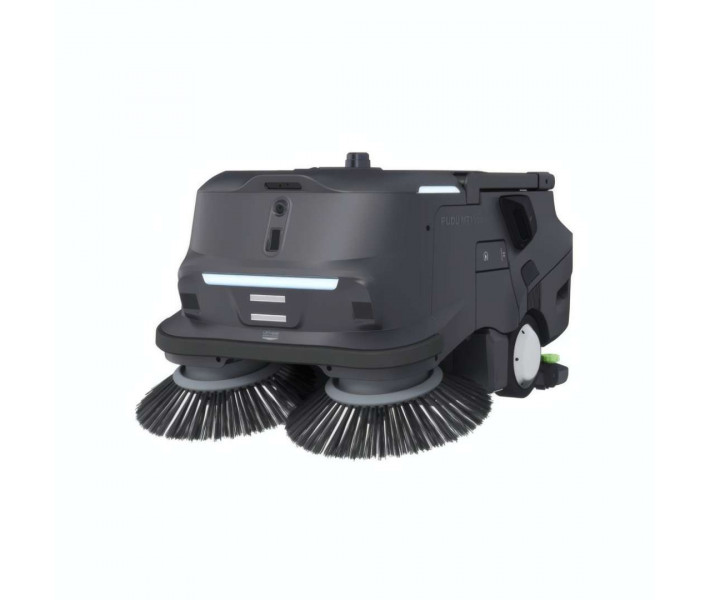
PUDU MT1 Vac is a commercial-grade, AI-powered robot for autonomous sweeping, vacuuming, and dust-mopping. It targets large-scale venues such as airports, five-star hotels, and banquet halls. A fused LiDAR SLAM and VSLAM stack pairs with dual-fan suction for high throughput. Onboard AI vision adapts to floor type, and long battery life supports multi-hour shifts.
| Specification | Why it matters |
|---|---|
| Max. Cleaning Coverage: 1,400 m²/h | Clears an entire airport concourse or banquet hall within a single operational shift. |
| Vacuuming Width: 55 cm | Covers twice the ground of a standard 25–30 cm commercial vacuum head in every pass. |
| Dustbag Capacity: 14 L (7 L × 2) | Extends the interval between manual emptying, keeping the fleet on task longer. |
| Runtime: 3–6.5 h | Supports extended shifts before an unattended charging stop is needed. |
Beyond the headline numbers, several design choices define how the PUDU MT1 Vac behaves in daily service:
- Dual independent air ducts raise suction efficiency by 200% versus single-duct designs, pinning fine dust to the floor before the roller brush passes over it.
- LiDAR SLAM + VSLAM + Marker navigation keeps positioning reliable even when furniture moves or crowds pass through, avoiding stalls in busy public spaces.
- AI floor recognition switches suction and brush speed between hard floor and carpet automatically, removing the need for manual mode changes.
- Tool-free modular components — side brushes, roller brush, dustbags, and mop plates all detach without tools, cutting downtime between shifts.
- PUDU Link IoT integration connects to elevators and electronic gates so the robot reaches multiple floors and access-controlled areas unescorted.
Two engineering choices define how the PUDU MT1 Vac moves and cleans: a dual-duct suction system and a fused SLAM navigation stack. Together they set the pace for every capability described below.
The short clip below shows the robot's cleaning cycle from start to finish, illustrating how sweeping, vacuuming, and dust-mopping combine into one autonomous pass.
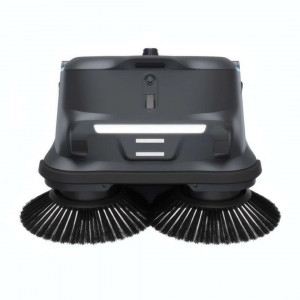
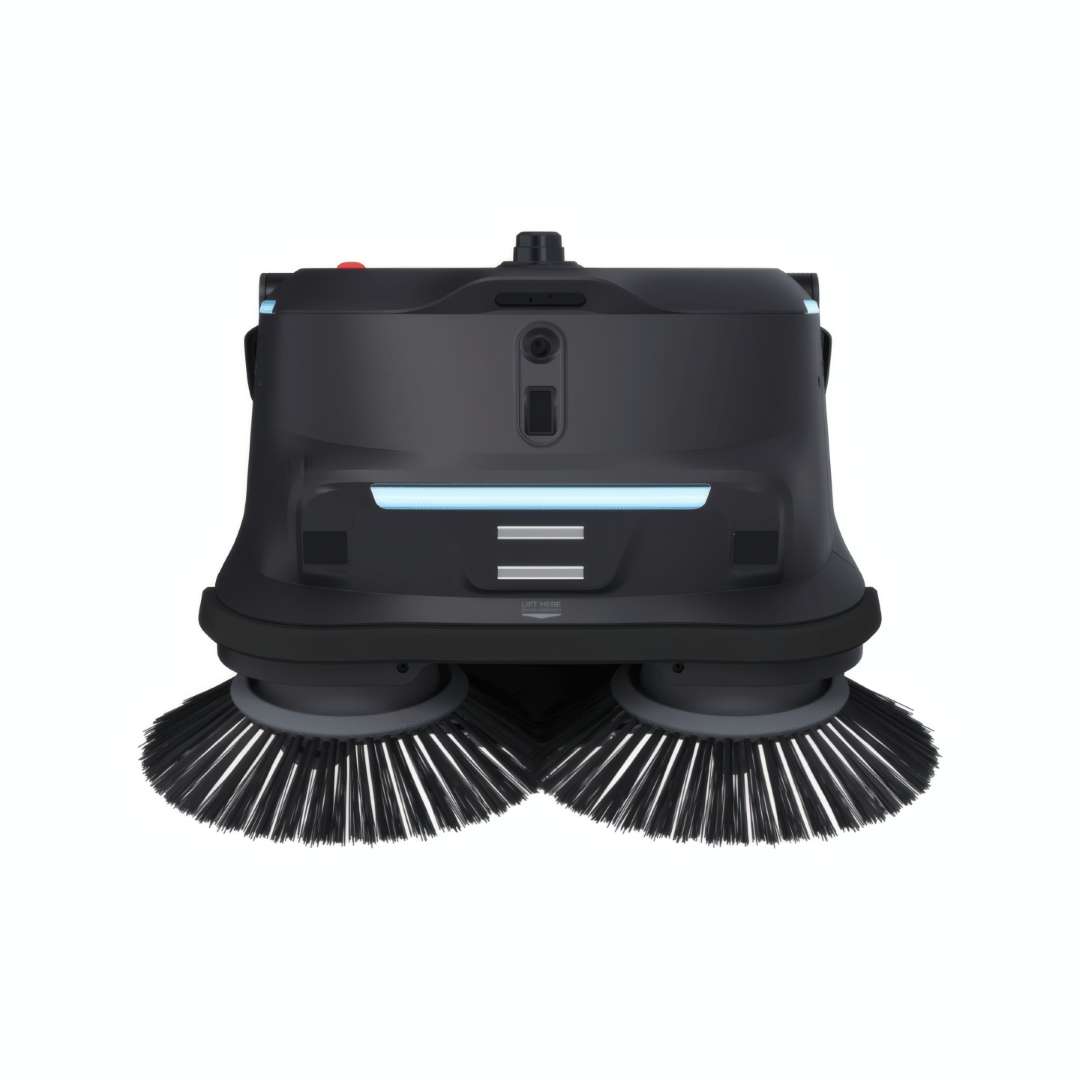
Seen from the front, the counter-rotating side brushes are what funnel loose debris inward before the central suction path takes over.
PUDU MT1 Vac Suction System
Conventional commercial vacuums rely on a single air duct. The dual independent duct design pins fine dust to the floor surface before the roller brush reaches it, suppressing the dust clouds that single-pass machines scatter. Paper shreds, wood chips, sand, and granular debris are all within specification. Strong, consistent suction also handles hard-floor-to-carpet transitions without manual brush-speed adjustment.
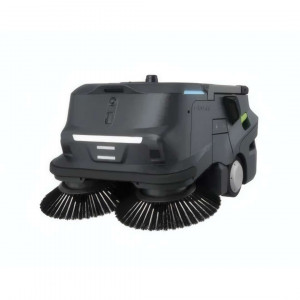
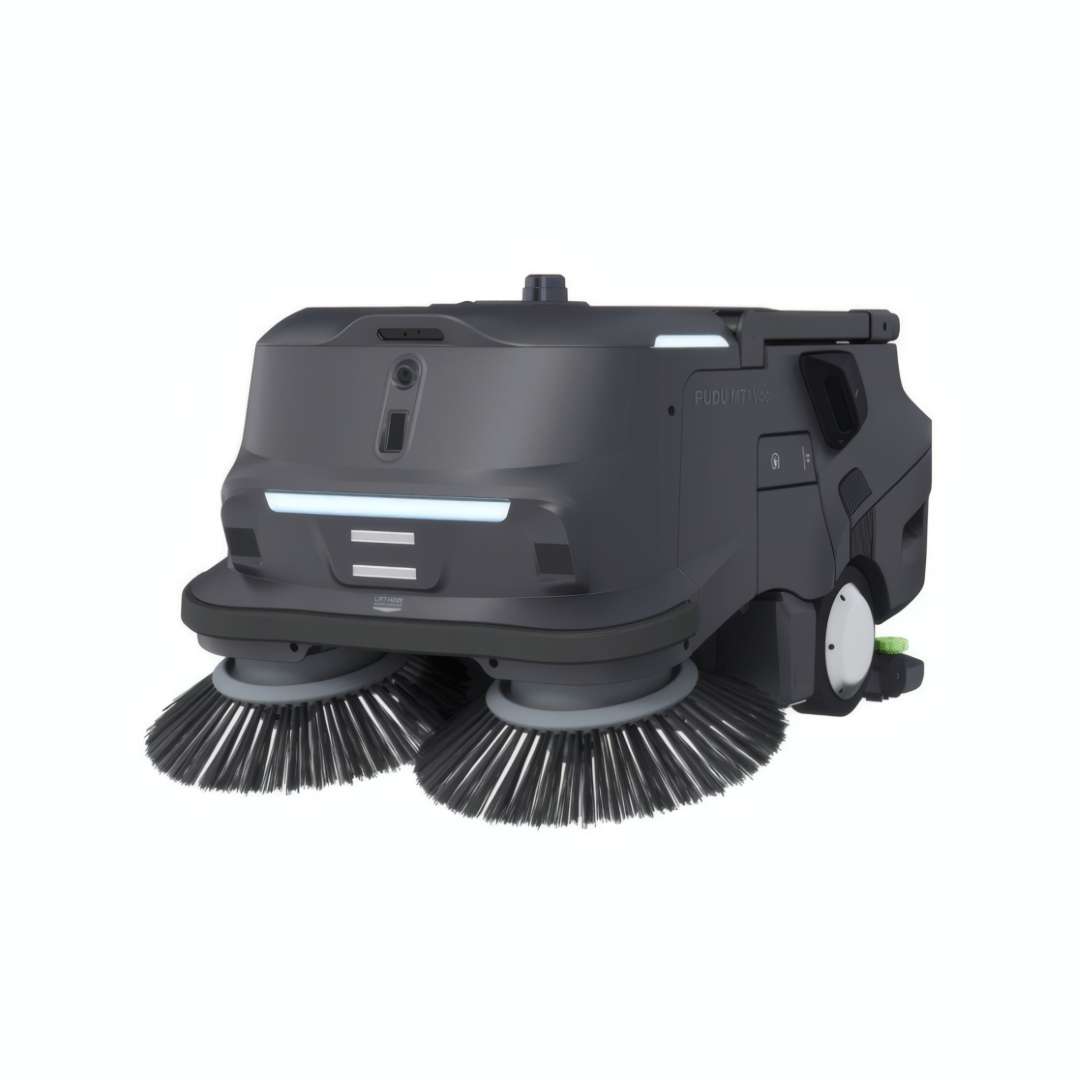
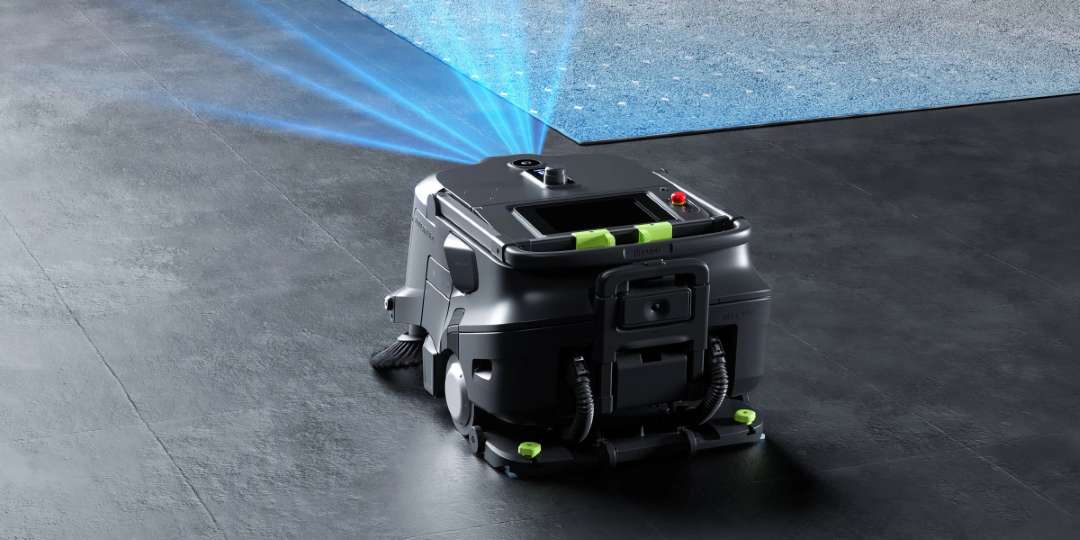
The three-quarter view below shows the compact enclosure, drive wheels, and side-panel labelling that give the robot its stable stance.
Wide-Path Coverage Geometry
Most commercial upright vacuums operate on a 25–30 cm head. At 55 cm suction width and 70 cm total sweep width with side brushes deployed, the MT1 Vac completes in one pass what a conventional machine needs two or three passes to cover. At cruise speeds up to 1.2 m/s, that geometry drives the throughput figure high enough to clean a full airport concourse within a single window. A 52 cm low-clearance profile slides under racks, display stands, and lobby furniture without operator intervention.
Navigation and Mapping
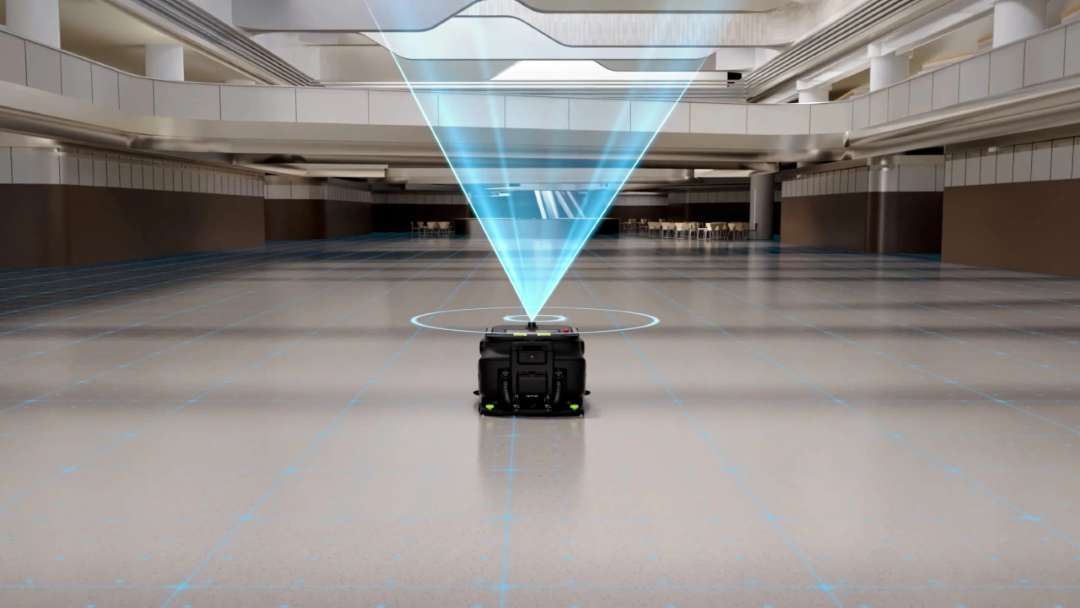
The positioning stack fuses three complementary methods: LiDAR SLAM for laser-precise spatial mapping, VSLAM (visual simultaneous localisation and mapping) for feature-rich environment recognition, and visual Marker positioning for deterministic startup-location anchoring. This redundant architecture re-localises reliably even when furniture is rearranged, temporary stalls appear, or crowds move through the cleaning zone. Minimum path clearance is 75 cm, and corridors wider than 80 cm allow the robot through without any speed reduction.
Scanning a large vacant hall, the robot projects a real-time LiDAR cone across the floor plane as it builds its route.
AI Floor Recognition
An onboard AI vision module classifies floor surface type in real time. Entering a carpet zone triggers automatic adjustment of suction intensity and roller-brush speed, protecting delicate pile while still extracting embedded particulate. Returning to hard floor, the system reverts to standard parameters without operator input. A companion feature, AI Exemption, lets operators teach the robot to ignore decorative floor patterns that the camera might otherwise misread as debris.
At the exact boundary between tile and carpet, the transition is where single-mode cleaning robots typically lose effectiveness.
AI Smart Spot Cleaning
During standard inspection passes, the AI vision system continuously scans for debris concentrations. When a contamination hotspot such as a drink spill or scattered litter is identified, the robot autonomously deviates from its planned route, executes a targeted cleaning sequence, then returns to the original path. Ultra Spot Clean mode extends this further: heat-map analysis of high-traffic areas triggers extra passes in zones statistically likely to accumulate waste, all without supervisor input.
The clip below demonstrates a targeted spot-cleaning deviation triggered automatically once the vision system flags a debris concentration.
Dustbag and Bin Capacity
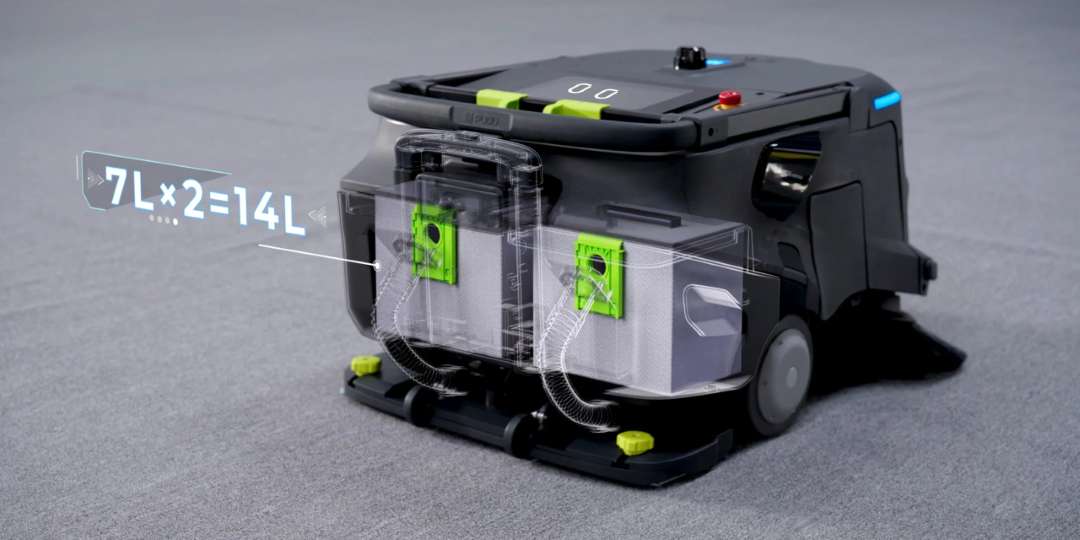
Cleaning throughput means little if the robot needs constant emptying. The MT1 Vac carries two independent 7 L dustbags, 14 L total, backed by a separate 6 L hard-shell dustbin for larger debris that bypasses the bag circuit. This dual-reservoir architecture extends the distance the robot covers before a maintenance stop is needed. Under typical mixed-duty conditions, emptying frequency drops well below once per shift.
Viewed through a transparent cutaway, both bags sit side by side inside the chassis, confirming their combined storage volume without opening a panel.
HEPA Filtration
The standard H11-grade HEPA filter captures over 98% of particles down to 0.3 µm, fine enough to trap the airborne particulate generated by high-traffic floor cleaning. Facilities with stricter air-quality requirements — pharmaceutical corridors, allergy-sensitive hotels, healthcare reception areas — can specify the optional H13 filter, raising capture efficiency to 99.97% at 0.3 µm. Neither grade is washable; the recommended replacement interval is weekly under standard commercial use.
Tool-Free Modular Maintenance
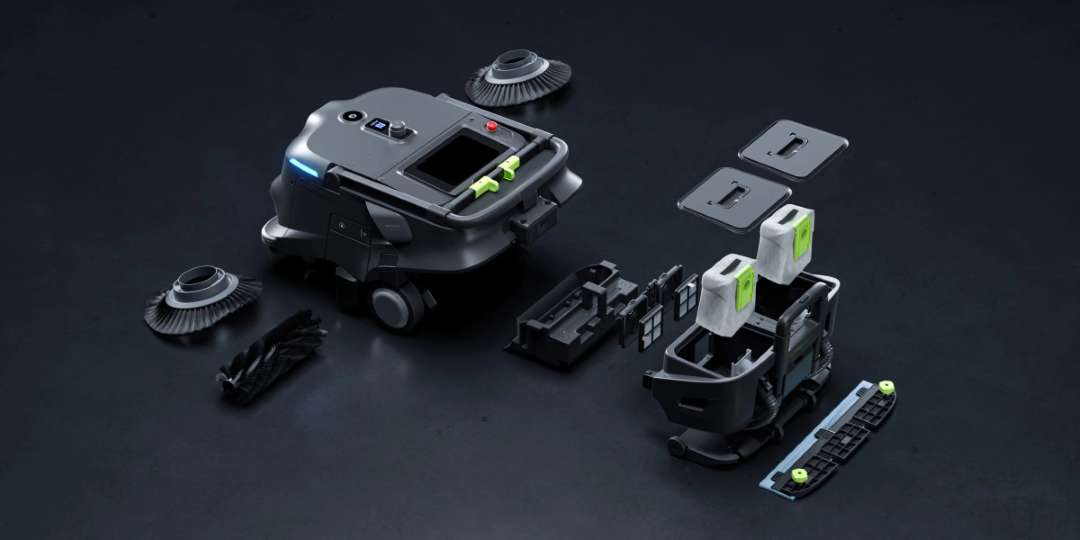
Commercial cleaning robots accumulate wear across five consumable categories. The MT1 Vac addresses this with a fully modular architecture: dust mop plates, dustbin, dustbag assembly, roller brush, and side brushes all detach without tools. Each swap takes seconds rather than minutes, which matters in airport and hotel environments where the fleet must return to service quickly between maintenance windows.
Laid out in an exploded view, every removable component sits apart from the main unit, forming a complete consumable map at a glance.
Hand-Vacuum Extension
A quick-release vacuum hose extends the robot's cleaning reach to surfaces the body cannot access: sofa cushion edges, vertical wall bases, glass partitions, and elevated display surfaces. This single feature closes the gap between autonomous floor cleaning and the residual manual work that remains after a robot pass, without requiring a separate machine.
The clip below shows the hose in use, reaching a surface the robot body alone could not clean.
IoT and Building Integration
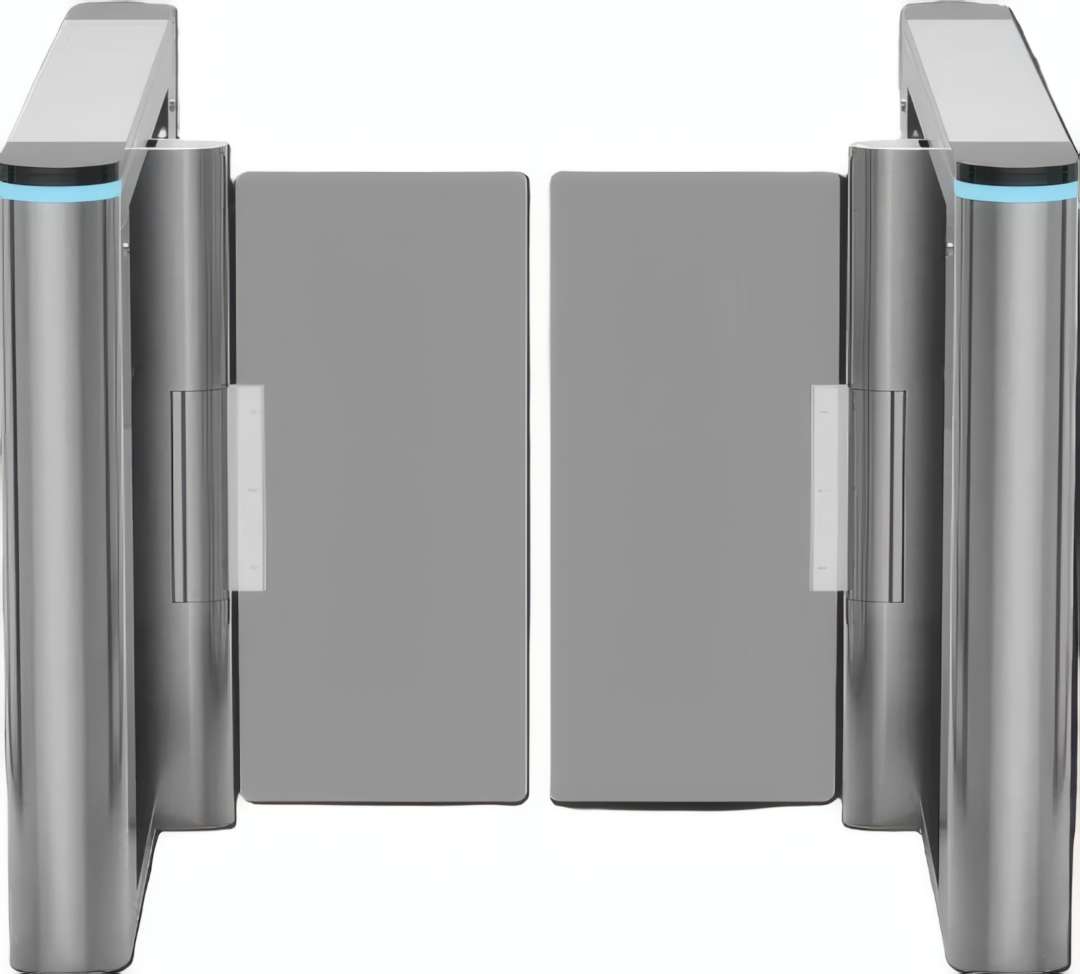
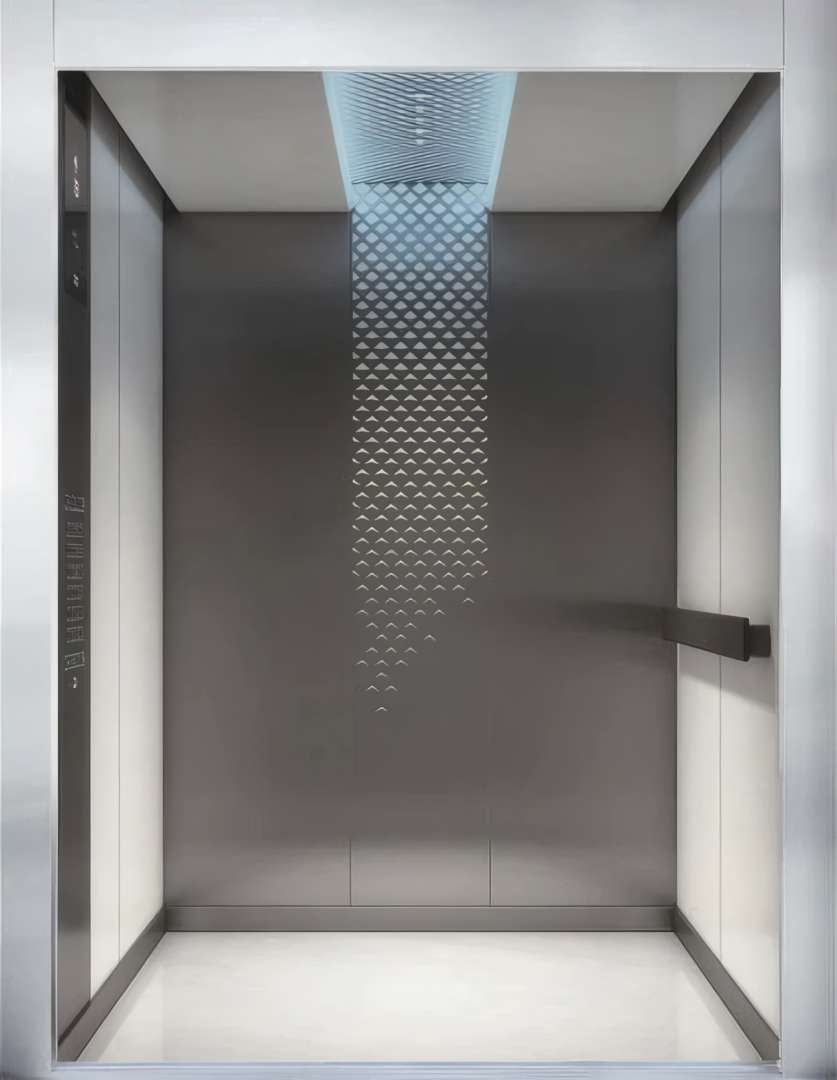
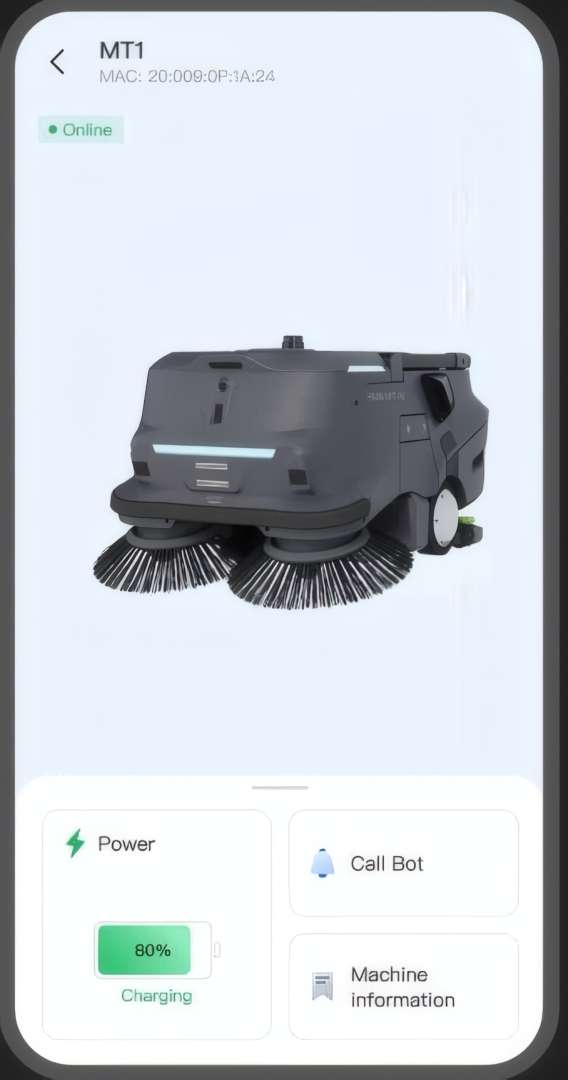
The MT1 Vac supports full building IoT integration via the PUDU Link platform. Elevator dispatch APIs let the robot call and board lifts autonomously, enabling multi-floor cleaning without a human escort. Electronic gate integration means access-controlled zones, such as terminal boarding corridors or hotel restricted areas, open automatically as the robot approaches. Communication options include 4G, Wi-Fi, Bluetooth, and optional LoRa / 2.4G for facilities with specific network topologies.
Flap-barrier turnstile gates like those shown below are navigated autonomously through the same IoT integration, removing the need for staff to hold gates open.
A modern elevator cabin, once the dispatch API is configured, presents no obstacle: the robot calls the lift, boards, rides to the target floor, and exits on its own.
Facility managers get live visibility into the fleet through the PUDU Link mobile app, shown below on a smartphone screen.
Automatic Charging and 24/7 Operation
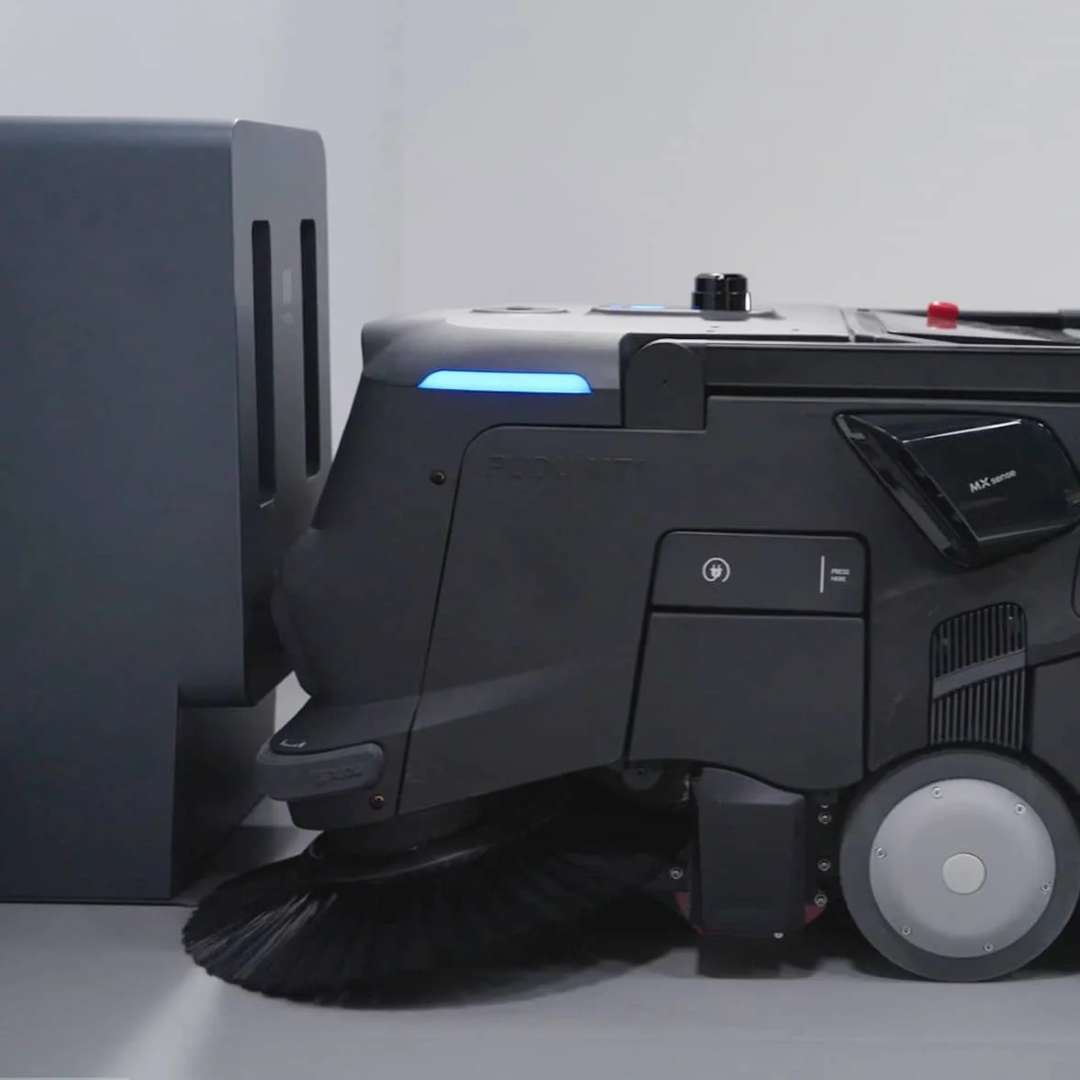
A dedicated auto-charging base station enables continuous 24/7 deployment cycles. When the battery level approaches its minimum threshold, the robot autonomously navigates to the dock, connects via contact electrodes, and resumes its cleaning schedule once recharged, with no operator involvement. Full recharge takes approximately 3.5 hours. Scheduled cleaning tasks run at pre-set times, maximising cleaning hours during off-peak periods when facilities are empty and floors are accessible.
Docked precisely at its base station, the robot's contact electrodes engage the dock pins to complete the autonomous return-to-charge cycle.
Applications
- Airports and transit hubs: Covers wide concourses within a single autonomous run and, once elevator API integration is configured, moves between terminal floors without an escort.
- Five-star hotels and banquet halls: Sweeps, vacuums, and dust-mops around lobby furniture and display stands, sliding under fixtures thanks to its low clearance profile.
- Healthcare and pharmaceutical corridors: The optional H13 HEPA filter raises capture efficiency to 99.97% at 0.3 µm for facilities with stricter air-quality requirements.
- Access-controlled zones: Electronic gate integration opens boarding corridors and restricted areas automatically as the robot approaches, removing the need for staff to hold doors.
- Multi-floor commercial buildings: Elevator dispatch through PUDU Link lets the robot call, board, and exit lifts on its own to clean multiple floors in one scheduled task.
- Event spaces with mixed flooring: AI floor recognition switches automatically between hard-floor and carpet settings, protecting pile carpet while extracting embedded particulate.
Compatible Accessories and Add-ons
- Air filtration: Standard H11 HEPA filter, with an optional H13-grade filter for stricter air-quality requirements.
- Cleaning reach extension: Quick-release hand-vacuum hose for surfaces the robot body cannot access, such as sofa edges and vertical wall bases.
- Charging infrastructure: Dedicated auto-charging base station with contact-electrode docking for unattended 24/7 operation.
- Communication modules: Optional LoRa / 2.4G module alongside the standard 4G, Wi-Fi, and Bluetooth connectivity.
What's in the Box
- PUDU MT1 Vac main unit × 1
- Charger × 1
- Sweeping side brush × 2
- Sweeping roller brush × 1
- Dustbag × 6
- HEPA filter × 4
- Dust mop cloth × 2
- Positioning code × 1
- Warning flagpole × 1
- User Manual × 1
- Certificate of Conformity × 1
Technical specifications
Mechanical Dimensions
| Parameter | Value |
| Model | MTBC02 |
| Dimensions (L × W × H) | 840 × 600 × 490 mm |
| Weight | ~77 kg |
| Enclosure Material | PC+ABS |
| Screen | 10.1-inch LCD |
| Operating System | Android |
Cleaning Performance
| Parameter | Value |
| Cleaning Capabilities | Sweeping, Vacuuming, Dust Mopping |
| Max. Cleaning Coverage | 1,400 m²/h |
| Vacuuming Width | 55 cm |
| Sweeping Width (with side brush) | 70 cm |
| Max. Surmountable Height | 20 mm |
| Max. Surmountable Gap | 30 mm |
| Max. Cleaning Slope | 3° |
| Air Filter Level | H11 (optional H13) |
| Dustbag Capacity | 14 L (7 L × 2) |
| Dustbin Capacity | 6 L |
Navigation and Mobility
| Parameter | Value |
| Navigation Method | LiDAR SLAM + VSLAM + Marker |
| Cruise Speed | 0.2–1.2 m/s (adjustable) |
| Min. Path Width | 75 cm |
| Min. Height Clearance | 52 cm |
| Max. Climbing Angle (non-cleaning) | 8° |
| IP Rating | IPX3 |
| Operating Noise | <65 dB(A) (noise reduction mode) |
Power and Battery
| Parameter | Value |
| Working Voltage | DC 23 V–29.2 V |
| Power Input | AC 100 V–240 V, 50/60 Hz |
| Power Output (Max.) | 29.2 V, 20 A |
| Battery Capacity | 60 Ah |
| Charging Time | ~3.5 h |
| Runtime | 3–6.5 h |
Connectivity
| Parameter | Value |
| Communication | 4G, Wi-Fi, Bluetooth, LoRa / 2.4G (optional) |
| Mobile App | PUDU Link (supported) |
Why buy the PUDU MT1 Vac from EXPERT3D?
EXPERT3D has specialised in advanced robotics and professional-grade technology solutions since 2012. As an official representative of PUDU, we guarantee the best price, authorised service, and an official warranty. Our team provides pre-sales technical consultation to configure fleet size, filter grade, and IoT setup for each venue. We coordinate delivery across Spain and the EU, and back every order with post-sale support through direct manufacturer contacts. Deploying a commercial cleaning robot like the PUDU MT1 Vac involves fleet configuration, elevator and gate IoT integration, and consumable planning — our specialists guide you from initial consultation through to ongoing maintenance and spare-parts supply.