Sharebot Metal 3D Printer in Spain
There are no products to list in this category.
Sharebot Metal 3D Printer in Spain
There are no products to list in this category.
A 3D printer is a computer-controlled machine capable of creating three-dimensional physical objects by successively adding layers of material. Unlike traditional CNC machines that remove material, a 3D printer builds the part from the ground up based on a pre-existing digital model.
Depending on the technology used, a 3D printer utilizes different components and processes to shape the object:
3D scanning is a technology that analyzes physical objects from the real world to capture their exact geometry, volume, and texture, converting them into a digital three-dimensional model.
By using projected light or lasers, the scanner measures thousands of coordinates per second on the object's surface, creating a dense point cloud. Specialized software then connects these points to form a polygonal mesh (typically in STL or OBJ formats), which can be modified in CAD programs or sent directly to a 3D printer.
Key applications in industrial sectors and additive manufacturing include:
Today, there are several additive manufacturing technologies, primarily classified by the state of the material they use (solid, liquid, or powder). Each offers different mechanical properties, levels of detail, and industrial applications:
3D printing has evolved from being a tool dedicated solely to rapid prototyping into a mature additive manufacturing technology, capable of producing functional end-use parts across critical sectors.
Due to the development of advanced materials and high-precision machinery, its current capabilities include:
Choosing the right 3D printer depends strictly on your goals and the type of parts you intend to manufacture. To make an informed decision, you should evaluate the following key factors:
There is no single "best" printer for everyone; the right choice depends on your budget, experience level, and the specific parts you want to create. Here are the top recommendations based on different user profiles:
There is no "best" plastic overall; the choice depends on your specific project needs. The most common filament is PLA, favored by beginners for its ease of use, but other options are better suited for technical applications:
To transform an idea into a physical object, you need to go through several software stages. The ecosystem is primarily divided into design tools and printer preparation programs:
Calculating the real cost of a 3D printed part involves adding up several direct and indirect factors. It is not just about the price of the plastic used, but also efficient resource management:
3D printing is often surrounded by misconceptions that can frustrate new users. It is essential to distinguish fact from fiction to achieve professional results:
The cost of a 3D printer varies significantly depending on the technology, component quality, and the level of support provided by the manufacturer. Costs can generally be classified into three main segments:
3D printing, technically known as additive manufacturing, is a process of creating physical objects by depositing successive layers of material. Unlike traditional subtractive manufacturing methods (such as CNC milling or turning), which involve removing material from a solid block, 3D printing uses only the precise amount of material required to form the part.
The workflow begins with a digital 3D model created in CAD software or obtained via 3D scanning. This file is processed through slicing software (Slicer), which divides the object into hundreds of horizontal layers and generates coordinates (G-Code) for the extruder or print head to move accurately across the X, Y, and Z axes.
A 3D model is a mathematical digital representation of a three-dimensional object. Unlike a flat image, a 3D model contains data regarding depth, volume, and geometry, allowing it to be viewed from any angle and, most importantly, processed for additive manufacturing.
These models are made up of a polygonal mesh consisting of three basic elements: vertices (points in space), edges (lines connecting the points), and faces (flat surfaces that close the volume). For a model to be 3D printable, it must be "manifold" or watertight, meaning the digital geometry has no holes or gaps.
There are several ways to obtain or create a 3D model:
RepRap (short for Replicating Rapid Prototyper) is an open-source project founded in 2005 by Adrian Bowyer. Its revolutionary concept is based on creating a self-replicating machine—a 3D printer capable of manufacturing most of its own plastic components.
This movement has been the cornerstone of modern desktop 3D printing. By operating as open-source hardware, it allowed thousands of developers worldwide to collaborate and improve designs without the constraints of industrial patents. Key aspects of this technology include:
The future of 3D printing is moving toward full integration into mass production lines and the development of applications that currently seem like science fiction. The trends that will shape the next decade include:
The 3D printing market features several leading brands known for their innovation, reliability, or value for money. Depending on whether you are a hobbyist, a professional, or an industrial user, these are the most prominent manufacturers:
Choosing where to buy is just as crucial as the printer itself. While large generic marketplaces exist, it is highly recommended to purchase your equipment from a specialized 3D printing retailer for several strategic reasons:
To start printing successfully, you will need more than just the machine itself. A set of consumables and accessories is essential for both maintenance and finishing your parts:
3D printing is a continuous learning process, and it is normal to face technical challenges. If your print fails or the machine is not behaving as expected, we recommend following this troubleshooting protocol:
The accuracy of a 3D printer is a concept often confused with resolution. While resolution refers to layer height (Z-axis), actual accuracy defines how closely the physical part matches the original digital model in its final dimensions.
In today's market, accuracy varies significantly depending on the technology used:
3D printing is a fascinating field that has pushed many technological boundaries. Here are some surprising facts that showcase the scope of this industry:

Looking for where to order 3D printing or buy a 3D printer in Spain? The Impresora 3D shop offers an extensive range of equipment for 3D printing, 3D scanning, filaments, and resins, alongside professional printing and modelling services.
Our range includes:

We offer custom 3D printing services for:
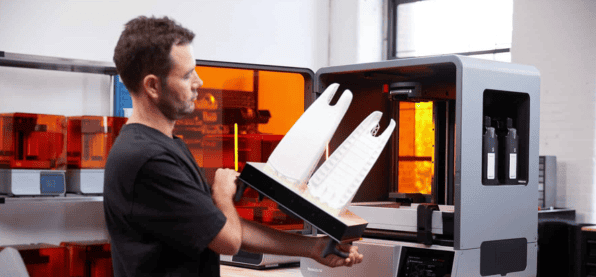
We help implement 3D technologies across industry, education, medicine, design, and architecture. We work with clients in all cities throughout Spain.
We offer:
Office: Calle Francesc Baldomar, 61 bajo, 46011, Valencia, Spain
At our showroom, you can test the equipment and request professional printing services.
Full contact details can be found in the “Contact” section.