

- Stock: In Stock
- Product code: 920372000000841001
- Weight Brutto: 4.20kg

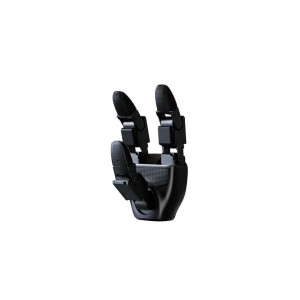
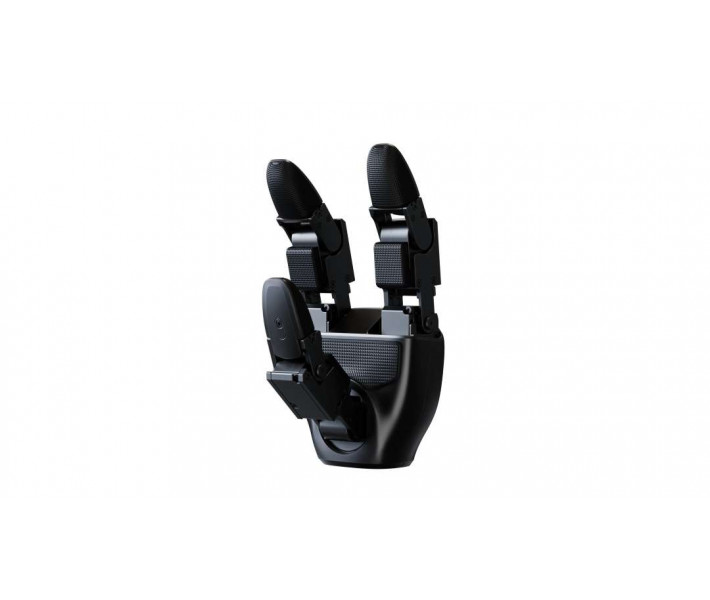
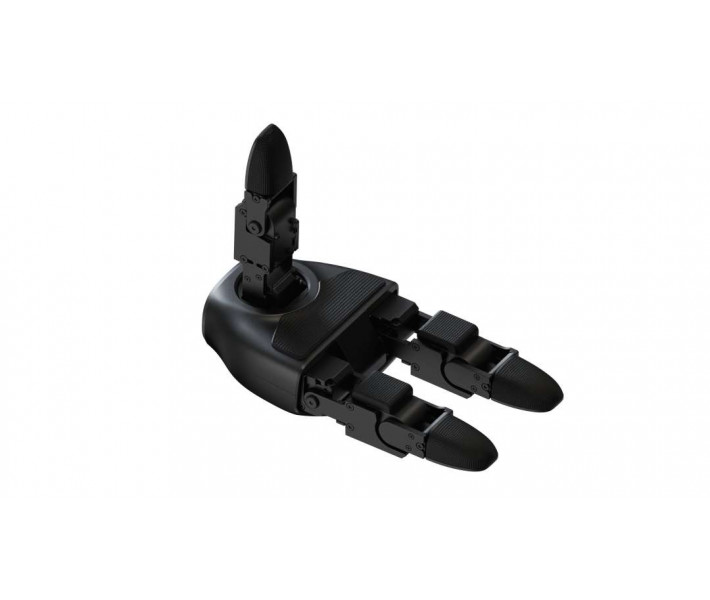
Unitree Dex3-1 — a three-finger robotic hand for complex manipulation with force control. Without tactile feedback, a gripper works blind, and delicate operations stay with a human. Hybrid force and position control gives the hand command over its grip force. The optional tactile array adds multi-point touch, imitating the fine sensitivity of the human body.
Key specifications and benefits
- Degrees of freedom: 7 — A wide range of movements allows complex actions, not just gripping.
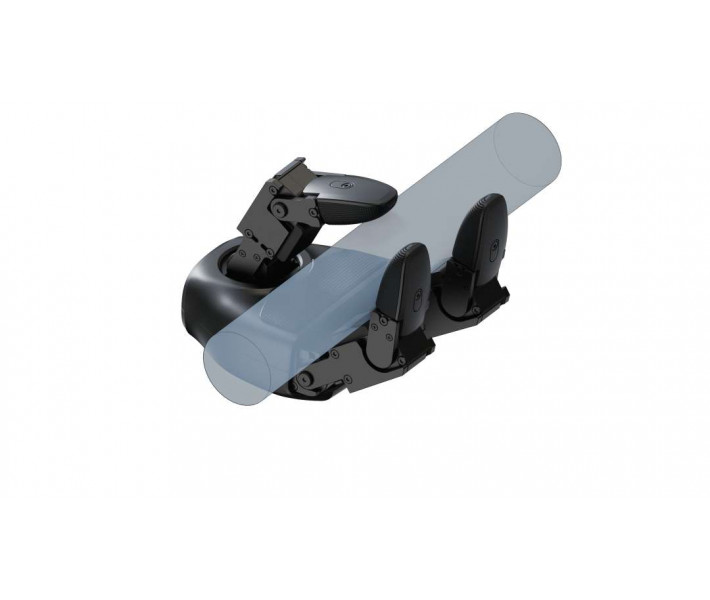
- Maximum load: 500 g — The hand holds a rigid cylinder 5 cm in diameter, both with the hand pointing down and with the palm facing left.
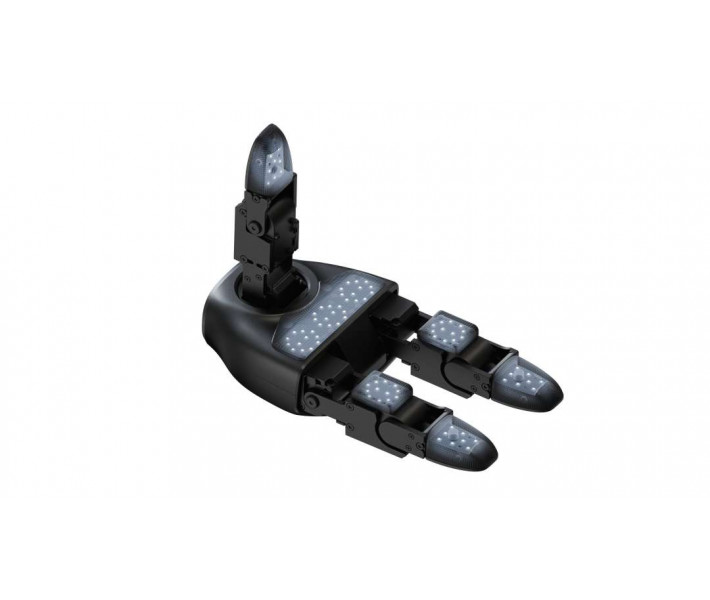
- Pressure sensors: 33 — The optional tactile array records pressure distribution across the palm and fingers.
- Hybrid force and position control: The Unitree Dex3-1 hand controls finger bend angle and force, so grip strength is set independently of position.
- Control frequency 1,000 Hz: The communication loop with the joints refreshes 1,000 times per second. This high exchange rate allows frequent corrections of torque and angle.
- Sensor load tolerance 20 kg: The sensor layer withstands up to 20 kg without damage. This leaves a margin for excessive pressure during contact.
Unitree Dex3-1 construction and kinematics
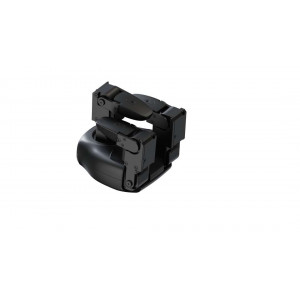
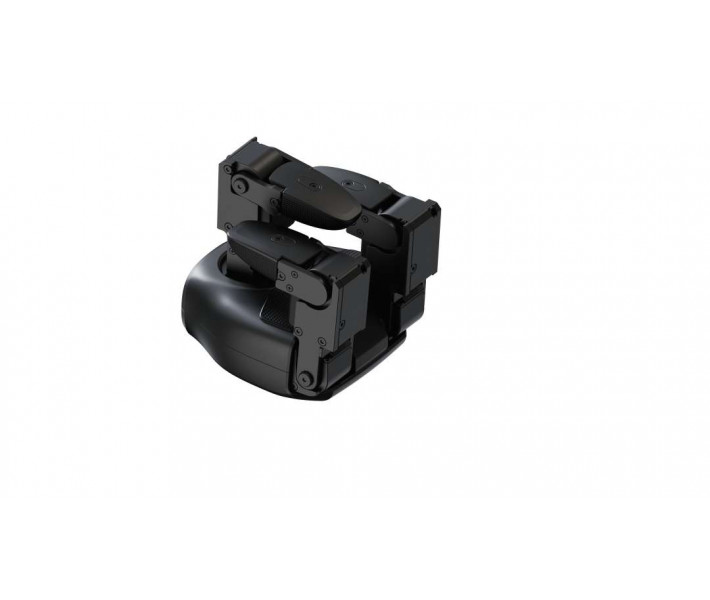
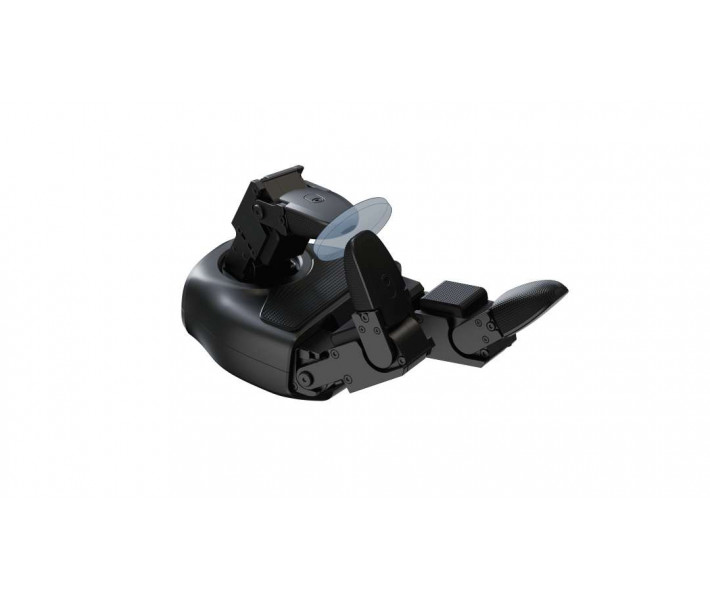
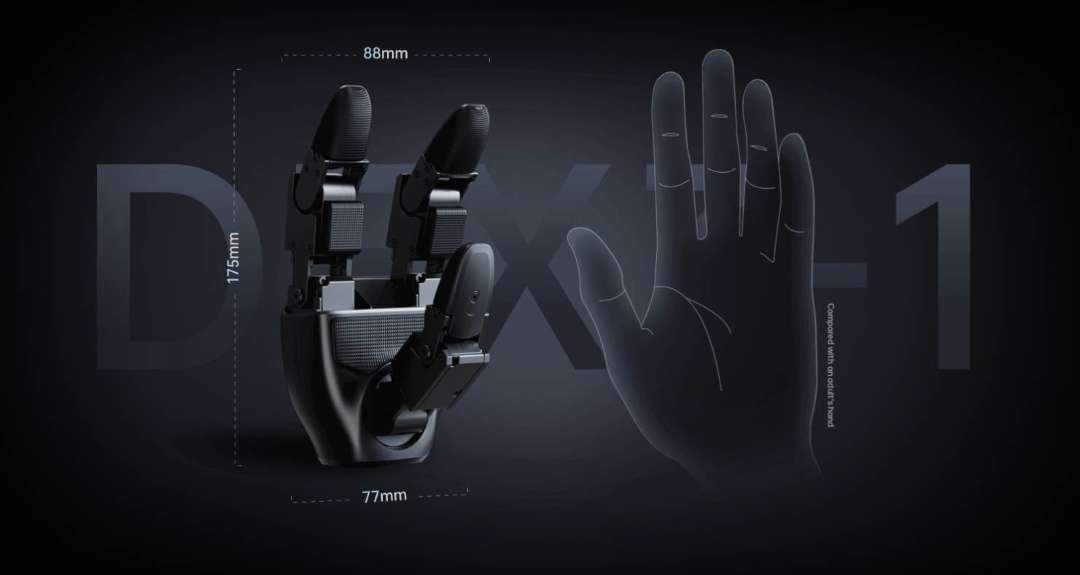
The three-finger hand is an in-house development by Unitree Robotics. The Unitree Dex3-1 weighs 710 g and measures 175 × 88 × 77 mm. The outline of an adult human hand is shown alongside for scale.
Finger kinematics
The hand has 7 degrees of freedom. Three of them belong to the thumb, and two each to the index and middle fingers. Thumb joint 0 moves from -60° to 60°, that is, to both sides of the neutral position. Thumb joint 1 covers -35° to 60°, and thumb joint 2 covers 0° to 100°. On the index and middle fingers, joint 0 bends from 0° to 90° and joint 1 from 0° to 100°.
Drive and joints
Six micro brushless joints with force control work with direct drive. The seventh joint has a gear transmission. According to the manufacturer, this layout provides precise motion control and efficient energy transfer.
The specification lists two joint models: F-1515-108 and F-1515-214. Both weigh 45 g and measure 34.8 × 23.1 × 23.3 mm. The 1:214 reduction delivers more torque: 1.498 N·m theoretical, against 0.76 N·m for the 1:108 model. Speed is lower, however: 11 rad/s against 23 rad/s.
No IP rating is specified for the joints. Bear this in mind when choosing operating conditions.
Force, position and stiffness control
This model implements hybrid force and position control. Each joint accepts five types of control command. Two of them set torque and angle. Another sets angular velocity. The remaining two, stiffness and damping, define how the finger reacts to resistance.
An absolute encoder records the rotor position; this sensor outputs the absolute value of the angle. Motor feedback covers torque and angle. In addition, the joint reports angular velocity and temperature. Data is exchanged over the high-speed Unibus protocol.
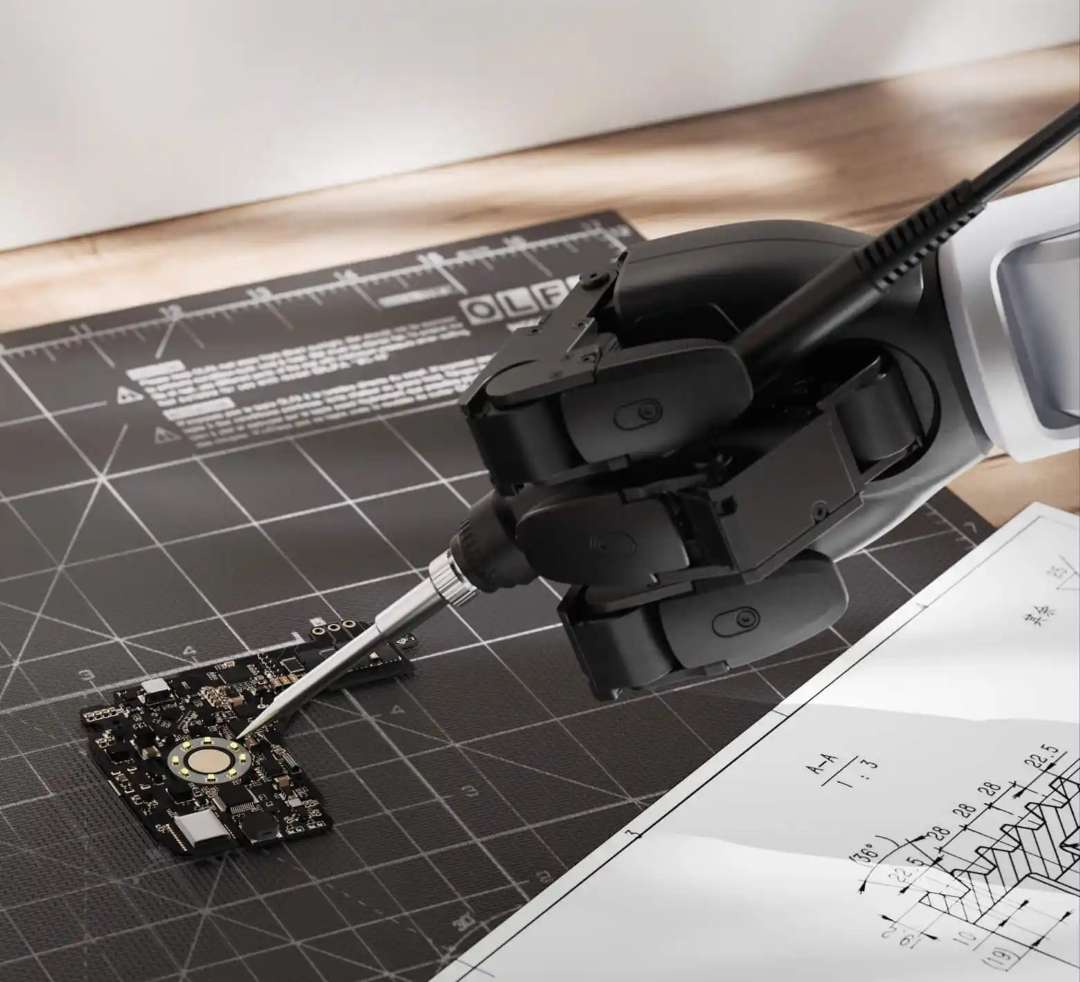
In the image, the hand holds a soldering iron over a printed circuit board on a cutting mat. This is an example of skilful tool use.
Tactile array for multi-point touch
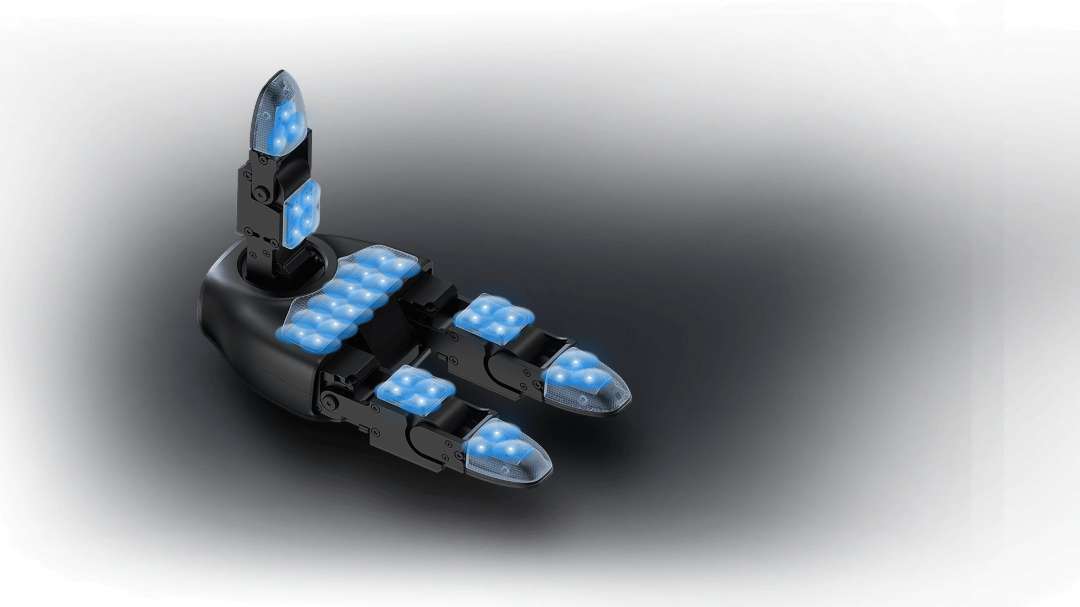
The optional tactile array imitates the fine touch of the human body. In the Unitree Dex3-1 configuration with the array, there are 33 pressure sensors grouped into 9 arrays. Instead of a single sensor, each array records pressure distribution across its own area.
- Palm: Three 2 × 2 arrays, 12 sensors in total.
- Finger pads: Three 2 × 2 arrays, 12 sensors in total.
- Fingertips: Three 3 × 1 arrays, 9 sensors in total.
In the image, blue highlighted tactile pads sit on the fingers and palm. The image shows pad placement, while the number and resolution of the arrays are given above.
Connection and power
The electrical interface of the hand uses lead wires. Separate leads are provided for communication and for power.
Communication uses USB 2.0 with a 1,150 mm cable, including the internal section. The power lead is 90 mm long, also including the internal section. Take these lengths into account when routing the cables.
The operating voltage of the hand is 24–58 V; for individual joints, the specification gives 12–24 V. The quiescent current is 0.2 A at 58 V, and the exact value depends on voltage. The maximum current is 10 A, so size the power supply to this value. The operating temperature range is -20 °C to +60 °C.
Applications
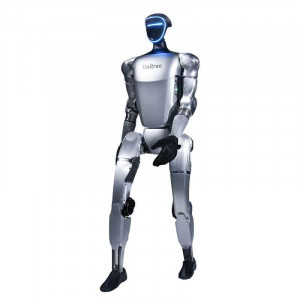
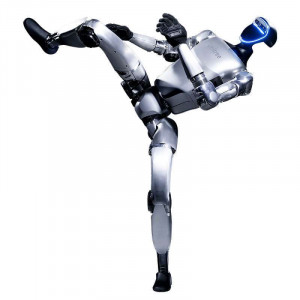
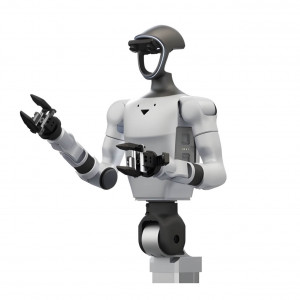
The hand is intended for scientific and industrial tasks. In such scenarios, the Unitree Dex3-1 works alongside the G1 humanoid robot.
- Control research: The joints accept five types of command and return feedback, so force and position control algorithms can be tested on a single hand.
- Humanoid robotics: Paired with the G1 robot, the hand performs complex actions thanks to 7 degrees of freedom across three fingers.
- Tool use: The hand holds a soldering iron over a printed circuit board, and hybrid force and position control lets it regulate the grip force on the tool.
- Moving objects of moderate weight: The hand holds a rigid cylinder 5 cm in diameter weighing up to 500 g, so it suits moving such objects.
- Tactile perception research: 33 pressure sensors in 9 arrays (optional) allow the study of pressure distribution across the palm and finger pads.
Compatibility and optional equipment
The device works in tandem with the G1 humanoid robot and performs complex actions with it. The Unitree Dex3-1 can optionally be fitted with a multi-point tactile array of 33 pressure sensors. Agree this configuration before ordering, so that it matches the task.
Technical specifications
Main parameters
| Parameter | Value |
| Weight | 710 g |
| Dimensions | 175 × 88 × 77 mm |
| Mobility | 7 degrees of freedom (3 for the thumb, 2 for the index finger, 2 for the middle finger) |
| Transmission mechanism | 6 direct-drive motors, 1 geared motor |
| Joint angle | Thumb joint 0: -60° – 60°, thumb joint 1: -35° – 60°, thumb joint 2: 0° – 100°, index finger joint 0: 0° – 90°, index finger joint 1: 0° – 100°, middle finger joint 0: 0° – 90°, middle finger joint 1: 0° – 100° |
Electrical parameters
| Parameter | Value |
| Operating voltage | 24–58 V |
| Quiescent current | 58 V @ 0.2 A (the exact value may vary with voltage) |
| Maximum current | 10 A |
| Communication interface | USB 2.0 |
| Operating temperature range | -20 °C – +60 °C |
| Load (at room temperature, hand pointing down, holding a rigid cylindrical object 5 cm in diameter) | Maximum weight 500 g |
| Load (at room temperature, palm facing left, holding a rigid cylindrical object 5 cm in diameter) | Maximum weight 500 g |
Sensor parameters
| Parameter | Value |
| Number of pressure sensors | 33 (in 9 arrays) |
| Array resolution | 2 × 2 (palm) × 3, 2 × 2 (one finger pad) × 3, 3 × 1 (one fingertip) × 3 |
| Maximum permissible load (without damage) | 20 kg |
Micro brushless joints with force control: F-1515-108 and F-1515-214
| Parameter | Value |
| Weight | F-1515-108 and F-1515-214: 45 g |
| Dimensions | F-1515-108 and F-1515-214: 34.8 × 23.1 × 23.3 mm |
| Reduction ratio | F-1515-108: 1:108; F-1515-214: 1:214 |
| Maximum torque (theoretical) | F-1515-108: 0.76 N·m; F-1515-214: 1.498 N·m |
| Maximum torque (actual) | F-1515-108: torque in the direction of speed 0.49 N·m, in the direction opposite to speed 1.37 N·m; F-1515-214: torque in the direction of speed 0.86 N·m, in the direction opposite to speed 3.1 N·m |
| Maximum speed | F-1515-108: 23 rad/s; F-1515-214: 11 rad/s |
| Maximum line current | F-1515-108 and F-1515-214: 4.76 A |
| Communication control frequency | F-1515-108 and F-1515-214: 1,000 Hz |
| Communication method | F-1515-108 and F-1515-214: high-speed Unibus |
| Encoder | F-1515-108 and F-1515-214: absolute rotor encoder |
| Operating temperature range | F-1515-108 and F-1515-214: -20 °C – 60 °C |
| IP rating | F-1515-108 and F-1515-214: none |
| Operating voltage | F-1515-108 and F-1515-214: 12–24 V |
| Motor feedback | F-1515-108 and F-1515-214: torque, angle, angular velocity, temperature |
| Motor control commands | F-1515-108 and F-1515-214: torque, angle, angular velocity, stiffness, damping |
Why buy the Unitree Dex3-1 from EXPERT3D?
EXPERT3D has supplied professional 3D equipment since 2012. Our specialists provide pre-sales consultation and help you configure the Unitree Dex3-1. The consultation covers choosing a configuration with or without the tactile array. We will confirm compatibility with your platform, including the G1 robot. We provide delivery across Spain and the EU. After your purchase, we provide after-sales service support. Spare parts can be ordered on the website, so your equipment does not stand idle.