

- Stock: In stock
- Product code: 920372000001458151
- Weight Brutto: 98.00

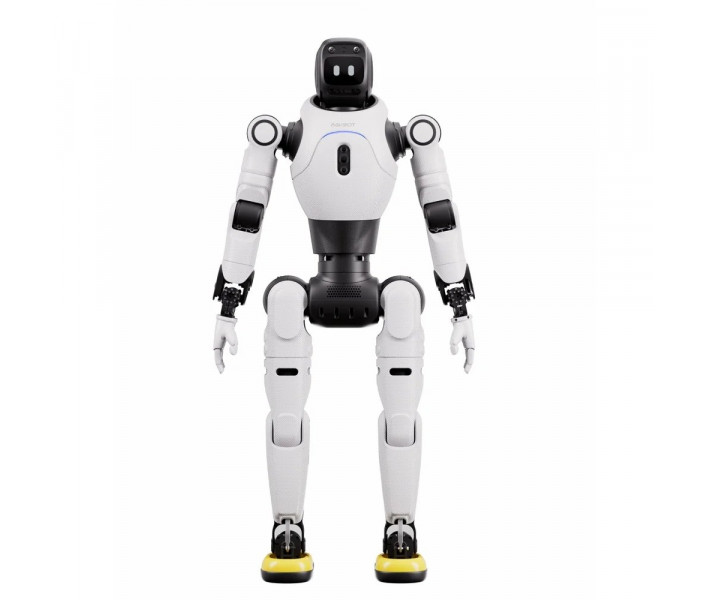
AgiBot X2 Ultra is a humanoid robot for autonomous navigation and dialogue with people. When going round an office, it plans a route and avoids obstacles without remote control. Touching its head triggers an appropriate response, and the head moves in sync with the voice. A large number of degrees of freedom accurately reproduces the logic of human body language.
Key features and benefits
- Degrees of freedom (DoF): 31 — The independent axes of each part of the body allow it to gesture and walk at the same time.
- Payload capacity: max. 3 kg (in certain positions), across the full range ≤ 1 kg (without end effector) — For manipulation across the full range of motion, plan around the lower limit.
- Operating time: approx. 2 h when walking at 0.5 m/s — The swappable battery lets you replace the power cell instead of waiting for it to charge.
- High-performance board: Orin NX (157 TOPS) — The computing headroom leaves room for your own algorithms within secondary development.
- Multimodal interaction: the robot combines visual, voice and tactile signals with facial expressions, so the dialogue is not limited to voice commands and remains natural.
- Autonomous navigation: AgiBot X2 Ultra plans its own route and avoids obstacles, so it works without remote control.
- Software flexibility: support for OTA, a mobile app and secondary development lets you update the software and adapt the robot's behaviour to your own tasks.
Bionic design of the AgiBot X2 Ultra
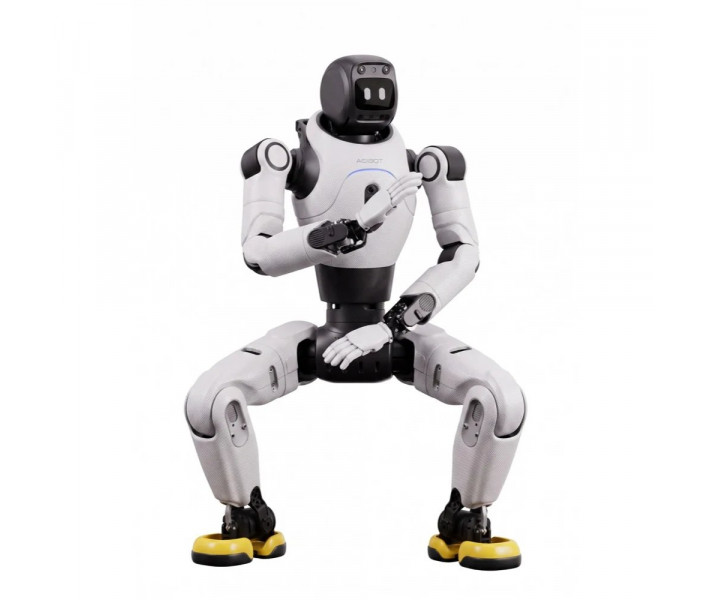
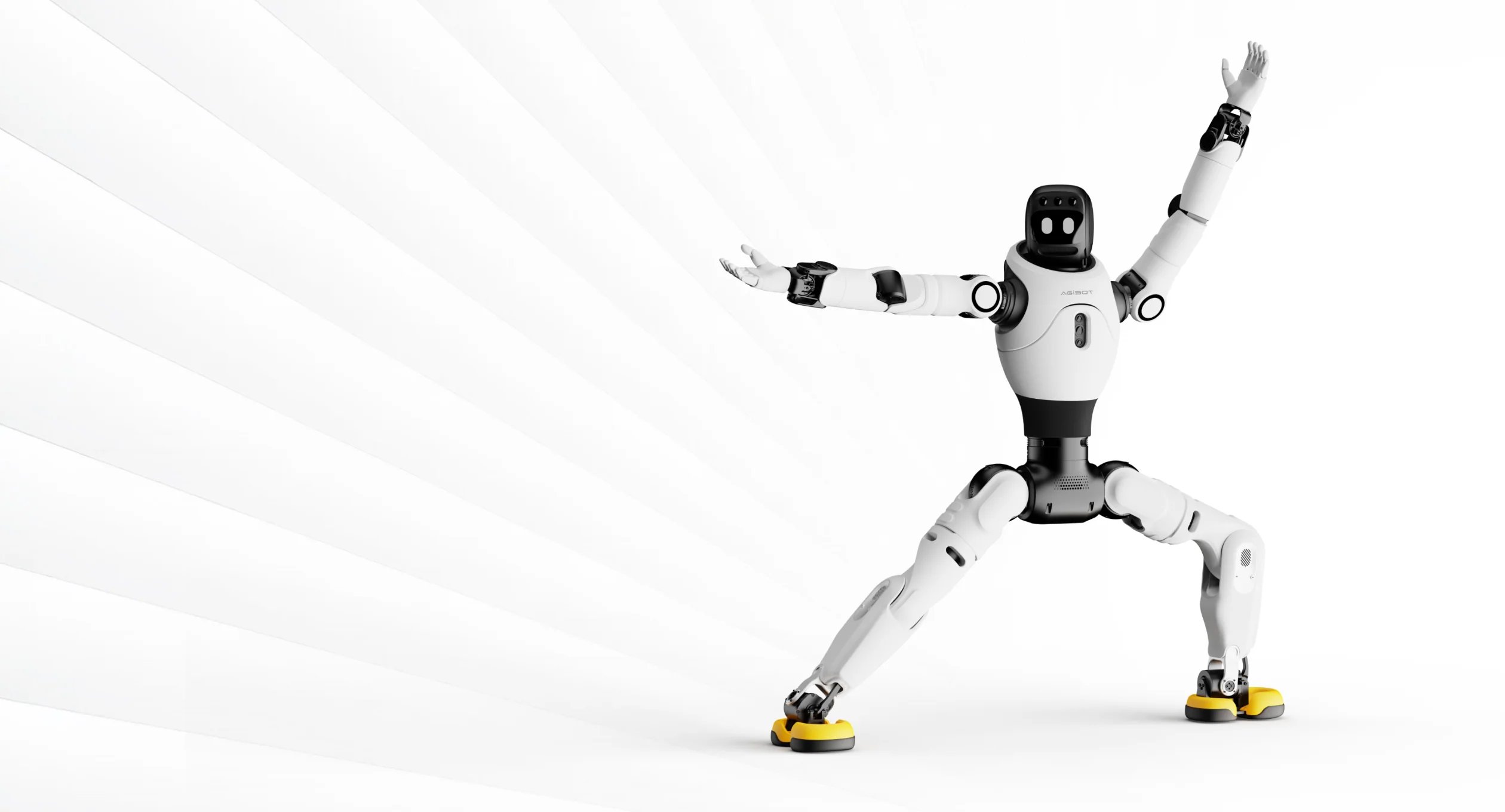
The anthropomorphic design of the AgiBot X2 Ultra reproduces the logic of human body language. The robot has 31 degrees of freedom (DoF — an independent axis of joint movement). The neck has 2 degrees of freedom and the waist has 3. Each arm has 7 degrees and each leg has 6. This number of axes provides flexible movements and expressive motion. The image shows a wide, dynamic stance with multi-axis articulation of the limbs.
Wrists and arms
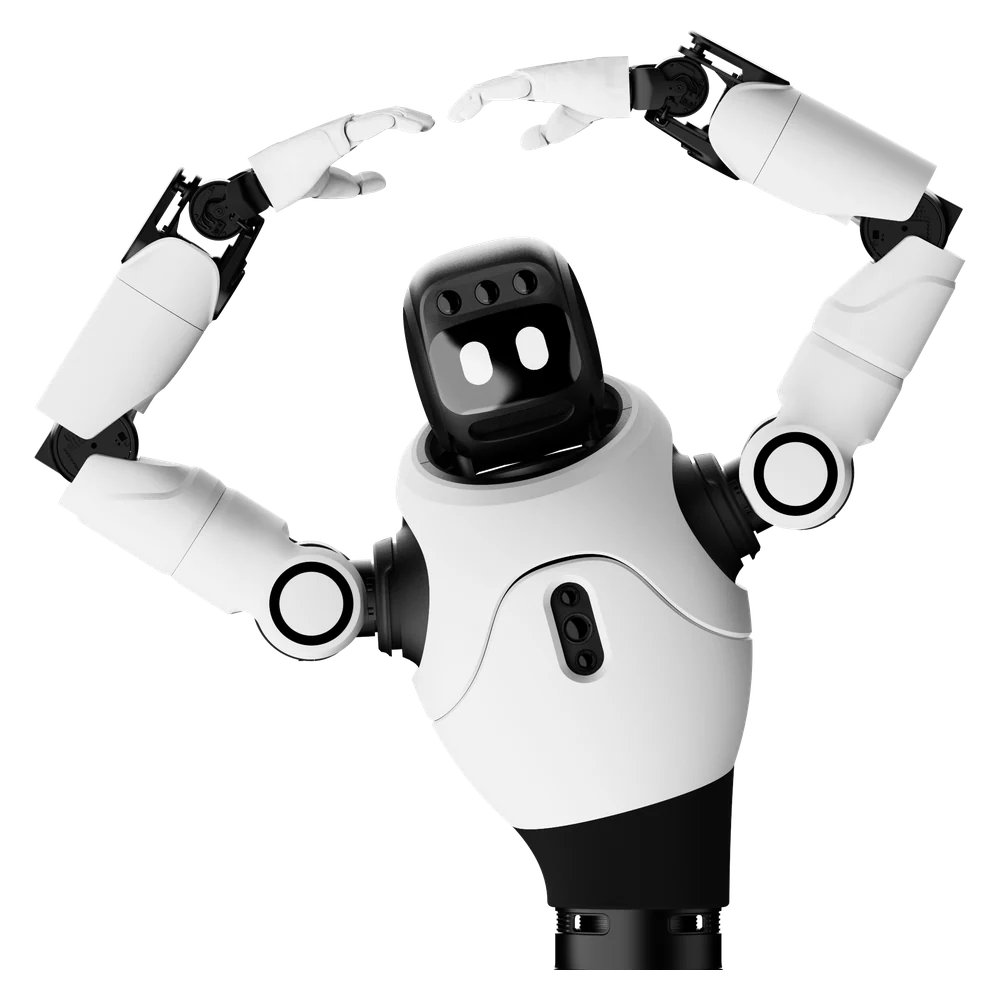
The wrists are built on a crossed-axis layout. Thanks to this, the robot waves and makes a heart shape with both hands, and the interaction looks human. The arm reach is 558 mm without the end effector. The image shows the upper torso and the articulated arms with multi-axis flexibility.
Torso and waist
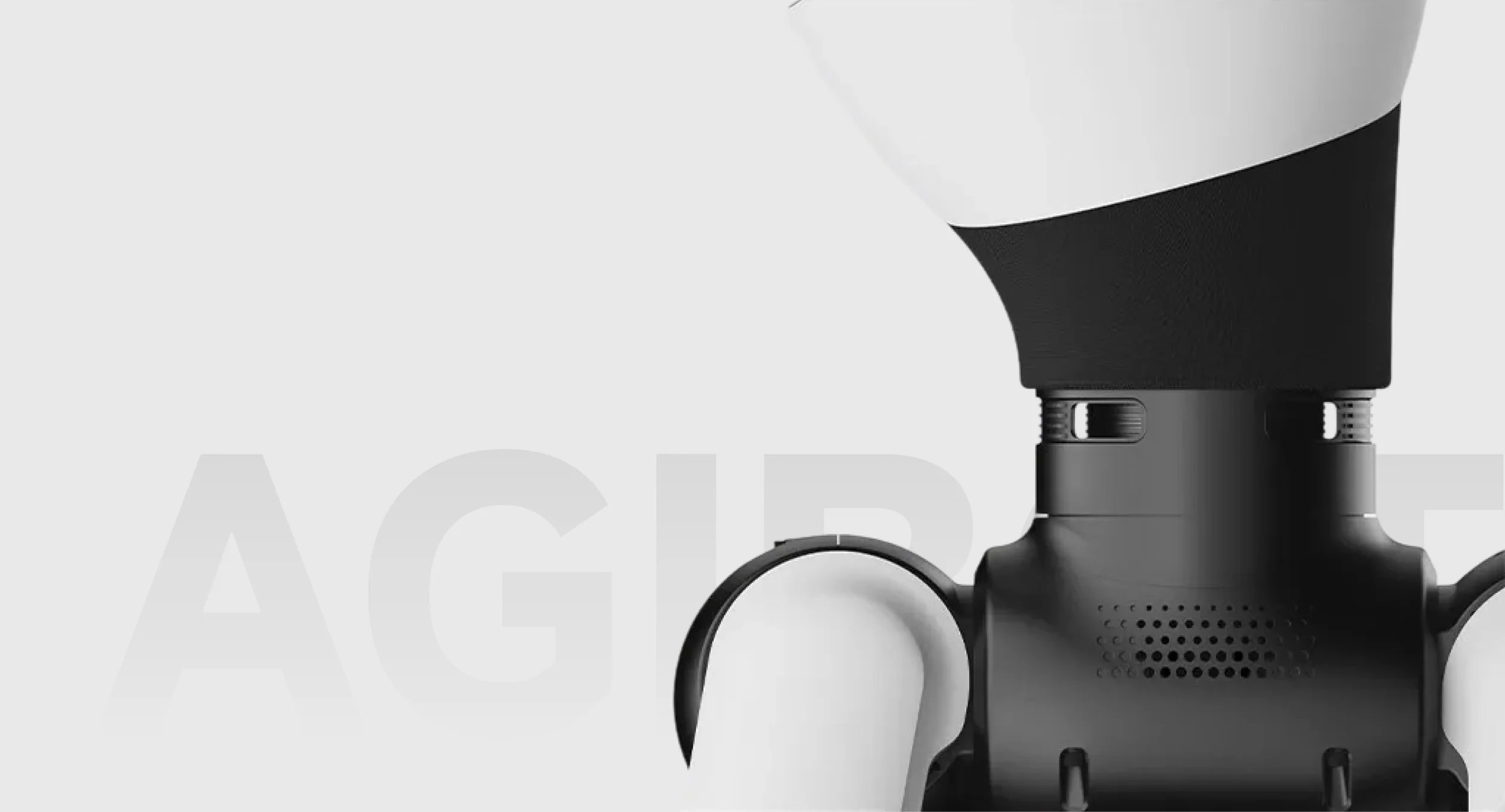
The torso rotates and tilts flexibly, and also leans to the side. When walking, the waist sways naturally, reproducing the rhythm of the human gait. The image shows a close-up of the neck mechanism and the shoulder joint.
Neck and head
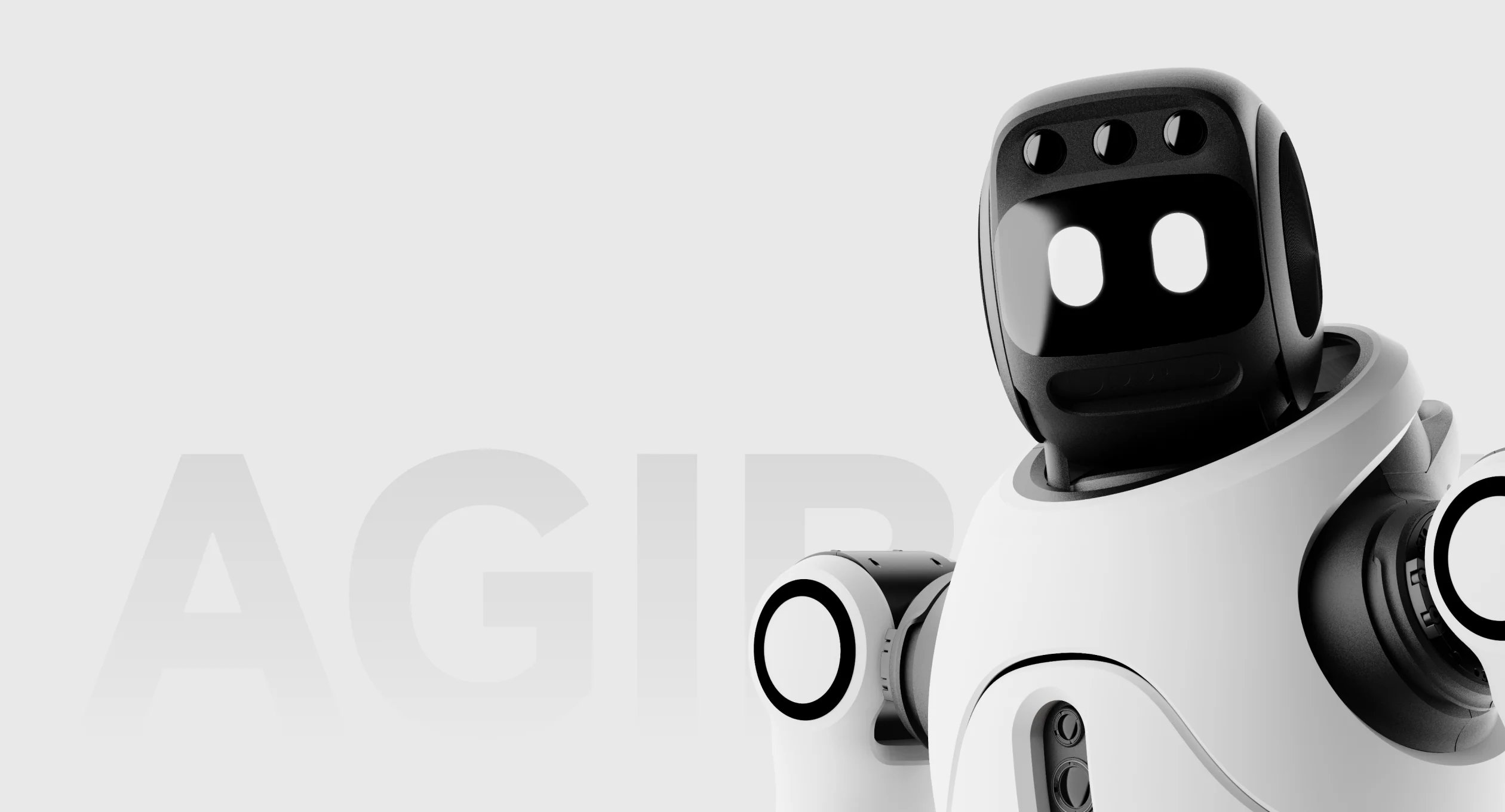
At rest, the head changes direction at random, imitating natural shifts of gaze. Touching the head triggers a corresponding action, which is detected by the head touch sensor. The image shows the head module with the face display and the sensor array.
Multimodal human interaction
This robot perceives people through several channels at once. It analyses the user's gestures and data about the surroundings. Context is also taken into account, so the dialogue comes across as natural in different scenarios.
- Vision: an interactive RGB camera supplies visual data about the person it is talking to.
- Voice: a microphone array, a wireless microphone and a speaker provide voice communication.
- Touch: the head touch sensor registers contact, and the robot responds with an action.
- Facial expression: an interactive screen with light effects visually shows the robot's reaction.
- Mobility: the robot also performs a heart gesture and dance routines.
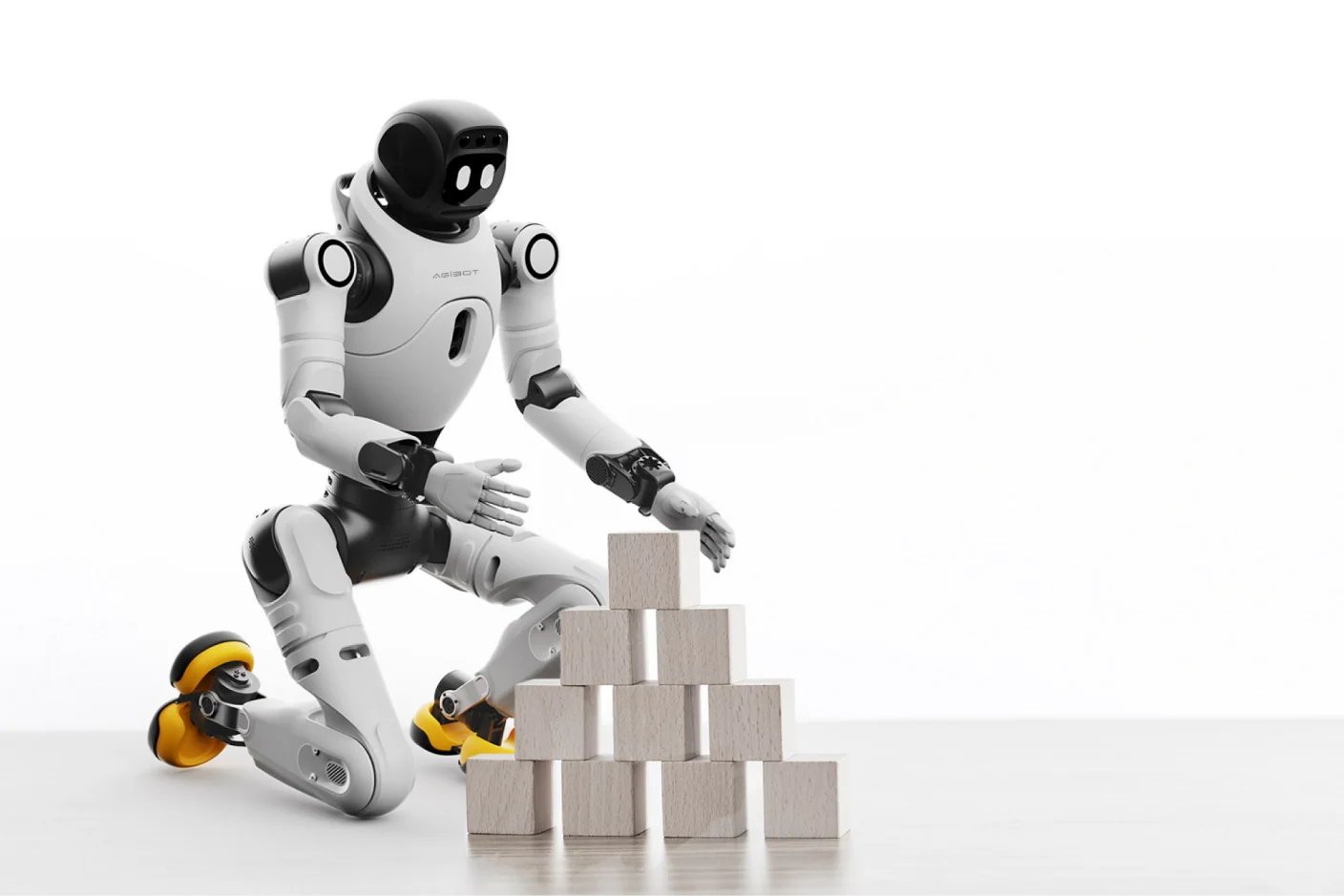
Beyond dialogue, the 7 degrees of freedom in each arm allow it to work with objects. The image shows the robot kneeling and stacking wooden blocks on a flat surface.
Gait and motion
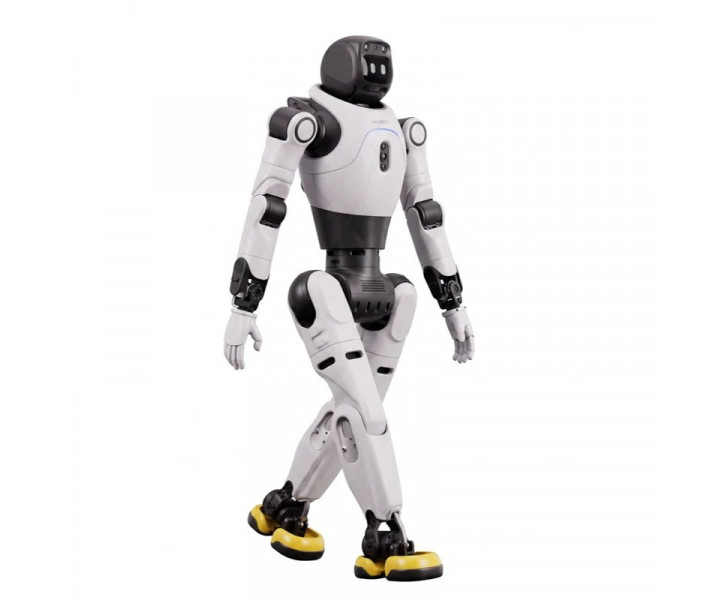
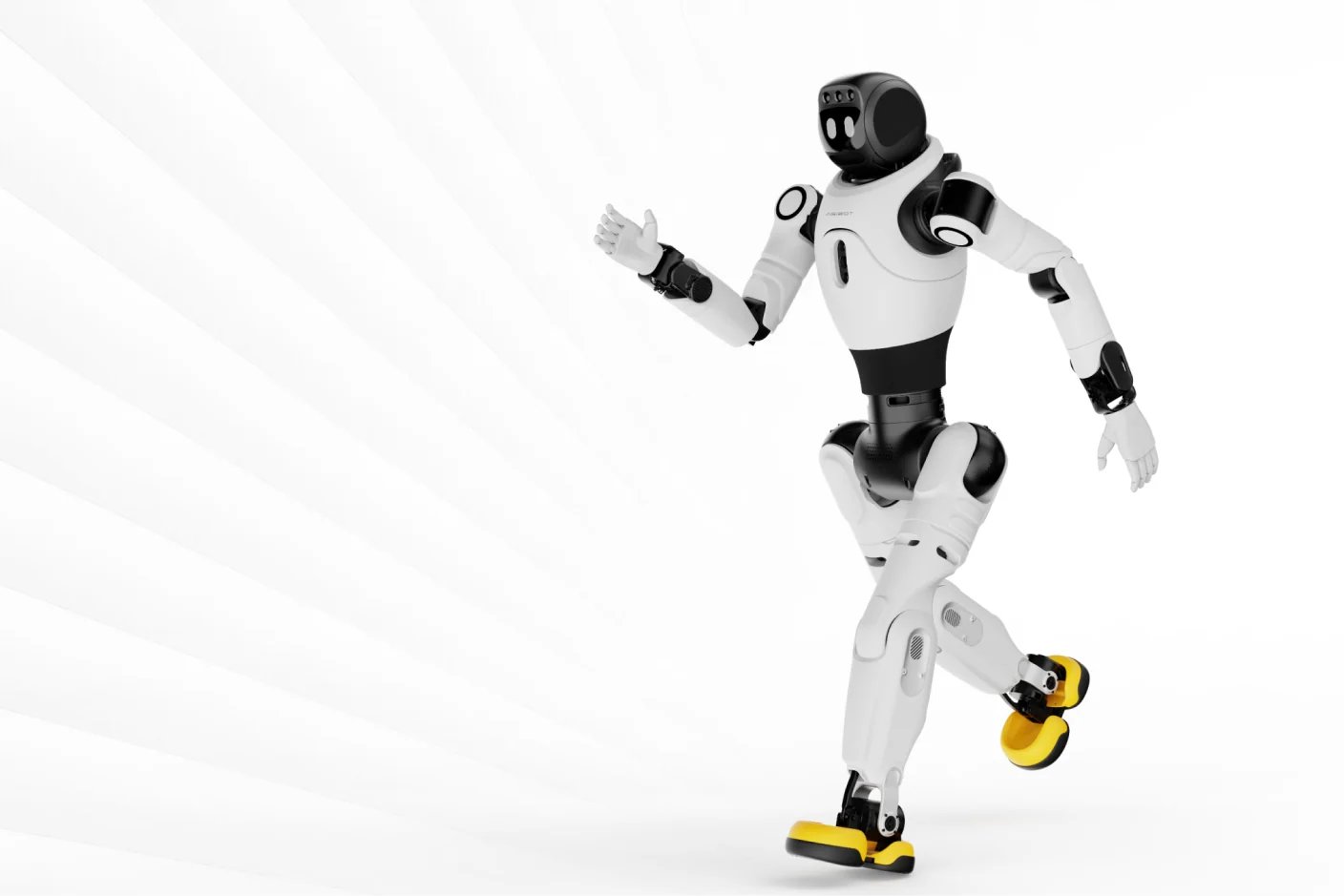
The robot performs a humanoid gait and complex dance routines. Head movements are synchronised with the voice. Each leg has 6 degrees of freedom, and the peak joint torque is 120 N·m. Walking speed is up to 2 m/s under laboratory conditions, while the typical speed does not exceed 0.8 m/s. When calculating routes, use the typical value. The image shows the dynamic gait of the biped robot against a white studio background.
Autonomous task execution
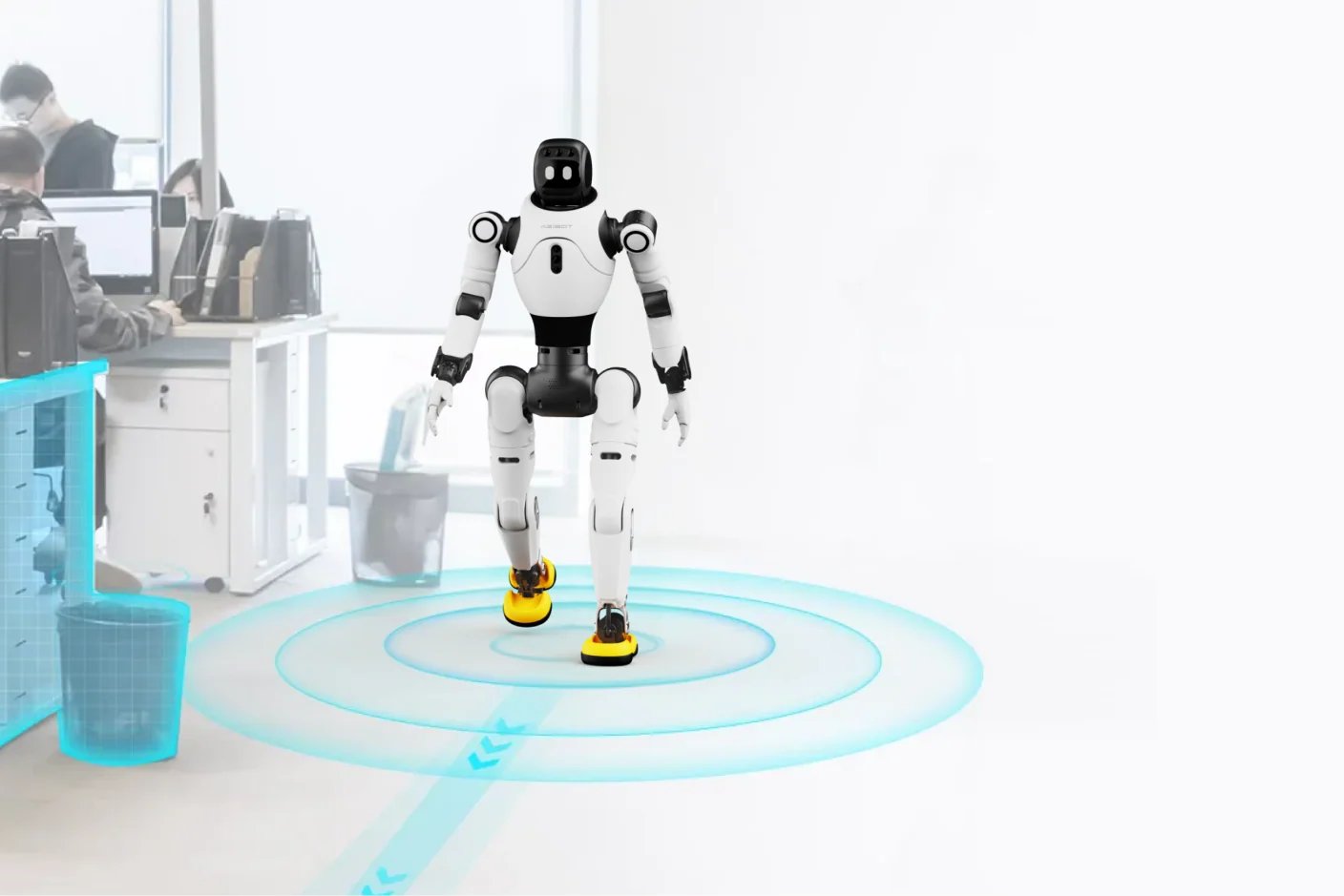
This model moves around autonomously and proactively avoids obstacles. Decisions are made by algorithms, so no remote control is needed for operation. Space is perceived by a 3D lidar and an RGB-D camera. These are complemented by a front dual RGB camera and a rear RGB camera. The image shows navigation through a room, obstacle avoidance and path planning in an office environment.
Hardware platform
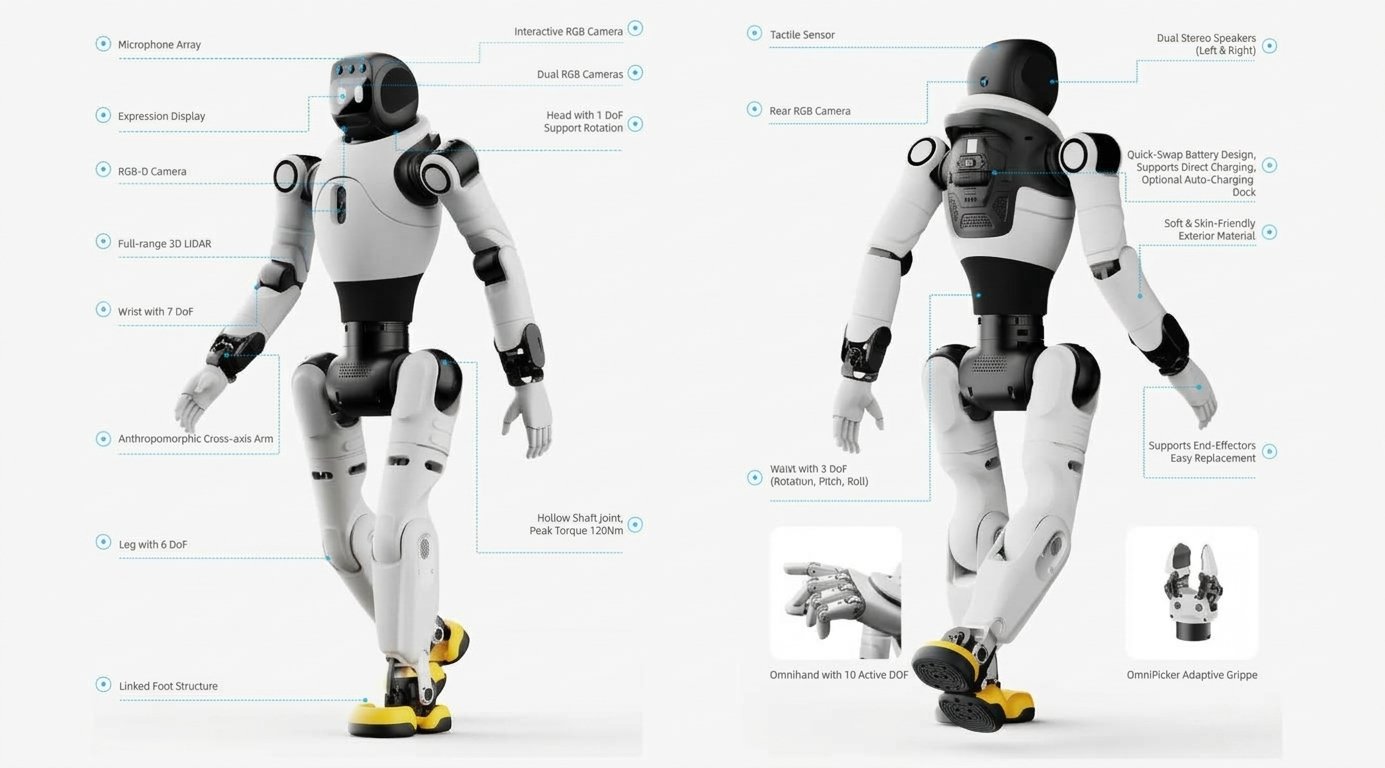
The hardware platform combines the sensor suite and the computing module. Power is supplied by a swappable battery, and the operating temperature range is from -10 °C to 40 °C. The infographic shows the anatomy of the humanoid robot. It details the sensors and degrees of freedom, as well as the swappable battery and modular end effectors.
Computing and interfaces
The computing core consists of two RK3588 boards. They are complemented by the high-performance Orin NX board; the TOPS unit stands for trillions of operations per second. For peripherals, there are 2 USB Type-A ports, 2 USB Type-C ports and 2 RJ45 ports. The Mini DP output is intended for a video signal. For additional equipment, there are 12 V/3 A and 48 V/5 A power outputs.
Power supply
The battery has a capacity of approx. 500 Wh. Two power options are provided: direct charging and battery replacement. Charging time is no more than 1.5 h. The charger accepts 100~220 V and delivers 54.6 V, 10 A.
Software and connectivity
AgiBot X2 Ultra supports over-the-air (OTA) software updates, so updates do not require a cable connection. A mobile app is supported, and a handheld controller is included. Wireless connectivity is provided by Wi-Fi and Bluetooth. A 4G/5G module is also fitted. Support for secondary development allows you to adapt the robot's behaviour to your own tasks.
Applications
- Navigating an office space: the robot plans its own route and avoids obstacles, so it does not need an operator with a controller. A 3D lidar and an RGB-D camera give it the spatial data for orientation.
- Voice dialogue with people: a microphone array and a speaker provide voice communication, while the head touch sensor registers contact. An interactive screen with light effects shows the robot's reaction.
- Gesture and choreography demonstrations: waving, the "heart" gesture with both hands and dance routines are performed thanks to the 31 degrees of freedom and the crossed-axis wrist layout.
- Practising object manipulation: each arm has 7 degrees of freedom and a reach of 558 mm without the end effector. This makes it possible to reproduce tasks such as stacking wooden blocks.
- Secondary development and research: support for secondary development and the Orin NX board with 157 TOPS make it possible to run your own algorithms. The USB, LAN and Mini DP ports allow you to connect peripherals.
What's in the box?
- AgiBot X2 Ultra robot — 1 pc
- Charger — 1 pc
- Microphone — 1 pc
- Quick user guide — 1 pc
- Certificate of conformity — 1 pc
- Battery — 1 pc
- Certificate of conformity (in the battery packaging) — 1 pc
- Handheld controller
The video below is about humanoid robots in a football setting. Watch it to see humanoid platforms in motion.