

- Stock: In stock
- Product code: 920372000001458751
- Weight Brutto: 30.00kg

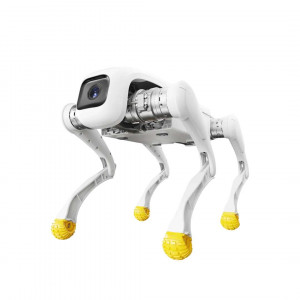
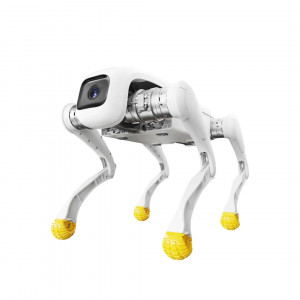
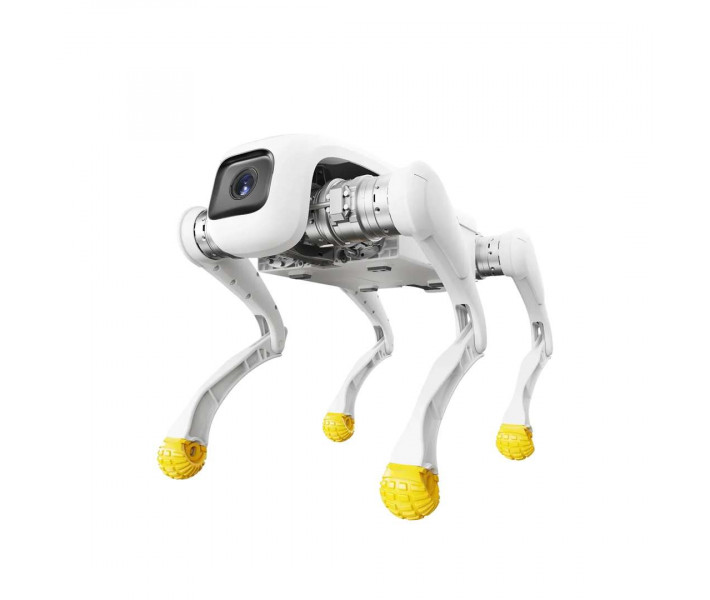
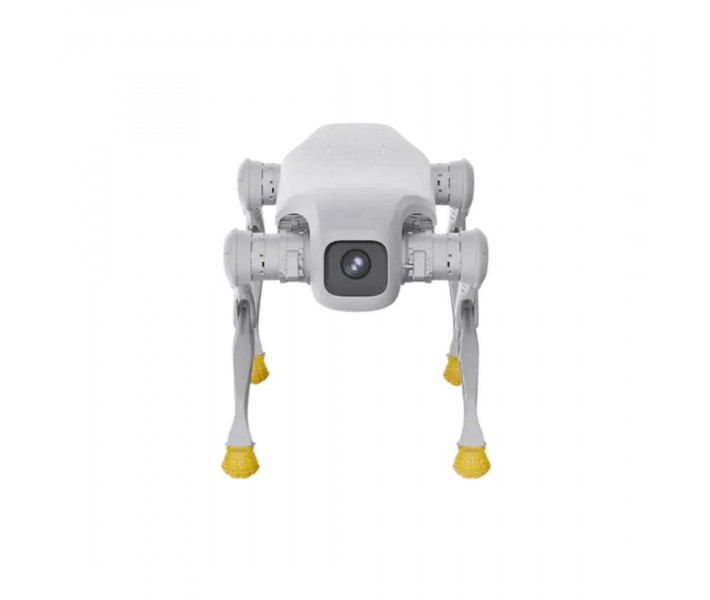
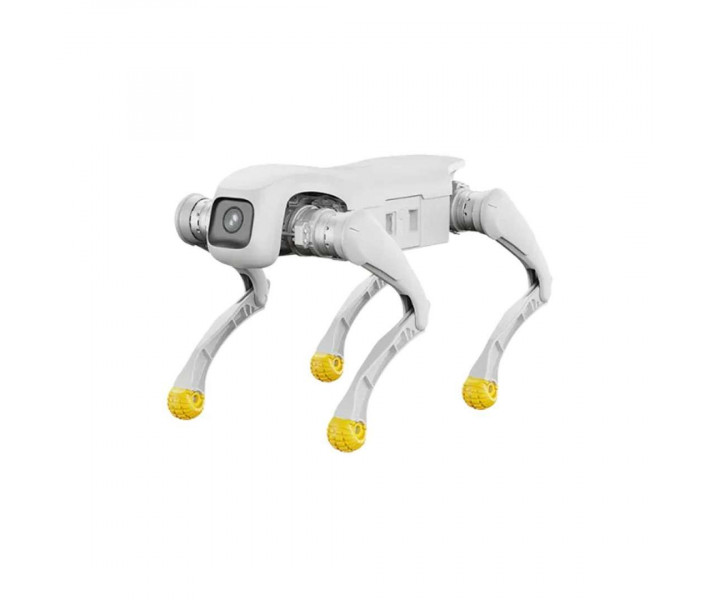
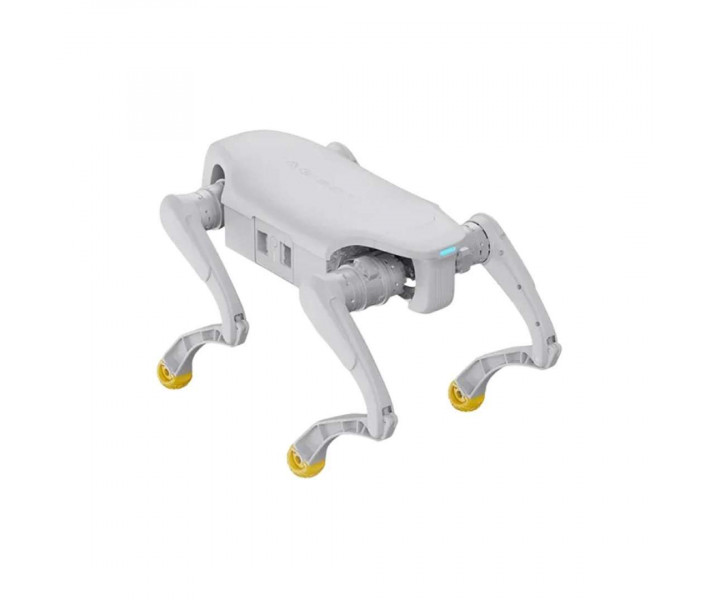
AgiBot D1 Edu — a quadruped robot for research and education with an SDK kit. Joint zero calibration is not required here: the dual encoder allows it to work immediately after power-on. Standardised interfaces make it possible to integrate modules and payloads. The URDF model enables simulation and testing in Isaac Sim and MuJoCo.
Key features and benefits
- Maximum joint torque: 48 N·m — The joint motors maintain reliable operation on difficult terrain and under heavy load.
- Payload: 5 kg — This capacity allows additional modules to be mounted on the platform, including LiDAR or depth cameras.
- Battery life: 1–2 h — The quick-swap battery lets you resume operation by replacing the battery instead of waiting for it to charge.
- Impact-resistant joints: the modules have passed millions of impact-cycle tests, so they offer a long service life under intensive use.
- Terrain adaptation: the RL gait algorithm adapts independently to difficult terrain, while self-balancing and fall protection maintain stability.
- Module integration: the Edu version's SDK and standardised interfaces allow you to connect hardware to the AgiBot D1 Edu and test solutions in simulators.
AgiBot D1 Edu mobility on difficult terrain
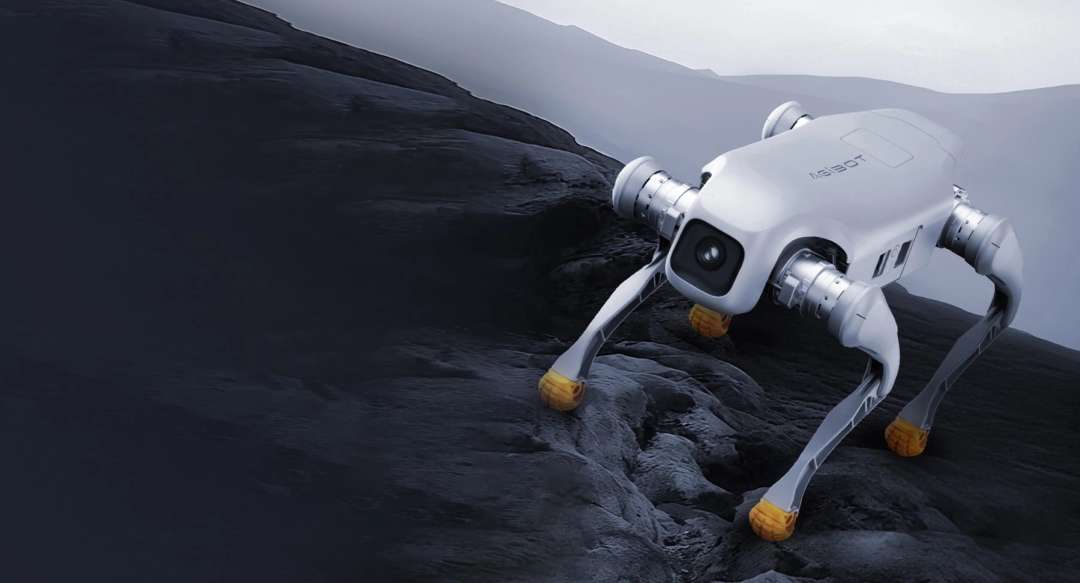
The RL (reinforcement learning) based gait control algorithm adapts independently to varied and difficult terrain. The robot can be controlled from a remote controller with a joystick or from an app (APP).
The image shows a white quadruped robot with orange feet climbing a dark rocky slope.
Balance and recovery
The self-balancing system keeps the body stable during movement. Fall protection and obstacle resistance work together with it. Fall recovery support is implemented separately.
Dynamics and climbing
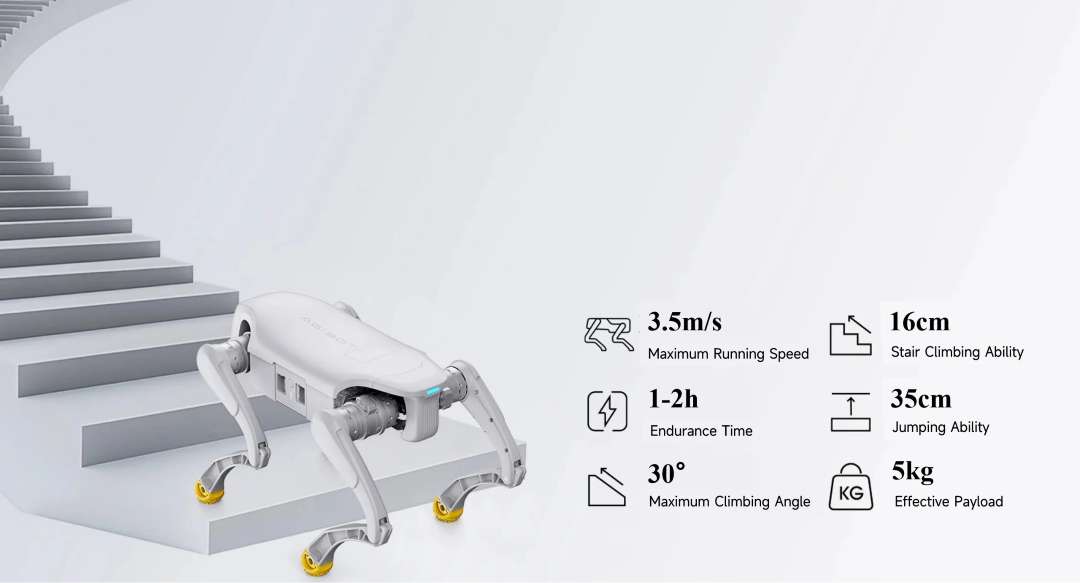
The maximum speed is 3.5 m/s, and the vertical jump height is 35 cm. The continuous stair-climbing height is 16 cm, and the maximum climbing angle is 30°.
The standard set of movements includes damping mode and pitch and height adjustment. Special movements include a forward jump and an upward jump. For performances, a backflip and a two-legged handstand are available.
The image shows a white quadruped robot climbing stairs, with its key performance figures displayed alongside.
Joint modules and drive
The drive is built around a motor module with high power density. The design uses 12 precision joint motors in an aluminium housing. The total number of degrees of freedom is also 12, 3 per leg.
The image shows a white quadruped robot with exposed joint modules, highlighting impact resistance and calibration-free start-up.
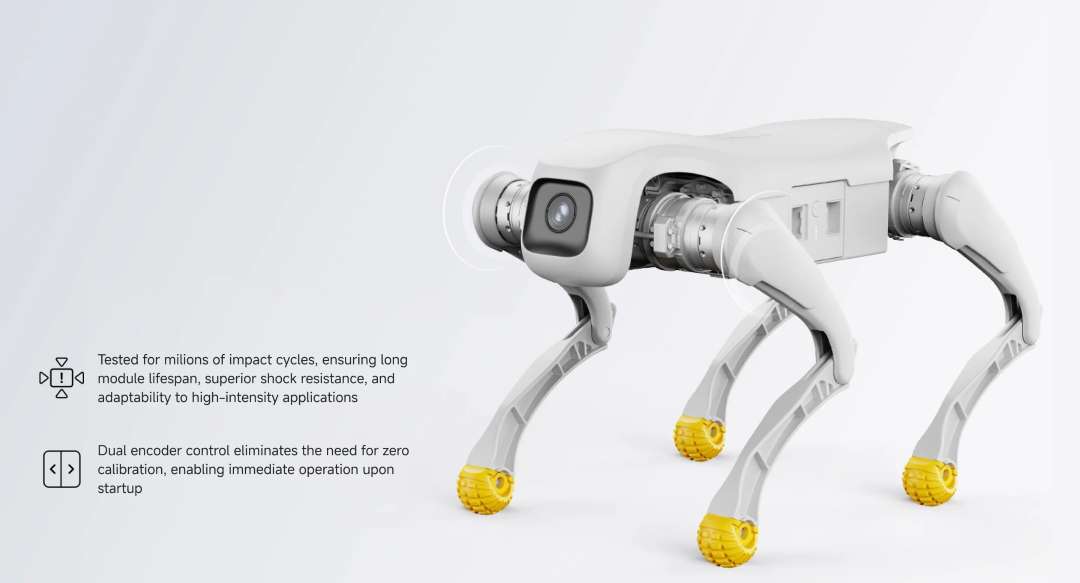
Tests of millions of impact cycles confirm the long service life of the modules. They also demonstrate resistance to impacts and suitability for intensive use.
The dual encoder (a sensor that measures the angular position of a shaft) eliminates the need for zero calibration. The start-up procedure therefore comes down to switching on the power.
The joint motion ranges determine the leg kinematics.
- Body: from -28° to 28°.
- Thigh: from -170° to 66°.
- Shank: from 35° to 156°.
Software, SDK and connectivity
The AgiBot D1 Edu edition comes with an SDK kit for development and payload integration. A comprehensive software interface supports secondary development.
URDF modelling (a format describing the robot's kinematics and geometry) supports simulation and testing in Isaac Sim and MuJoCo. Standardised interfaces allow you to develop scenarios for a variety of applications.
Connectivity is provided by Wi-Fi 5.0 and Bluetooth 5.0. The camera has a resolution of 1920 × 1080 and a wide-angle view with a field of view of DFOV 122°, HFOV 111°, VFOV 70°. The image is transmitted in real time.
Core computing power is provided by a high-performance 8-core processor. The hardware expansion also includes an additional computing platform.
The image shows a white quadruped robot with a front camera standing on a printed-circuit-board-style platform.
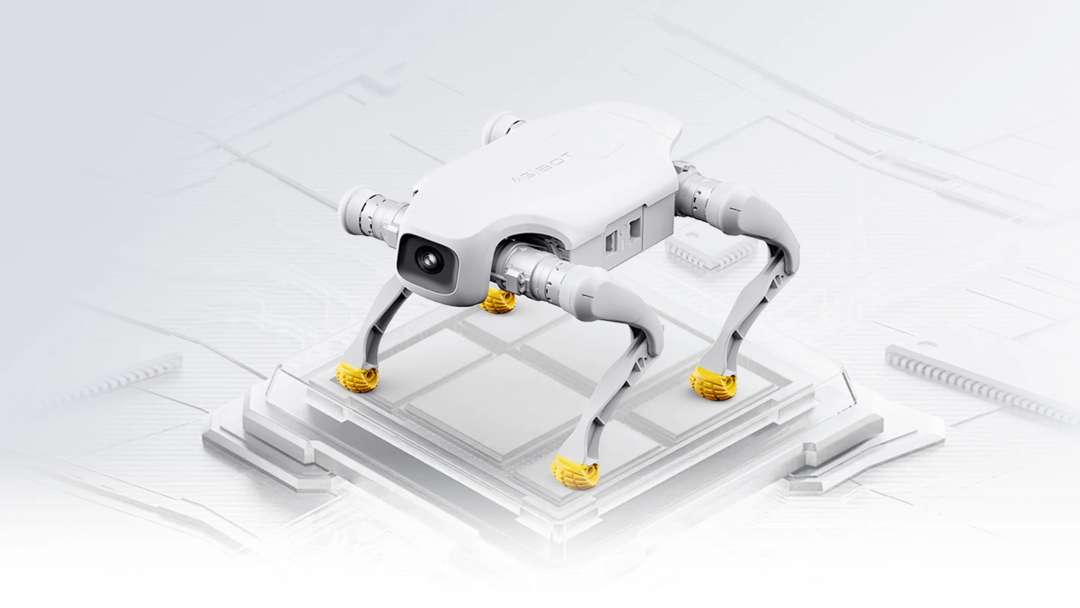
Construction and power
The body is made of aluminium alloy with high-strength engineering plastic. The weight with the battery is 15.5 kg.
In the standing position, the dimensions are 635 mm × 360 mm × 420 mm. In the lying position, they are 675 mm × 435 mm × 145 mm. The operating temperature is from 0 °C to 40 °C.
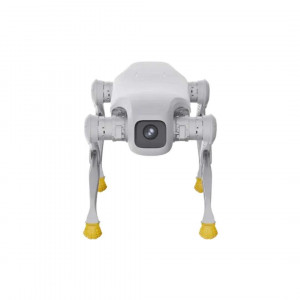
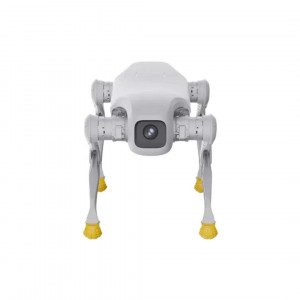
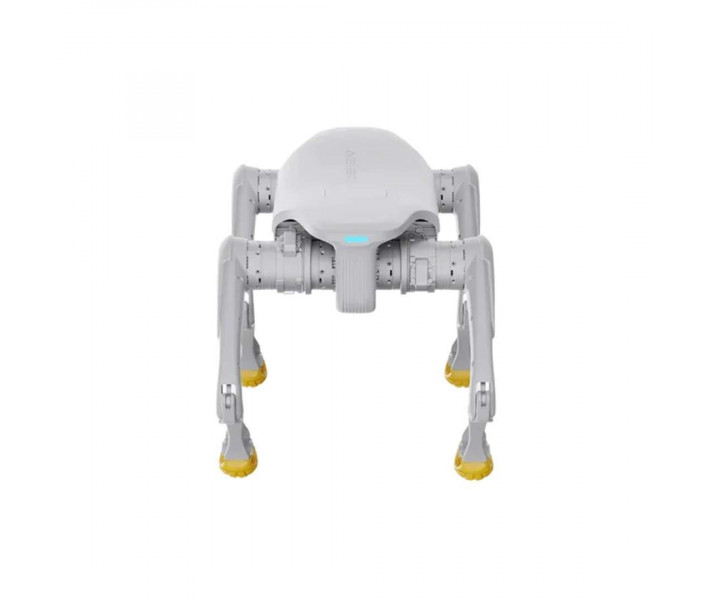
The image shows a rear view: the robot stands on four articulated legs with yellow feet and turquoise lighting.
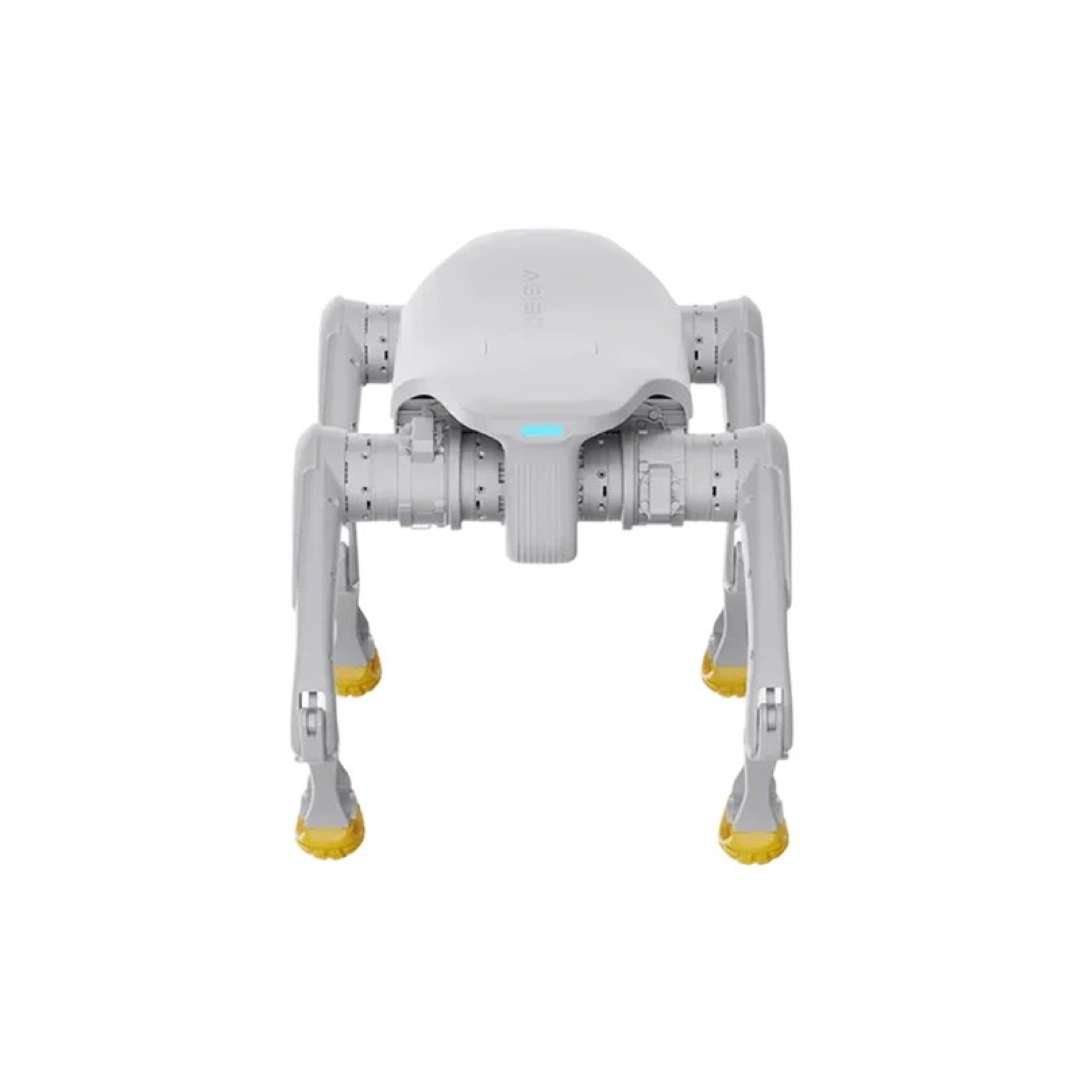
The quick-swap battery has a nominal capacity of 4.6 A·h and a voltage of 43.2 V. Charging from 10 % to 90 % takes about 1 h. The battery life is 1–2 h, and the operating range is 6 km ± 1 km. The maximum operating power reaches 3500 W.
Applications
The main application scenarios for the AgiBot D1 Edu are scientific research, education and entertainment performances.
The image shows a white quadruped robot with a front camera standing in a futuristic control room with workstations.
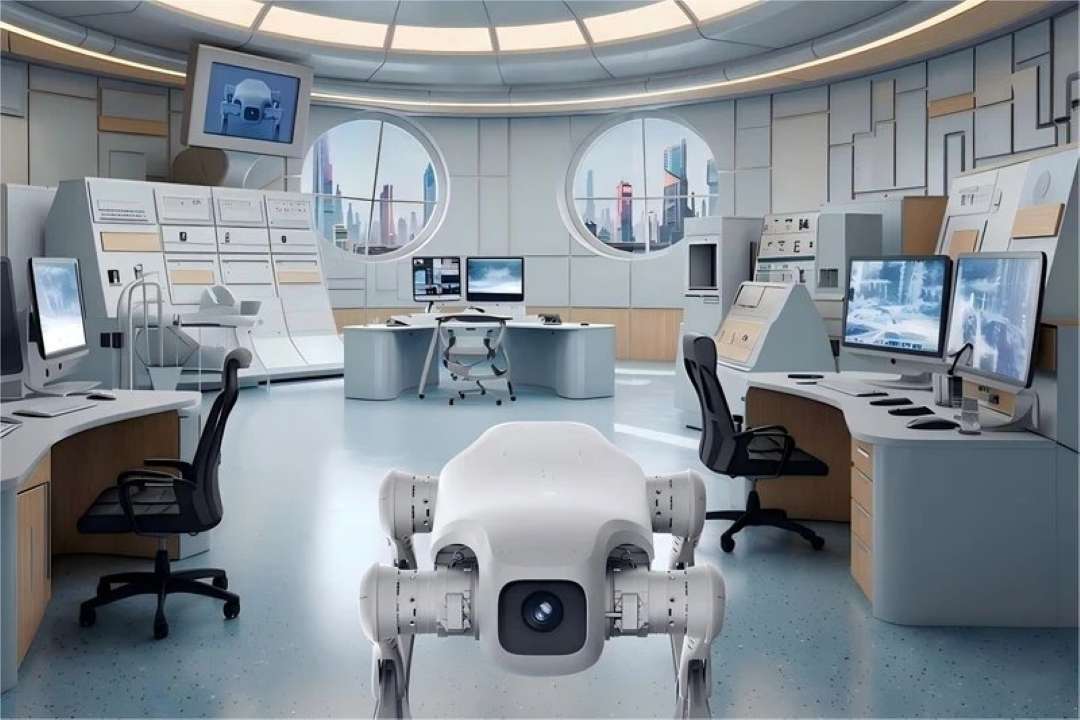
The image shows three quadruped robots wearing festive heads for a Chinese lion dance.

- Scientific research: the SDK kit, URDF model and simulation in Isaac Sim and MuJoCo allow you to develop and verify algorithms in a virtual environment.
- Educational laboratories: standardised interfaces and the SDK allow you to build teaching projects with real modules, including LiDAR and depth cameras.
- Entertainment performances: the platform performs a backflip and a two-legged handstand. The remote controller with a joystick lets you control it manually during a show.
- Payload development: a payload of up to 5 kg and additional modules connect via standardised interfaces and expansion ports.
- Testing on difficult terrain: the RL gait adapts to slopes and uneven surfaces, while stair climbing and an angle of up to 30° allow you to test mobility in real-world conditions.
Compatible modules and accessories
The AgiBot D1 Edu supports various modules via standardised interfaces.
The diagram labels the front camera and the hardware expansion elements of the white quadruped robot.
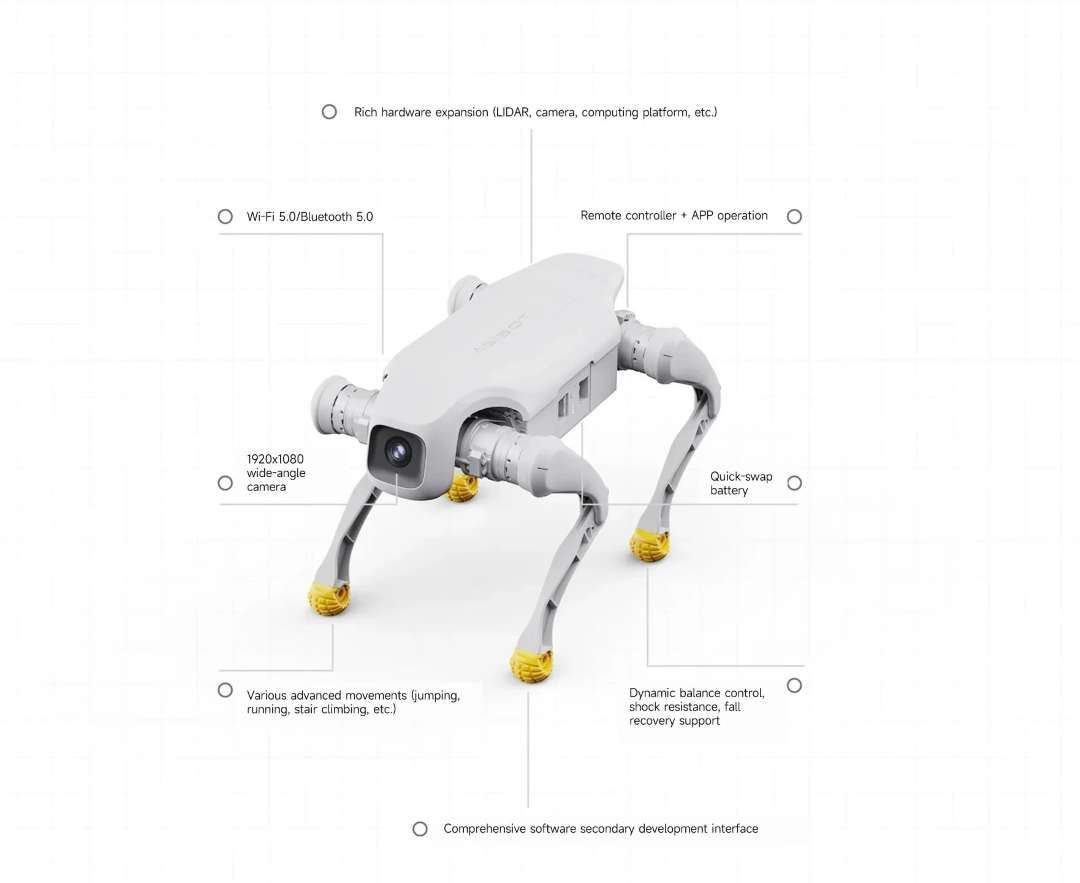
- Navigation: positioning modules and RTK modules.
- Perception: LiDAR and depth cameras.
- Communication: 4G/5G modules and image transmission modules.
- Expansion ports: Ethernet × 1, USB × 2, power port × 2, SBUS × 1, UART × 1.
What's in the box?
- D1 Robot Dog robotic platform — 1 pc.
- Charger — 1 pc.
- Handheld remote controller — 1 pc.
Technical specifications
Construction and dimensions
| Parameter | Value |
| Material | Aluminium alloy with high-strength engineering plastic |
| Dimensions in standing position (L×W×H) | 635 mm × 360 mm × 420 mm |
| Dimensions in lying position (L×W×H) | 675 mm × 435 mm × 145 mm |
| Total weight (with battery) | 15.5 kg |
| Operating temperature | 0 °C – 40 °C |
Mobility and dynamics
| Parameter | Value |
| Degrees of freedom | Whole machine: 12, each leg: 3 |
| Maximum speed | 3.5 m/s |
| Payload | 5 kg |
| Continuous stair-climbing height | 16 cm |
| Maximum climbing angle | 30° |
| Vertical jump height | 35 cm |
| Standard movements | Standing, lying, damping mode, pitch adjustment, height adjustment, horizontal turning |
| Special movements | Forward jump, upward jump, two-legged handstand, backflip, waving, etc. |
Drive and joints
| Parameter | Value |
| Drive type | Motor module with high power density |
| Maximum joint torque | 48 N·m |
| Precision joint motor in aluminium housing | 12 |
| Joint motion range (body) | -28° – 28° |
| Joint motion range (thigh) | -170° – 66° |
| Joint motion range (shank) | 35° – 156° |
Power and battery life
| Parameter | Value |
| Charging time | about 1 h (charge level 10 %-90 %) |
| Battery life (operating time) | 1–2 h |
| Operating range | 6 km ± 1 km |
| Maximum operating power | 3500 W |
| Battery | Nominal capacity: 4.6 A·h, voltage: 43.2 V |
| Power adapter | Standard |
| Charging dock | Standard |
Computing, camera and control
| Parameter | Value |
| Core computing power | High-performance 8-core processor |
| Camera field of view (FOV) | DFOV 122°, HFOV 111°, VFOV 70° |
| IMU | Standard version |
| Real-time image transmission | Supported |
| Secondary development (SDK) | Supported |
| Function expansion ports | Ethernet × 1, USB × 2, power port × 2, SBUS × 1, UART × 1 |
| Remote controller | Remote controller with joystick |
| Warranty period | 1 year |
Why buy the AgiBot D1 Edu from EXPERT3D?
EXPERT3D has supplied professional 3D equipment since 2012. Our specialists will advise you on choosing and configuring the AgiBot D1 Edu before purchase. The warranty period for the device is 1 year. We provide delivery throughout Spain and the EU countries. After purchase, we offer service support. Order spare parts and consumables on the website: we will promptly deliver everything so that your equipment does not stand idle.