

- Stock: In stock
- Product code: 920372000001458724
- Weight Brutto: 30.00kg

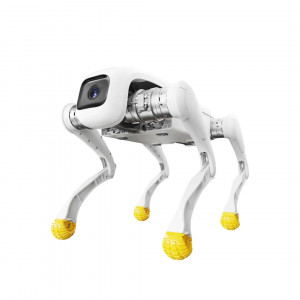
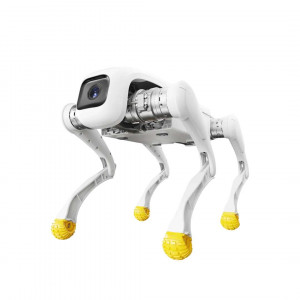
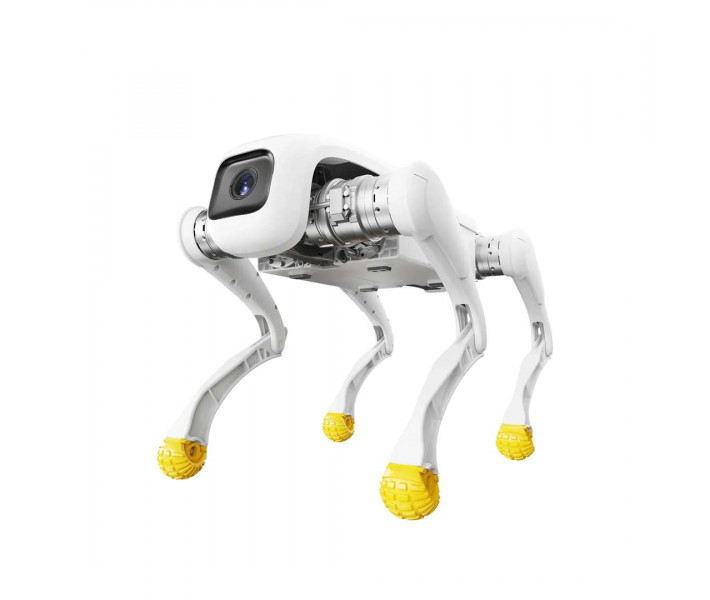
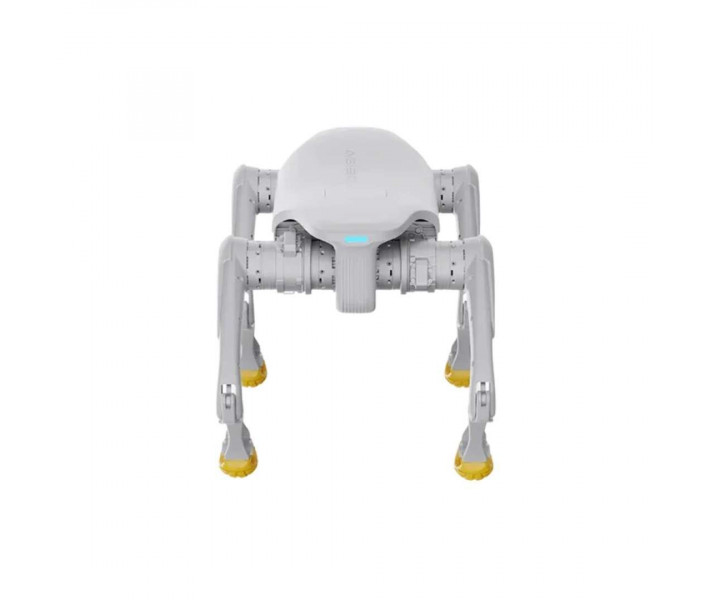
AgiBot D1 Pro — a quadruped research platform with self-balancing and a quick-swap battery. A research team mounts a LiDAR module or a camera on the body. Reinforcement-learning-based gait control adapts on its own to stairs and uneven ground. The operator drives the robot from the remote controller or the app.
Key features and benefits
- Maximum joint torque: 48 N·m — The joint drive provides a torque reserve for work on difficult terrain and under heavy load.
- Payload: 5 kg — This is the mass limit for additional equipment that the platform carries while moving.
- Battery runtime: 1–2 hours — This is the interval to plan for one test session before the battery needs replacing.
- Endurance: the quick-swap battery of the AgiBot D1 Pro lets you continue a session after replacing it. Charging from 10% to 90% takes about 1 hour.
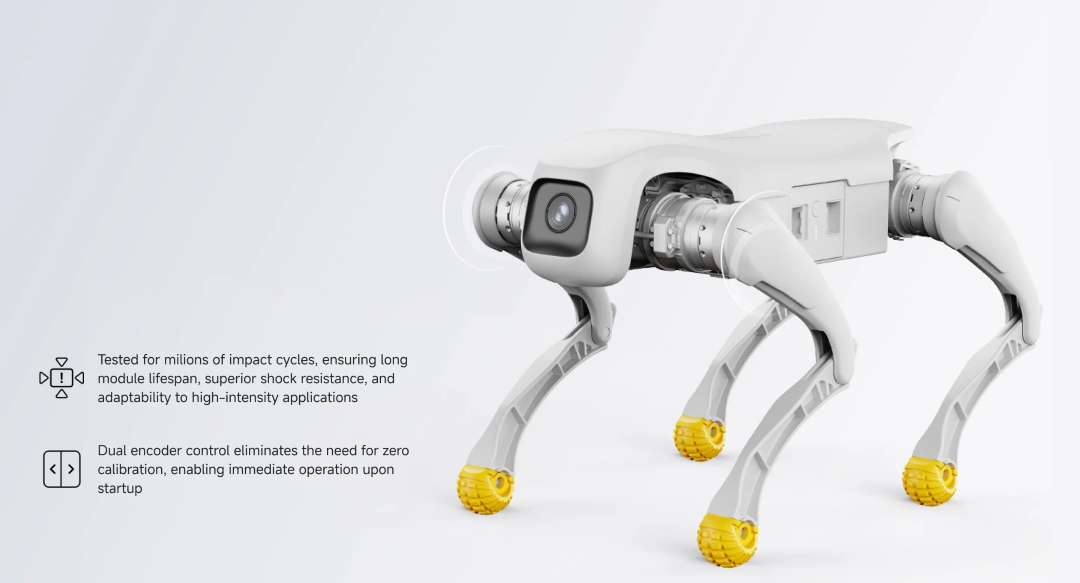
- Calibration-free start-up: dual-encoder control removes the need for zero calibration, so the robot is ready for work immediately after power-on.
- Remote control: the joystick controller and the app give two ways to operate the robot at a distance.
How the AgiBot D1 Pro handles difficult terrain
Autonomous terrain adaptation rests on two components. The first is the gait algorithm, the second is the joint power modules.
Gait control
The gait algorithm is built on reinforcement learning (RL). This is a method in which the algorithm improves its movements through interaction with the environment. As a result, the platform adapts on its own to varied and difficult terrain.
Self-balancing keeps the body in a stable position. Fall protection and resistance to external disturbances complement this mechanism. Dynamic balance control works together with fall recovery support.
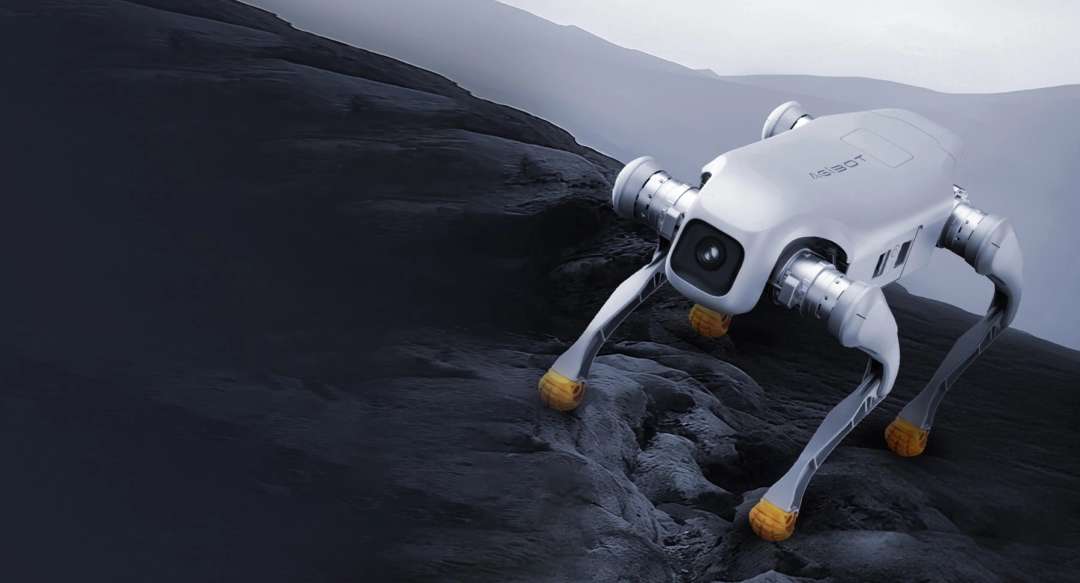
Movement across uneven rocky ground outdoors is captured in the image below. This kind of terrain is among the scenarios the gait control system is designed for.
Speed and obstacle clearance
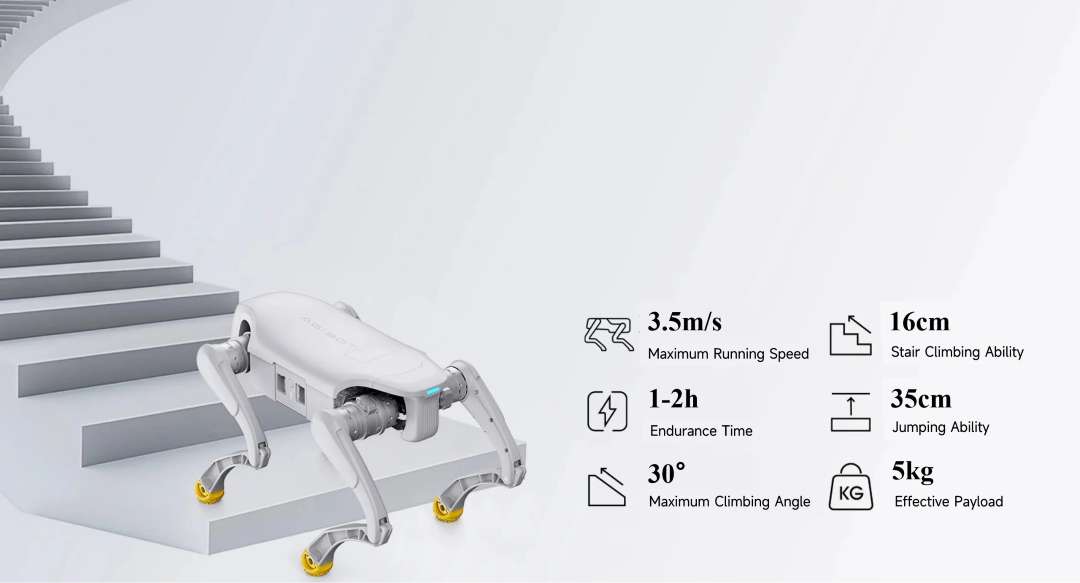
The AgiBot D1 Pro reaches up to 3.5 m/s. The platform climbs steps up to 16 cm high continuously. The maximum climbing angle is 30°, and the upward jump reaches 35 cm.
In the next image, the platform moves up a staircase. The image highlights its agility and climbing ability.
Joint drive and impact resistance
The motion section is made up of 12 precision joint motors in an aluminium alloy housing. This is a high power-density motion module, that is, one with high power relative to its own mass. Such a drive provides a reserve of strength for difficult terrain.
The image highlights the impact-resistant leg joint modules. It also shows the dual-encoder control.
Joint range of motion
The platform has 12 degrees of freedom, 3 per leg. A degree of freedom is an independent direction of joint movement. The body joint moves from -28° to 28°. For the thigh, the range is from -170° to 66°, and for the shank, from 35° to 156°.
Service life and impact resistance
The modules have been tested for millions of impact-load cycles. This extends the module's service life and increases its resistance to shocks. The drive is therefore suited to intensive use.
Control, vision and connectivity
The platform supports Wi-Fi 5.0 and Bluetooth 5.0. Real-time image transmission is also supported, so a video stream is available during operation.
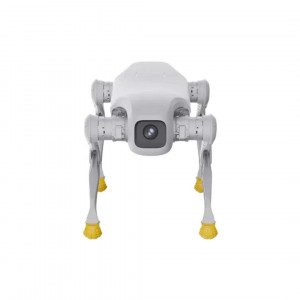
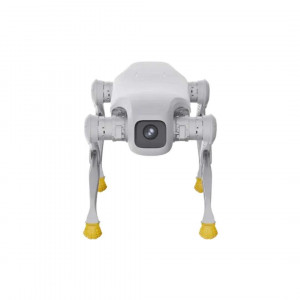
The wide-angle camera has a resolution of 1920 × 1080. The diagonal field of view (DFOV) is 122°. The horizontal (HFOV) is 111°, and the vertical (VFOV) is 70°.
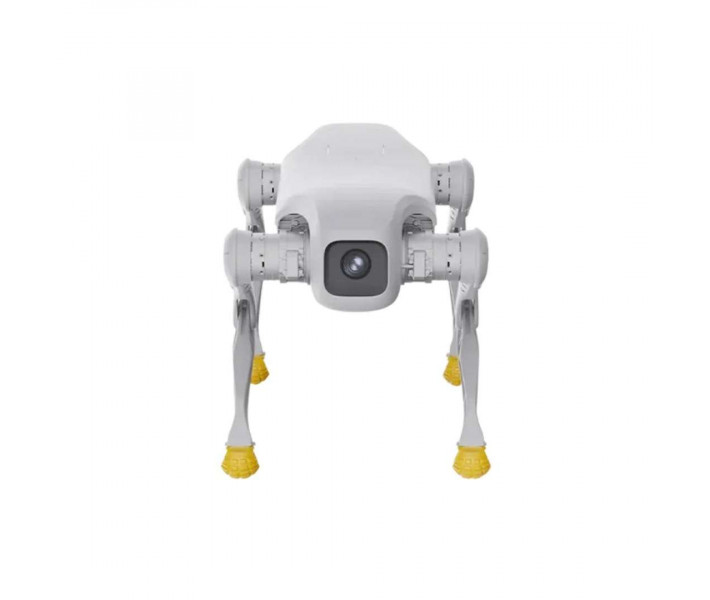
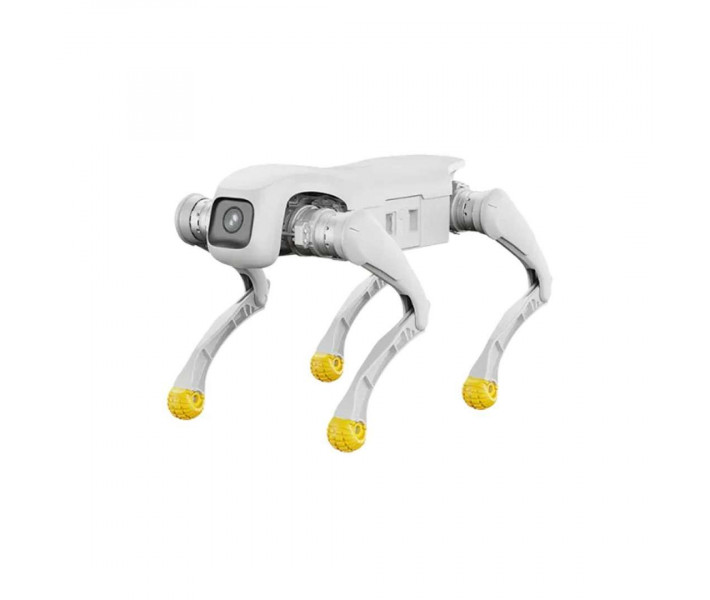
The camera is located at the front of the body. The image shows it together with the articulated legs and yellow feet.
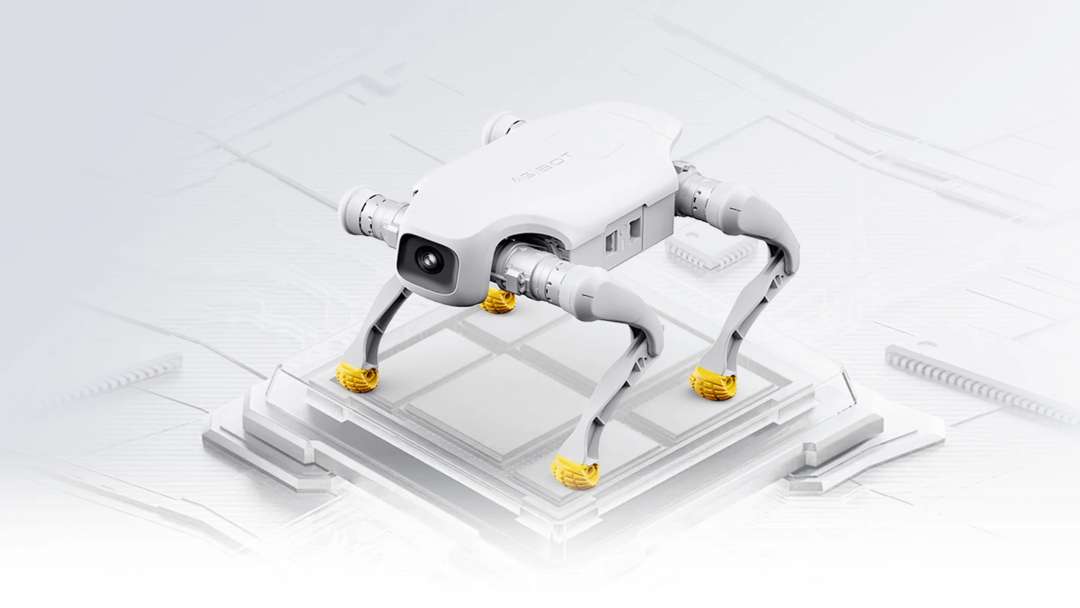
Hardware expansion
The platform is designed for hardware expansion. Additional sensors, such as a LiDAR or a camera, can be connected to it. A connection for a computing platform is provided separately.
Five types of expansion ports are provided for connection. The number of ports of each type is given in the specifications table. The computing core is a high-performance 8-core processor. An IMU (inertial measurement unit) of the standard version is also included.
The infographic below summarises the platform's capabilities. The labelled functions include the hardware and motion control.
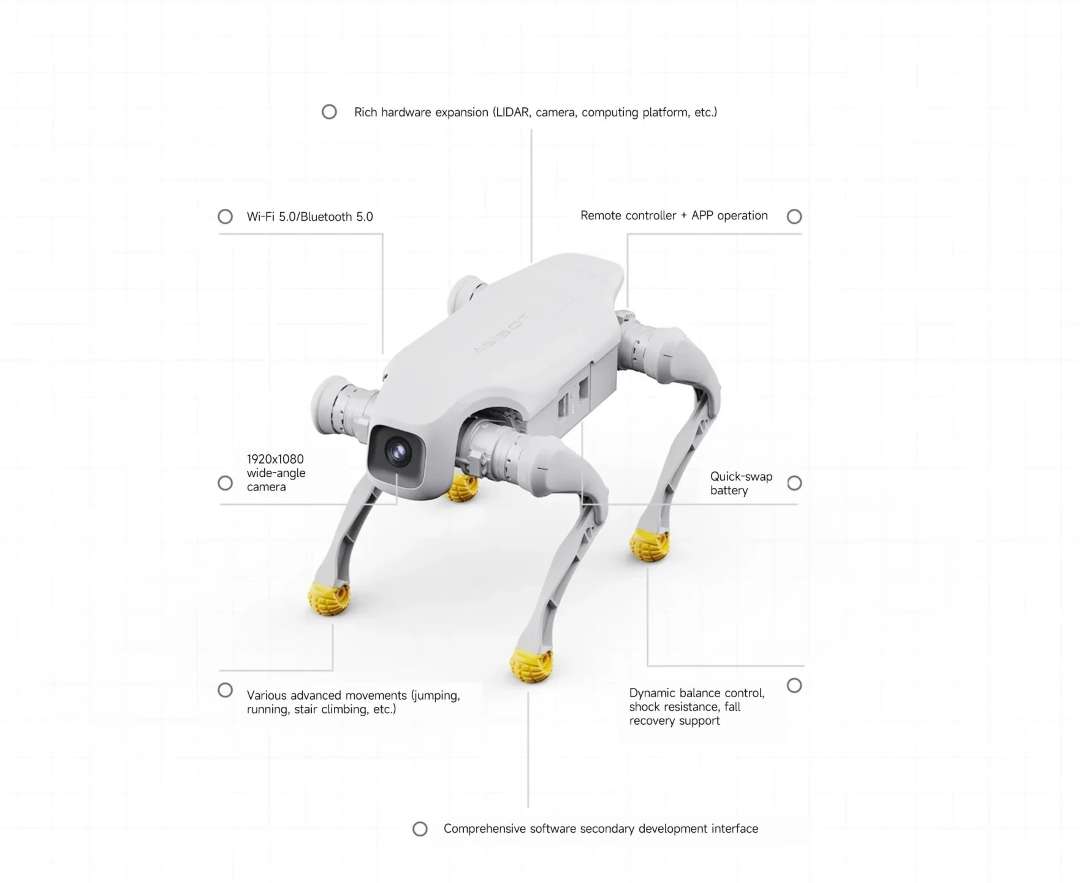
Construction and power supply
The body is made of aluminium alloy and high-strength engineering plastic. The total weight of the platform with the battery is 15.5 kg.
The battery has a nominal capacity of 4.6 Ah and a voltage of 43.2 V. The maximum operating power reaches 3500 W. The operating temperature is from 0 °C to 40 °C.
Areas of application
Among the stated application scenarios are entertainment performances. In the image, the platforms are dressed with decorative Chinese lion dance masks.

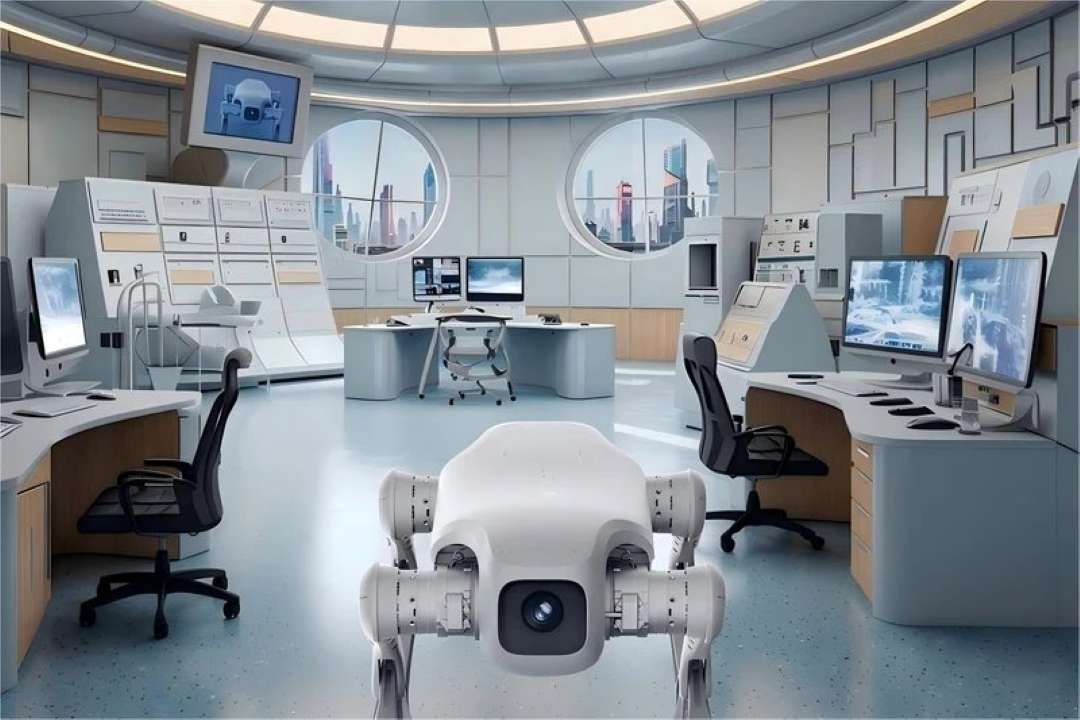
The second stated area is scientific research and education. In a laboratory environment, as in the image, the AgiBot D1 Pro works as a research platform.
- Entertainment performances: special moves, including a backflip and a paw greeting, form the basis of an act. The impact-resistant modules withstand intensive load during performances.
- Scientific research: the expansion ports allow you to mount a LiDAR or a camera. The high-performance 8-core processor provides the basic computing for experiments with gait on varied terrain.
- Education and teaching laboratories: real hardware is used to explain self-balancing and gait adaptation clearly. The dual encoder shortens lesson preparation, because zero calibration is not required.
- Video-stream control: the robot is driven from the joystick controller or from the app. Real-time image transmission from the 1920 × 1080 camera provides visual control of the route.
- Testing on difficult terrain: climbs of up to 30° and stairs make it possible to test routes beyond flat floors. The gait algorithm adjusts itself to the terrain.
What's in the box?
- D1 robot dog platform — 1 pc.
- Charger — 1 pc.
- Handheld remote controller — 1 pc.
Technical specifications
Construction and dimensions
| Parameter | Value |
| Material | Aluminium alloy with high-strength engineering plastic |
| Dimensions in standing position (L×W×H) | 635 × 360 × 420 mm |
| Dimensions in lying position (L×W×H) | 675 × 435 × 145 mm |
| Total weight (with battery) | 15.5 kg |
| Operating temperature | 0 °C – 40 °C |
Motion characteristics
| Parameter | Value |
| Degrees of freedom | Whole machine: 12, each leg: 3 |
| Maximum speed | 3.5 m/s |
| Payload | 5 kg |
| Continuous step-climbing height | 16 cm |
| Maximum climbing angle | 30° |
| Upward jump height | 35 cm |
| Standard movements | Standing, lying down, damping mode, pitch adjustment, height adjustment, turning in the horizontal plane |
| Special movements | Forward jump, upward jump, two-leg stand, backflip, paw greeting, etc. |
Drive and joints
| Parameter | Value |
| Drive type | High power-density motion module |
| Maximum joint torque | 48 N·m |
| Precision joint motor in an aluminium alloy housing | 12 |
| Joint range of motion (body) | -28° – 28° |
| Joint range of motion (thigh) | -170° – 66° |
| Joint range of motion (shank) | 35° – 156° |
Power supply and endurance
| Parameter | Value |
| Charging time | about 1 hour (battery charge level 10%–90%) |
| Battery runtime (operating time) | 1–2 hours |
| Range | 6 km ± 1 km |
| Maximum operating power | 3500 W |
| Battery | Nominal capacity: 4.6 Ah, voltage: 43.2 V |
Computing, vision and connectivity
| Parameter | Value |
| Basic computing power | High-performance 8-core processor |
| Camera field of view (FOV) | DFOV 122°, HFOV 111°, VFOV 70° |
| IMU | Standard version |
| Real-time image transmission | Supported |
| Secondary development (SDK) | Not supported |
| Function expansion ports | Ethernet × 1, USB × 2, power port × 2, SBUS × 1, UART × 1 |
Included items and warranty
| Parameter | Value |
| Power adapter | Standard |
| Charging station | Standard |
| Remote controller | Remote controller with joystick |
| Warranty period | 1 year |
Why buy the AgiBot D1 Pro from EXPERT3D?
EXPERT3D has been supplying professional 3D equipment since 2012. Our specialists provide advice before purchase and help you choose a configuration for your task. Before ordering, you can check the contents of the package and the technical parameters. We deliver throughout Spain and the EU countries. The warranty period for the AgiBot D1 Pro is 1 year. After purchase, we provide service support. Order spare parts and consumables on the website so that your equipment does not stand idle.