

- Stock: In Stock
- Product code: 10250-000008
- Weight Brutto: 160.00kg

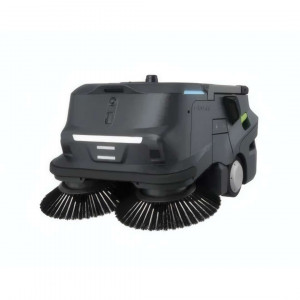
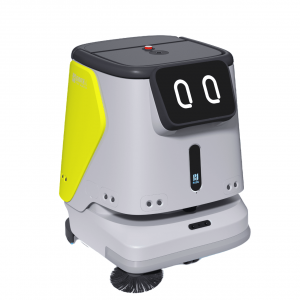
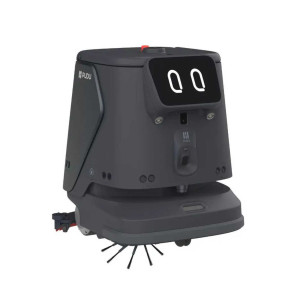
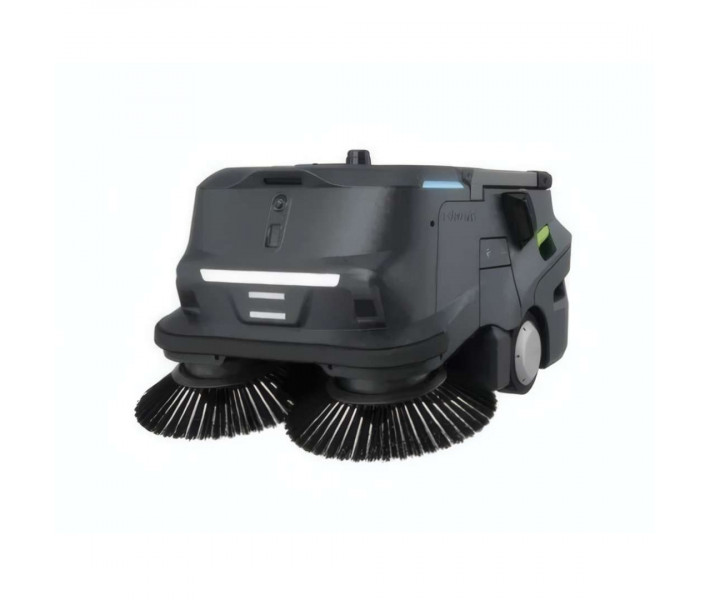
The PUDU MT1 is a professional AI-powered autonomous sweeping robot built for large indoor venues — warehouses, logistics hubs, manufacturing facilities, airports, and retail superstores — where hard-floor debris accumulates at scale. Combining LiDAR SLAM + VSLAM dual-positioning navigation, an onboard AI trash-recognition camera, and a 35 L quick-release dustbin, the MT1 delivers professional-grade dry cleaning across areas up to 100,000 m² at cruising speeds of 0.2–1.2 m/s, operating continuously for up to 8 hours per charge on polished concrete, epoxy resin, rubber flooring, and ceramic tiles.
The video below demonstrates the full operational scope of the PUDU MT1 — from AI debris detection to autonomous docking at the charging station.
| Dustbin Capacity | 35 L (quick-release) |
|---|---|
| Max. Runtime | Up to 8 h (45 Ah battery) |
| Effective Cleaning Width | ~70 cm (with side brushes) |
| Navigation System | LiDAR SLAM + VSLAM dual positioning |
The image below shows the PUDU MT1 in fully autonomous mode, sweeping a wide illuminated industrial corridor — its front-mounted LED bar active, dual side brushes fully deployed, covering the passageway width in a single uninterrupted pass.
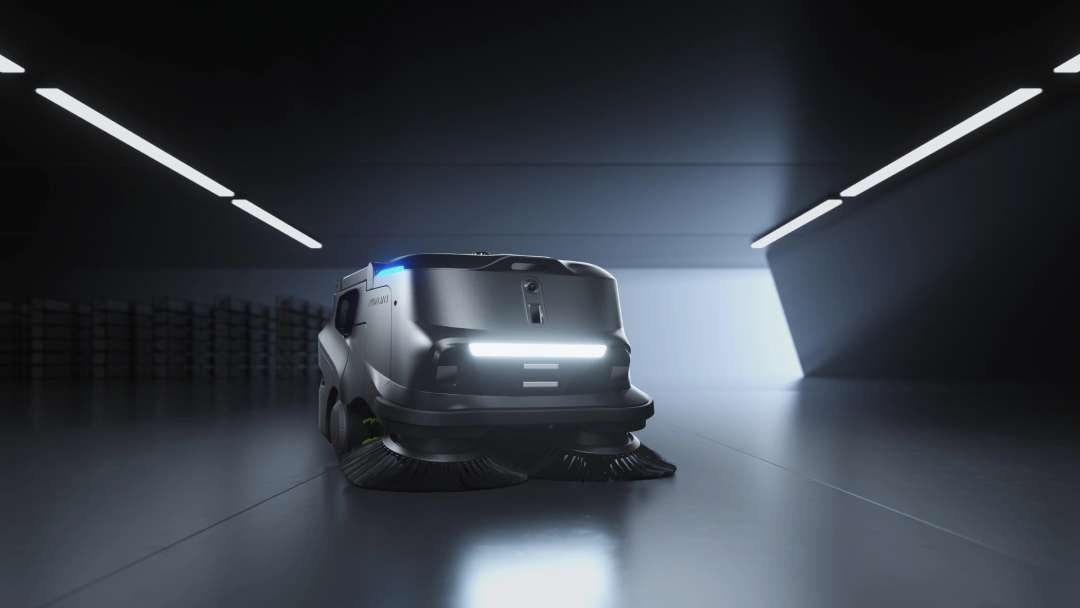
Industrial-Scale Cleaning Performance — Up to 100,000 m² Coverage
Most robotic sweepers are designed for retail or office environments. The PUDU MT1 is built for a different category of challenge: the vast, debris-heavy floors of logistics warehouses, assembly plants, home improvement superstores, and transport hubs where a single cleaning shift must cover tens of thousands of square metres without stopping to empty the bin. The 35 L dustbin capacity is the foundation of this endurance. Combined with a runtime of up to 8 hours per charge, the MT1 can complete a full coverage sweep of a 50,000 m² facility without a single manual intervention.
Dual-Brush Cleaning System — Every Debris Type, One Pass
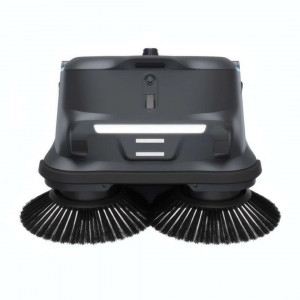
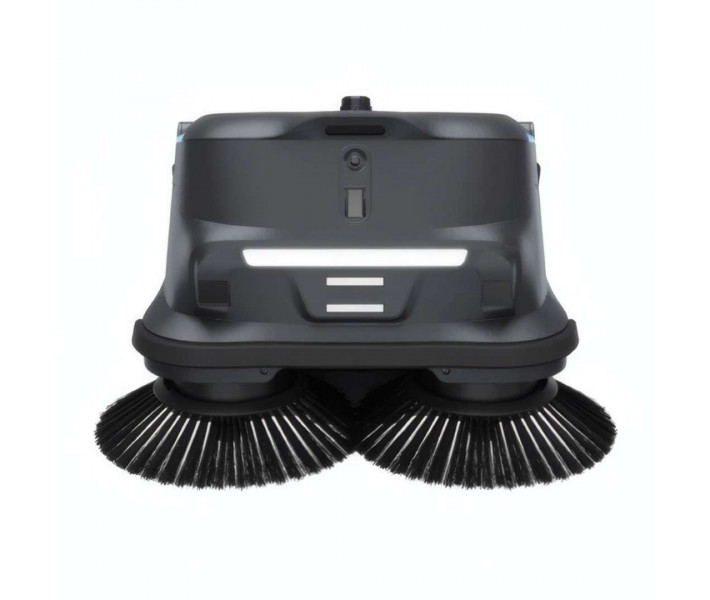
The MT1's cleaning mechanism pairs a central roller brush with two rotating side brushes to achieve an effective sweeping width of approximately 70 cm. Side brushes channel large-radius debris — leaves, plastic bottles, cardboard scraps, aluminium cans — inward toward the central intake roller. The roller brush then drives all captured material into the dustbin through a high-flow negative pressure ventilation circuit, where an integrated air filter traps fine particulate and prevents secondary particle suspension. This active dust-control architecture is essential in food logistics and pharmaceutical distribution, where floor cleaning must not re-contaminate packaged product with airborne dust.
The close-up below shows the PUDU MT1's front profile and side brush geometry, including the positioning of the brush relative to the chassis edge for zero-gap perimeter sweeping.
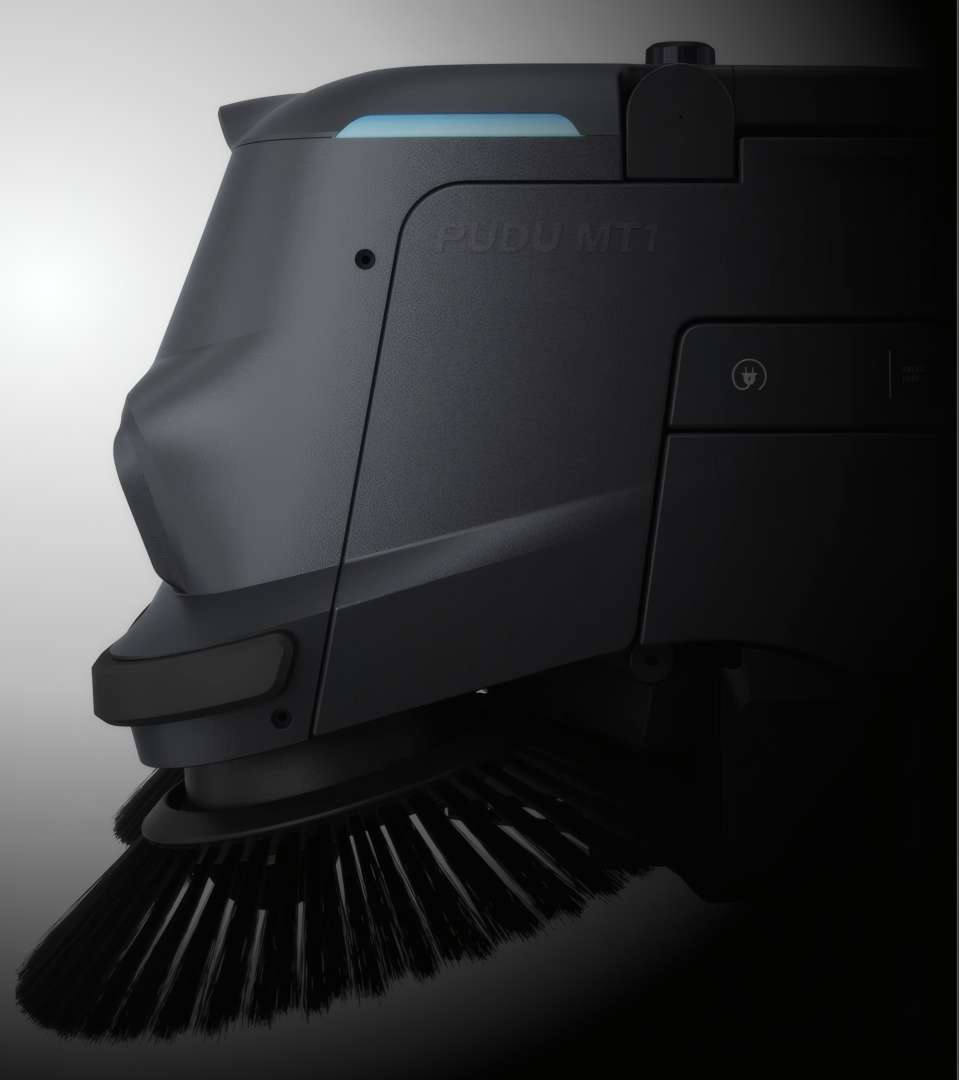
35 L Quick-Release Dustbin — Sized for Extended Runs
At 35 L, the MT1's dustbin holds enough debris for hours of continuous sweeping in high-debris environments. The image below — taken during a factory floor validation — shows the range of material a single session produces: cardboard fragments, plastic film, bottles, paper shreds, and general floor litter. The quick-release mechanism allows removal and emptying without tools in under 30 seconds, keeping maintenance interruptions minimal even in multi-shift operations.
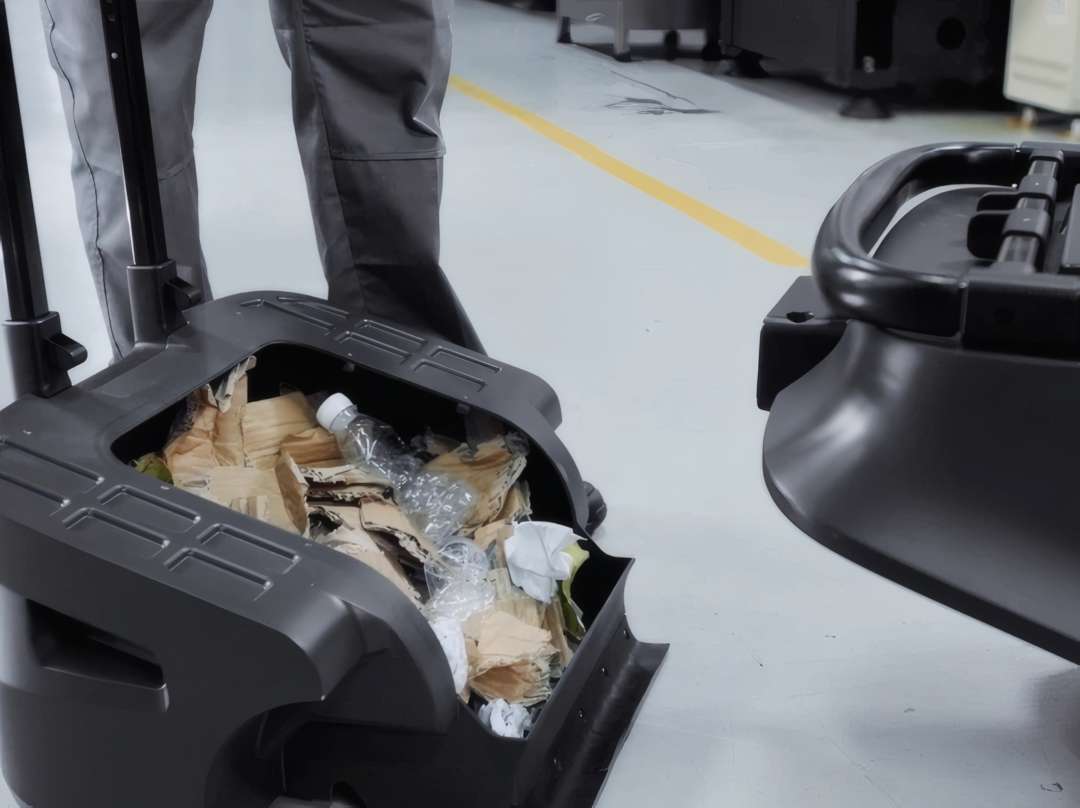
Modular Quick-Release Design
All consumable components — dustbin, side brushes, roller brush, and air filter — are built with modular quick-release connections requiring no tools. The green side-latch button visible below is the single-action release for the entire dustbin module. This design philosophy carries through every maintenance point on the robot: side brushes detach by hand, the air filter dust-removal handle is accessible from the exterior, and rubber contact strips are replaceable without disassembly.
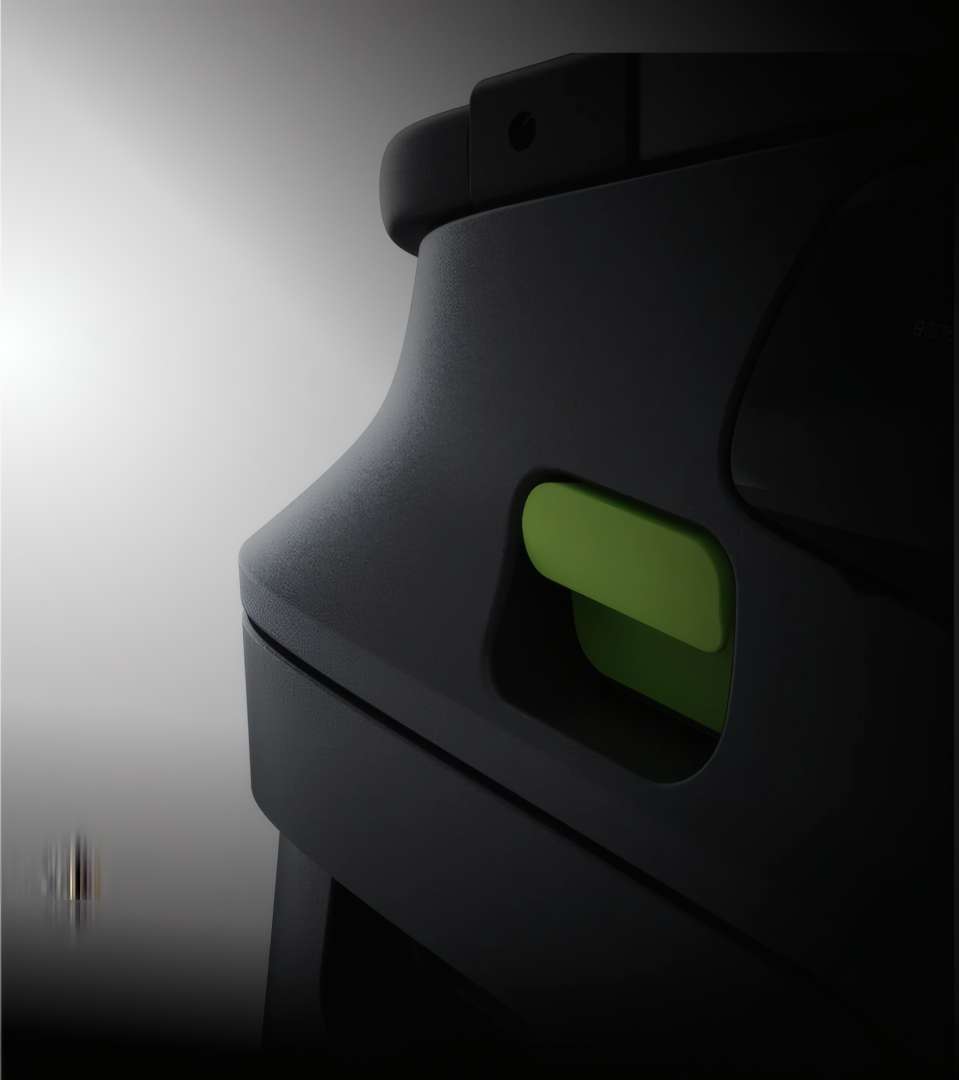
AI Trash Recognition — Learns Debris Patterns, Not Just Cleans Them
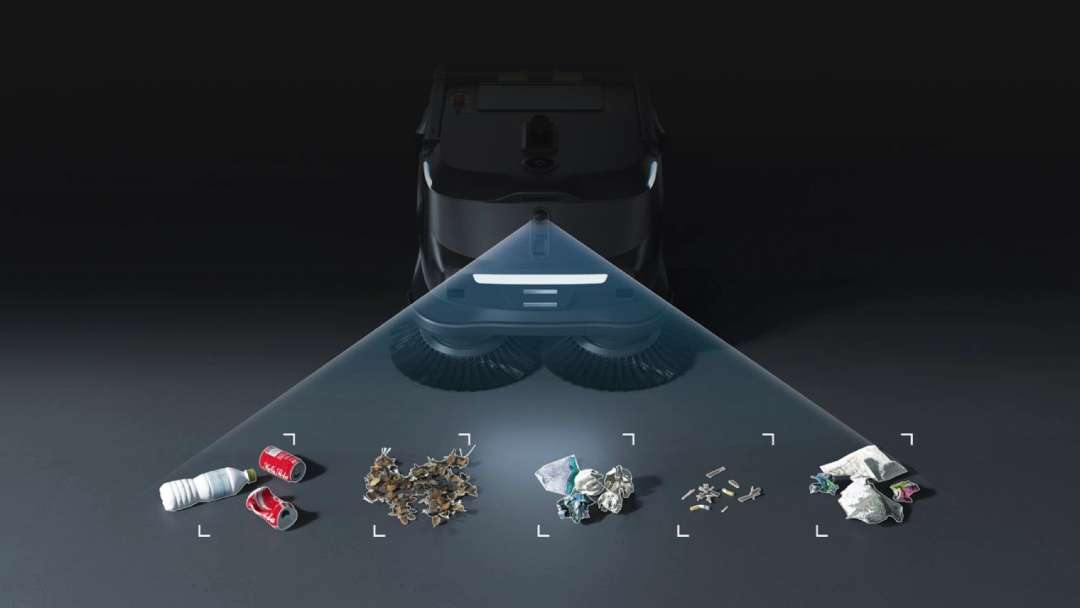
The MT1's front-mounted AI camera continuously scans the floor in real time, classifying individual waste items using a deep-learning model that improves through ongoing database updates. Recognised debris categories include plastic bottles, aluminium cans, leaves and organic matter, crumpled foil wrappers, cigarette butts, and loose plastic bags. When a high-density waste zone is identified, the system activates Ultra Spot Cleaning — a targeted high-intensity pass that delivers up to 500% greater cleaning efficiency in that zone compared to standard patrol speed. The AI also distinguishes genuine debris from floor patterns such as printed tile markings or painted lines, preventing false-positive cleaning activations that waste battery cycles.
The image below shows the AI camera's detection cone scanning five distinct debris categories simultaneously — from rigid containers to loose organic material — demonstrating the breadth of the recognition system.
LiDAR SLAM + VSLAM — Dual Positioning in Live Industrial Environments
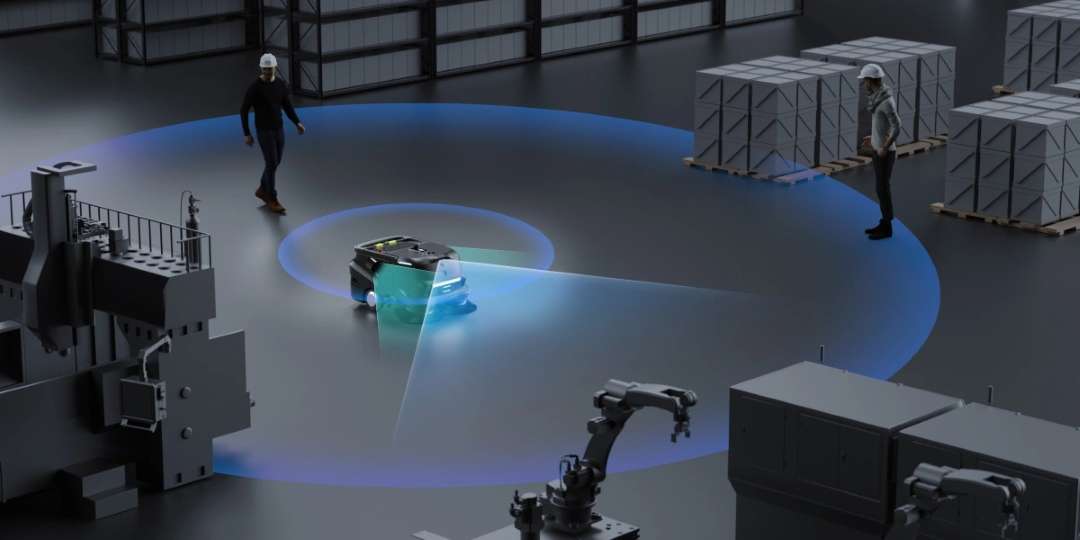
A single-sensor navigation system fails in a live facility. Forklifts shift, pallets move, and workers change the spatial map every hour. The MT1 addresses this by fusing 360° LiDAR SLAM with VSLAM visual simultaneous localisation and mapping. LiDAR provides global metric consistency across the mapped floor plan; VSLAM compensates in areas with reflective racking, glass partitions, or featureless surfaces where pure LiDAR positioning drifts. Together they maintain accurate, adaptive localisation regardless of how the operational environment evolves during the working day.
The 3D render below illustrates the MT1's navigation sensor footprint inside a factory operating at night: the blue arcs represent 360° LiDAR coverage, the forward cone indicates active RGB-D depth perception during the live obstacle-avoidance scan, and the two workers present confirm the system's human-detection capability.
Multi-Sensor Safety Perception
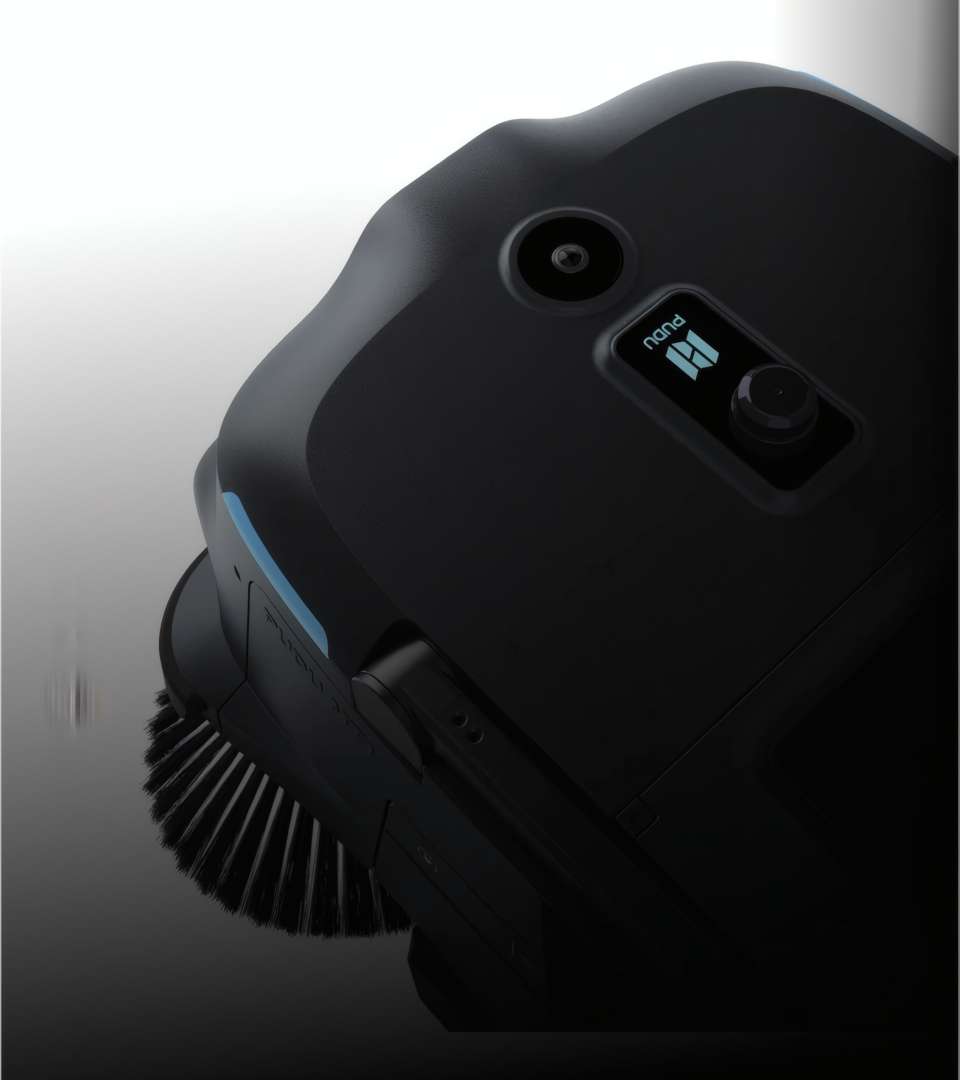
Safety in high-traffic industrial spaces requires sensor redundancy. The MT1 integrates LiDAR, dual RGB cameras, dual RGB-D depth cameras, and line laser sensors in a layered detection architecture. This multi-sensor fusion enables recognition of low-profile obstacles, moving personnel at floor level, and dynamic objects crossing the cleaning path — triggering avoidance or a controlled stop before any contact occurs. The front-top sensor arrangement is visible in the close-up below: the VSLAM camera and front-facing RGB camera are positioned above the side-brush deployment zone for an unobstructed detection field.
Manual Mode and Ergonomic Handle — Human Control When It Counts
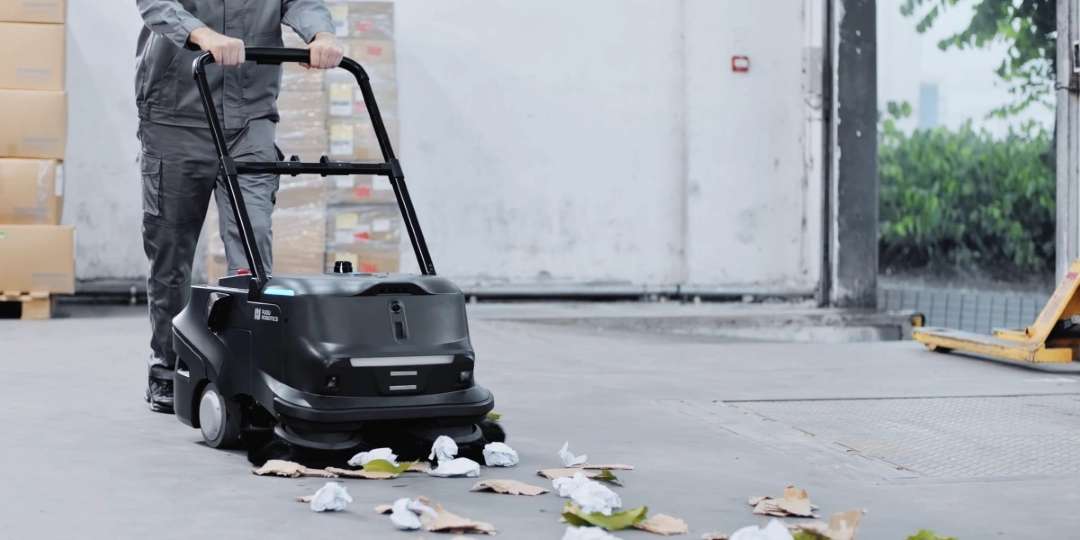
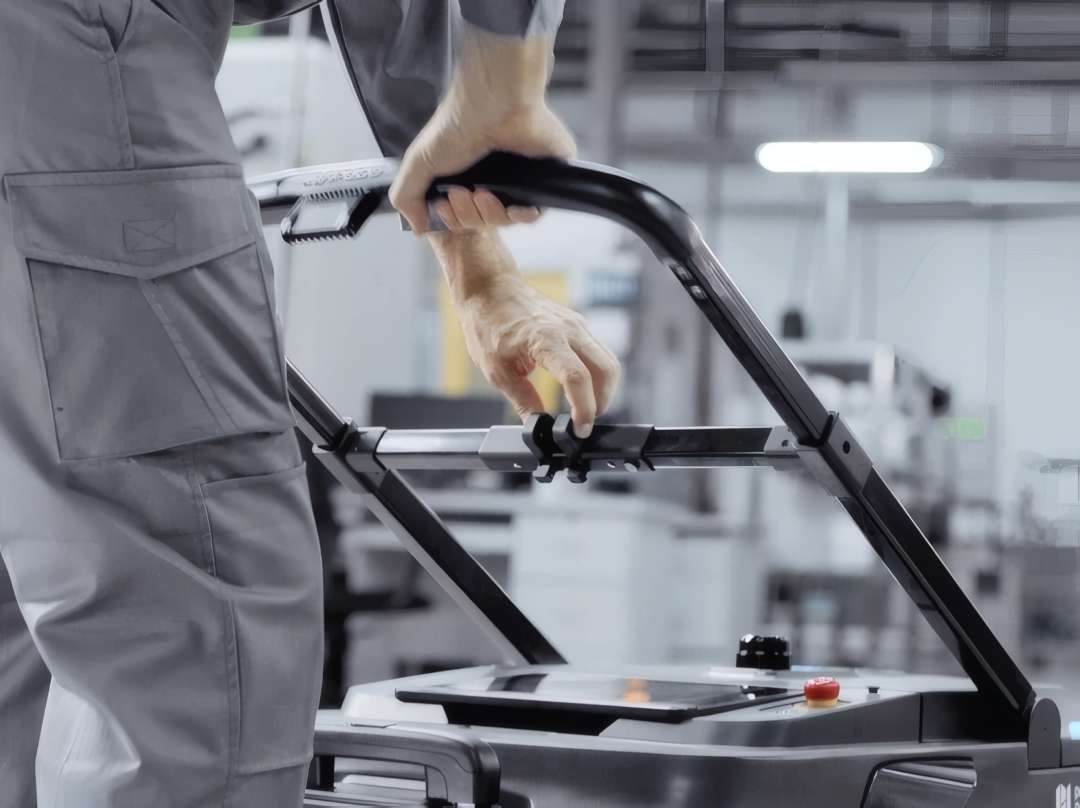
Autonomous navigation is not always the right mode. Loading dock approaches, elevator transitions, construction zones, and post-incident clearances all require direct human guidance. The MT1 transitions from autonomous to manual mode by raising its retractable steering handle, which converts the robot to a walk-behind sweeper. The brushes and dustbin system remain fully active in manual mode — the operator steers, the robot cleans.
The image below shows the MT1 in manual cleaning mode on a concrete loading dock, guided by an operator clearing a mixed field of leaves, paper scraps, and cardboard fragments in a single forward pass.
Detachable 10.1-Inch Screen and Retractable Handle Mechanism
The MT1's control interface runs on a 10.1-inch Android-powered LCD screen with a protective cover. The screen is designed to detach entirely — it can be used hand-held or mounted on the steering handle rail for full interface access during manual operation. The close-up below shows the scissor-arm handle attachment mechanism and the screen dock position on the upper bar: the ergonomic fold-up design allows height adjustment and stows flush against the robot body during autonomous operation.
24/7 Continuous Operation — Autonomous Charging, Three Cycles Per Day
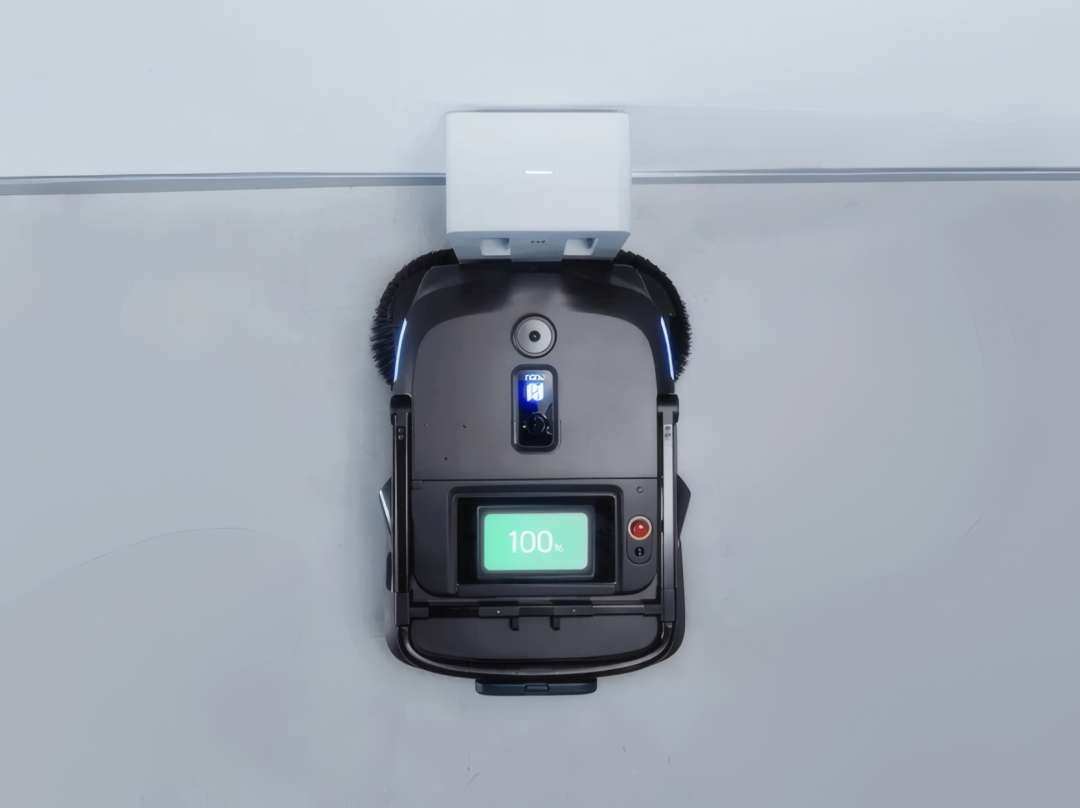
The 45 Ah battery delivers 4 to 8 hours of runtime per charge cycle under standard mixed-speed conditions. A full recharge completes in approximately 3 hours — allowing three complete charge-discharge cycles within a 24-hour period. When battery level drops to the return threshold, the MT1 autonomously docks with the charging station, recharges, and resumes its programmed cleaning schedule without staff intervention. Scheduled tasks can be configured for specific time windows, enabling overnight facility cleaning to run unsupervised.
The top-down view below shows the MT1 fully docked at its charging station with the screen displaying 100% battery — the standard ready state before the next automated session begins.
Technical Specifications of the PUDU MT1
Identification and Physical Parameters
| Model | MTBC01 |
|---|---|
| Dimensions (L × W × H) | 84 × 60 × 49 cm |
| Weight | ~65 kg |
| Enclosure Material | PC+ABS |
Power and Battery
| Operating Voltage | DC 23–29.2 V |
|---|---|
| Power Input | AC 100–240 V, 50/60 Hz |
| Power Output | Max. 29.2 V, 20 A |
| Battery Capacity | 45 Ah |
| Charging Time | ~3 h |
| Runtime | 4–8 h |
Mobility and Navigation
| Navigation Method | Integrated LiDAR and VSLAM dual positioning |
|---|---|
| Cruise Speed | 0.2–1.2 m/s (adjustable) |
| Min. Travel Width | 75 cm |
| Min. Turning Width | 110 cm |
| Max. Surmountable Height | 20 mm |
| Max. Climbing Angle | 8° |
| Max. Surmountable Gap | 30 mm |
| Working Noise | <75 dB |
Cleaning System
| Cleaning Width (with side brushes) | ~70 cm |
|---|---|
| Dustbin Capacity | 35 L |
| Cleaning Capabilities | Paper, plastic film, leaves, bottles, and general floor debris |
Interface and Computing
| Screen | 10.1-inch LCD (detachable) |
|---|---|
| Operating System | Android |
| Mobile App | Supported |
| Operation Mode | Manual / Auto |
Connectivity and Automation
| Communication | 4G, Wi-Fi, Bluetooth, Lora / 2.4G (optional) |
|---|---|
| Auto Charging | Supported (with MT1 charging station) |
Environmental Conditions
| Working Temperature | 0–40°C (32–104°F) |
|---|---|
| Working Humidity | ≤90% RH |
| Storage Temperature | -20–70°C (-4–158°F) |
| Storage Humidity | ≤90% RH |
| Working Altitude | <2000 m |
| Application Scope | Polished concrete, epoxy resin, rubber, brick, ceramic tiles |
| IP Rating | IPX3 |
What's in the Box
- PUDU MT1 main unit (fully assembled)
- Charger × 1
- Sweeping side brushes × 2
- Sweeping roller brush × 1
- PUDU MT1 User Manual × 1
- Certificate of Conformity × 1
- Positioning marker (visual marker) × 1
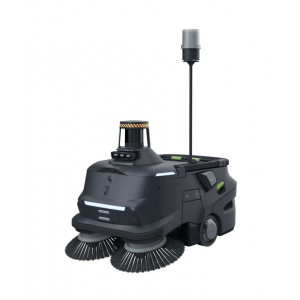
- Warning flagpole × 1
How to Start an Automatic Cleaning Task on the PUDU MT1
This procedure describes the steps to initiate a pre-configured autonomous cleaning task on the PUDU MT1, from powering on through to task execution.
Step 1: Power On the Robot
Press and hold the power button for approximately 3 seconds. The LED light strip along the bottom of the robot will turn blue, confirming that the system has started. Wait for the screen to fully load before proceeding.
Step 2: Position the Robot at the Visual Marker
Place the robot directly below or in front of the installed visual positioning marker (depending on the marker's mounting position). Correct initial positioning is required for the SLAM system to lock onto its start location. If the robot fails to position, recheck the alignment with the marker.
Step 3: Lower the Handle
Ensure the retractable steering handle is fully lowered and stowed. Automatic cleaning tasks require the handle to be in the down position before the task will start. If the screen is mounted on the handle, detach it and reattach to the robot body or hold it in hand.
Step 4: Select a Cleaning Task and Tap Start
On the home page, select the pre-configured cleaning task for the target area. Review the task parameters (cleaning speed gear, brush speed, target zone) and tap "Start." The robot will begin autonomous navigation immediately, following the mapped route.
Step 5: Monitor and Use Emergency Stop if Needed
Monitor the task on screen or via the mobile app. To pause at any time, tap the screen once. In an emergency, press the red emergency stop switch to halt the robot immediately. To resume, rotate the emergency stop switch clockwise and follow the on-screen prompts.
What floor types and debris can the PUDU MT1 handle?
The PUDU MT1 is designed for hard indoor floor surfaces including polished concrete, epoxy resin, rubber flooring, standard brick, and ceramic tiles. Its dual side brushes and central roller brush handle both large debris — leaves, plastic bottles, cardboard fragments, aluminium cans — and fine particulate dust. It is not suitable for heavily oil-stained surfaces, floors with standing water, or outdoor unpaved ground.
How long does the PUDU MT1 battery last per charge?
The 45 Ah battery provides 4 to 8 hours of operational runtime per charge cycle under standard mixed-activity conditions. Actual runtime depends on cruise speed, debris density, and floor surface type. A full recharge from depleted takes approximately 3 hours, enabling up to three complete operational cycles within a 24-hour period.
Does the PUDU MT1 return to its charging station automatically?
Yes. When the battery drops to the return threshold, the MT1 autonomously navigates to the MT1 charging station, docks without operator intervention, recharges to full, and resumes its programmed cleaning schedule. This autonomous charging cycle supports 24/7 continuous operation in facilities that run overnight cleaning shifts.
What is the minimum corridor width required for the PUDU MT1?
The PUDU MT1 requires a minimum passage width of 75 cm for travel. Passages wider than 85 cm are recommended for smooth sustained movement through long corridors. The minimum turning width is 110 cm. Corridors or aisles narrower than 75 cm are not suitable for autonomous operation.
Can the PUDU MT1 be operated in manual mode?
Yes. Raising the retractable steering handle immediately activates manual cleaning mode, transforming the MT1 into a walk-behind sweeper. All brushes and the dustbin system remain fully active under manual guidance. The 10.1-inch screen can be detached from the body and mounted on the handle, or held in hand, for full interface access during manual operation.
Why Choose EXPERT3D?
EXPERT3D has specialised in advanced robotics and 3D technology since 2012 — more than a decade of hands-on experience selecting, deploying, and supporting professional-grade platforms across logistics operations, manufacturing facilities, retail chains, and transport infrastructure across Spain and Europe. We provide pre-sales technical consultation, delivery coordination, and post-sale support backed by direct manufacturer contacts. The PUDU MT1 is a complex autonomous system: our team can help you evaluate deployment scenarios, configure cleaning schedules, and integrate the robot into existing facility management workflows. As an official representative of PUDU, we guarantee the best price, authorised service, and official warranty. Contact us to discuss your specific application requirements and current availability.