

- Stock: In Stock
- Product code: 10170-000015
- Weight Brutto: 75.00kg

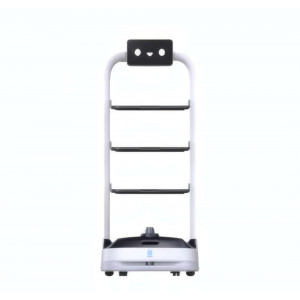
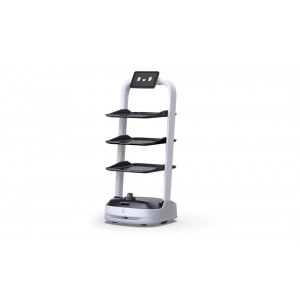
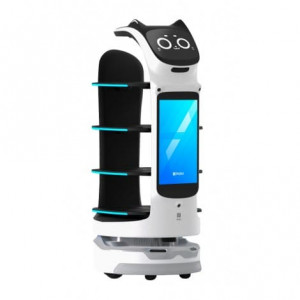
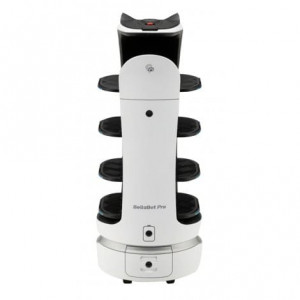
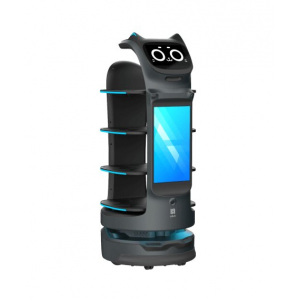
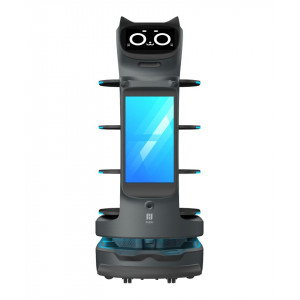
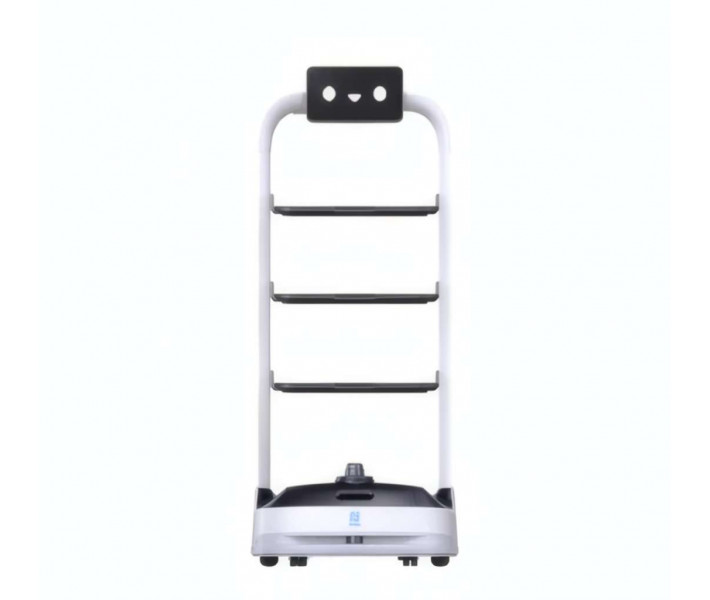
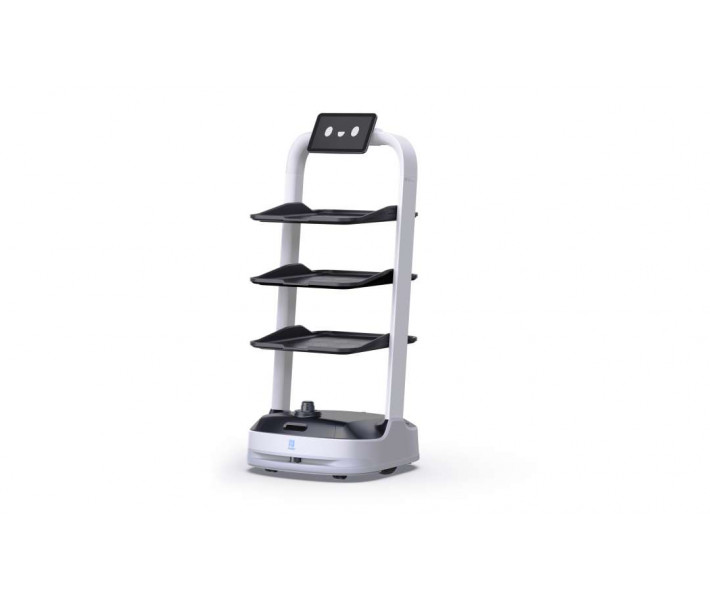
The PUDU PuduBot 2 is an autonomous indoor delivery robot engineered for high-traffic commercial environments — restaurants, hotels, hospitals, supermarkets, offices, and shopping centres. Standing 1290 mm tall with three removable, height-adjustable metal trays rated at 10 kg per level, it navigates without markers using dual-LiDAR + VSLAM visual positioning at speeds up to 1.2 m/s, backed by a 25 Ah LFP battery delivering 12–15 hours of continuous operation per charge.
| Battery Autonomy | 12–15 h (no load), 25 Ah LFP |
|---|---|
| Tray Capacity | 10 kg/level (rated), 13 kg/level (max) × 3 trays |
| Navigation System | VSLAM + Dual LiDAR + 3D depth obstacle avoidance |
| Max Cruise Speed | 1.2 m/s (adjustable 0.1–1.2 m/s) |
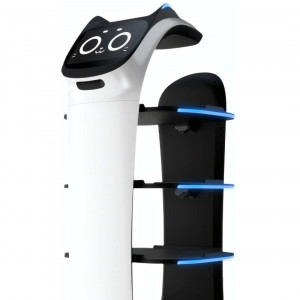
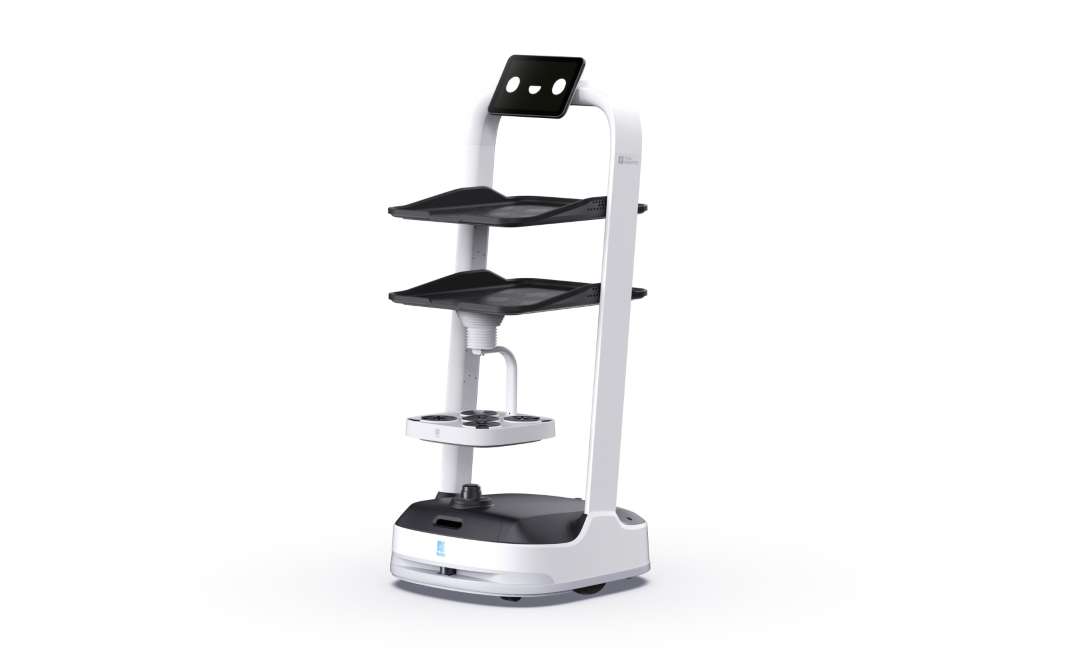
The image below shows the PuduBot 2 in its standard three-tray configuration with the 10.1" LCD display — a clean, ergonomic architecture designed to fit through doorways as narrow as 80 cm.
Six Operational Modes for Every Commercial Scenario
Few robotic platforms cover the operational breadth of the PuduBot 2. Six distinct work modes address the full spectrum of commercial use cases without requiring any hardware changes:
- Food Delivery Mode — multi-table delivery with per-tray destination assignment; a staff member taps "Done" upon unloading, and the robot continues to the next stop.
- Delivery Mode — point-to-point transport with automatic return to the docking station after task completion.
- Cruise Mode — autonomous patrol along a fixed route for advertising or reception duties, with configurable rest points (1–600 s pause per stop).
- Direct Mode — one-way transport that keeps the robot stationary at the delivery destination until manually cleared.
- Birthday Mode — celebratory delivery accompanied by fully customizable music playback.
- Collection Mode — retrieval of used items (plates, trays, cups) with optional transit stops en route to the final collection point.
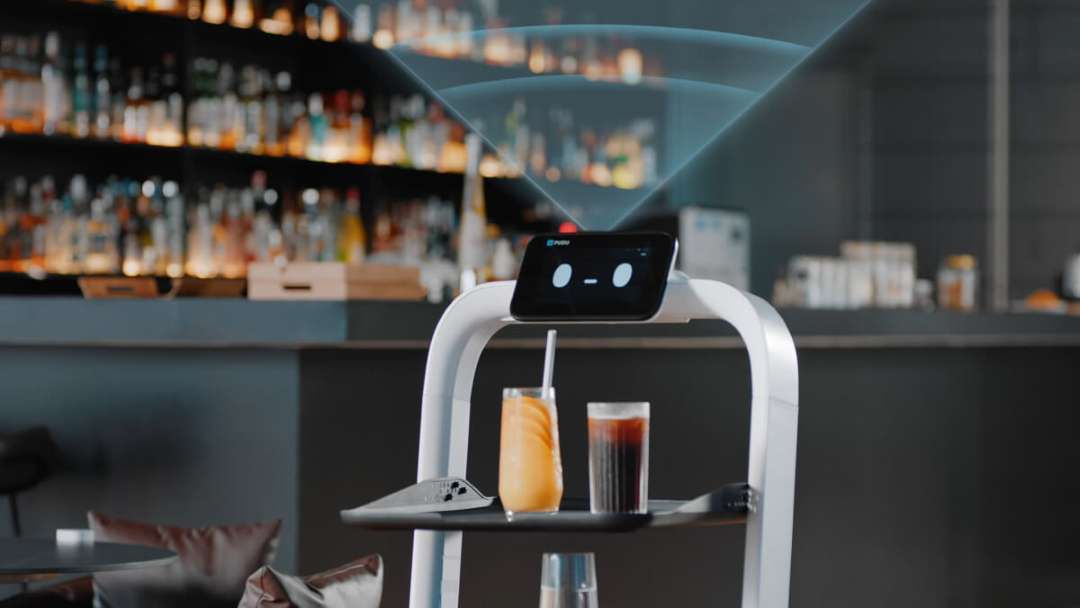
The PuduBot 2's 3D depth vision sensors create a continuous field of spatial awareness, detecting obstacles as small as 2 cm within a 1 m range and rerouting in real time. The image below captures the robot in active bar service, the onboard VSLAM sensor projecting its detection cone as it scans the environment ahead.
Dual-LiDAR Navigation: 360° Environmental Awareness
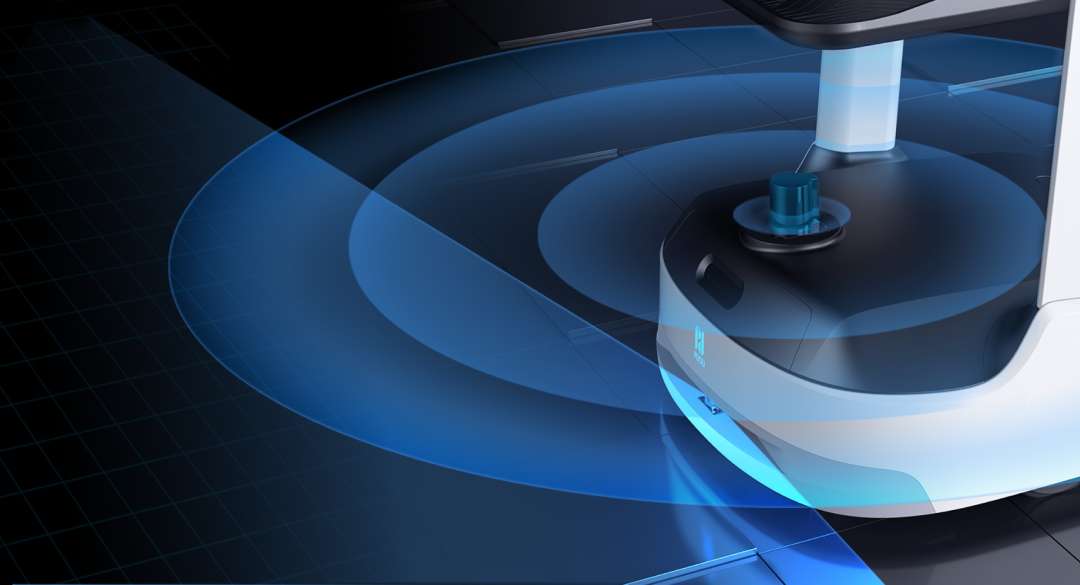
The PuduBot 2 navigation stack layers three complementary sensing technologies. A primary LiDAR at base level handles horizontal plane mapping; a secondary LiDAR extends coverage upward to detect overhanging obstacles like table edges and chair legs. The VSLAM (Visual Simultaneous Localisation and Mapping) system reads natural ceiling features to anchor positional estimates — no reflective stickers, no ceiling modifications required. PUDU SLAM reduces initial deployment time by 75% versus marker-based setups and operates reliably in venues with ceiling heights up to 30 m.
The visualisation below shows the PuduBot 2 base unit with its LiDAR scanning radius rendered as concentric blue arcs — the omnidirectional detection field that keeps the robot continuously aware of its surroundings during navigation.
Multi-Robot Coordination and Precision Docking
For facilities deploying multiple units, the PuduBot 2 supports three docking modes: one-to-one (each robot assigned a fixed pickup station), free mode (priority-based nearest-station selection), and waiting mode (temporary standby until a docking slot opens). Robots operating in parallel require a minimum aisle width of 2 m for head-on passing and maintain 35 cm clearance between units at standby positions.
Aviation-Grade Aluminum Chassis: The Engineering Inside
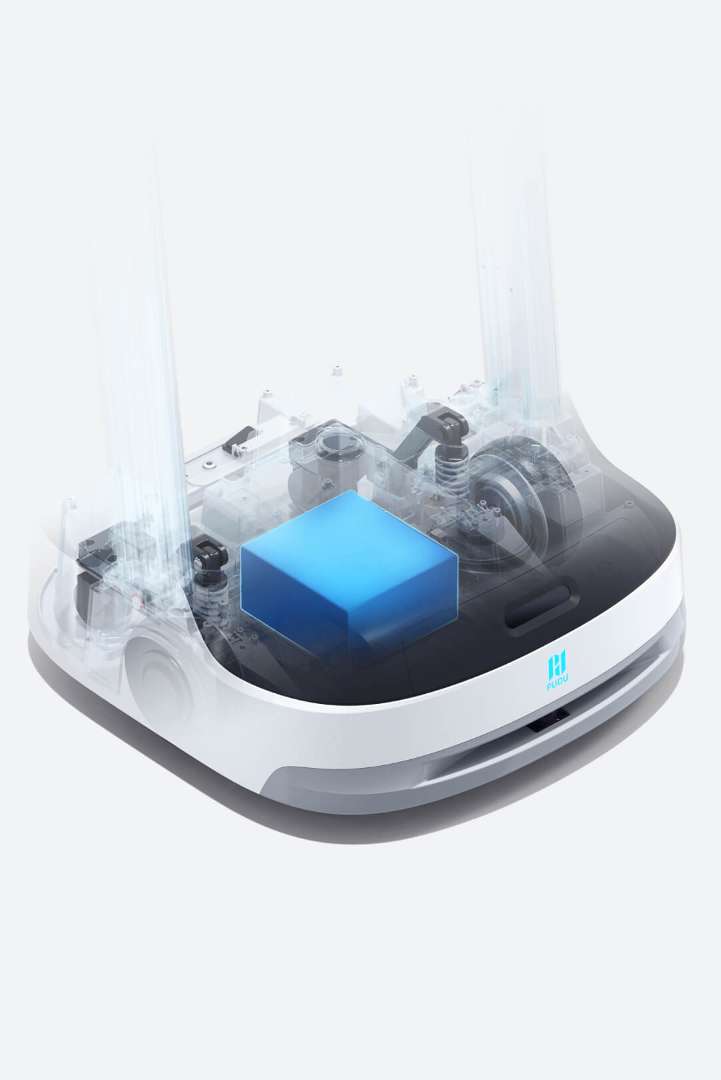
The cutaway render below reveals the precision-machined aluminum alloy frame inside the PuduBot 2's base — a structure that houses the drive motors, sensor array, and battery pack. The outer shell combines PC+ABS polymers with aluminium structural members, delivering impact resistance without inflating the robot's 39 kg operational weight.
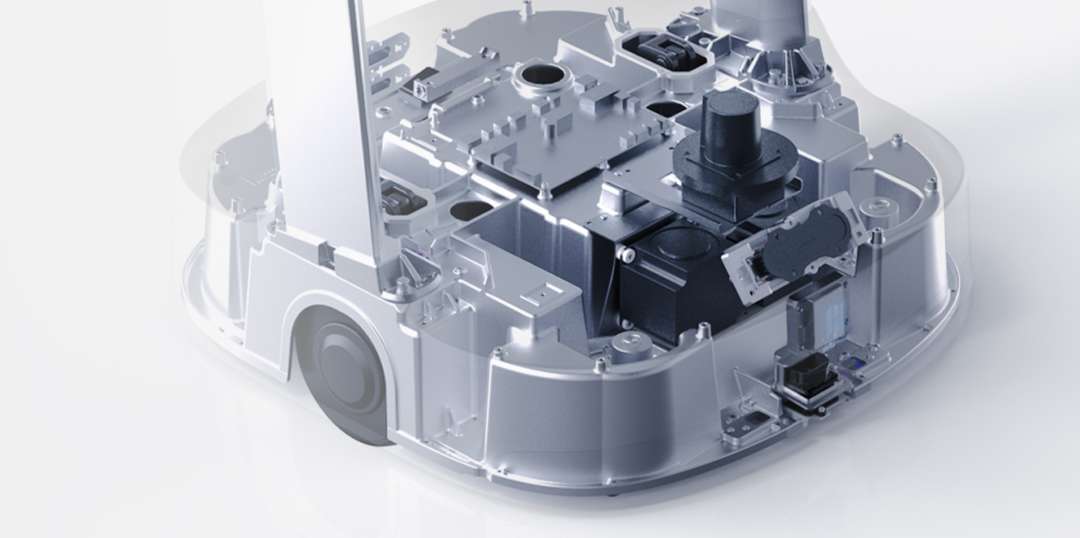
The optimised suspension geometry and balanced mass distribution deliver a 30% improvement in driving stability compared to the previous generation platform. The robot traverses minor floor irregularities up to 10 mm in height and gradients up to 5° — covering the full range of real-world hospitality and commercial floor surfaces.
25 Ah LFP Battery and Auto-Charging Station
The PuduBot 2 runs on a lithium iron phosphate (LFP) battery rated at 25 Ah — a chemistry selected for its thermal stability and superior cycle longevity over standard lithium-ion cells. Under no-load conditions, runtime reaches 12–15 hours; a full charge from empty takes approximately 4 hours at 29.4 V / 8 A. When battery level drops to the user-configured threshold (settable between 5% and 50%), the robot navigates autonomously to the charging station and docks without any staff involvement.
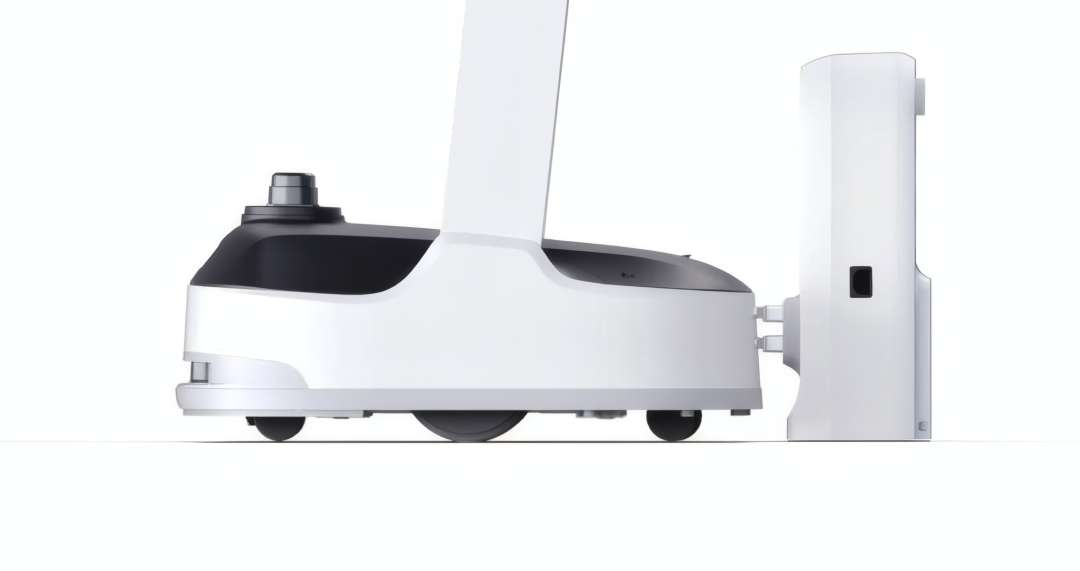
The side-profile image below shows the PuduBot 2 precisely aligned with its dedicated auto-charging station — the robot's underbelly electrode plates making contact with the station connectors autonomously.
The transparent chassis render below makes the LFP battery pack visible inside the base — the large blue block positioned centrally for optimal weight distribution, flanked by the drive wheel assemblies and suspension components.
PuduOS Ecosystem: Four-Way Calling and Remote Management
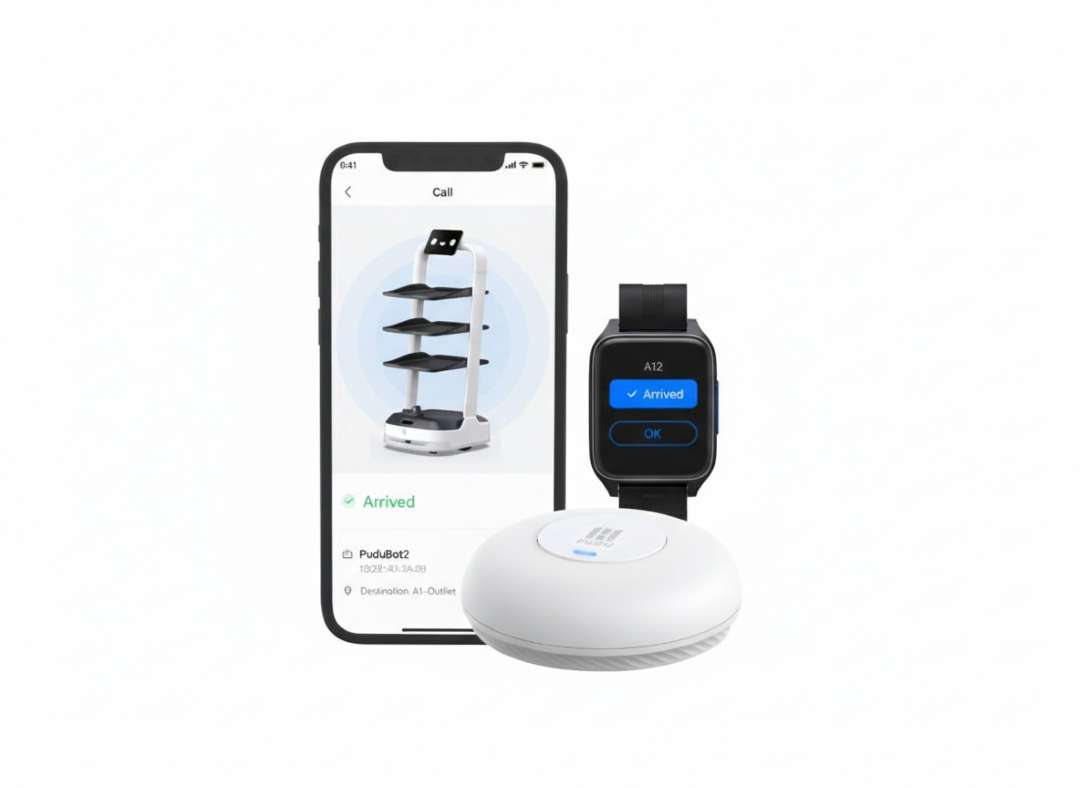
The PuduBot 2 runs on PuduOS — an Android-based operating system purpose-built for robotic fleet management that handles navigation, task queuing, calling integration, and over-the-air firmware updates from a unified interface. Staff can summon the robot or receive arrival notifications through four independent channels:
- PuduLink — mobile app with real-time status monitoring and calling (requires network connection)
- 4G Smartwatch — wrist-worn display showing delivery destination and arrival confirmation
- PuduBeeper — button-based pager integration (requires network connection)
- Pudu Pager — operates via local gateway, functional without internet; handles up to 48 simultaneous tasks with a 5-minute validity window per task
The image below illustrates the complete PuduLink calling ecosystem: the smartphone app showing an "Arrived" status, a 4G smartwatch confirming table A12 delivery, and the Pudu Pager gateway — all communicating with a single PuduBot 2 unit simultaneously.
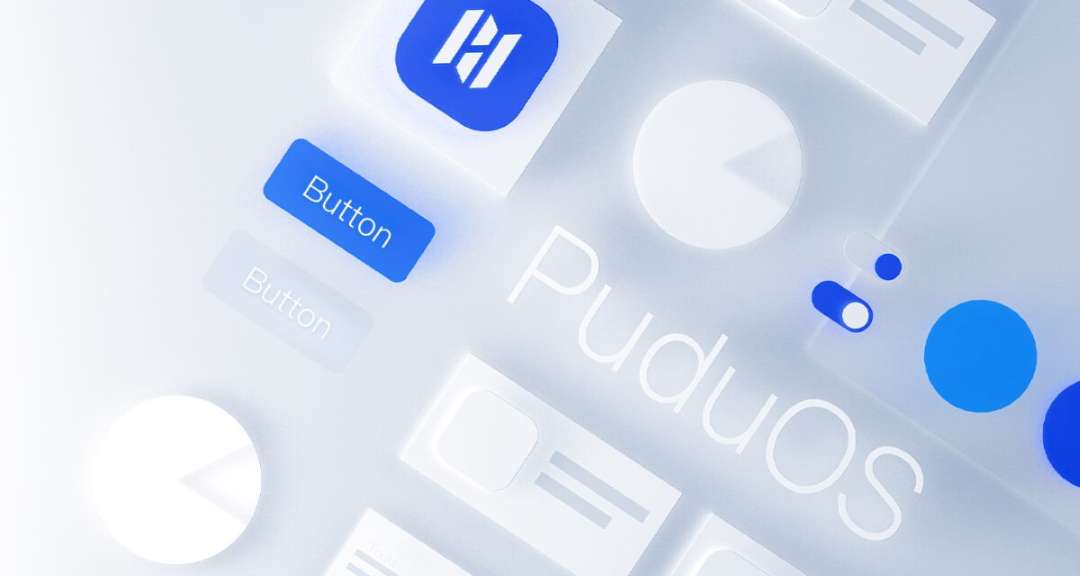
PuduOS extends beyond task control to include music library management (up to 20 custom audio tracks imported via QR code scan), speed profile configuration, map switching, and scheduled auto-recharge time slots. The design language shown below prioritises touchscreen operation by non-technical staff — no specialist training required.
10.1" Display, Rear Camera, and 4G Connectivity
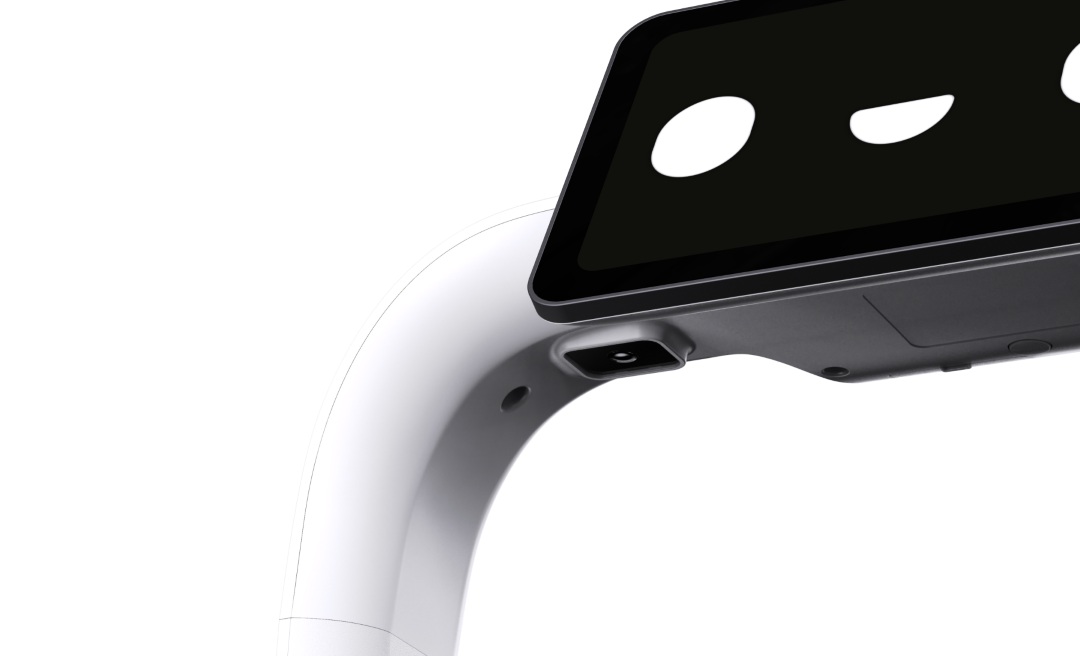
The PuduBot 2 PDFD22 model features a 10.1" LCD touchscreen for task selection, status display, and optional digital advertising content — making the robot a mobile signage platform in addition to a delivery unit. A rear-facing camera positioned just below the display provides visual context for navigation and mapping verification. A 4G SIM card slot enables cellular network connectivity for remote management and PuduLink calling in environments where Wi-Fi coverage is limited.
The close-up below shows the underside of the 10.1" LCD panel with the rear camera lens clearly visible, mounted at the junction between the display housing and the robot's upper support arch.
Reliable in Real-World Environments
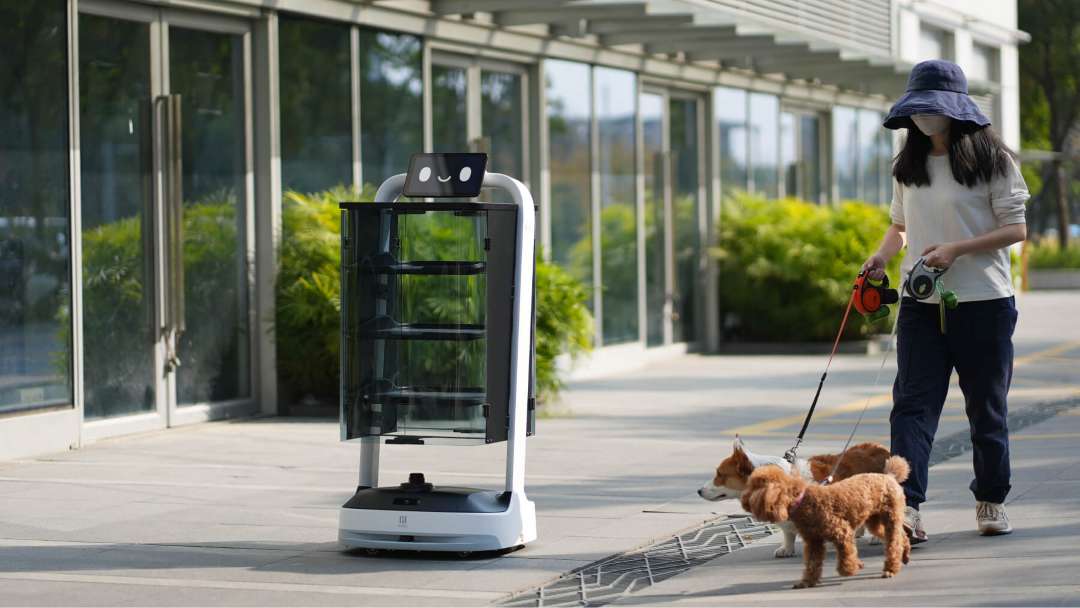
While the PuduBot 2 is designed for indoor deployment on flat surfaces, its sensor architecture and chassis capabilities extend to covered outdoor areas, building corridors, and semi-open commercial spaces. The image below captures the robot navigating an outdoor pedestrian zone and passing a person walking two dogs — a live demonstration of dynamic multi-target obstacle detection in an uncontrolled environment.
Technical Specifications of the PUDU PuduBot 2
Physical Dimensions & Build
| Product Model | PDFD22 |
|---|---|
| Overall Dimensions (L × W × H) | 580 mm × 535 mm × 1290 mm |
| Overall Weight | 39 kg |
| Shell Material | PC+ABS / Aluminum alloy |
| IP Rating | IP40 |
Mobility & Navigation
| Navigation Method | VSLAM, LiDAR, VSLAM + LiDAR fusion |
|---|---|
| Cruise Speed | 0.1–1.2 m/s (adjustable) |
| Steady Mode Max Speed | 0.4 m/s |
| Minimum Passing Width | 80 cm |
| Max. Climbing Angle | 5° |
| Max. Surmountable Height | 10 mm |
| Max. Surmountable Gap | 15 mm |
| Max. VSLAM Ceiling Height | 30 m |
| Parking Accuracy | 5–10 cm from arrival point |
| Max Boot Points (map) | 16 |
Tray System
| Number of Trays (standard) | 3 (removable, height-adjustable) |
|---|---|
| Tray Dimensions | 520 mm × 435 mm |
| Tray Load — Rated | 10 kg per level |
| Tray Load — Maximum | 13 kg per level |
| Tray Spacing | Adjustable |
| Tray Material | Metal |
Power & Battery
| Battery Capacity | 25 Ah (LFP) |
|---|---|
| Battery Life (no load) | 12–15 h |
| Charging Time | ~4 h |
| Operating Voltage | DC 23–29.4 V |
| Power Input | AC 100–240 V, 50/60 Hz |
| Power Output | 29.4 V, 8 A |
| Auto-Charging Station | Yes — autonomous docking |
Display & Audio
| Head Screen | 10.1" LCD |
|---|---|
| Optional Advertising Screen | 32" (optional accessory) |
| Speaker Power | 10 W × 2 stereo |
| Supported Audio Formats | MP3, WAV, FLAC, AAC, PCM, WMA, APE |
| Music Library Capacity | Up to 20 tracks (QR import) |
Connectivity & Interfaces
| Wireless | Wi-Fi, 4G (SIM card slot) |
|---|---|
| Bluetooth Gate Support | Yes |
| Expansion Port | 1 × USB Type-C |
| Calling Ecosystem | PuduBeeper, PuduLink, 4G Watch, Pudu Pager |
| Max Simultaneous Pager Tasks | 48 |
Software & Operating System
| Operating System | Android (PuduOS) |
|---|---|
| Navigation Software | PUDU SLAM (markerless) |
| Work Modes | Food Delivery, Delivery, Cruise, Direct, Birthday, Collection |
| PUDU SLAM Setup Time Reduction | 75% vs. marker-based systems |
| OTA Firmware Updates | Yes |
| Docking Modes | One-to-one, Free mode, Waiting mode |
Environmental Ratings
| Operating Temperature | 0 °C to 40 °C |
|---|---|
| Operating Humidity | ≤ 85% RH |
| Storage Temperature | -40 °C to 65 °C |
| Operating Altitude | < 2000 m |
| IP Rating | IP40 |
| Road Surface Requirement | Indoor, flat, smooth surfaces |
What's in the Box
- PUDU PuduBot 2 delivery robot × 1 (model PDFD22, 10.1" LCD)
- User Manual × 1
- Quality Certificate × 1
- Charger × 1
How to Start Up and Dispatch the PUDU PuduBot 2
This procedure covers the full startup sequence for the PuduBot 2, from battery and master switch verification through to dispatching the first autonomous delivery task.
Step 1: Verify the Master Switch Position
Locate the master switch on the robot's base and confirm it is set to the "I" (ON) position. This switch controls the main power supply and must be active before charging or powering on the robot.
Step 2: Position the Robot at the Startup Location
Move the robot to the designated startup location — a floor position beneath a ceiling area with clear, distinct visual features for VSLAM initialisation. The startup label should be fixed to the floor at this point. Up to 16 boot points can be configured per map.
Step 3: Power On
Press and hold the power switch for 1 second. The light strip turns blue to confirm successful power-on. The PuduOS interface initialises automatically along with all navigation sensors and communication modules.
Step 4: Assign a Task and Dispatch
On the 10.1" LCD touchscreen, select the desired work mode (e.g., Delivery). Place the item on the appropriate tray, select the destination table or location identifier on screen, then tap "Start" to dispatch the robot autonomously.
Step 5: Confirm Delivery and Return
Upon arrival, the robot announces its presence via speaker and on-screen notification. The staff member removes the item and taps "Done" on the touchscreen, or confirms via the connected 4G watch or PuduLink app. The robot then returns autonomously to its docking station.
How long does the PuduBot 2 battery last on a single charge?
The 25 Ah LFP battery provides 12–15 hours of operation under no-load conditions. Charging time from empty is approximately 4 hours. When battery level drops to the configured threshold (5%–50%), the robot autonomously navigates to the auto-charging station and docks without staff intervention.
Does the PuduBot 2 require ceiling markers or stickers for navigation?
No. The PuduBot 2 uses PUDU SLAM — a markerless visual positioning system that reads natural ceiling features for localisation. No ceiling modifications are needed, and deployment setup time is reduced by approximately 75% compared to marker-based systems. The VSLAM system operates reliably in spaces with ceiling heights up to 30 m.
What is the minimum corridor width required for the PuduBot 2?
The PuduBot 2 requires a minimum passing width of 80 cm for a single robot. For two robots passing head-on, a corridor width of at least 2 m is recommended. The recommended working path width is above 1.2 m to ensure smooth navigation.
How much weight can each tray carry?
Each of the three metal trays has a rated load capacity of 10 kg and a maximum load capacity of 13 kg. Tray spacing is fully adjustable to accommodate items of varying heights. Tray dimensions are 520 mm × 435 mm each.
Can the PuduBot 2 operate without an internet connection?
Yes, for most operational functions. The robot performs autonomous navigation and delivery tasks without internet access. The Pudu Pager calling system also works offline via a local gateway connection and can handle up to 48 simultaneous tasks. PuduLink app calling and 4G watch integration require an active network connection.
What happens when the PuduBot 2 detects an obstacle?
The dual-LiDAR system and 3D depth vision sensors detect obstacles continuously and trigger automatic rerouting. RGBD sensors can detect obstacles as small as 2 cm within a 1 m range. If the physical collision sensor is triggered, the robot stops immediately and waits for manual resumption via the touchscreen. In emergencies, pressing the physical emergency stop button halts all motion immediately.
Why Choose EXPERT3D?
EXPERT3D has specialised in advanced robotics and 3D technology since 2012 — more than a decade of hands-on experience selecting, deploying, and supporting professional-grade platforms for businesses, research institutions, and commercial operations across Spain and Europe. As an official representative of PUDU, we guarantee the best price, authorised service, and official warranty. We provide pre-sales technical consultation, site survey coordination, delivery logistics, and post-sale support backed by direct manufacturer contacts. The PUDU PuduBot 2 is a field-proven commercial system: our team can assist with site mapping, fleet configuration, and integration into your facility's existing workflow. Contact us to discuss your specific operational requirements and current stock availability.