- Stock: In Stock
- Product code: 10260-000013
- Weight Brutto: 135.00kg

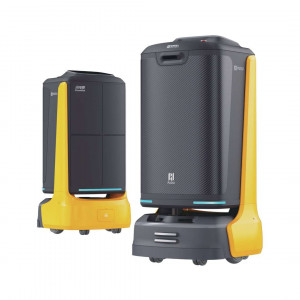
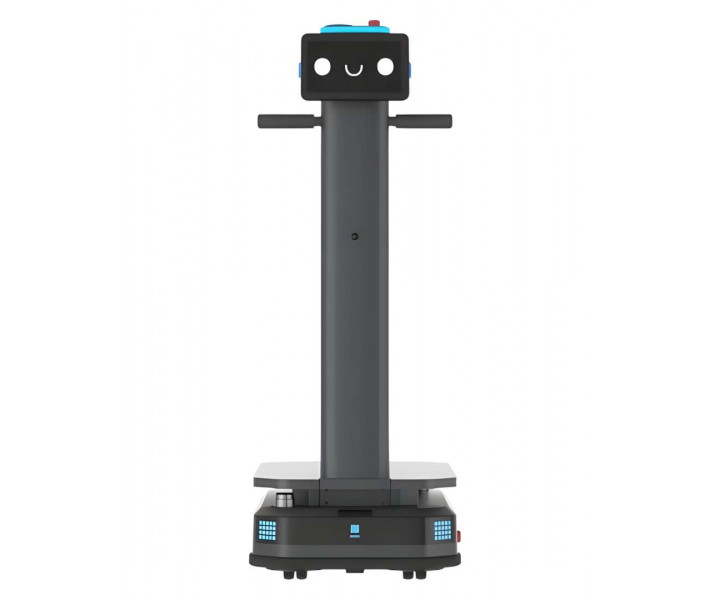
The PUDU T300 Elevator is an industrial autonomous mobile robot (AMR) engineered for heavy-load material transport in manufacturing and logistics environments. Carrying up to 300 kg, navigating with VSLAM+ and Laser-SLAM without floor markers, operating up to 12 hours unloaded, and connecting natively to building elevators via IoT API, the T300 replaces manual trolleys and traditional AGV systems in a single deployable platform.
| Maximum Payload | 300 kg |
|---|---|
| Battery Runtime | 12 h (unloaded) / 6 h (full load) |
| Navigation Technology | VSLAM+ and Laser-SLAM (marker-free) |
| Safety Certification | ISO 3691-4 |
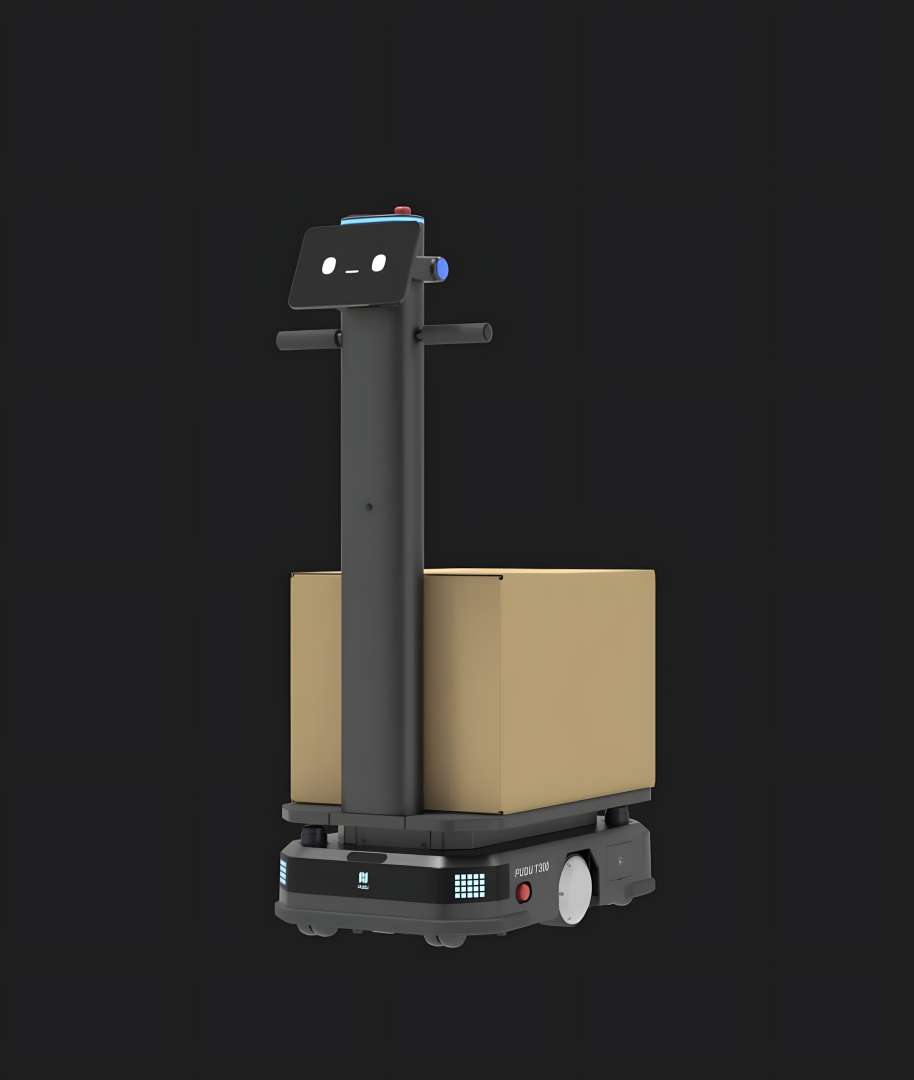
The image below shows the T300 in its standard configuration, carrying a full-size cardboard box — the everyday reality of autonomous line-side and inter-department logistics on a factory floor.
Industrial Applications: From Line-Side Delivery to Final-Product Logistics
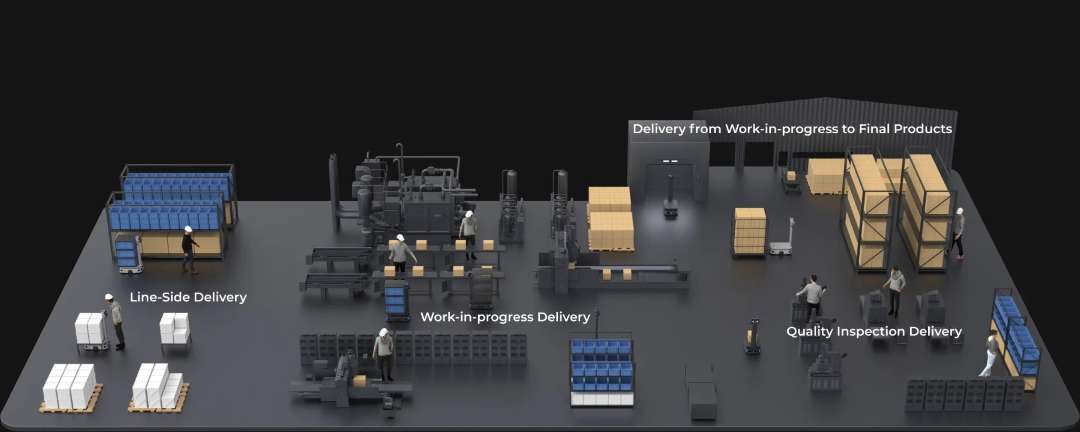
The T300 covers four distinct workflow stages that define modern industrial material flow. Line-side delivery keeps assembly stations continuously supplied without human runners. Work-in-progress transport moves semi-finished goods between production cells. WIP-to-final-product transfer handles the handoff from production into finished-goods storage. Quality inspection delivery routes samples to QA stations autonomously — removing the last manual touchpoints in continuous-flow manufacturing.
The diagram below maps each of these four application zones across a typical factory floor, illustrating how a single T300 fleet covers the full intra-logistics chain from raw material intake to outbound staging.
VSLAM+ Navigation: Deploy in 70% Less Time Than Traditional AGVs
Traditional AGVs require physical track installation — magnetic strips, QR grids, or reflective tape — that takes days to lay and locks the robot to a fixed route. The T300 operates as a true AMR: it builds its own map using PUDU's proprietary VSLAM+ technology, combining visual odometry with Laser-SLAM point-cloud fusion. No floor markings. No structural modifications. The robot maps, navigates, and re-localizes in real time.
High-Ceiling and Large-Scale Environments
VSLAM+ performs reliably in facilities with ceilings up to 30 m, which rules out many landmark-based AMR systems limited to standard warehouse heights. Map capacity reaches 200,000 m² per project — sufficient for the largest distribution centers and multi-wing manufacturing complexes. When production layouts change, map updates take minutes, not days.
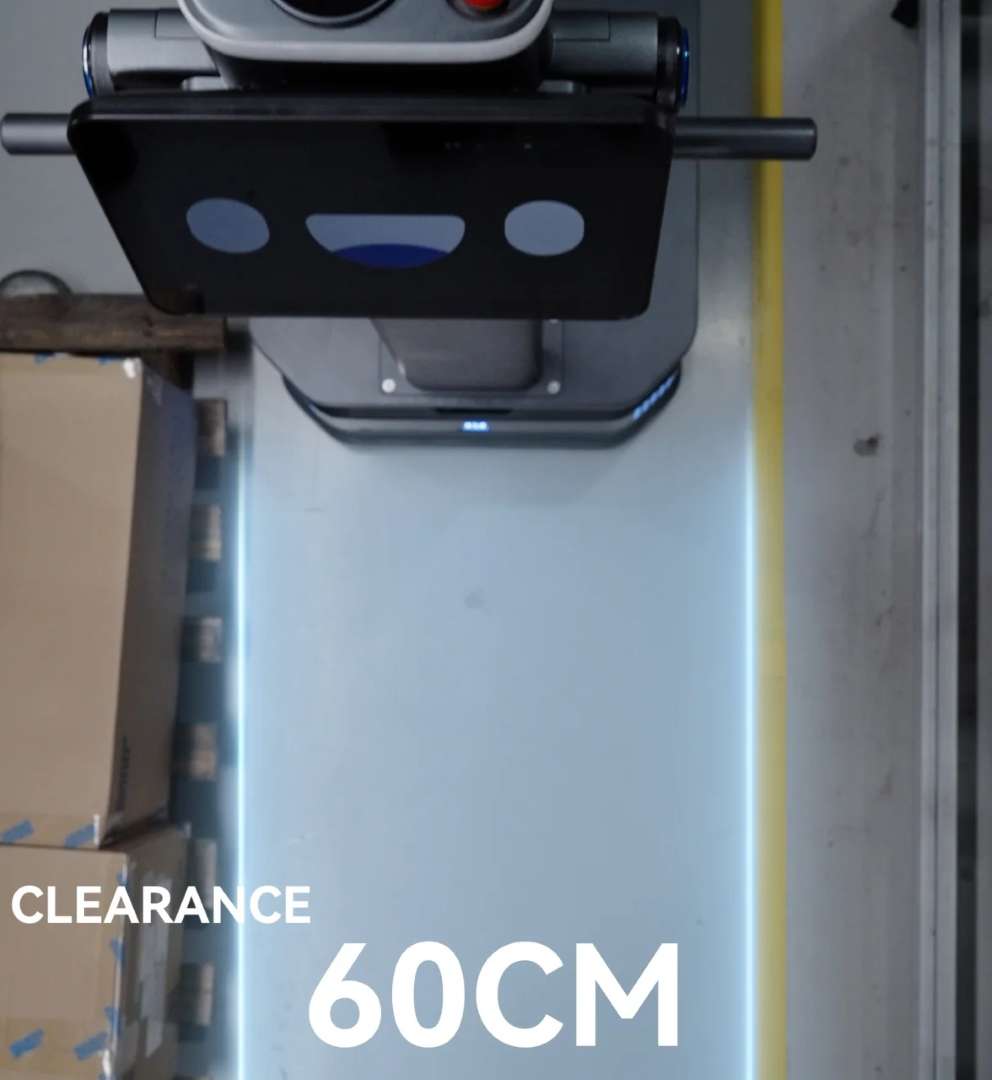
The overhead view below shows the T300 threading through a 60 cm path clearance — the robot's minimum aisle requirement — demonstrating the compact footprint that allows deployment alongside existing racking, machinery, and pedestrian corridors.
360° Omni-Sense Safety: ISO 3691-4 Certified
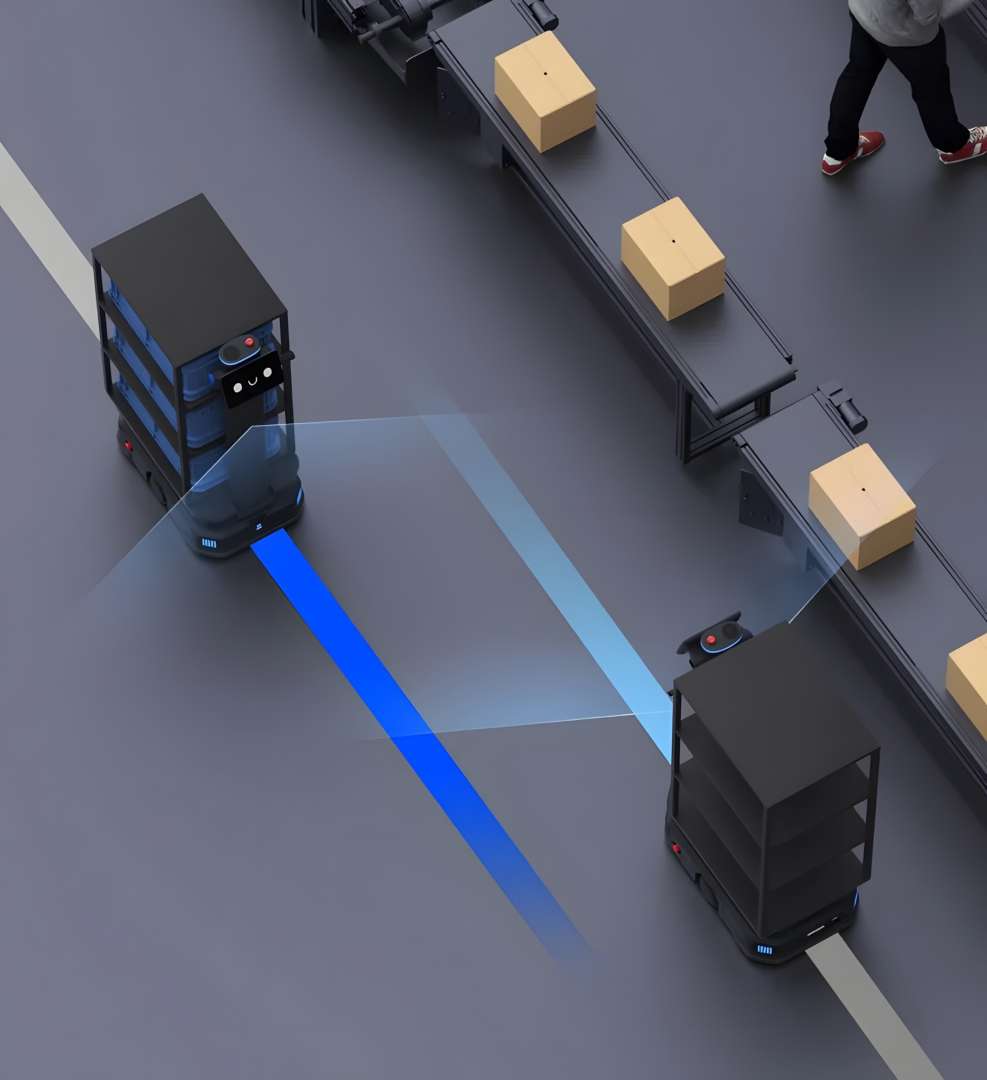
The T300 meets the ISO 3691-4 standard for industrial automated vehicles — the same certification framework applied to autonomous forklifts and factory transport systems. Three sensor layers work simultaneously: a 360° LiDAR sweep detects obstacles in the horizontal plane; RGBD depth cameras provide spatial awareness in three dimensions; and a front-view camera handles close-range object identification. Together they create overlapping detection zones with no blind spots.
The render below shows two T300 robots operating near active conveyor belts, with their LiDAR scan beams visualized as blue cones — each robot continuously broadcasting its presence while calculating dynamic safe-path adjustments around moving objects and personnel.
Follow Mode and Power-Assist Mode
When full autonomy is not yet configured for a zone, the T300 supports two semi-autonomous operating modes. In Follow Mode, the robot tracks a designated worker using visual recognition — maintaining convoy spacing while the worker leads. Multiple robots can queue in ordered sequence, each matching the pace and direction of the person ahead. In Power-Assist Mode, the electric drive provides assistance when an operator pushes the robot manually, simultaneously generating or refining the area map through the on-board VSLAM+ system.
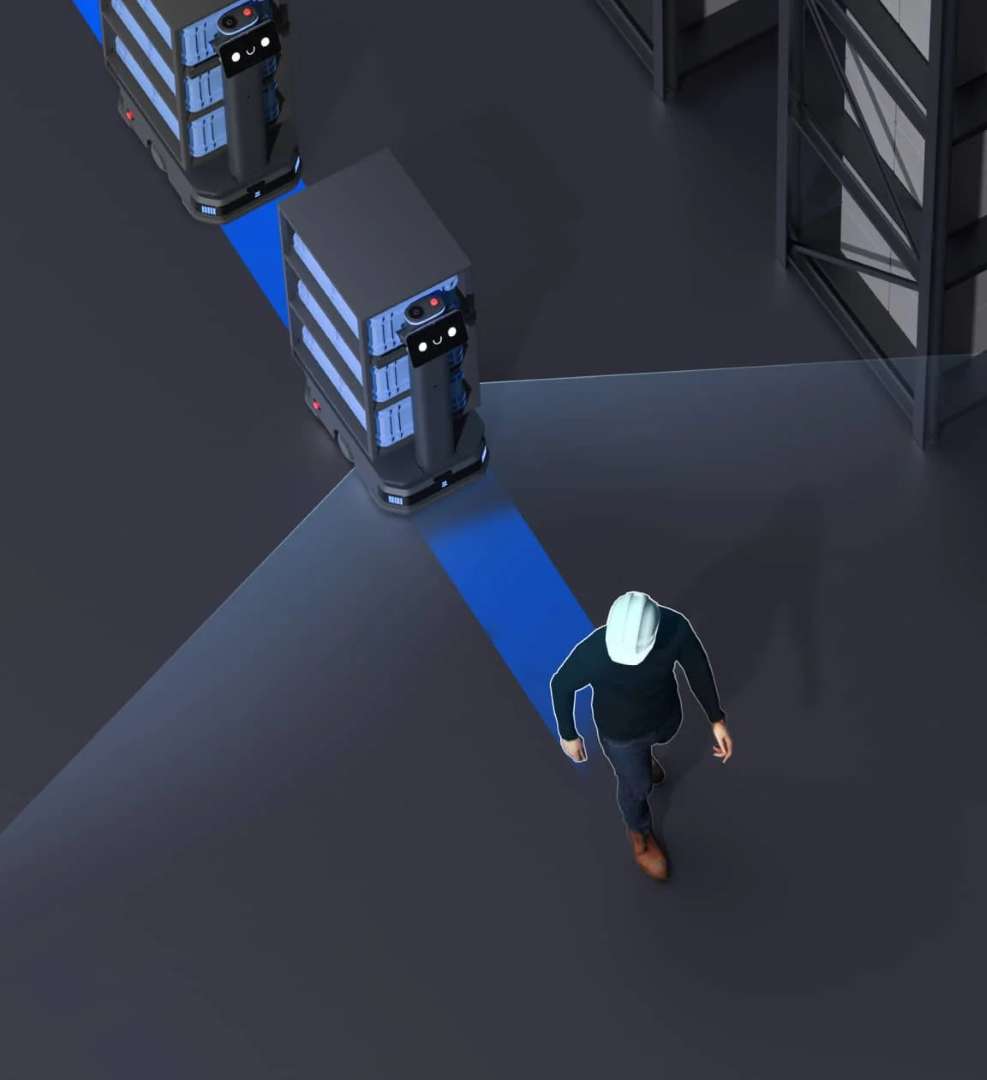
The image below shows two T300 robots in Follow Mode locking onto a hard-hat worker across an open warehouse floor, with tracking beams visible.
Four Attachment Configurations
The T300's open-top chassis is designed as a universal base for modular load carriers. Four configurations cover the full spectrum of industrial transport tasks.
Standard and Shelf Modes
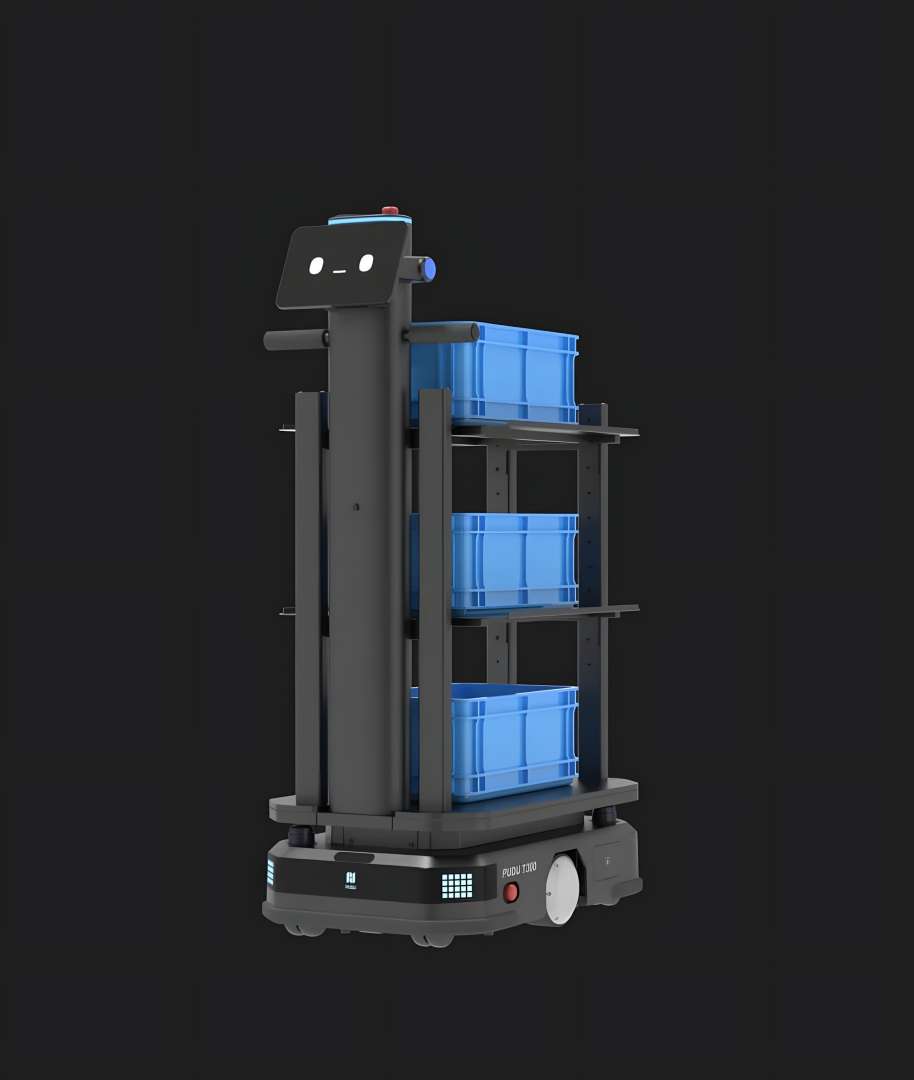
Standard Mode mounts a large flat-platform carrier for oversized single-unit loads — cartons, tooling bins, and raw-material pallets up to the 300 kg limit. Shelf Mode installs a multi-tier rack that carries small-to-medium containers across multiple destinations in a single trip. The image below shows the T300 loaded with three levels of blue storage bins, each destined for a different workstation.
Lifting Mode (WTIDL1 Variant) and Towing Mode
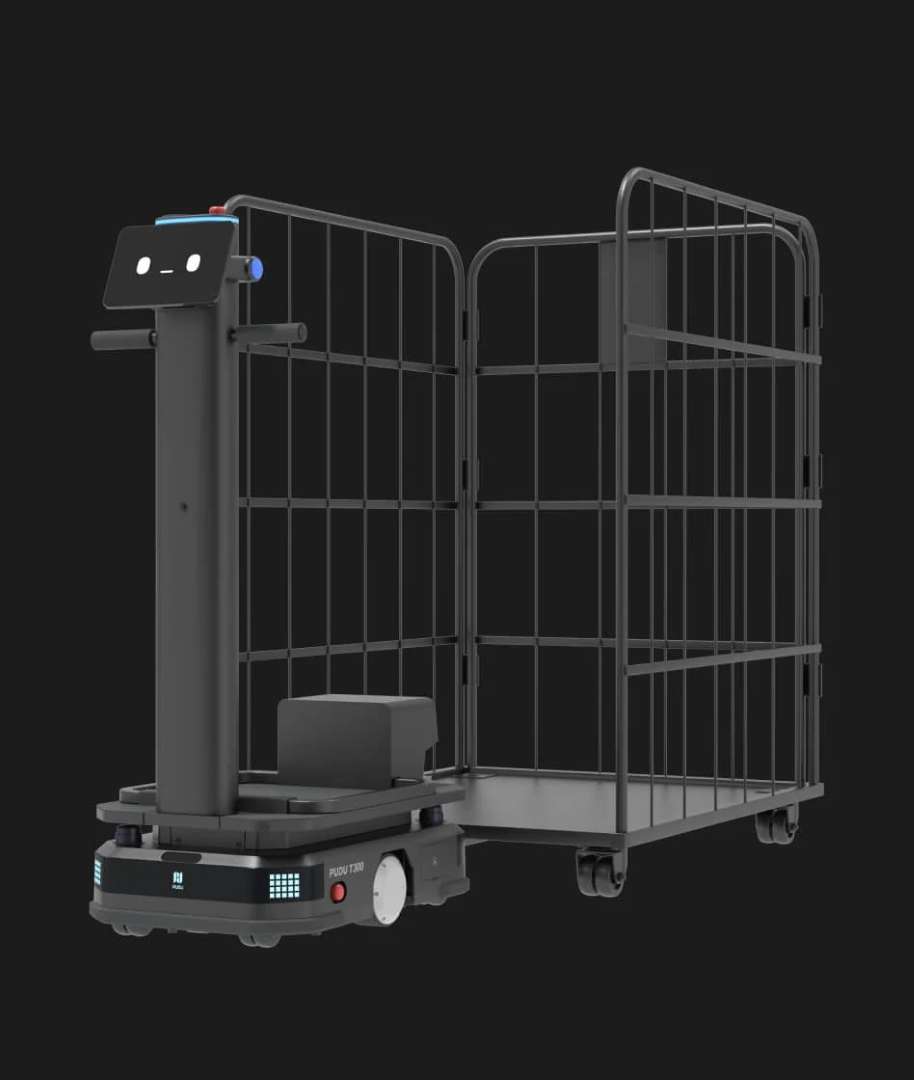
Lifting Mode, available on the WTIDL1 model, enables fully automated load-and-unload operations. The robot drives beneath a rack fitted with reflective markers, raises the load hydraulically to transport height, and delivers it to the programmed drop-off point — no human intervention at pickup or destination. Supported rack lengths range from 600 mm to 1,200 mm, with rack height up to 1,300 mm. Towing Mode connects the T300 to existing wheeled carriers via a mechanical coupling, letting the robot pull roll cages, wire trolleys, and custom-built transport frames without requiring new infrastructure. The image below shows the T300 coupled to a metal wire roll cage.
24/7 Operation: 12-Hour Runtime, Quick-Swap Battery, Auto-Charging
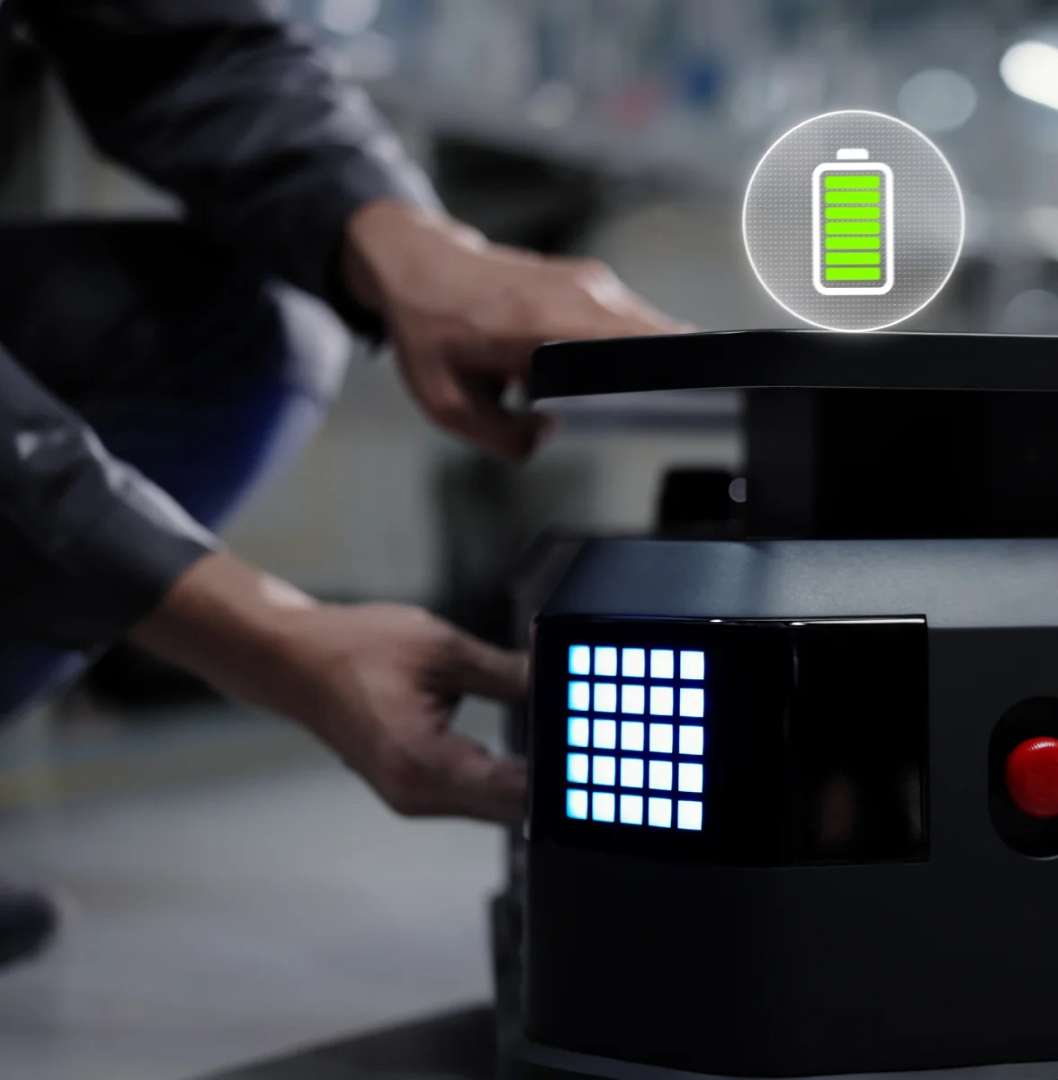
The T300 runs for 12 hours without a load and 6 hours at maximum payload — covering a full day shift on a single charge for most deployment patterns. The 30 Ah lithium-ion battery is tool-free swappable: open the compartment, disconnect the power connector, and insert a charged unit. Total swap time is under two minutes with a trained operator, enabling continuous 24/7 operation with a simple battery rotation schedule.
The image below shows a worker mid-swap on a T300, with the battery status indicator confirming a full charge on the replacement unit.
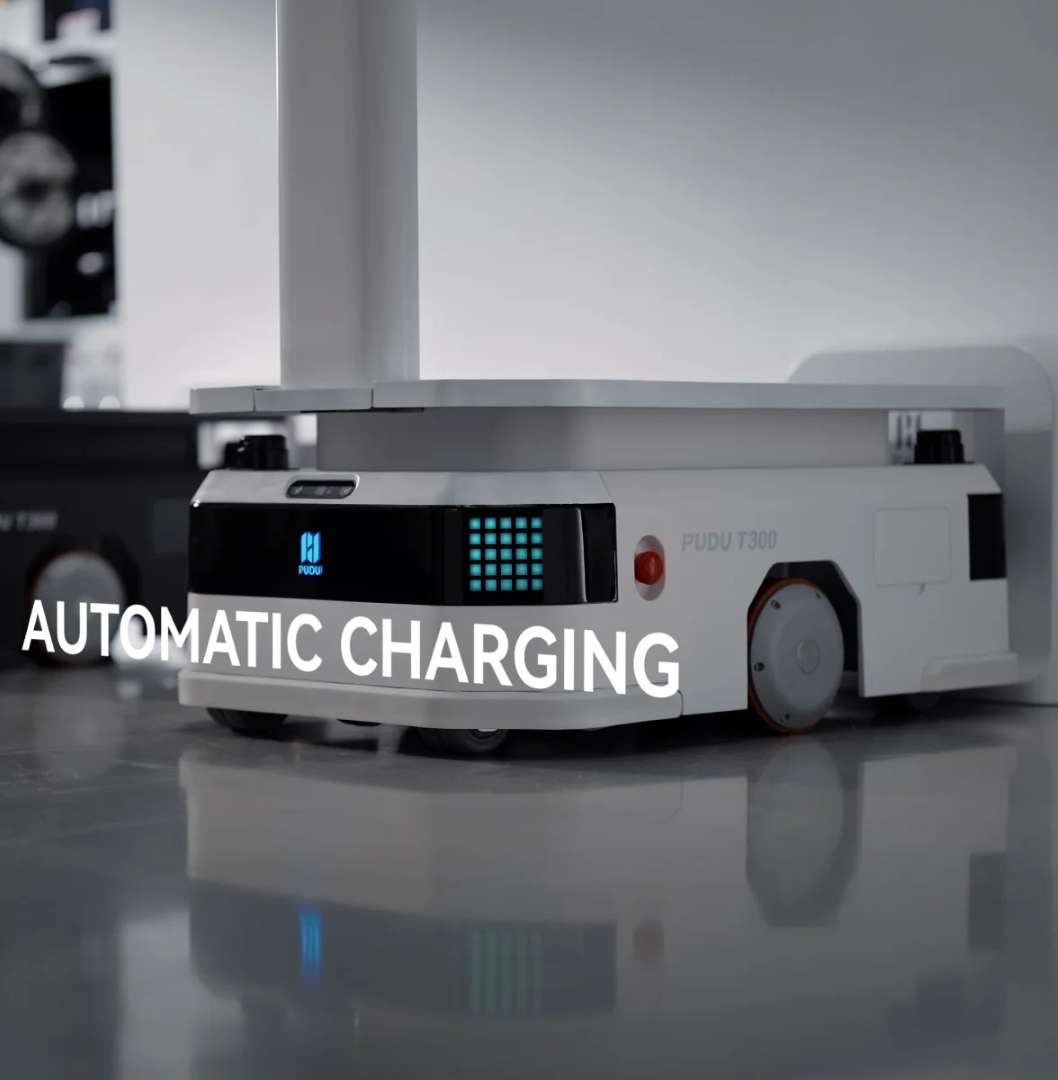
When battery rotation is not needed, the T300 autonomously navigates to its charging station and docks without operator assistance. Charging from 0% to 90% takes approximately 2 hours using the standard charger (AC 100–240 V input, 29.2 V / 15 A output).
IoT Integration: Elevator Control, E-Gate, and Fleet Management
The "Elevator" designation in the T300's name reflects its native multi-floor capability. Through the built-in IoT module, the robot communicates with building elevator controllers, calls the correct car, boards, selects the destination floor, and exits — all autonomously. The same IoT stack handles e-gate access control for secured zones, remote pager notifications to dispatch staff, and a Bluetooth speaker for on-robot voice alerts. Software API integration with PDUD Link (mobile app) and third-party systems is supported via a standard interface.
Fleet management through the PUDU Scheduler System coordinates up to 20 robots in a single environment. The scheduler resolves traffic conflicts, routes detours around congestion, and redistributes tasks dynamically as conditions change — with no manual coordination required.
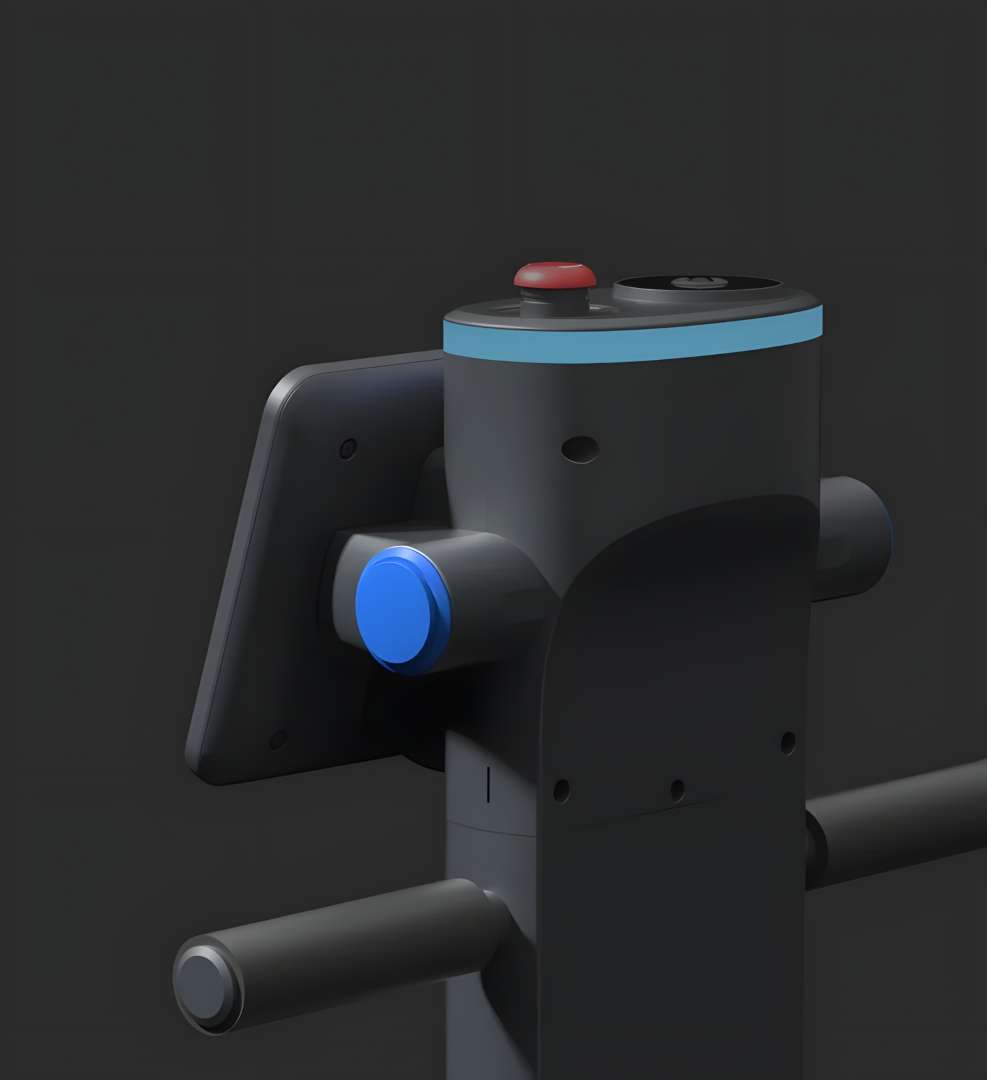
The image below shows the T300's top assembly in detail: the rotating LiDAR sensor tower, the 10.1-inch touch screen, the press-to-go button for manual dispatch, and the emergency stop switch.
Tech Tip: When mapping a new facility, perform the initial VSLAM+ scan during off-peak hours with minimal foot traffic and no moving equipment. Map quality scales directly with environmental consistency at scan time — dynamic objects introduce phantom features that degrade re-localization accuracy under load. Run at least two full passes in opposite directions before saving the master map.
Technical Specifications of the PUDU T300 Elevator
Mechanical Dimensions
| Model Variants | WTID01 (standard) / WTIDL1 (with lifting) |
|---|---|
| Overall Dimensions (H × W × D) | 835 × 500 × 1350 mm |
| Chassis Dimensions (H × W × D) | 780 × 500 × 240 mm |
| Machine Weight — WTID01 | 65 kg |
| Machine Weight — WTIDL1 (with lifting) | 81 kg |
| Screen | 10.1 inch LCD touch screen |
| Operating System | Android |
Performance
| Maximum Load Capacity | 300 kg |
|---|---|
| Cruise Speed | 0.2–1.2 m/s (adjustable) |
| Minimum Path Clearance | 60 cm |
| Maximum Surmountable Threshold Height | 20 mm |
| Maximum Surmountable Gap Width | 35 mm |
| Speaker Power | 10 W × 2 (stereo) |
Navigation and Safety
| Navigation Methods | Visual-SLAM (VSLAM+) and Laser-SLAM |
|---|---|
| Sensors | 360° LiDAR, RGBD depth camera, front-view camera, VSLAM camera |
| Safety Standard | ISO 3691-4 |
| Maximum Scene Mapping Area | 200,000 m² |
| Maximum Ceiling Height for VSLAM+ | 30 m |
| Fleet Capacity (PUDU Scheduler) | Up to 20 robots per environment |
Battery and Power
| Operating Voltage | DC 20.8–29.2 V |
|---|---|
| Battery Capacity | 30 Ah (swappable lithium-ion) |
| Battery Life — No Load | 12 h |
| Battery Life — Maximum Load | 6 h |
| Charging Time (0% to 90%) | ~2 h |
| Charger Input | AC 100–240 V, 50/60 Hz |
| Charger Output | 29.2 V, 15 A |
External Expansion Interfaces
| Power Supply Port | 24 V DC, maximum 2.5 A output |
|---|---|
| USB | USB 2.0 — data communication with external devices |
| LED IO | Signal communication for external optional accessories |
| SIM Card Slot | Nano SIM |
| OTG Port | Device debugging |
Environmental Conditions
| Working Temperature | 0 °C to 40 °C |
|---|---|
| Working Humidity | ≤ 85% RH |
| Storage Temperature | -20 °C to 60 °C |
| Maximum Operating Altitude | < 2000 m |
| Floor Surface Requirements | Indoor, flat, smooth surfaces |
What's in the Box
- PUDU T300 Elevator autonomous mobile robot (WTIDL1 configuration with lifting mechanism)
- 30 Ah swappable lithium-ion battery (pre-installed)
- AC charger (100–240 V input / 29.2 V, 15 A output)
- User Manual and Quality Certificate
How to Launch the First Autonomous Delivery Task on the PUDU T300 Elevator
This procedure covers how to map a new deployment area and run the first automated delivery cycle after initial system setup on the PUDU T300 Elevator.
Step 1: Power On and Initialize
Ensure the 30 Ah battery is fully charged and locked in the battery compartment. Press and hold the main power switch for 3 seconds. The indicator light turns blue and the LCD screen displays the home screen, confirming successful startup.
Step 2: Create the Area Map Using Power-Assist Mode
Enable Power-Assist Mode on the touch screen. Push the robot through the entire delivery area at a walking pace. The VSLAM+ system builds the environmental map in real time. Complete at least two full passes in opposite directions to improve map density and feature coverage.
Step 3: Save the Map and Set Key Points
Navigate to Settings → Map Settings on the touch screen. Save the completed map. Mark delivery destinations, the standby (home) point, and the charging station location on the map. For Lifting Mode deployments, also register rack dimensions under Robot Functions → Lifting Settings → Picking Method.
Step 4: Configure the First Delivery Task
From the home screen, select Delivery Mode. Load materials onto the robot or attachment. On the task screen, select one or more destination points from the list. The robot plans the optimal multi-stop route automatically.
Step 5: Dispatch and Monitor
Tap Depart to start the task. The robot navigates autonomously to all destinations, stops at each point for pickup/drop-off, and returns to the standby point on completion. Monitor progress on the LCD screen or through the PDUD Link mobile app. To pause at any point, tap the screen; tap again to resume.
What is the maximum payload of the PUDU T300 Elevator?
The PUDU T300 Elevator carries a maximum payload of 300 kg. This applies to all attachment configurations: standard platform, shelf rack, lifting mechanism, and towing. Runtime at maximum load is 6 hours on a single 30 Ah battery charge.
Does the PUDU T300 Elevator support multi-floor operation via building elevators?
Yes. The T300 Elevator includes a built-in IoT elevator control module that communicates with compatible building elevator systems via software API. The robot autonomously calls an elevator car, boards it, selects the destination floor, and exits — enabling fully unattended multi-floor material transport without human operators at either end.
How quickly can the PUDU T300 Elevator be deployed in a new facility?
Deployment time is reduced by approximately 70% compared to traditional AGV systems. No floor markers, magnetic strips, or structural modifications are required. An operator drives the robot through the target area in Power-Assist Mode to build a VSLAM+ map, marks delivery points and the charging station, and the robot is ready for autonomous operation — typically within a single shift.
Can multiple PUDU T300 robots operate together in the same space?
Yes. The PUDU Scheduler System coordinates fleets of up to 20 T300 robots in a single environment. The scheduler handles traffic conflict resolution, dynamic rerouting around congestion, and real-time task redistribution. Robots detect each other and yield appropriately, with no manual coordination required from operators.
What attachment types are compatible with the PUDU T300 Elevator?
Four configurations are supported: Standard Mode (large flat platform for oversized single loads), Shelf Mode (multi-tier rack for multi-destination small and medium containers), Lifting Mode (automated under-rack pickup and delivery, WTIDL1 model only), and Towing Mode (mechanical coupling to existing wheeled carriers and roll cages via a compatible towing device).
Why Choose EXPERT3D?
As an official representative of PUDU Robotics, we guarantee the best price, authorized service, and official warranty on the full PUDU product line. EXPERT3D has specialized in advanced robotics and industrial automation since 2012 — over a decade of hands-on experience selecting, deploying, and supporting professional-grade platforms across manufacturing facilities, universities, and R&D centers throughout Spain and Europe. We provide pre-sales technical consultation, delivery coordination, and post-sale support backed by direct manufacturer contacts. The PUDU T300 Elevator is a complex deployment requiring site analysis, map commissioning, and IoT integration planning: our team can guide you through each step. Contact us to discuss your application requirements and current availability.