

- Stock: In Stock
- Product code: G1-U9-EDU
- Weight Brutto: 70.00kg

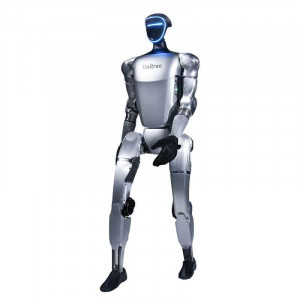
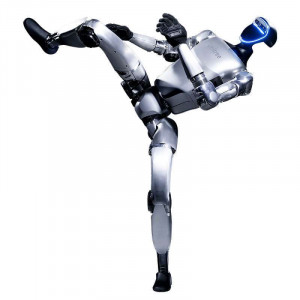
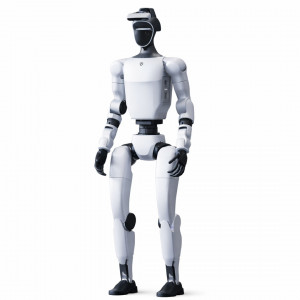
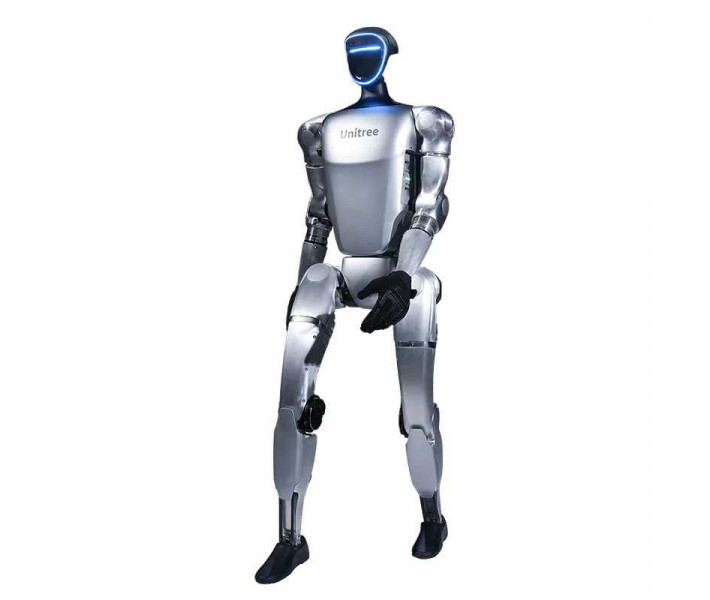
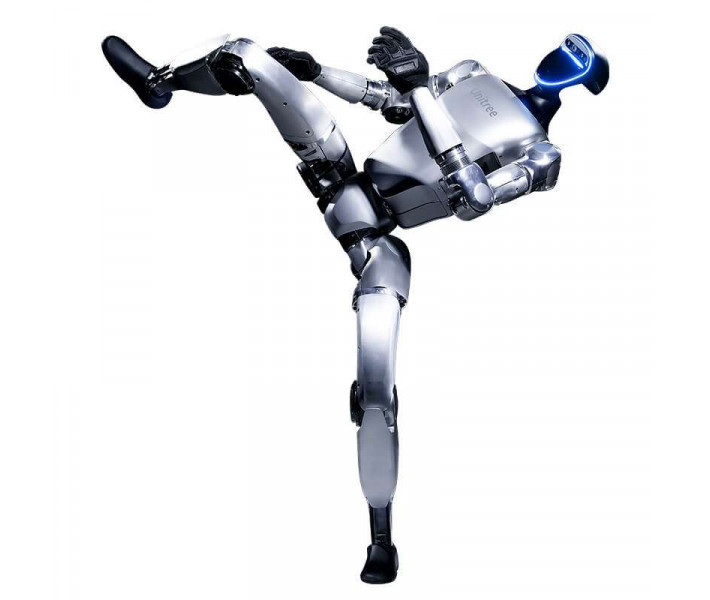
The UNITREE G1-U9 EDU is a full-scale humanoid research robot built for advanced academic and industrial applications, standing 1,320 mm tall and weighing approximately 35 kg. This EDU-tier platform ships in the U9 configuration with 37 total degrees of freedom, two pre-installed Dex3-1 force-control dexterous hands, a 120 N·m maximum knee-joint torque, an onboard NVIDIA Jetson Orin NX AI compute module, and Intel RealSense D435i depth perception — delivering human-like manipulation at a locomotion speed of up to 2 m/s.
| Total Degrees of Freedom (U9 config) | 37 |
|---|---|
| Maximum Joint Torque (knee) | 120 N·m |
| AI Computing Module | NVIDIA Jetson Orin NX (8-core, 2 GHz, 16 GB) |
| Battery Life | ~2 h (9,000 mAh smart battery) |
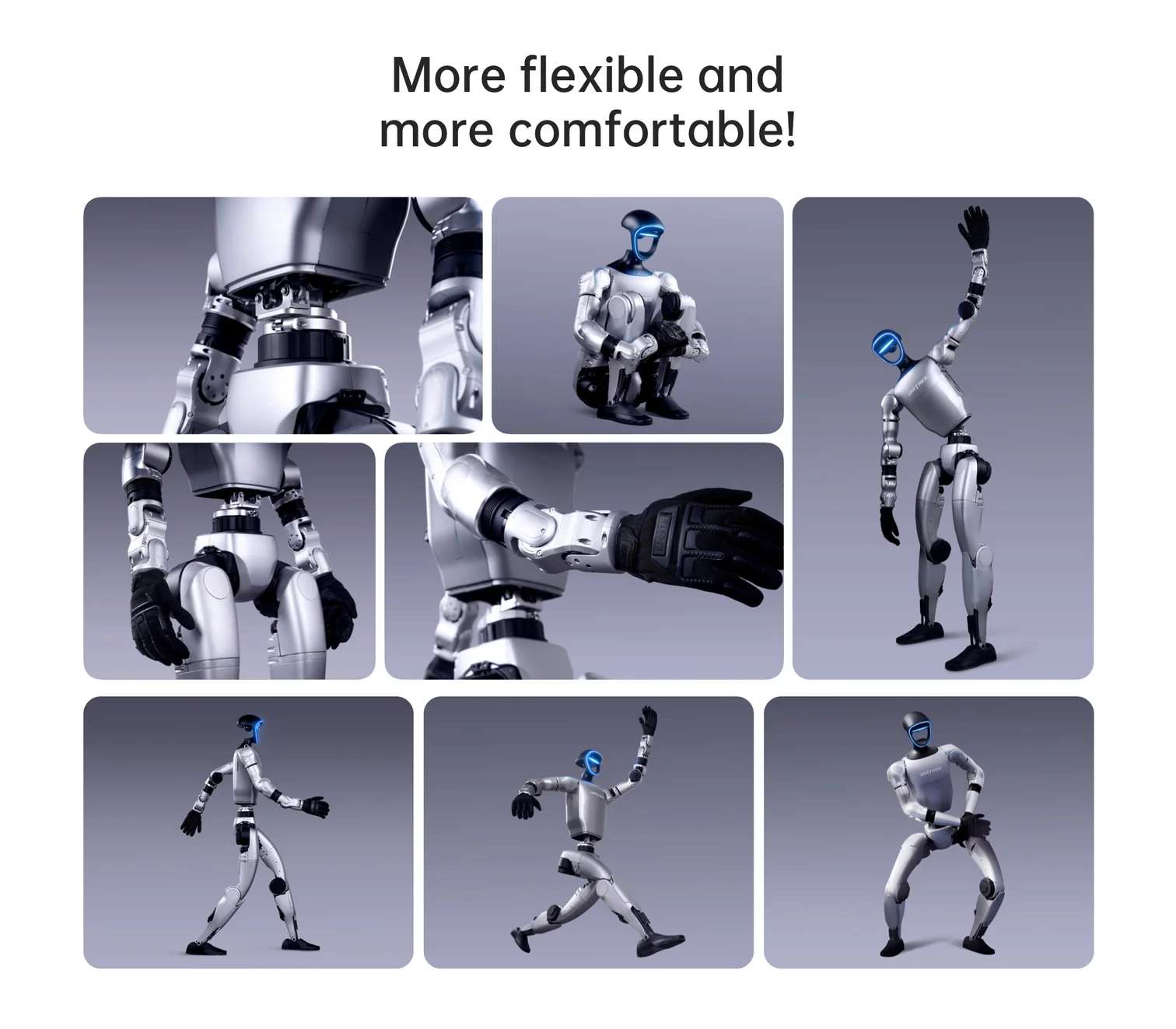
The image below shows the full range of poses the G1-U9 EDU can achieve — from a deep squat and crouched rest position to a dynamic running stride and wide lateral stance — all enabled by its extra-large joint movement space and industrial-grade crossed roller bearings.
37 Degrees of Freedom — Movement Beyond Human Limits
Where a standard G1 ships with 23 joints, the U9 EDU configuration pushes that count to 37 active degrees of freedom by adding both Dex3-1 dexterous hands (7 DOF each plus 2 optional wrist DOF each) and the expanded waist module. The result is a kinematic envelope that genuinely exceeds typical human joint mobility. The waist Z-axis alone rotates a full ±155°, the knee extends through 0°–165°, and hip-joint Pitch sweeps ±154° — parameters that allow poses a human spine could not safely replicate.
- Single leg: 6 DOF — hip (3), knee (1), ankle (2)
- Single arm: 5 DOF — shoulder (3), upper arm, elbow
- Dex3-1 hand: 7 DOF per hand — thumb (3), index (2), middle (2)
- Optional wrist extension: +2 DOF per arm (P±92.5°, Y±92.5°)
- Waist: 1 DOF standard, expandable to 3 (optional X±45°, Y±30°)
Every joint routes its wiring through a hollow-core electrical channel — no external cable looms visible on the body, which eliminates snagging hazards during close-quarters manipulation tasks.
Dex3-1 Force-Controlled Hands — Sub-Kilogram Precision Grip
The G1-U9 EDU is the first G1 configuration to ship with two Dex3-1 three-fingered hands pre-installed. Each hand combines force-position hybrid control with a perception range of 10 g–2,500 g, enabling the robot to handle fragile laboratory glassware and resist loads of up to 3 kg per arm with the same control loop. The thumb carries three independent active joints (rotation range: 0°–+100°, -35°–+60°, -60°–+60°), while both the index and middle finger each contribute two joints — giving a total of 7 active DOF per hand.
Note: the U9 configuration ships with force sensing enabled but without the optional tactile sensor arrays. The 9-point tactile array can be retrofitted to each hand independently at a later stage.
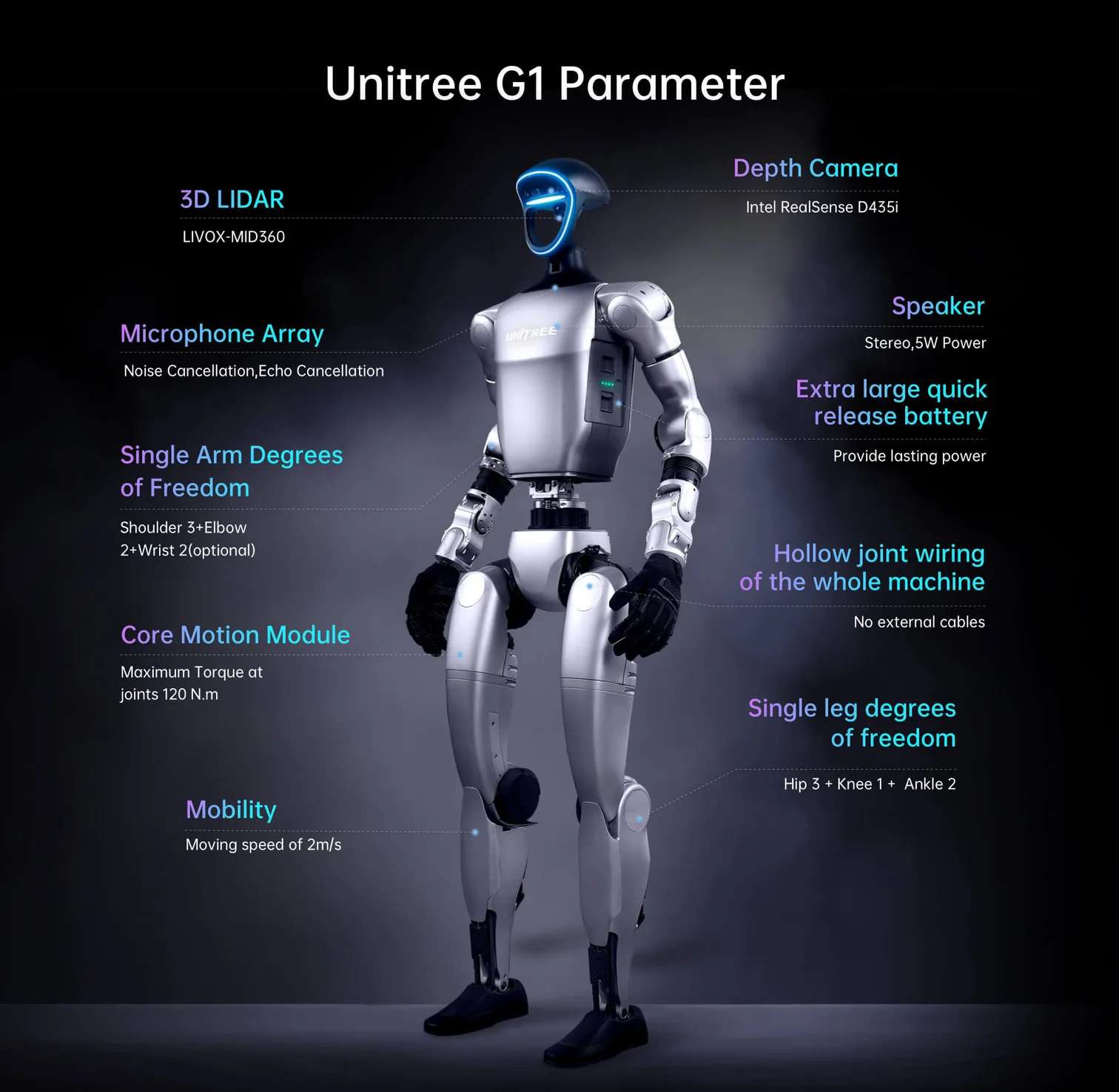
The annotated diagram below identifies every major sensor, actuator cluster, and connectivity port on the G1-U9 EDU body, including the LIVOX-MID360 LiDAR, Intel RealSense D435i depth camera, microphone array, hollow-joint wiring architecture, and quick-release battery bay.
360° Environmental Awareness — LiDAR + Depth Camera Fusion
The perception stack pairs a LIVOX-MID360 3D LiDAR with an Intel RealSense D435i depth camera. The MID360 provides a full 360° horizontal field of view, mapping the surrounding workspace in real time, while the D435i adds dense stereoscopic depth to the forward view for grasping-target localisation. The microphone array consists of four channels with built-in noise cancellation and echo cancellation, allowing the robot to receive voice commands in noisy factory or laboratory environments. A 5 W stereo speaker completes the audio interface for voice feedback and operator alerts.
NVIDIA Jetson Orin NX — AI-Accelerated Autonomy
The G1-U9 EDU runs a two-tier compute architecture. The primary motion-control unit handles real-time joint coordination with a dedicated 8-core high-performance CPU. The secondary development unit is a NVIDIA Jetson Orin NX — Arm Cortex-A78AE at 2 GHz, 8 cores, 16 GB of unified memory — which hosts perception models, reinforcement-learning inference, and the UnifoLM unified robot large model. This separation of motion-critical and AI-inference workloads reduces latency on control loops while giving researchers full GPU acceleration for vision and manipulation algorithms.
WiFi 6 and Bluetooth 5.2 provide high-throughput wireless connectivity for teleoperation, dataset streaming, and OTA firmware updates. The right-side electrical panel exposes two Gigabit Ethernet ports (RJ45), three USB 3.0 Type-C ports, one Alt-Mode Type-C (USB 3.2 + DP 1.4), power outputs at 58 V / 24 V / 12 V, and GPIO lines — a complete secondary-development interface without requiring body disassembly.
Industrial-Grade Drive System — Reliability Under Load
Each joint uses a low-inertia high-speed internal-rotor PMSM (permanent magnet synchronous motor) paired with an industrial-grade crossed roller bearing at the output. PMSM motors respond faster to torque commands and dissipate heat more effectively than conventional brushless designs — a critical advantage during sustained manipulation tasks where joint temperatures would otherwise drift. A dual encoder per joint (absolute + incremental) provides continuous position feedback even across power cycles, making homing sequences unnecessary after restart.
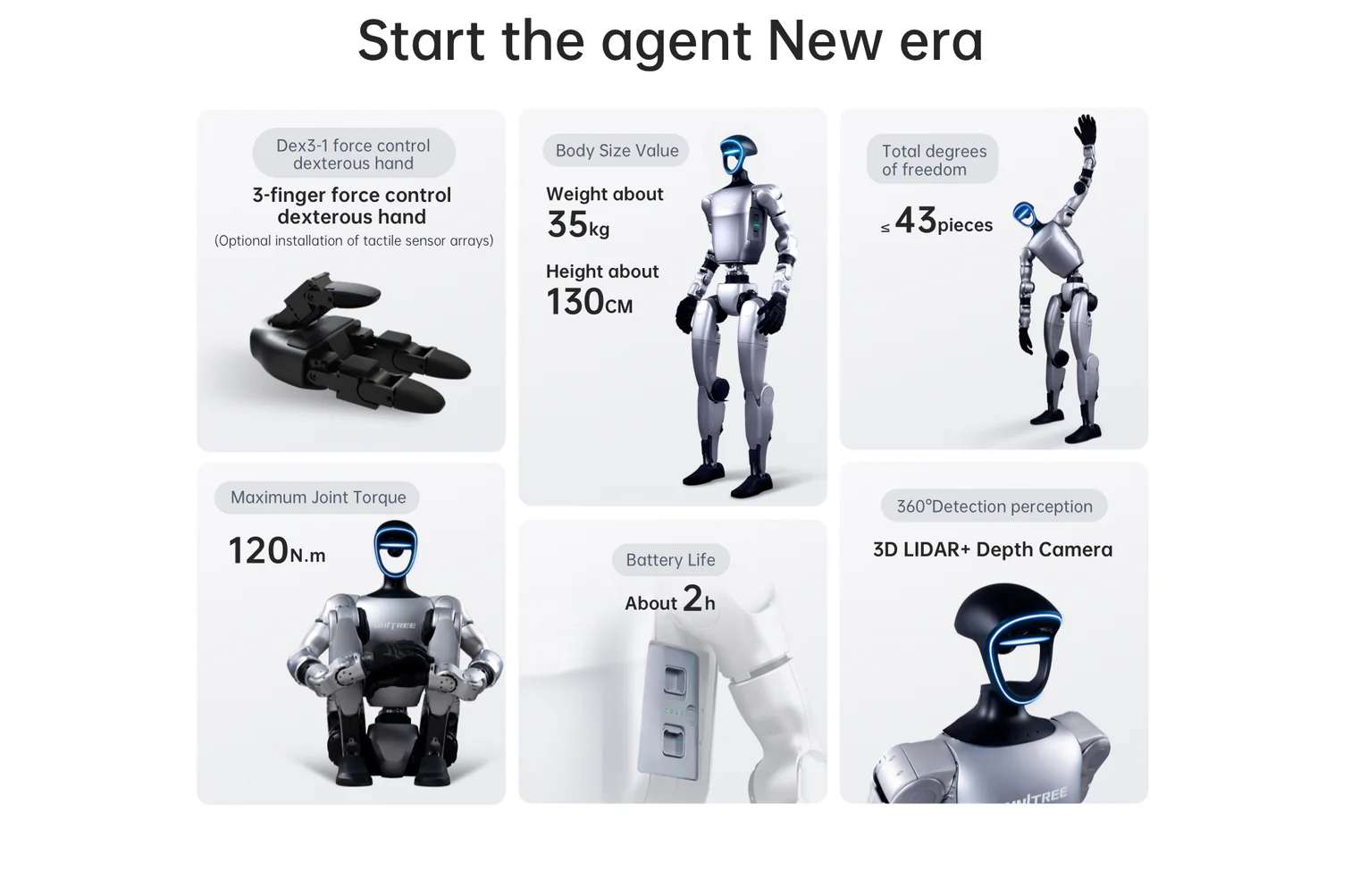
The summary panel below cross-references the six most critical performance parameters of the G1-U9 EDU at a glance: the Dex3-1 hand configuration, body size and weight, total degree-of-freedom count, maximum joint torque, battery runtime, and the dual-sensor 360° perception system.
Technical Specifications of the UNITREE G1-U9 EDU
Mechanical Dimensions
| Height × Width × Thickness (standing) | 1,320 × 450 × 200 mm |
|---|---|
| Height × Width × Thickness (folded) | 690 × 450 × 300 mm |
| Weight (with battery) | ~35 kg+ |
| Calf + thigh length | 0.6 m |
| Arm span | ~0.45 m |
Degrees of Freedom (U9 Configuration)
| Total degrees of freedom (U9) | 37 |
|---|---|
| Single leg degrees of freedom | 6 |
| Waist degrees of freedom | 1 + (optional 2 additional) |
| Single arm degrees of freedom | 5 |
| Single hand degrees of freedom (Dex3-1) | 7 + 2 (optional wrist) |
Joint Range of Motion
| Waist joint Z-axis | ±155° |
|---|---|
| Waist joint X-axis (optional) | ±45° |
| Waist joint Y-axis (optional) | ±30° |
| Knee joint | 0°–165° |
| Hip joint (Pitch) | ±154° |
| Hip joint (Roll) | -30°–+170° |
| Hip joint (Yaw) | ±158° |
| Wrist joint (Pitch) | ±92.5° |
| Wrist joint (Yaw) | ±92.5° |
Drive System
| Joint output bearing | Industrial grade crossed roller bearings (high precision, high load) |
|---|---|
| Joint motor | Low inertia high-speed internal rotor PMSM |
| Maximum torque — knee joint | 120 N·m |
| Arm maximum load | ~3 kg |
| Maximum walking speed | 2 m/s |
| Joint encoder | Dual encoder |
| Full joint hollow electrical routing | Yes |
| Cooling system | Local air cooling |
Dex3-1 Three-Fingered Dexterous Hand
| Operating voltage | 12–58 V |
|---|---|
| Force sensing range | 10 g–2,500 g |
| Total DOF per hand | 7 active (thumb 3, index 2, middle 2) |
| Thumb joint range | 0°–+100°; -35°–+60°; -60°–+60° |
| Index / middle finger joint range | 0°–+90°; 0°–+100° |
| Tactile sensor array (U9 config) | Not included (optional retrofit, 9-point array) |
Sensing & Perception
| 3D LiDAR | LIVOX-MID360 (360° horizontal FOV) |
|---|---|
| Depth camera | Intel RealSense D435i |
| Microphone array | 4-channel (noise cancellation, echo cancellation) |
| Speaker | 5 W stereo |
Computing & Connectivity
| Motion control CPU | 8-core high-performance CPU |
|---|---|
| AI development module | NVIDIA Jetson Orin NX (Arm Cortex-A78AE, 8-core, 2 GHz, 16 GB) |
| Wireless connectivity | WiFi 6, Bluetooth 5.2 |
| Wired interfaces | 2× Gigabit Ethernet (RJ45), 3× USB 3.0 Type-C, 1× Alt-Mode Type-C (USB 3.2 + DP 1.4) |
| OTA firmware updates | Yes (intelligent OTA) |
| Secondary development | Yes (SDK + ROS compatible) |
Power System
| Battery capacity | 9,000 mAh |
|---|---|
| Battery type | 13-string lithium-ion (smart battery, quick release) |
| Charger | 54 V / 5 A |
| Battery life | ~2 h |
| Warranty | 2 years |
What's in the Box
- 1× UNITREE G1-U9 EDU humanoid robot (fully assembled)
- 2× Dex3-1 three-fingered force-control dexterous hands (pre-installed, U9 configuration)
- 1× 9,000 mAh smart battery with quick-release mechanism
- 1× 54 V / 5 A charger
- 1× portable manual remote controller
What is the difference between the G1 EDU and the G1-U9 EDU?
The G1-U9 EDU is a specific configuration of the G1 EDU platform that includes two factory-fitted Dex3-1 force-control dexterous hands (without tactile arrays). This brings the total degree-of-freedom count to 37, compared to the base G1 EDU's 23–43 configurable range. All other G1 EDU features — NVIDIA Jetson Orin NX, 120 N·m torque, secondary development access, 18-month base warranty (extended to 2 years in this listing) — are fully included.
What sensors does the UNITREE G1-U9 EDU use for navigation?
The G1-U9 EDU uses a LIVOX-MID360 3D LiDAR providing 360° horizontal environmental mapping, paired with an Intel RealSense D435i depth camera for forward-facing stereo depth estimation. Together they form a complete spatial perception stack for obstacle avoidance, terrain mapping, and manipulation target localisation.
Can the G1-U9 EDU be programmed for custom tasks?
Yes. The G1 EDU platform supports full secondary development via an official SDK. The NVIDIA Jetson Orin NX development unit exposes two Gigabit Ethernet ports, three USB 3.0 Type-C ports, GPIO lines, and power outputs (58 V / 24 V / 12 V) on the right side of the body, allowing researchers to connect peripherals and deploy custom algorithms without disassembling the robot. ROS compatibility is supported.
What is the maximum payload per arm?
Each arm of the G1-U9 EDU can carry approximately 3 kg in optimal posture. The actual load capacity varies significantly depending on arm extension angle and posture — a fully extended arm at maximum reach will support considerably less than 3 kg. Unitree recommends consulting the secondary development manual for payload envelopes by joint configuration.
Can tactile sensors be added to the Dex3-1 hands later?
Yes. The Dex3-1 hand is designed to optionally accept a 9-point tactile sensor array. The U9 configuration ships without this array installed, but the mechanical and electrical mounting points are present, allowing a post-purchase upgrade without modifying the hand structure.
Why choose EXPERT3D?
EXPERT3D has been the specialist in advanced robotic and 3D technology systems in Valencia since 2012. Our technical team provides pre-sale configuration guidance, on-site commissioning support, and post-sale service for every humanoid robot platform we carry. We work directly with leading manufacturers so that every system delivered meets its published specification. Contact our robotics specialists for a tailored demonstration, financing options, or research partnership enquiries.