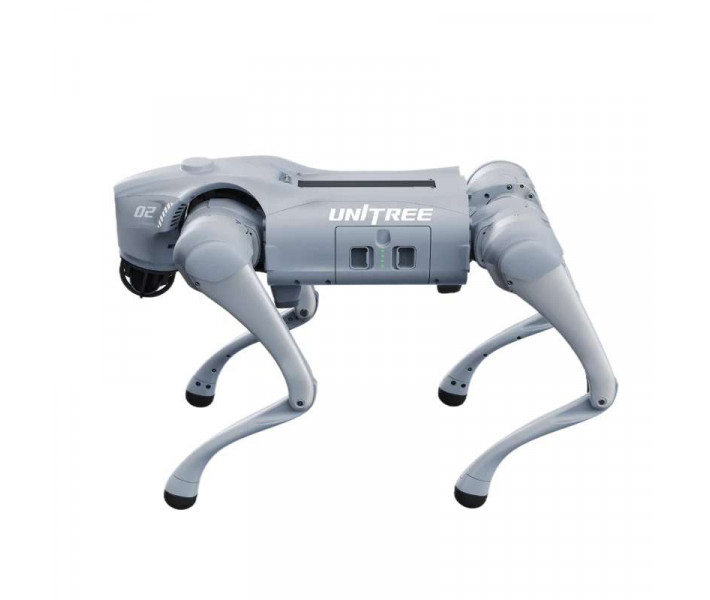


- Stock: In Stock
- Product code: GO2-EDU-ENT1
- Weight Brutto: 30.00kg

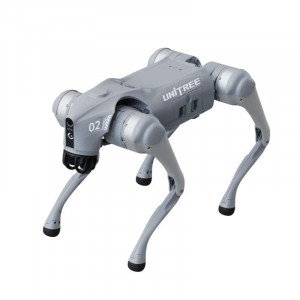
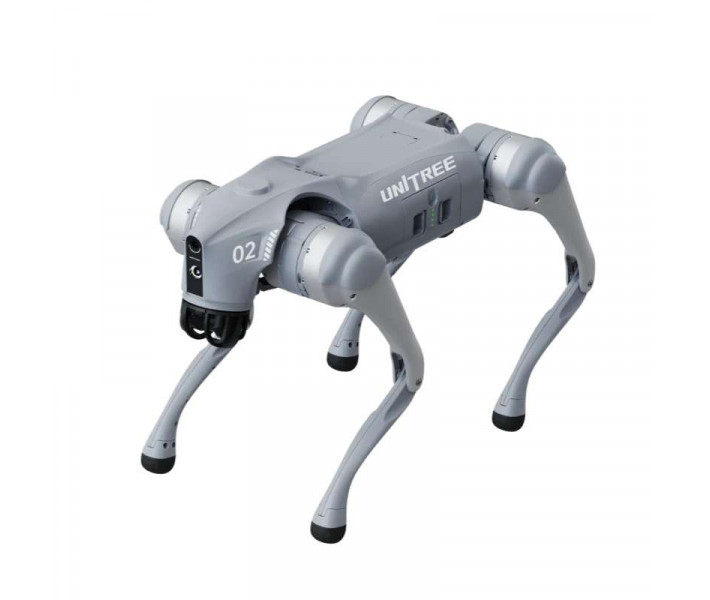
The Unitree Go2 EDU ENT U1 is a professional quadruped robot engineered for field inspection, university research, and security deployment, combining Unitree's proprietary 4D LiDAR L2 (360°×96° hemispherical coverage, minimum detection distance 0.05 m) with 12 aluminium-alloy joint motors delivering 45 N.m peak torque and a top speed of 5 m/s. The ENT U1 payload adds a dual 1080P wide-angle camera array, a 30 W / 3000 lm spotlight, red/blue warning lights, and a digital voice broadcast system with a propagation range of 500–800 m — a purpose-built package for professional inspection, patrol, and emergency-response scenarios.
| Peak Joint Torque | ~45 N.m |
|---|---|
| Maximum Speed | ~5 m/s (lab tested) |
| Battery Life | ~2–4 h (15000 mAh long-endurance) |
| 4D LiDAR Coverage | 360° × 96° hemispherical |
The image below captures the Go2 EDU performing a dynamic trotting sequence on a wet wooden deck — a visual demonstration of the real-time balance control and 12-motor drivetrain that define its locomotion architecture.
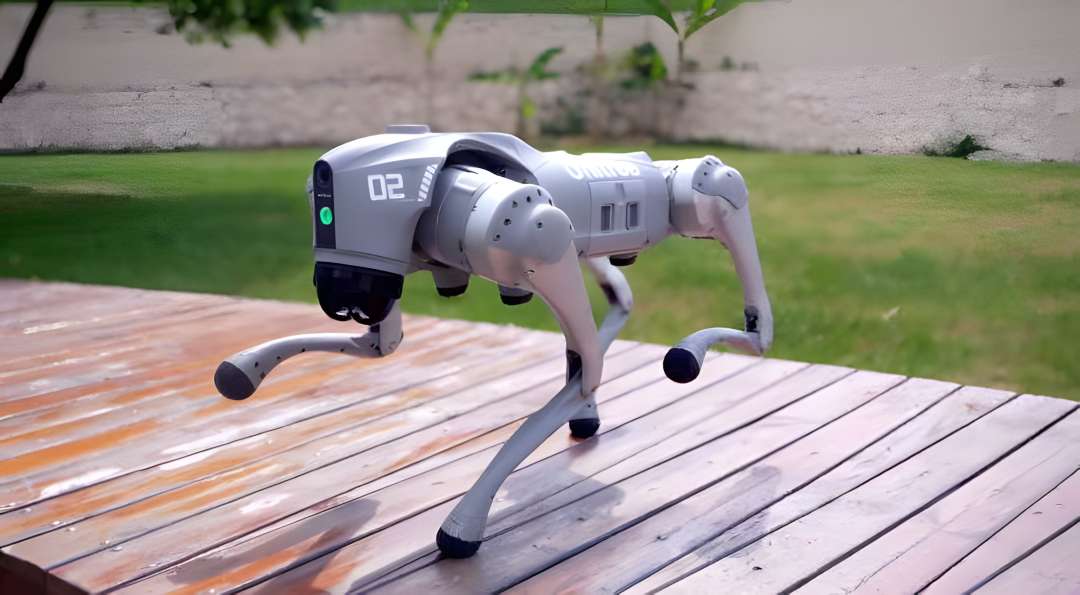
Twelve-Motor Chassis: Engineered for 40° Slopes and 5 m/s Sprints
Joint Motor Architecture and Torque
The Go2 EDU carries 12 aluminium-alloy precision joint motors, each featuring an intra-joint wiring channel and a dedicated heat-pipe cooler. Internal cable routing eliminates external cable snag points on rough terrain — a detail that matters when the robot negotiates gravel, stairs, or wet surfaces. Peak torque of 45 N.m at the largest joint motor translates into genuine climbing capability: the platform handles steps up to 16 cm high and slope angles up to 40°. That is significantly steeper than a standard staircase.
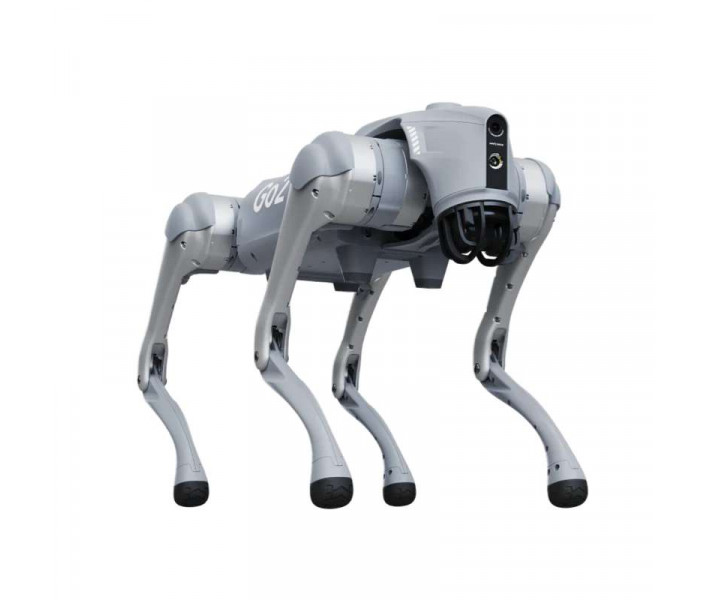
Joint range of motion covers body roll from -48° to +48°, thigh pitch from -200° to +90°, and shank flexion from -156° to -48°. This combination lets the Go2 EDU adopt a crouching posture — dimensions drop from 70 × 31 × 40 cm (standing) to 76 × 31 × 20 cm when folded — making it transportable through standard vehicle doors and narrow corridors.
The dramatic product shot below shows the Go2 EDU standing on a submerged rock with water surrounding it — a clear illustration of its multi-terrain stability and the foot-contact force sensing that continuously adapts ground reaction forces in real time.
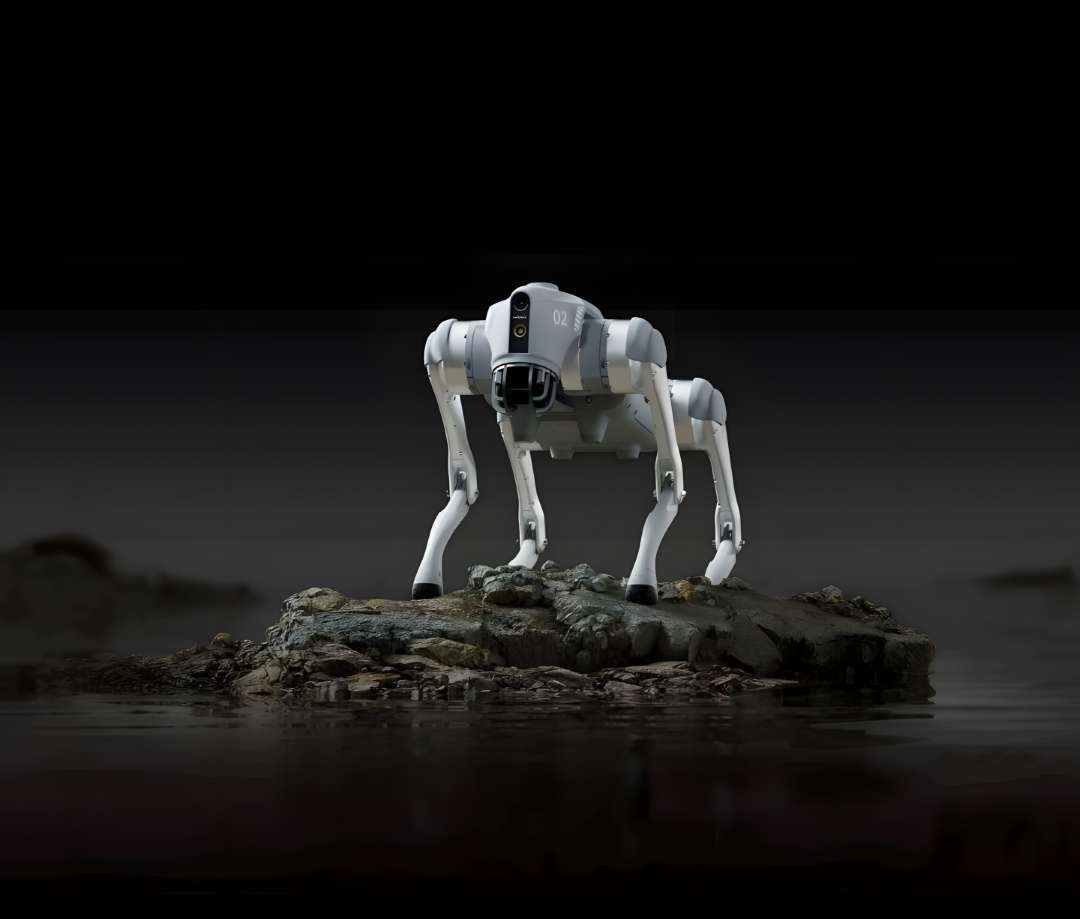
Rage Mode: Full-Throttle Locomotion at 5 m/s
Standard operation runs the Go2 EDU at up to 3.7 m/s with full sensor-fusion active. Engaging Rage Mode unlocks the hardware's full joint-motor potential, pushing top speed to approximately 5 m/s with more aggressive steering responsiveness and stable gait across complex surfaces like gravel and sloped terrain. The onboard 8-core high-performance CPU manages locomotion, perception, and communication tasks concurrently without thermal throttling — a necessity for uninterrupted field operation.
4D LiDAR L2: 360°×96° Hemispherical Terrain Intelligence
Unitree's self-developed 4D LiDAR L2 is the sensor at the core of the Go2 EDU's perception stack. The 360° horizontal × 96° vertical field of view creates a near-spherical scan envelope with a minimum detection distance of 0.05 m — meaning the robot detects obstacles essentially at its own feet. This resolution of scan coverage upgrades the recognition system by approximately 200% compared to conventional 2D laser scanners, enabling reliable navigation in environments where floor-level obstacles, furniture legs, or low-lying debris would blind a narrower sensor.
The image below shows the ISS 2.0 intelligent side-follow system in operation outdoors: the Go2 tracks a walking person while the visualised terrain-detection overlay maps the surrounding ground and obstacle geometry in real time.
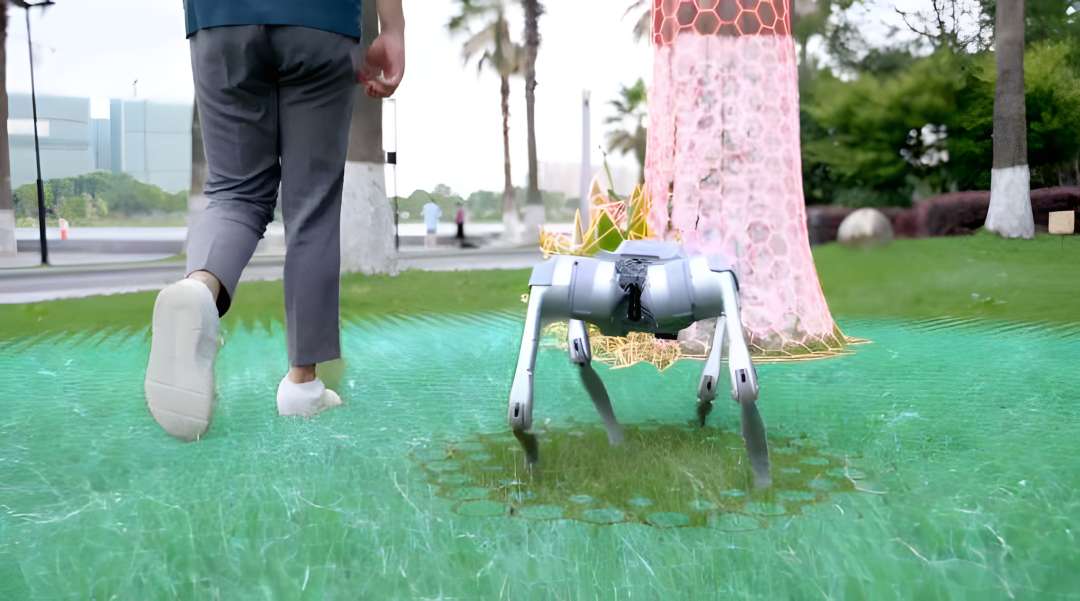
ISS 2.0 Intelligent Side-Follow System
The ISS 2.0 (Intelligent Side-Follow System) builds on wireless vector positioning technology to achieve a 50% improvement in positioning accuracy over the first generation, with a remote-control distance exceeding 30 m in open environments. The UWB-based tag provides centimetre-level plane positioning combined with a 3-axis accelerometer and 3-axis gyroscope, giving the robot a reliable attitude reference for the tracking module. Combined with the optimised obstacle-avoidance strategy from the LiDAR stack, ISS 2.0 allows the Go2 EDU to shadow its operator through complex terrain — narrow corridors, uneven outdoor surfaces, partially blocked pathways — without manual steering inputs.
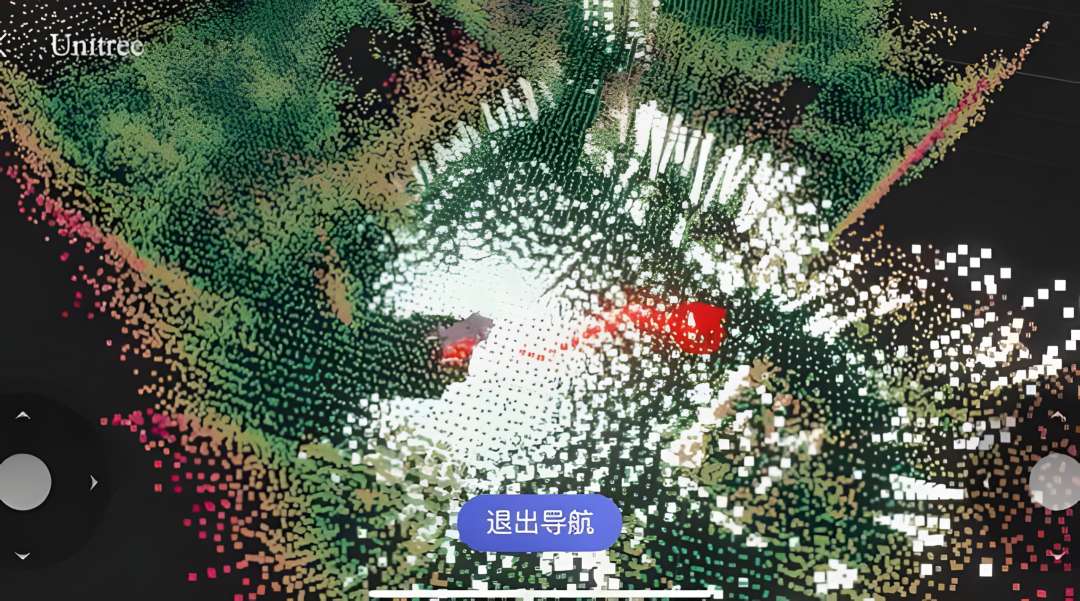
The smartphone screenshot below shows the Unitree app displaying the output of the 3D LiDAR point-cloud mapping function — a real-time colourised voxel map of an outdoor environment constructed entirely on-device using the L2 sensor data.
SLAM Mapping, Positioning, and Autonomous Navigation
The Go2 EDU's software stack includes a full three-stage SLAM pipeline: mapping generates a persistent environment model; positioning resolves the robot's pose within that map; and the navigation module plans a collision-free path to any target point, executing it autonomously. Via the dedicated mobile app, an operator can construct a 3D LiDAR point-cloud map of a given area and define a waypoint route — the robot then traverses the route independently, adapting gait in real time to terrain changes detected by the LiDAR.
ENT U1 Payload: Professional Inspection and Security System
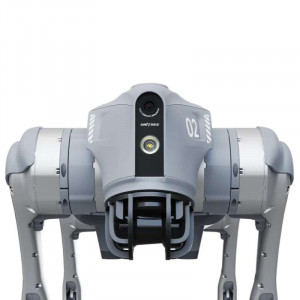
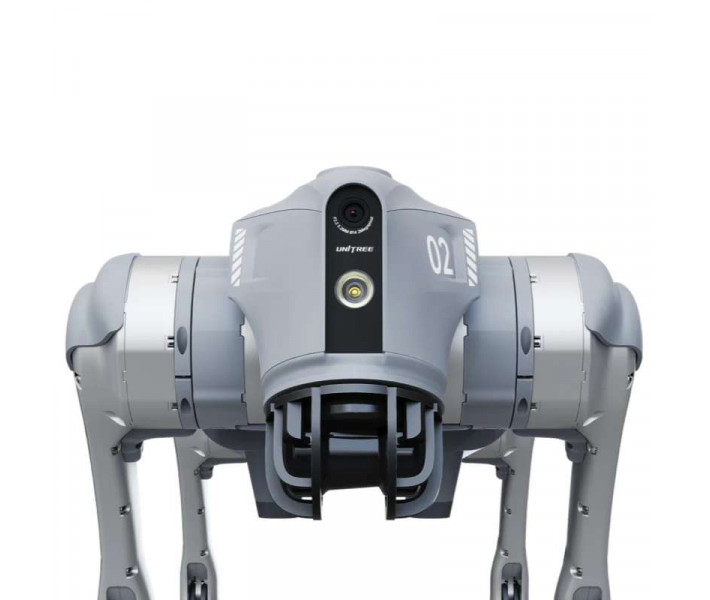
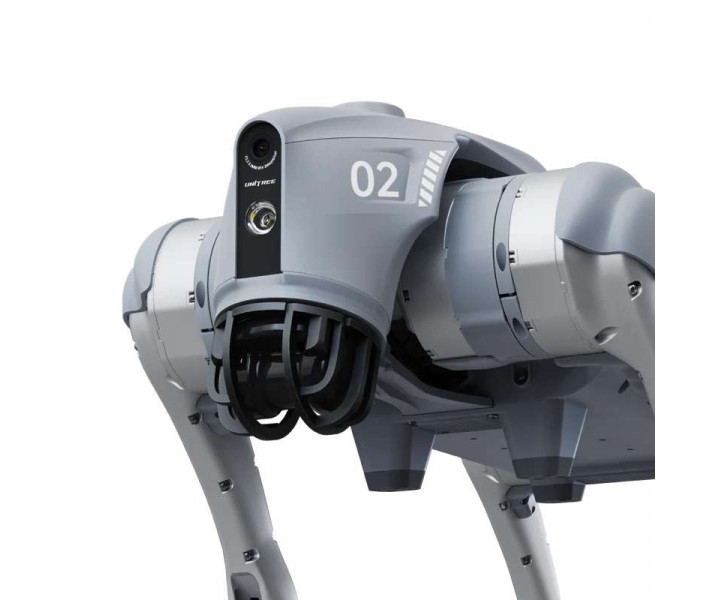
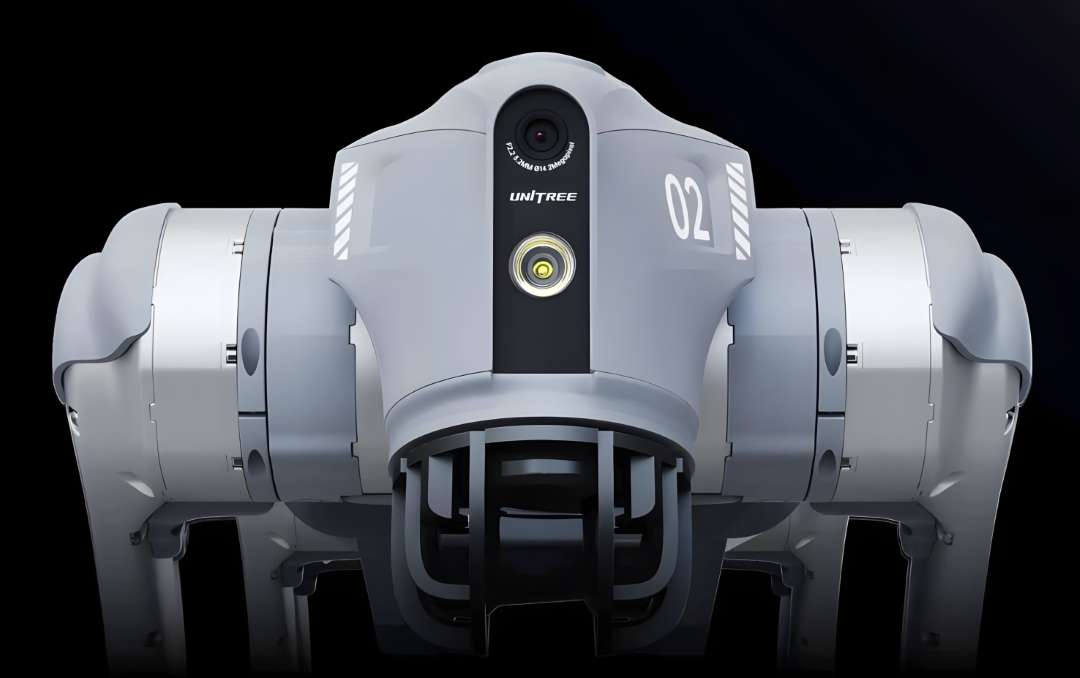
The ENT U1 configuration converts the Go2 EDU research platform into a field-deployable inspection and patrol unit. A close-up of the robot's front sensor cluster — shown in the image below — reveals the precision wide-angle camera lens and front-facing LED, the two forward-looking sensors that anchor both the standard navigation system and the ENT U1's enhanced imaging payload.
Dual 1080P Camera Array, Spotlight, and Warning Lights
The ENT U1 module mounts a dual 1080P wide-angle camera system (FOV 120°) with four high-brightness fill lights, replacing the standard depth camera with a broadcast-grade imaging solution. Video is transmitted at 1080P HD with latency as low as 180 ms over the 5.8G primary link, while a standard network-port streaming input also supports dual-channel 1080P signal simultaneously. A 30 W spotlight delivering 3000 lm illuminates inspection targets in complete darkness. The red/blue police warning light system (10 W) supports multiple flash modes — constant illumination, burst flash, alternating red-blue, and brightness-adjustable continuous — making the robot immediately recognisable as an official inspection unit in all lighting conditions.
Digital Voice Broadcast and Dual Communication Link
The ENT U1 integrates a digital encoding/decoding voice broadcast system with a maximum speaker propagation distance of 500–800 m. Functions include real-time voice alerting, recording upload, audio playback, and text-to-speech output — all controllable from the operator's screen-equipped remote. The communication architecture uses 5.8G digital telemetry as the primary channel (integrated video and control signal transmission) with a full 4G all-network link as an automatic backup, ensuring the robot remains reachable even when the primary radio link is interrupted. The controller itself is explosion-proof with a built-in 4G network pass-through display.
Hardware Architecture and Open Development Platform
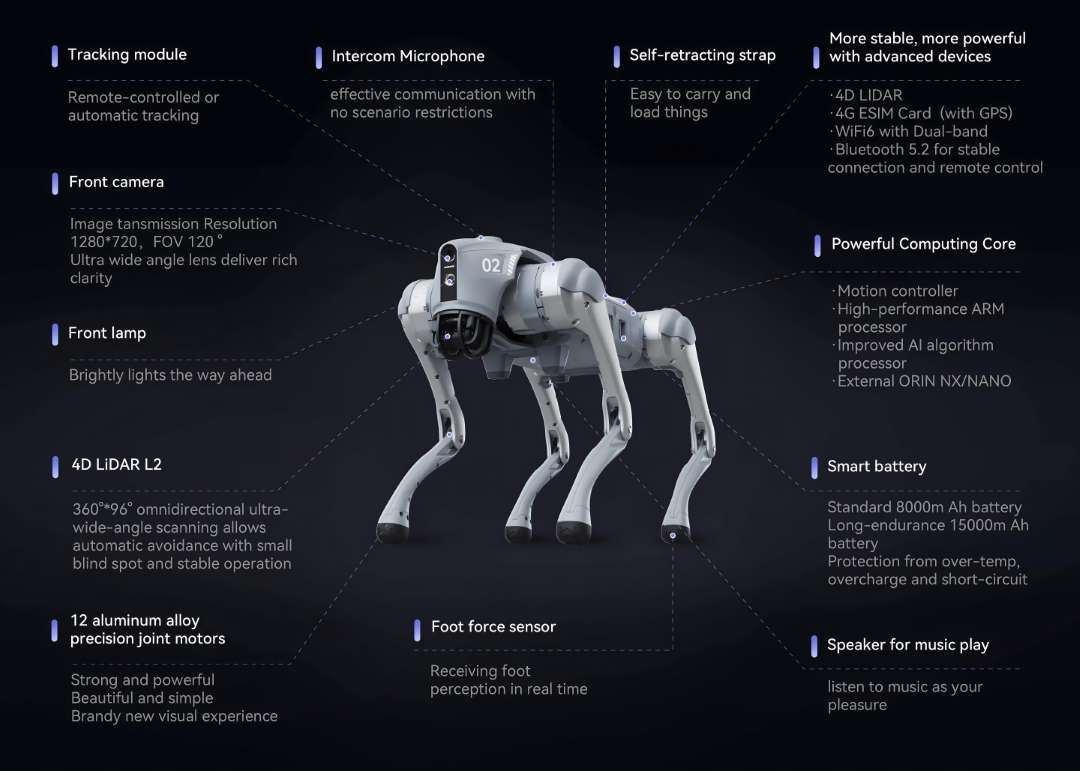
The hardware infographic below maps the full component layout of the Go2 EDU ENT U1: the tracking module, intercom microphone, front camera (1280×720, FOV 120°), front lamp, 4D LiDAR L2, 12 aluminium-alloy joint motors, foot-end force sensor, powerful computing core, and the long-endurance smart battery — all integrated into the ~15 kg aluminium and high-strength engineering plastic chassis.
DDS, ROS2, and Secondary Development
The EDU-grade platform exposes a full secondary-development environment via DDS (Data Distribution Service) middleware supporting C++ and Python, plus a native ROS2 interface with adaptive RMW. Available service layers cover basic motor and IMU data access, high-level motion control (speed, trajectory tracking, obstacle avoidance, gait switching), image streaming via GST, radar point-cloud and altitude-map retrieval, full SLAM services, and UWB positioning. This architecture means existing ROS2 packages, sensor drivers, and visualisation pipelines port onto the Go2 EDU with minimal rework — a significant time saving for university labs and R&D teams.
For tasks requiring heavier on-board computation, the Go2 EDU supports an optional NVIDIA Jetson Orin NX or Nano module (40–100 TOPS of AI inference), which slots into the robot's expansion bay without external cabling modifications.
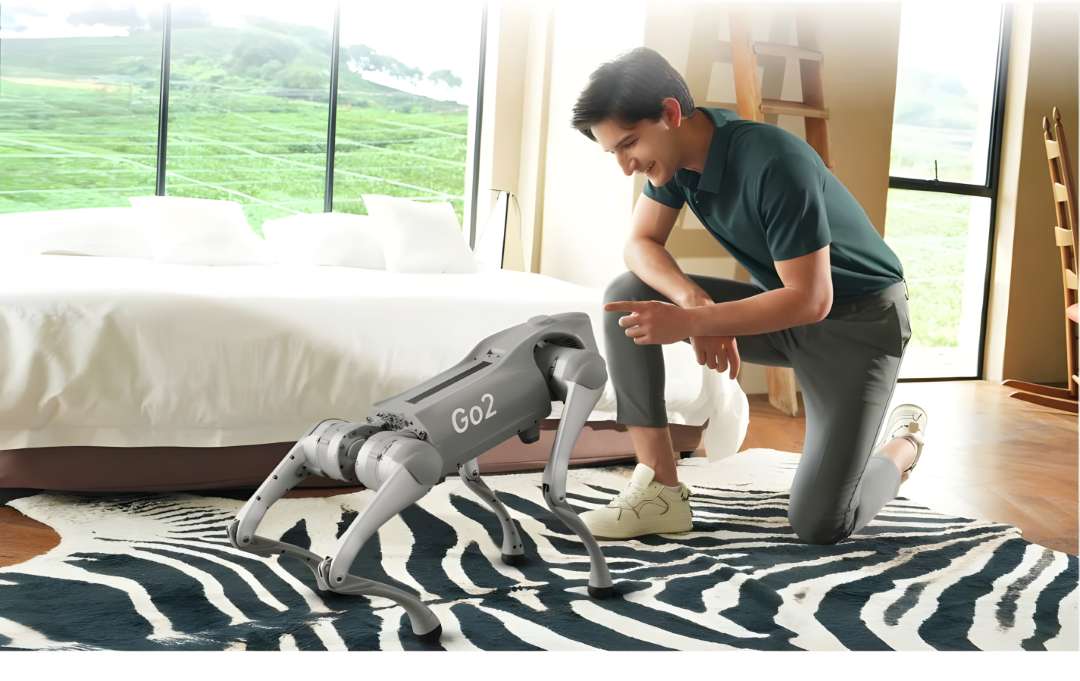
The image below shows a user interacting with the Go2 at close range indoors — a scene that reflects the platform's approachable interaction model: the robot can respond to offline voice commands, sit, stretch, dance, execute forward somersaults, and switch between trot, trot-run, and climbing gaits on request.
Technical Specifications of the Unitree Go2 EDU ENT U1
Mechanical Specifications
| Dimensions — Standing | 70 cm × 31 cm × 40 cm |
|---|---|
| Dimensions — Crouching | 76 cm × 31 cm × 20 cm |
| Weight (with battery) | ~15 kg |
| Shell Material | Aluminium alloy + high-strength engineering plastic |
Electrical Parameters
| Operating Voltage | 28 V–33.6 V |
|---|---|
| Maximum Working Power | ~3000 W |
Performance Parameters
| Rated Payload | ~8 kg (MAX ~12 kg) |
|---|---|
| Speed Range | 0–3.7 m/s (MAX ~5 m/s) |
| Max Step / Drop Height | ~16 cm |
| Maximum Climb Angle | 40° |
| Basic Computing Core | 8-core high-performance CPU |
Joint Motor Parameters
| Peak Joint Torque | ~45 N.m |
|---|---|
| Joint Motors | 12 × aluminium alloy precision motors |
| Body Joint Range | -48° to +48° |
| Thigh Joint Range | -200° to +90° |
| Shank Joint Range | -156° to -48° |
| Intra-Joint Wiring (Knee) | Yes |
| Joint Heat-Pipe Cooler | Yes |
Sensors and Perception
| 4D LiDAR | Unitree L2 — 360° × 96° hemispherical ultra-wide |
|---|---|
| Minimum LiDAR Detection Distance | 0.05 m |
| Wireless Vector Positioning Module | Yes |
| HD Wide-Angle Front Camera | Yes — 1280×720, FOV 120° |
| Foot-End Force Sensor | Yes |
ENT U1 — Imaging and Communication System
| Imaging Cameras | Dual 1080P wide-angle (FOV 120°) |
|---|---|
| Fill Lights | 4 × high-brightness |
| Video Transmission Latency | As low as 180 ms |
| Primary Communication Channel | 5.8G digital telemetry + integrated video |
| Backup Communication Channel | 4G all-network (with GPS) |
| Spotlight | 30 W, 3000 lm |
| Warning Light System | Red/blue police lights, 10 W, multiple flash modes |
| Voice Broadcast Range | 500–800 m (digital encoding/decoding) |
| Remote Controller | Screen-equipped, explosion-proof with 4G pass-through |
| Depth Camera | Not included in ENT U1 configuration |
Connectivity
| WiFi | WiFi 6 dual-band |
|---|---|
| Bluetooth | 5.2 / 4.2 / 2.1 |
| 4G Module | Yes (with GPS) — supports 43 European countries (excl. Ukraine) |
Features and Capabilities
| ISS 2.0 Intelligent Side-Follow System | Yes — follow distance >30 m, 50% improved positioning |
|---|---|
| Intelligent Obstacle Avoidance | Yes |
| 3D LiDAR Mapping | Yes — point-cloud map with autonomous waypoint navigation |
| Voice Functions | Yes — offline interaction, commands, intercom, music playback |
| Graphical Programming | Yes |
| OTA Firmware Updates | Yes |
| Charging Pile Compatibility | Yes |
| Secondary Development | Yes — DDS (C++/Python), ROS2, GST image streaming |
| Optional High-Performance Module | NVIDIA Jetson Orin NX / Nano (40–100 TOPS) — sold separately |
| Front Lamp | Yes |
Power and Battery
| Smart Battery Capacity | 15000 mAh (long-endurance) |
|---|---|
| Battery Life | ~2–4 h |
| Charger | Fast charge 33.6 V / 9 A |
| Battery Protection | Over-temperature, overcharge, short-circuit protection |
Warranty
| Warranty Period | 12 months |
|---|
What's in the Box
- Unitree Go2 EDU robot (fully assembled)
- Long-endurance 15000 mAh smart battery
- Fast-charge charger (33.6 V / 9 A)
- Screen-equipped remote controller (explosion-proof, with 4G pass-through)
- ENT U1 payload module: dual 1080P wide-angle cameras (FOV 120°) with 4 fill lights
- 30 W spotlight (3000 lm)
- Red/blue warning light system (10 W)
- Digital voice broadcast system (range 500–800 m)
Why Choose EXPERT3D?
EXPERT3D has specialised in advanced robotics and 3D technology since 2012 — more than a decade of hands-on experience selecting, deploying, and supporting professional-grade platforms across research institutions, universities, and industrial R&D teams across Spain and Europe. We provide pre-sales technical consultation, delivery coordination, and post-sale support backed by direct manufacturer contacts. The Unitree Go2 EDU ENT U1 is a complex integrated system: our team can assist with ENT U1 configuration, SDK onboarding, and integration into existing inspection or research workflows. Contact us to discuss your specific application requirements and current availability.