

- Stock: In Stock
- Product code: GO2-EDU-ENT-U5
- Weight Brutto: 38.00kg

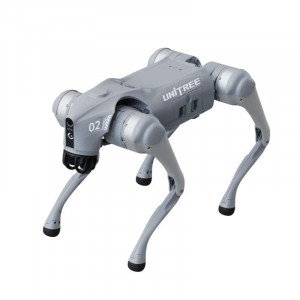
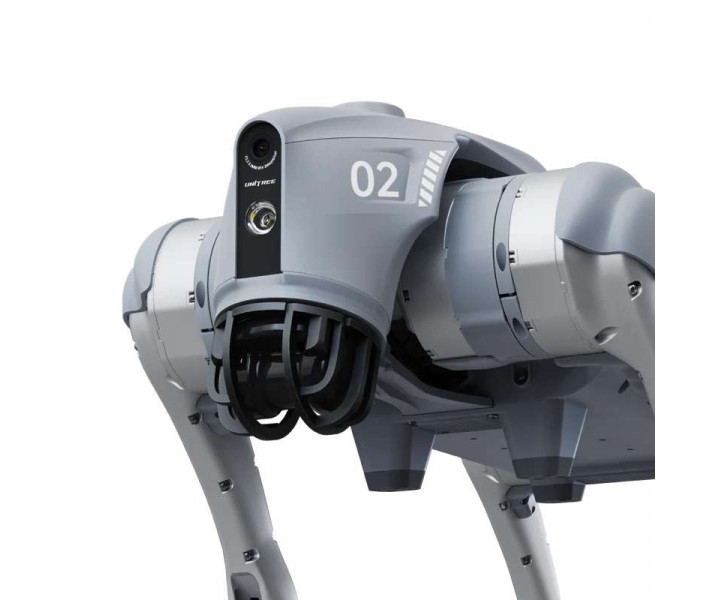
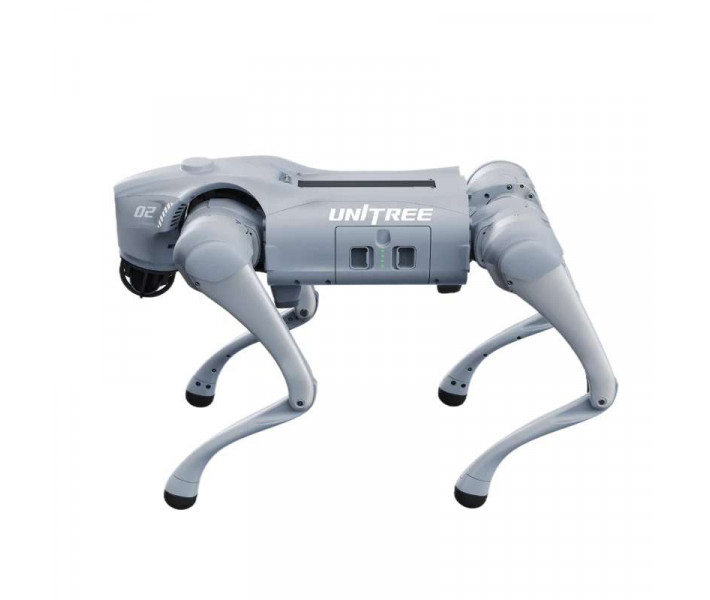
The Unitree Go2 EDU ENT U5 is a research-grade quadruped robot built for autonomous inspection, advanced field surveillance, and open-platform robotics development, combining the fully equipped Go2 EDU base — with 4D LiDAR L2, foot-end force sensors, and full secondary development access — with an integrated dual-light three-axis stabilized gimbal that pairs an 8 MP Sony CMOS visible camera with a 640×512 thermal imaging sensor, all operated via a dedicated 5.5-inch screen remote controller.
| Max Locomotion Speed | 0~3.7 m/s (limit ~5 m/s) |
|---|---|
| Peak Joint Torque | ~45 N.m |
| Thermal Camera Resolution | 640×512 px (8~14 µm wavelength) |
| Battery Life | ~2~4 h (15 000 mAh long-endurance) |
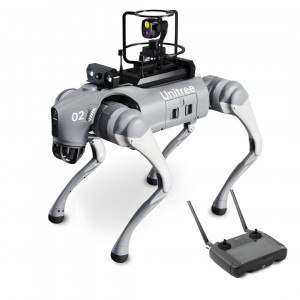
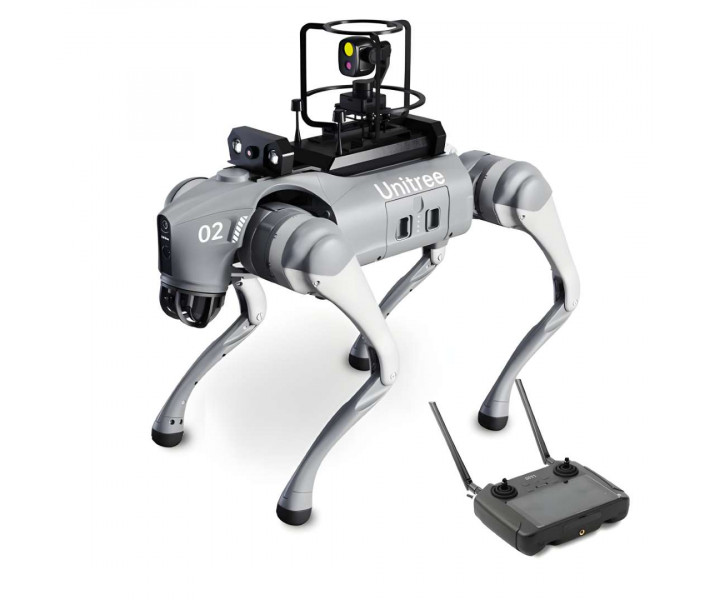
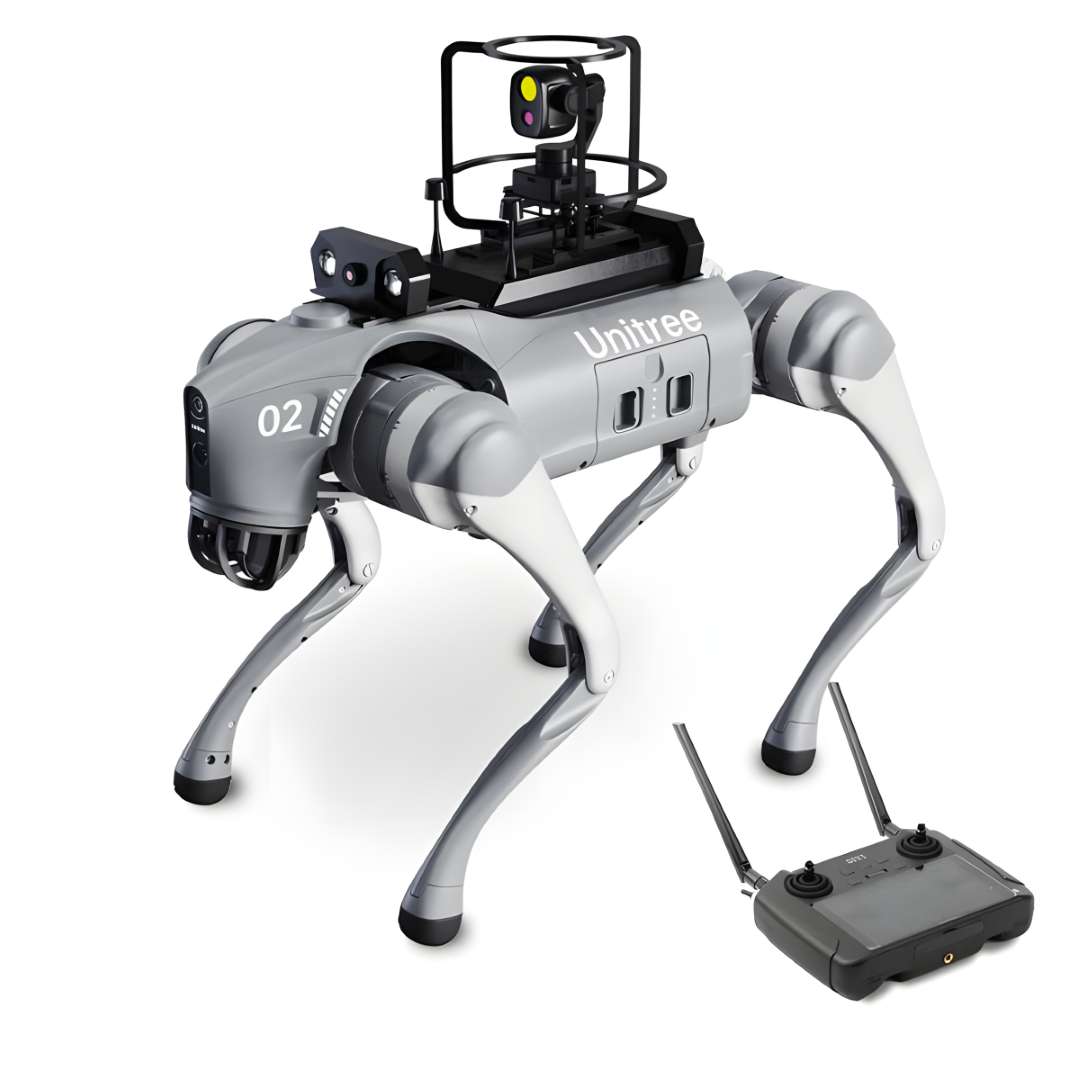
The image below shows the complete Go2 EDU ENT U5 system: the quadruped chassis carrying the dual-light gimbal payload on top, together with the 5.5-inch screen remote controller with dual-camera attachment.
All-Terrain Locomotion: 45 N.m Joints, 40° Climb, Rage Mode
At ~15 kg with a ~8 kg nominal payload (up to 12 kg limit), the Go2 EDU moves with a self-assurance that heavier inspection platforms simply cannot match. Twelve aluminium alloy joint motors — each cooled by an internal heat pipe and linked via an intra-joint circuit that eliminates external wiring — deliver a peak torque of ~45 N.m. The joint range spans body -48~+48°, thigh -200~+90°, and shank -156~-48°, enabling stable crouching transitions and confident stair negotiation.
Rage Mode unlocks the full hardware potential for open-terrain operation: top speed climbs to ~5 m/s, steering response sharpens, and the gait adapts dynamically to gravel, slopes, and uneven ground. Standard operating speed sits at a still-capable 3.7 m/s. Maximum climb height is ~16 cm and max slope angle is 40° — comfortable for most industrial staircases and unimproved ground.
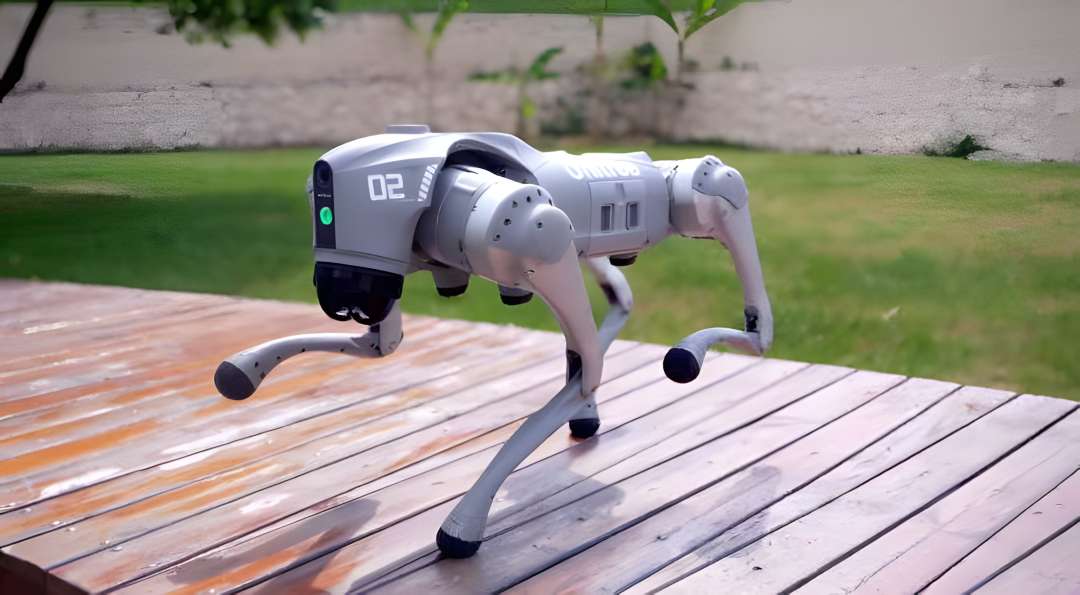
The sequence below captures the Go2 mid-movement on a wooden deck, illustrating the fluid dynamic balance the Go2's whole-body controller maintains even on slippery elevated surfaces.
4D LiDAR L2 and ISS 2.0: Spatial Awareness at 360°×96°
Every Go2 EDU ships with Unitree's proprietary 4D LiDAR L2 — a hemispheric scanner delivering 360°×96° coverage with a minimum detection distance of 0.05 m. The ultra-wide angular envelope effectively eliminates blind spots that plague conventional 2D planar LiDAR systems, allowing real-time point-cloud mapping of rooms, corridors, and outdoor environments in a single pass.
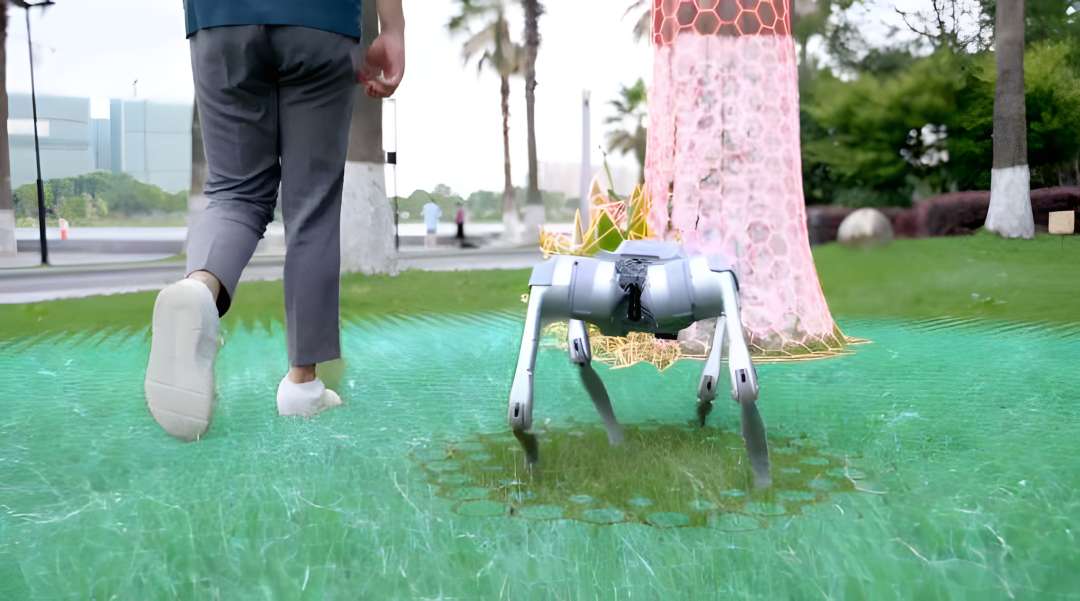
The ISS 2.0 (Intelligent Side-Follow System) builds on this spatial data with wireless vector positioning technology. Positioning accuracy is upgraded 50% versus the first generation, with a reliable following distance over 30 m in open terrain. Combined with the optimised multi-obstacle avoidance strategy, ISS 2.0 allows the Go2 to escort an operator through cluttered environments without interrupting its own gait. The image below shows the robot tracking a moving person across a landscaped area, with the LiDAR scanning overlay visible in the augmented view.
3D LiDAR Mapping and Autonomous Navigation
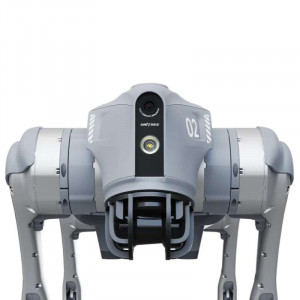
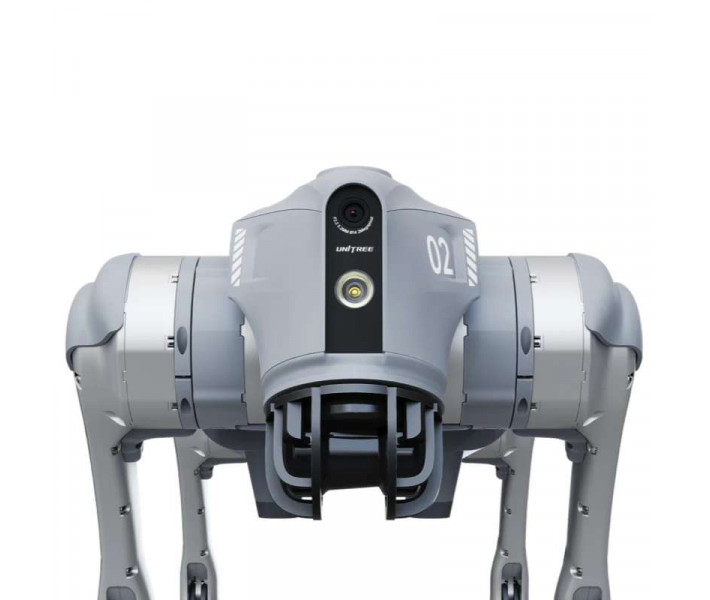
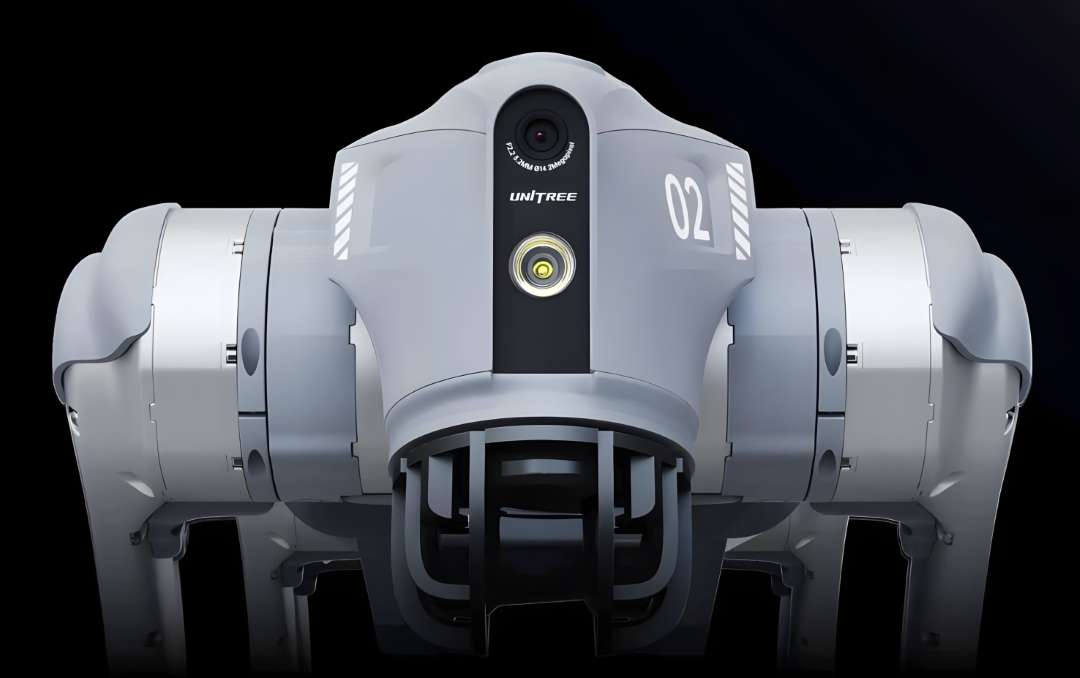
Using the dedicated companion app and the onboard L2 LiDAR, operators can construct dense 3D point-cloud maps of any bounded area and then define autonomous waypoint routes for the Go2 to follow without human input. This mapping-and-route workflow is the foundation for repetitive inspection missions: define the path once, deploy the robot on schedule. The front-facing sensor array — visible in the close-up below — integrates the wide-angle camera (FOV 120°, 1280×720 resolution) with the front LED lamp that illuminates dark inspection zones.
U5 Payload: Three-Axis Dual-Light Gimbal with Thermal Imaging
The ENT U5 configuration adds the defining capability that separates it from the base EDU platform: a precision dual-light gimbal with three-axis stabilisation across heading, pitch, and roll axes. Angle jitter is held to ±0.01° — tight enough that fine thermal-detail analysis is viable even while the robot is actively walking. The gimbal weight without the shock-absorbing plate is 177 g (197 g with plate), and it operates across a power range of 11~25.2 V at an average of 6 W.
The gimbal houses two independent optical systems working in parallel. The visible light camera uses a Sony 1/2.8-inch CMOS sensor with 8 MP resolution, a fixed-focus 6× digital zoom (20 mm equivalent focal length), an aperture of F2.8, and a diagonal FOV of 93°. It records video at up to 4K @ 30 fps and captures stills at 3840×2160. The thermal (infrared) camera uses an uncooled Vanadium Oxide (VOx) microbolometer at 640×512 pixels, a fixed 13 mm / F1.0 athermalized lens covering 8~14 µm wavelength, and a 2× electronic zoom. Temperature measurement spans -20 to +150 °C (high gain, ±2 °C accuracy) and extends to +550 °C in low-gain mode (±5% accuracy) — covering everything from pipeline heat tracing to fire-risk assessment.
The pitch axis travels from -90° (straight down) to +25°, horizontal rotation reaches ±270°, and roll compensation covers ±45° — a sweep that lets operators inspect overhead infrastructure, ground-level assets, and any angle in between without repositioning the robot.
Computing Architecture and Open Development Platform
The Go2 EDU runs an 8-core high-performance CPU for primary motion control, sensor fusion, and AI inference tasks including advanced mode, 3D LiDAR mapping, and voice command processing. For teams requiring more intensive on-board compute — large-language-model integration, visual SLAM, or custom deep-learning pipelines — the EDU variant supports an optional NVIDIA Jetson Orin module (40~100 TOPS) as an expansion computing unit. The hardware architecture overview below maps all major system components and their interconnections.
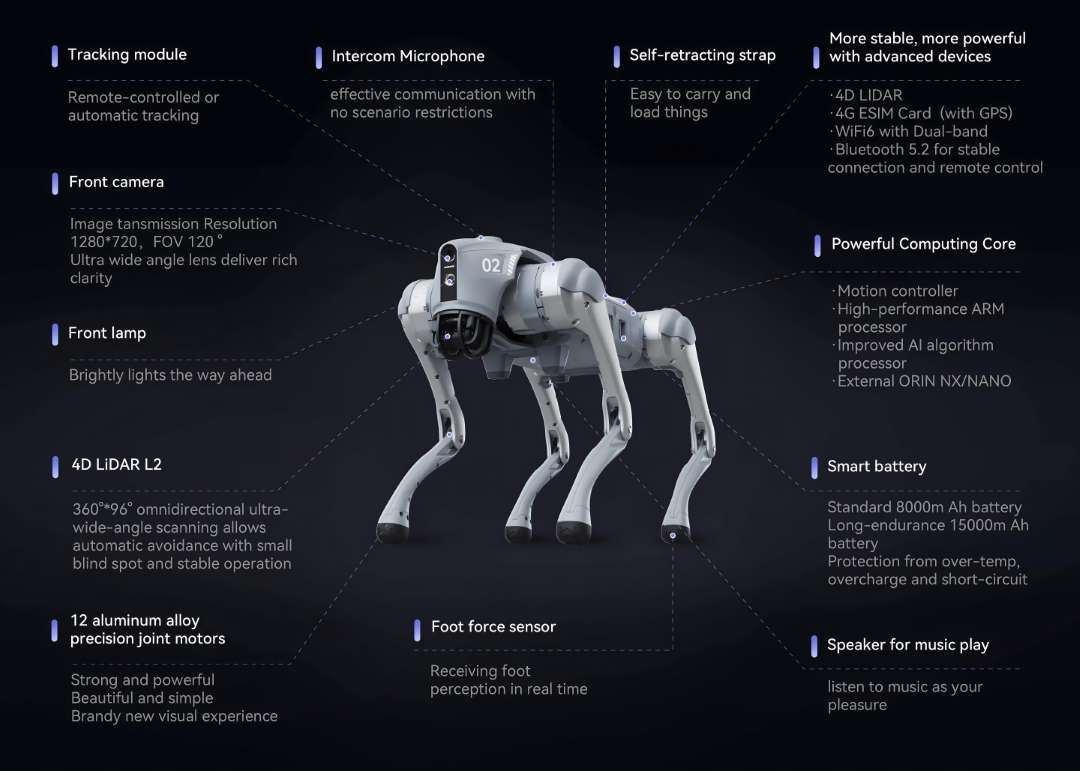
Connectivity covers Wi-Fi 6 dual-band, Bluetooth 5.2/4.2/2.1, and an integrated 4G module with GPS for remote deployment beyond local network range. The Go2 EDU is the only variant in the lineup that grants full secondary development access — full ROS integration, custom gait parameter modification, sensor data streaming APIs, and graphical programming environment support. OTA firmware updates keep the motion controller and application stack current automatically.
3D LiDAR Mapping: Point Cloud in the Field
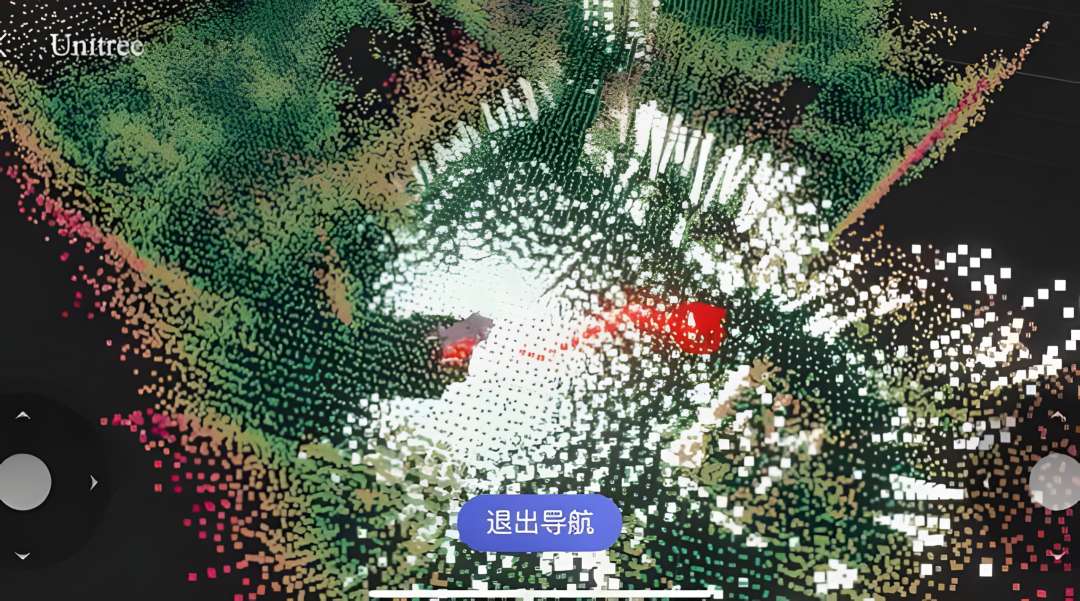
The image below is a real-time point-cloud map generated by the Go2's L2 LiDAR during an autonomous mapping run. The colour-coded density representation shows the robot's precise geometric understanding of its surroundings — data that feeds directly into autonomous path planning and obstacle classification.
Screen Remote Controller and Dual Camera
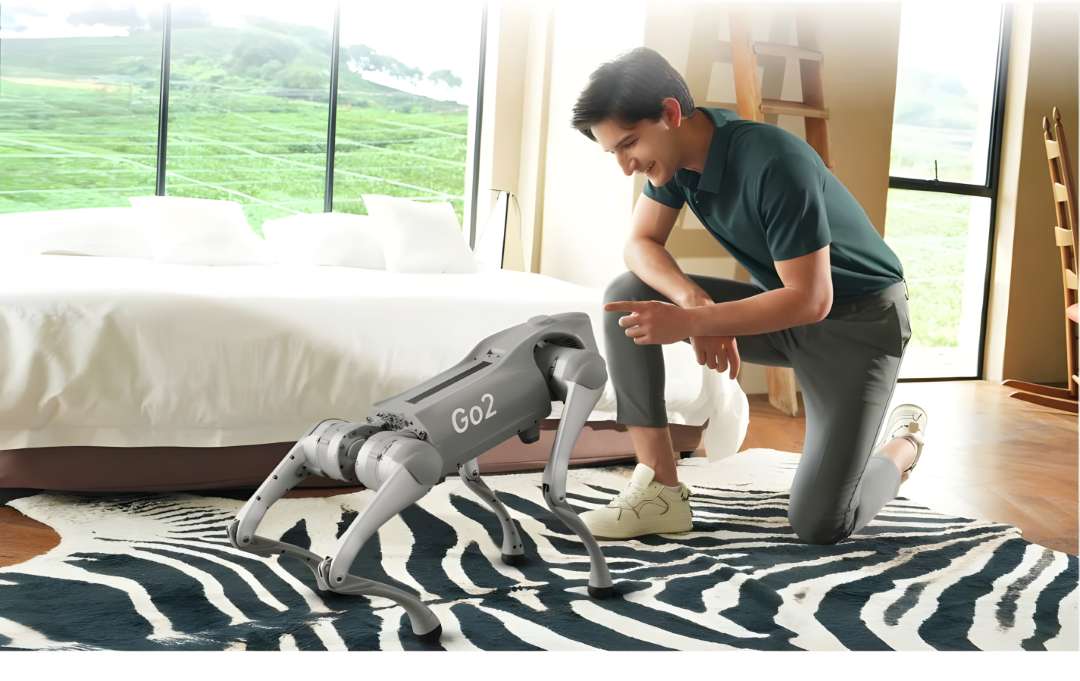
The included screen remote controller brings a 5.5-inch 1080P high-brightness LCD touchscreen running Android 9.0 (2 GB RAM / 16 GB storage). Its internal 10200 mAh battery sustains 13 hours of field operation and recharges in 5 hours via PD 20 W fast charging. The dual-camera attachment adds a compact unit (FOV 120°, 8 W searchlight, 120~140 lm output) that streams live video directly to the controller display, giving operators a first-person view during teleoperation. External SIM card support enables mobile data on the controller independent of the robot's own 4G link. The photo below illustrates the natural human-robot interaction made possible by the intuitive control system.
Rugged Build and Long-Endurance Battery
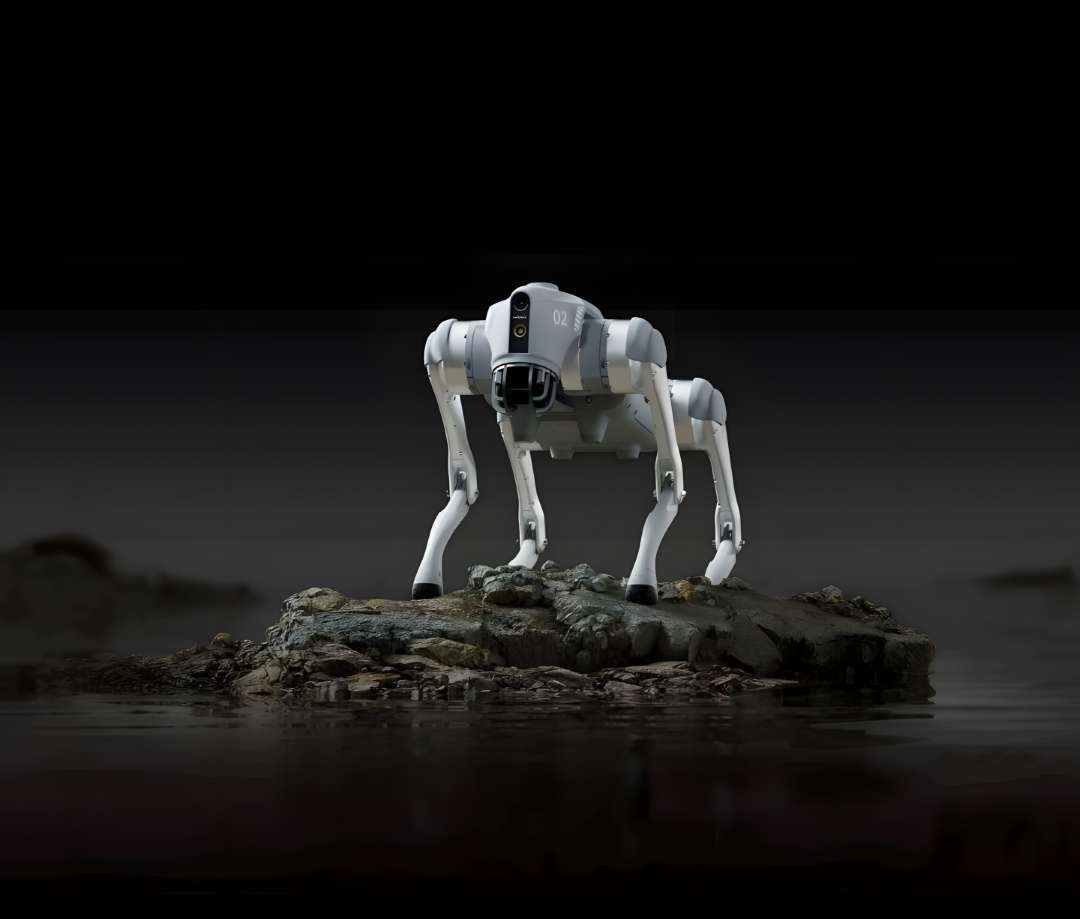
The Go2 EDU frame combines aluminium alloy structural members with high-strength engineering plastic panels — the same material strategy used in the full professional Go2 lineup. At 70×31×40 cm standing and collapsing to 76×31×20 cm crouching, the platform fits in standard equipment transit cases. The long-endurance smart battery at 15 000 mAh delivers 2~4 hours of field operation and charges via a dedicated 33.6 V / 9 A fast charger. Over-temperature, overcharge, and short-circuit protection are built into the battery management system. The image below demonstrates the Go2 operating in a demanding outdoor environment — wet rock terrain under low-light conditions — underlining the structural and locomotion resilience the platform brings to challenging inspection sites.
Technical Specifications of the Unitree Go2 EDU ENT U5
Mechanical Dimensions
| Dimensions (standing) | 70×31×40 cm |
|---|---|
| Dimensions (crouching) | 76×31×20 cm |
| Weight (with battery) | ~15 kg |
| Shell Material | Aluminium alloy + high-strength engineering plastic |
Performance
| Payload (nominal / max) | ~8 kg / ~12 kg |
|---|---|
| Locomotion Speed | 0~3.7 m/s (limit ~5 m/s) |
| Max Climb Height | ~16 cm |
| Max Climb Angle | 40° |
Joint Parameters
| Max Joint Torque | ~45 N.m |
|---|---|
| Joint Motor Count | 12 × aluminium alloy precision motors |
| Range of Motion — Body | -48°~+48° |
| Range of Motion — Thigh | -200°~+90° |
| Range of Motion — Shank | -156°~-48° |
| Intra-Joint Circuit (knee) | Yes |
| Joint Heat Pipe Cooler | Yes |
Power & Electrical
| Operating Voltage | 28~33.6 V |
|---|---|
| Maximum Working Power | ~3000 W |
| Smart Battery Capacity | 15 000 mAh (long endurance) |
| Battery Life | ~2~4 h |
| Charger | 33.6 V / 9 A (fast charge) |
Sensors & Perception
| 4D LiDAR | Unitree L2 — 360°×96° hemispheric, min. detection 0.05 m |
|---|---|
| Front Camera | HD wide-angle, 1280×720, FOV 120° |
| Depth Camera | Yes (included) |
| Foot-End Force Sensor | Yes |
| Wireless Vector Positioning Module | Yes (ISS 2.0) |
Computing & Connectivity
| Basic Computing Power | 8-core high-performance CPU |
|---|---|
| Optional AI Module | NVIDIA Jetson Orin NX/Nano (40~100 TOPS) |
| Wi-Fi | Wi-Fi 6 dual-band |
| Bluetooth | 5.2 / 4.2 / 2.1 |
| 4G Module | Yes — with GPS (supports 43 European countries) |
| Secondary Development | Yes — full access |
| Voice Function | Yes — offline interaction, commands, intercom, music |
| OTA Firmware Updates | Yes |
| Warranty | 12 months |
Screen Remote Controller
| Display | 5.5-inch 1080P high-brightness LCD touchscreen |
|---|---|
| Operating System | Android 9.0, 2 GB RAM, 16 GB storage |
| Dimensions | 189×138×41 mm (antenna retracted) |
| Weight | 850 g |
| Battery | 10 200 mAh, 7.4 V 2S lithium |
| Fast Charging | PD 20 W |
| Charging Time | ~5 h |
| Controller Runtime | ~13 h |
| Interfaces | USB-A (charging), Type-C (firmware / file transfer), external SIM slot |
Dual Camera (Remote Controller Attachment)
| Camera FOV | 120° |
|---|---|
| Dimensions | 106×25×41 mm |
| Weight | 108 g |
| Power Consumption | 3 W |
| Searchlight Power / Output | 8 W / 120~140 lm (translucent type) |
Dual-Light Gimbal (U5 Payload)
| Stabilisation | 3-axis (heading / pitch / roll) |
|---|---|
| Working Voltage | 11~25.2 V (3S~6S) |
| Power Consumption | Average 6 W / Peak 15 W |
| Working Temperature | -10~50 °C |
| Dimensions | 73.5×75×131.5 mm |
| Weight (without / with shock plate) | 177 g / 197 g |
| Angle Jitter | ±0.01° |
| Controllable Pitch Range | -90°~+25° |
| Controllable Horizontal Rotation | -270°~+270° |
| Roll Range | -45°~+45° |
Visible Light Camera (Gimbal)
| Lens | Fixed focus, 6× digital zoom, 20 mm equivalent |
|---|---|
| Image Sensor | Sony 1/2.8-inch CMOS, 8 MP effective pixels |
| Aperture | F2.8 |
| Field of View | Diagonal 93° / Horizontal 84.5° |
| Video Resolution | 4K / 2K / 1080p / 720p @ 30 fps |
| Photo Resolution | 4K (3840×2160) |
Infrared Thermal Camera (Gimbal)
| Sensor Type | Uncooled Vanadium Oxide (VOx) Microbolometer |
|---|---|
| Resolution | 640×512 px |
| Electronic Zoom | 2× |
| Lens | 13 mm / F1.0 fixed focus, athermalized |
| Wavelength Range | 8~14 µm |
| Temperature Measurement Range (High Gain) | -20~+150 °C |
| Temperature Measurement Range (Low Gain) | 50~+550 °C |
| Accuracy (-20~150 °C) | ±2 °C |
| Accuracy (50~550 °C) | ±5% |
What's in the Box
- Unitree Go2 EDU ENT U5 quadruped robot (full assembly)
- Dual-light three-axis stabilized gimbal (thermal + visible camera, pre-mounted)
- Screen remote controller — 5.5-inch 1080P LCD with dual-camera attachment
- Long-endurance smart battery — 15 000 mAh
- Fast charger — 33.6 V / 9 A
- Manual joystick controller
What is the difference between the Go2 EDU ENT U5 and the standard Go2 EDU?
The Go2 EDU ENT U5 includes all hardware and software features of the base Go2 EDU — 4D LiDAR L2, foot-end force sensors, depth camera, full secondary development access, and long-endurance 15 000 mAh battery — and adds three exclusive components: a dual-light three-axis stabilized gimbal carrying both a Sony 8 MP visible camera and a 640×512 thermal imaging sensor, plus the 5.5-inch Android screen remote controller with dual-camera attachment.
What temperature range does the thermal camera on the U5 gimbal cover?
The gimbal's infrared camera operates in two gain modes. In high-gain mode it covers -20 °C to +150 °C with ±2 °C accuracy — suitable for electrical panel inspections and HVAC diagnostics. In low-gain mode the range extends from 50 °C to +550 °C with ±5% accuracy, covering high-temperature industrial processes and fire-risk assessment.
Can the Go2 EDU ENT U5 be used for secondary development and ROS integration?
Yes. The Go2 EDU variant provides full secondary development access, including a graphical programming environment, open sensor data streaming APIs, and compatibility with the ROS ecosystem. An optional NVIDIA Jetson Orin NX/Nano module (40~100 TOPS) can be installed for on-board deep-learning inference without cloud dependency.
How long does the battery last on the Go2 EDU ENT U5?
The long-endurance 15 000 mAh smart battery provides approximately 2 to 4 hours of operation depending on terrain, payload weight, and active sensor load. The dedicated fast charger operates at 33.6 V / 9 A. Battery protection covers over-temperature, overcharge, and short-circuit conditions.
Does the Go2 EDU ENT U5 support 4G connectivity and GPS?
Yes. The Go2 EDU includes an integrated 4G module with GPS. For non-Chinese mainland units, 4G supports 43 European countries. The screen remote controller also accepts an external SIM card for independent mobile data on the operator side. Wi-Fi 6 dual-band and Bluetooth 5.2 are standard on both robot and controller.
Why Choose EXPERT3D?
EXPERT3D has specialised in advanced robotics and 3D technology since 2012 — more than a decade of hands-on experience selecting, deploying, and supporting professional-grade platforms across research institutions, universities, and industrial R&D teams. We provide pre-sales technical consultation, delivery coordination across Spain and Europe, and post-sale support backed by direct manufacturer contacts. The Unitree Go2 EDU ENT U5 is a complex multi-sensor inspection system: our team can assist with configuration, SDK onboarding, ROS integration, and mission planning for your specific application. Contact us to discuss availability and technical requirements.