

- Stock: In Stock
- Product code: GO2-EDU-ENT-U6
- Weight Brutto: 35.00kg

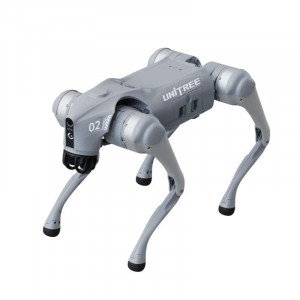
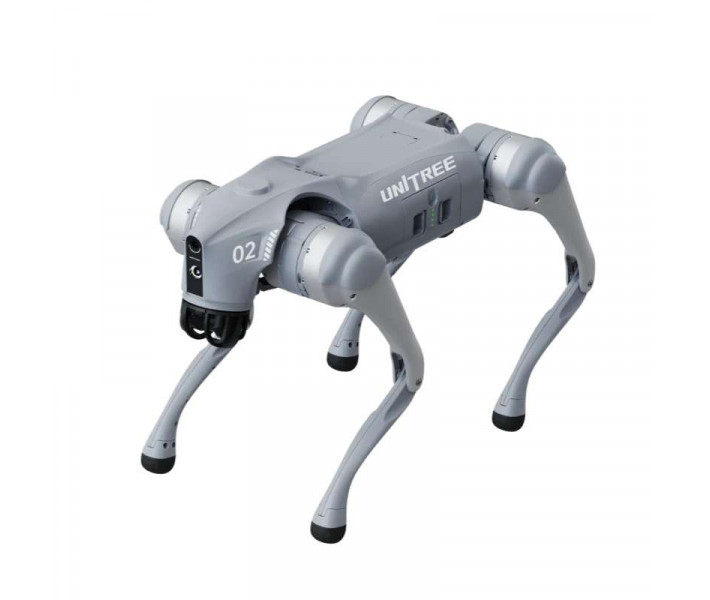
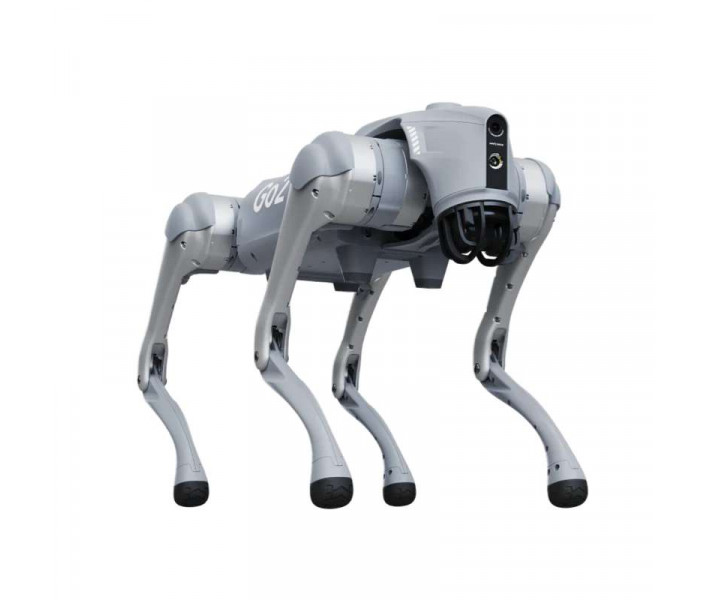
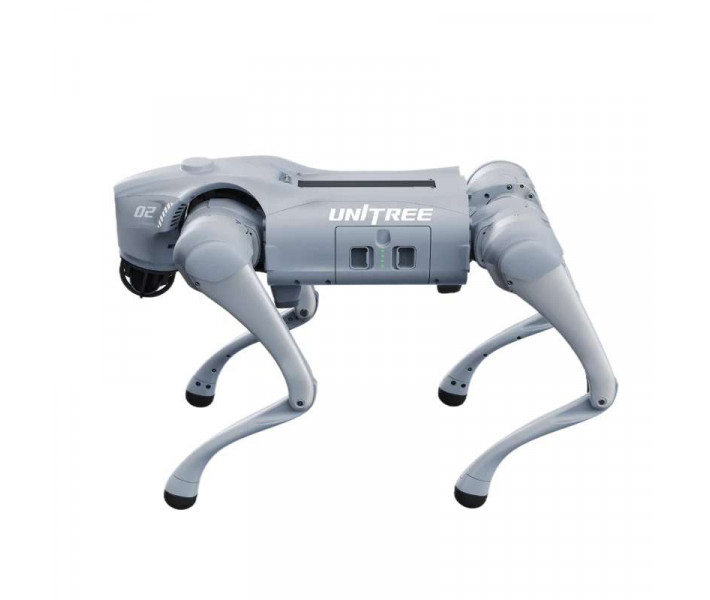
The Unitree Go2 EDU ENT U6 is a professional-grade quadruped inspection robot engineered for hazardous environment operations, featuring Unitree's self-developed 4D LiDAR L2 with 360°×96° hemispherical coverage, a dual 5.8G/4G communication system, a 30 W spotlight at 3000 lumens, a seven-parameter gas detection suite, and a 15000 mAh long-endurance battery — all packed into a 15 kg aluminium alloy frame capable of a peak locomotion speed of approximately 5 m/s.
| Max Locomotion Speed | ~5 m/s (peak, lab-tested) |
|---|---|
| 4D LiDAR Coverage | 360°×96° hemispherical, min. detection 0.05 m |
| Battery Life | ~2–4 h (15000 mAh long-endurance battery) |
| Spotlight System | 30 W, 3000 lumens |
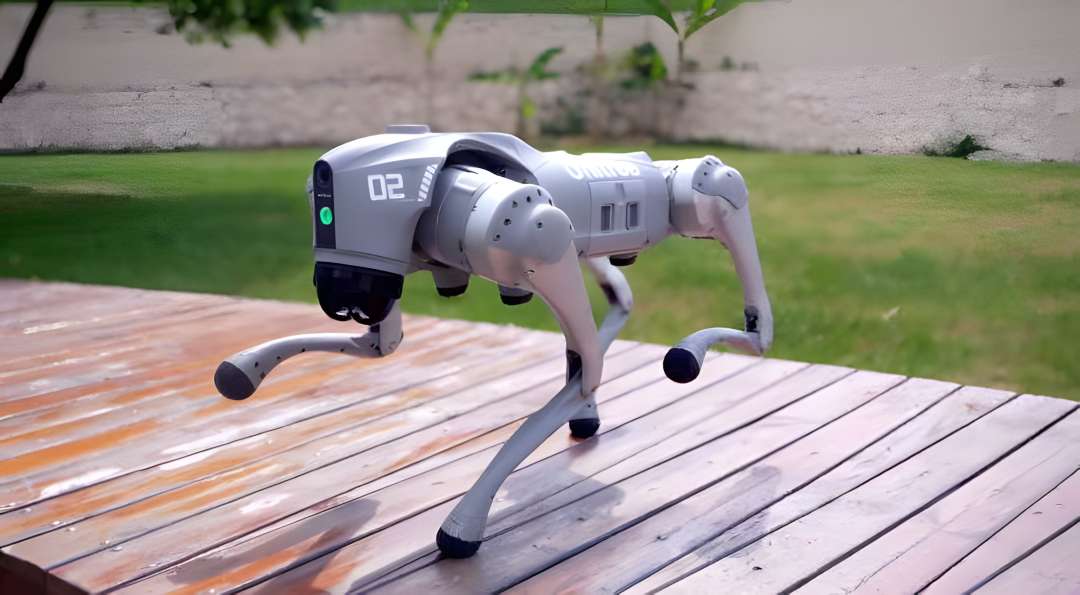
The image below captures the Go2 EDU performing dynamic movement on an outdoor deck — a demonstration of the Rage Mode locomotion system that fully exploits joint motor potential for faster speed, sharper steering, and stable traversal across uneven surfaces.
4D LiDAR L2: 360° Situational Awareness at 0.05 m Resolution
Obstacle avoidance is only as reliable as the sensor feeding it. The Go2 EDU ships with Unitree's proprietary 4D LiDAR L2 — a 360°×96° hemispherical scanner with a minimum detection distance of just 0.05 m. That near-zero blind spot matters in confined industrial corridors and fire rescue scenarios where objects appear suddenly at close range. The LiDAR simultaneously enables real-time 3D LiDAR Mapping: the robot constructs a point cloud of its operating area via the companion app, then navigates autonomously along user-specified paths. Two-hundred percent more recognition capability versus legacy radar configurations is Unitree's own benchmark for this sensor upgrade.
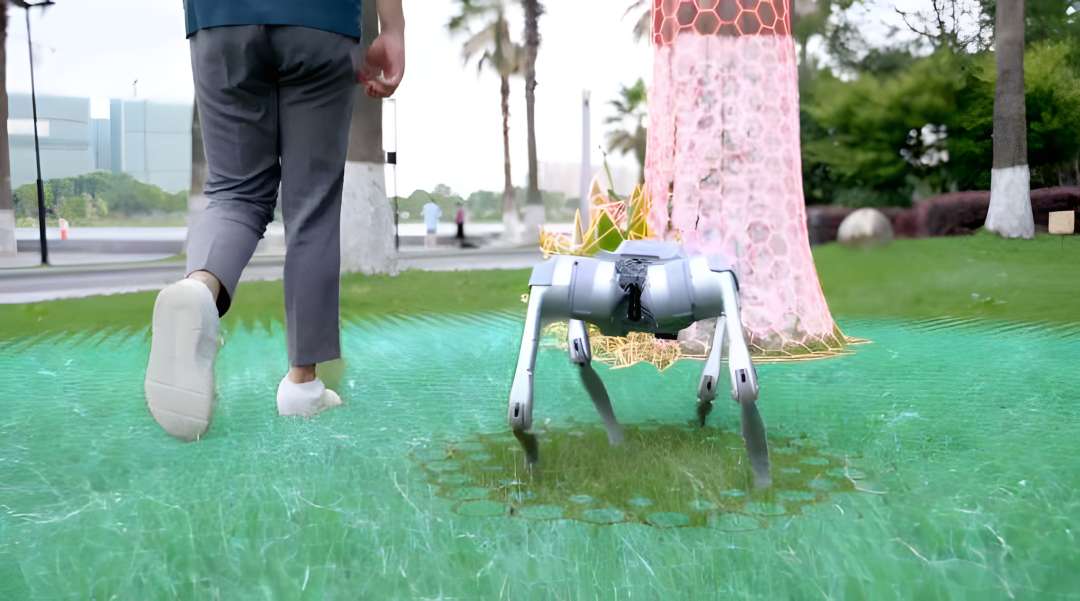
The photo below shows the ISS 2.0 Intelligent Side-follow System in outdoor operation, with the LiDAR scanning overlay rendered in real time as the robot tracks a walking person through a mixed obstacle environment.
ISS 2.0 Intelligent Side-follow System
The second-generation Intelligent Side-follow System (ISS 2.0) uses Unitree's self-developed wireless vector positioning module for centimetre-level planar positioning accuracy — a 50% improvement over the previous generation. Remote control range exceeds 30 m in open environments. When the operator moves, the Go2 tracks alongside, dynamically adjusting its path around obstacles rather than stopping. For site patrol and first-responder companion roles, this behaviour reduces operator cognitive load significantly.
Front Perception Suite: Camera, Light, and Audio in One Head
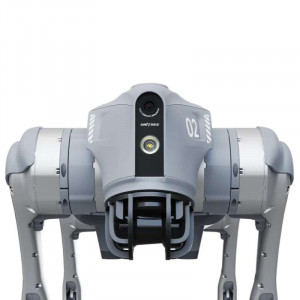
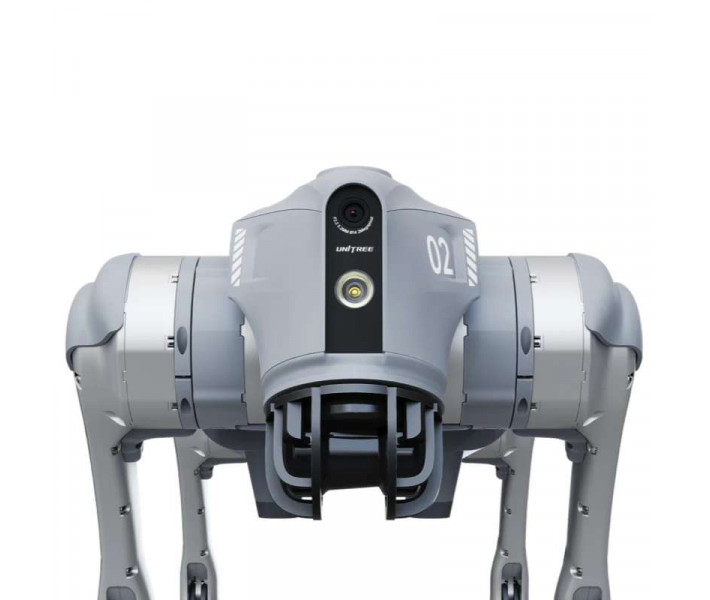
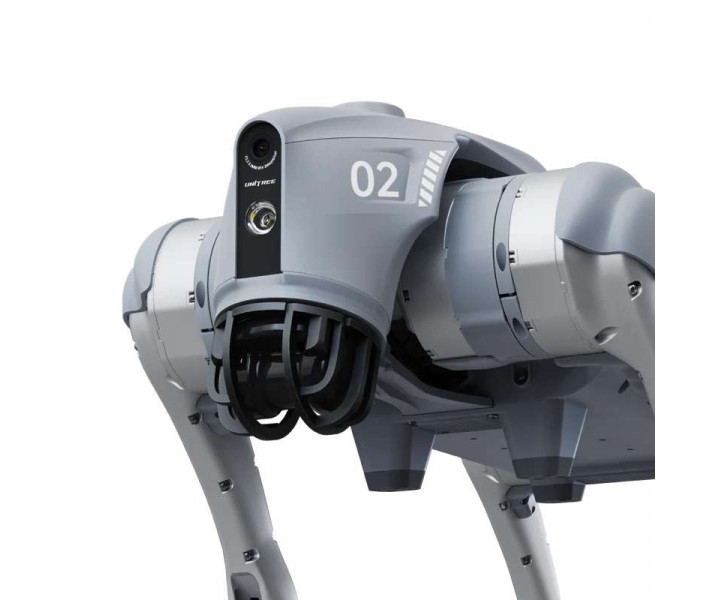
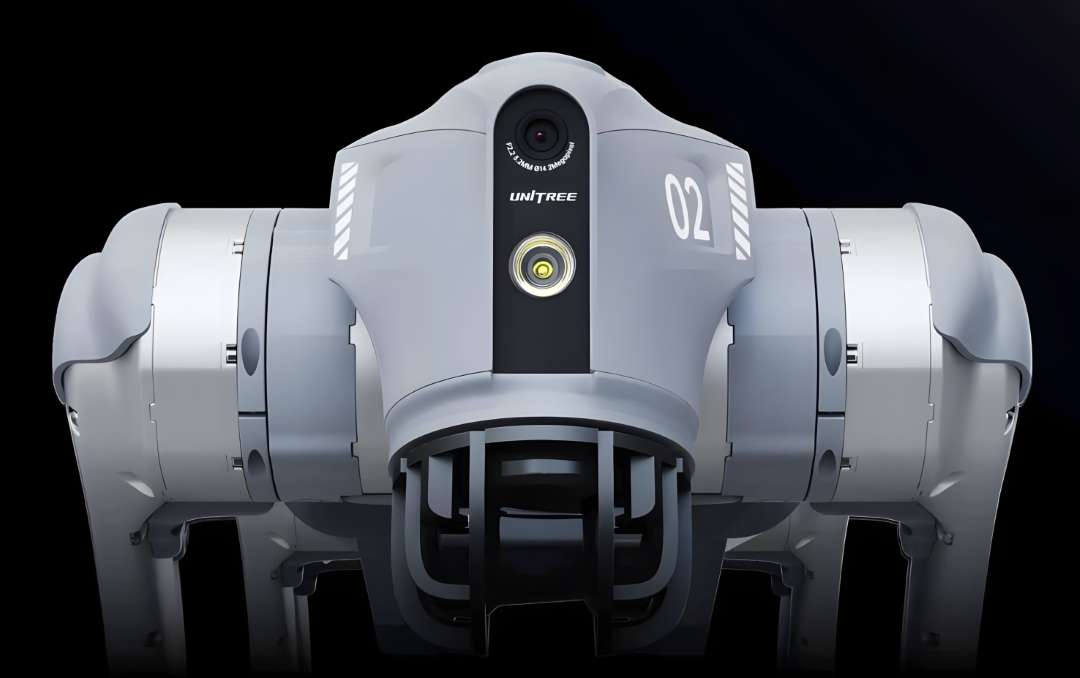
The Go2 EDU's forward-facing head integrates everything needed for remote visual inspection. The wide-angle camera resolves at 1280×720 px with a 120° field of view, transmitting 720p 60fps video with F2.2 aperture in interference-free conditions. A dedicated front lamp illuminates dark passages without auxiliary equipment. The close-up below shows the compact optical and illumination assembly that anchors the ENT U6's dual-camera detection system.
ENT U6 Tactical Systems: Communication, Light, and Environmental Detection
The ENT U6 configuration adds a mission-critical layer to the standard EDU platform. The hardware infographic below maps all integrated subsystems — from the tracking module and intercom microphone through to the smart battery and foot force sensor array.
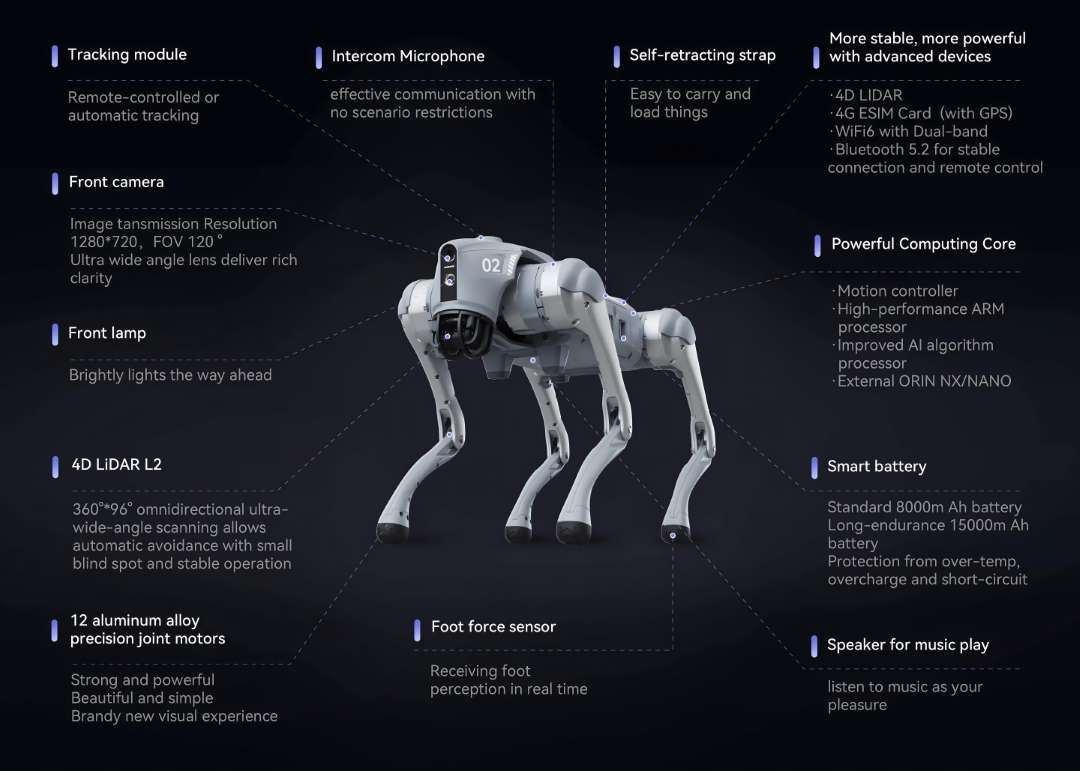
Dual-Link Communication: 5.8G Primary + 4G Backup
Single-frequency radios fail in RF-dense environments. The ENT U6 addresses this with a two-channel architecture: the primary link runs 5.8G digital telemetry with integrated signal transmission, delivering 1080P dual-channel HD video at latency as low as 180 ms via standard Ethernet stream input. When the primary link is disrupted, the all-netcom 4G backup channel (with GPS) switches in automatically. The explosion-proof display supports full 4G pass-through networking.
30 W Spotlight and Police Warning System
Darkness and visual alerting are two constants in fire rescue and industrial patrol. The ENT U6's spotlight delivers 3000 lumens at 30 W — sufficient to illuminate a standard industrial corridor or search area at operational distance. The warning light system outputs 10 W in police-pattern red/blue flash modes, enabling safe zone demarcation and personnel alerting without additional equipment. The digital voice broadcast system reaches 500–800 m maximum propagation distance, supporting real-time callout, pre-recorded playback, text-to-speech, and burst flash modes.
Seven-Parameter Gas Detection Integrated in the Go2 App
The ENT U6 gas detection interface is fully embedded in the official Go2 application — no separate software stack required. The sensor suite monitors humidity, oxygen, carbon monoxide, carbon dioxide, methane, hydrogen sulphide, and benzene simultaneously, each at ±3% accuracy. This makes the platform directly deployable for post-incident atmospheric assessment in industrial incidents without third-party integration work.
3D LiDAR Mapping: Autonomous Navigation from Point Cloud to Path
The point cloud visualisation below, generated by the Go2's L2 LiDAR and rendered in the companion app, demonstrates the density and spatial fidelity achievable in a complex mixed-indoor environment. From this map, operators specify waypoints; the robot executes autonomous navigation using SLAM-based positioning with path planning updating in real time.
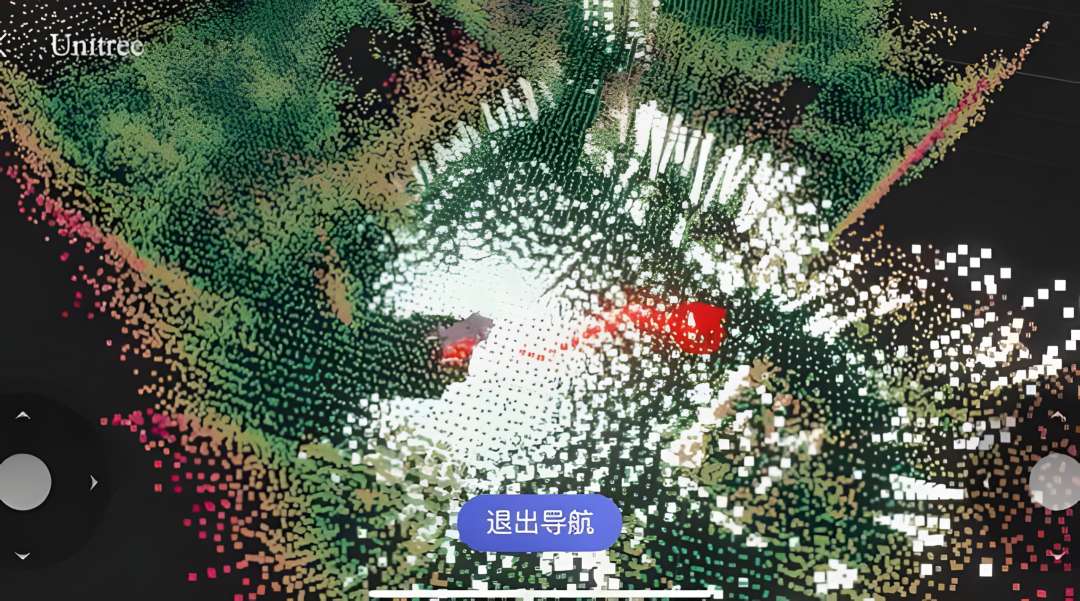
EDU Open Platform: Full Secondary Development with ROS2 and DDS
The EDU tier is the only Go2 variant that opens the full secondary development interface. All communication between modules flows over DDS, which is IDL-compatible with ROS2 — allowing existing lab packages, sensor drivers, and visualisation pipelines to port with minimal rework. The SDK communicates at 500 Hz on both low-level and high-level interfaces. C++ and Python bindings are provided. An optional NVIDIA Jetson Orin NX/NANO docking station (40–100 TOPS) extends onboard AI capacity for vision-based navigation policies, object recognition, and custom inference workloads.
The scene below illustrates the Go2 EDU's interactive behaviour indoors: voice commands, gesture response, and proximity interaction are all accessible through the Go2 app and offline voice recognition system, giving the platform an accessible human-machine interface alongside its developer-grade SDK.
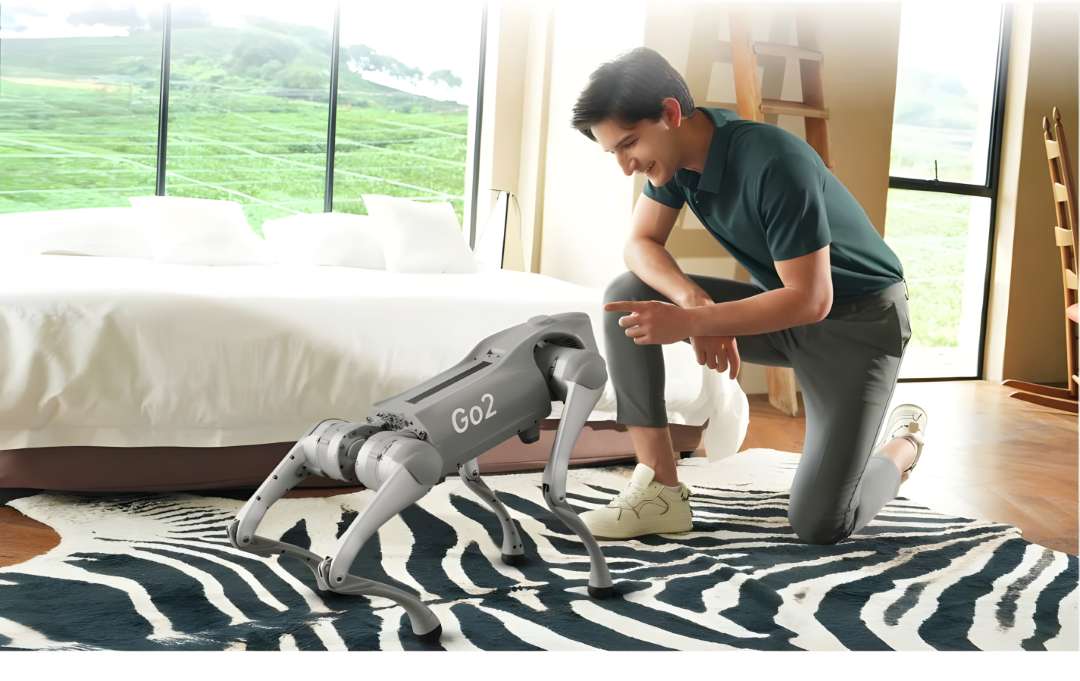
All-Terrain Locomotion: 40° Climb Angle, 16 cm Drop Height, ~5 m/s Peak Speed
The Go2 EDU's twelve aluminium alloy joint motors each achieve a peak torque of ~45 N.m, with heat pipe coolers on every joint to maintain performance during extended operation. The Rage Mode controller unlocks the full kinematic envelope: maximum rated speed is 3.7 m/s with a peak lab-tested figure of ~5 m/s. Climb angle reaches 40°; step height clearance is ~16 cm. The foot-end force sensors — exclusive to EDU and above — deliver real-time foot perception, allowing the motion controller to adapt gait dynamically to surface compliance changes.
The image below shows the Go2 EDU standing on a rocky surface in shallow water — a test of both locomotion stability on irregular substrates and the ingress resistance of the aluminium alloy and engineering plastic chassis under wet conditions.
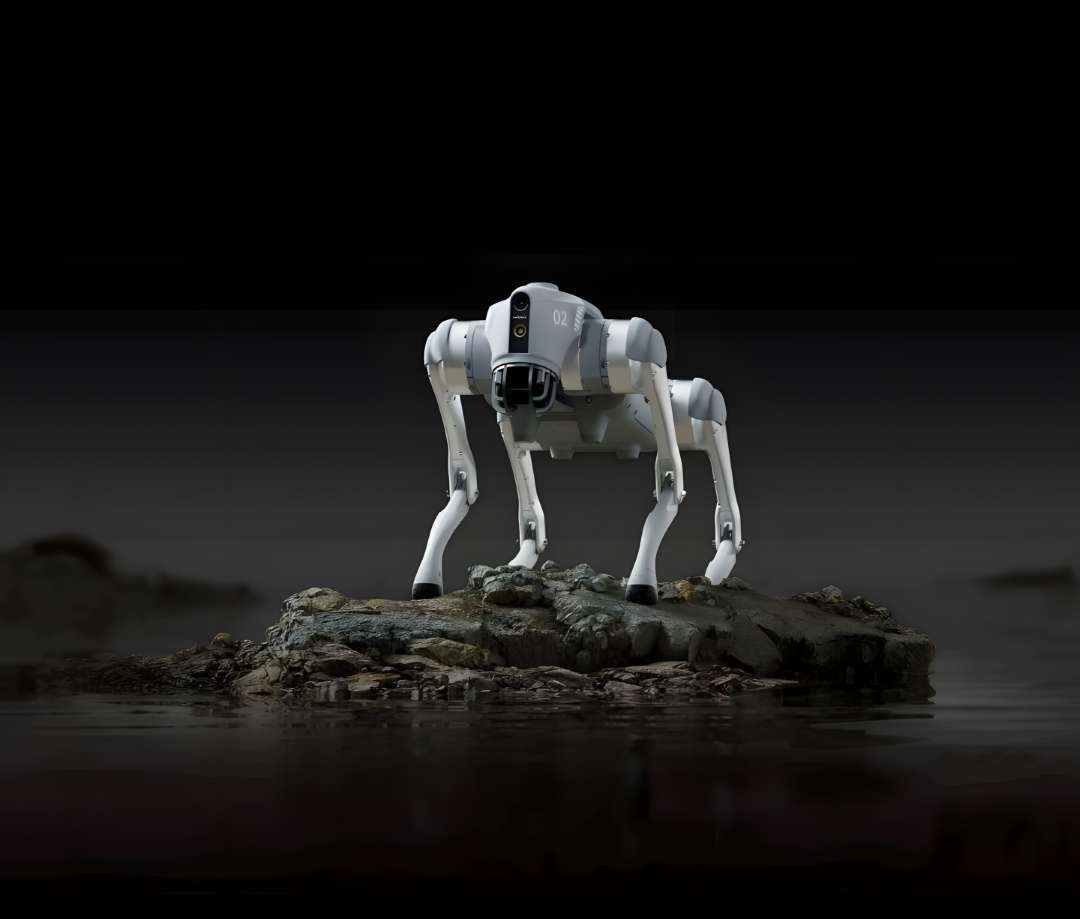
Technical Specifications of the Unitree Go2 EDU ENT U6
Mechanical Dimensions
| Model | Go2 EDU ENT U6 |
|---|---|
| Dimension — Standing (L × W × H) | 70 cm × 31 cm × 40 cm |
| Dimension — Crouching (L × W × H) | 76 cm × 31 cm × 20 cm |
| Weight (with battery) | ~15 kg |
| Shell Material | Aluminium alloy + high-strength engineering plastic |
| Default Standing Ground Clearance | 0.33 m |
Electrical Parameters
| Operating Voltage | 28–33.6 V |
|---|---|
| Maximum Working Power | ~3000 W |
Performance Parameters
| Payload (typical) | ~8 kg |
|---|---|
| Payload (maximum) | ~12 kg |
| Rated Locomotion Speed | 0–3.7 m/s |
| Maximum Speed (peak, lab-tested) | ~5 m/s |
| Max Climb / Drop Height | ~16 cm |
| Max Climb Angle | 40° |
| Basic Computing Power | 8-core high-performance CPU |
Joint Parameters
| Peak Joint Torque | ~45 N.m |
|---|---|
| Joint Motors | 12 aluminium alloy precision motors |
| Range of Motion — Body Roll | -48°~+48° |
| Range of Motion — Thigh | -200°~+90° |
| Range of Motion — Shank | -156°~-48° |
| Intra-joint Circuit (knee) | Yes |
| Joint Heat Pipe Cooler | Yes |
Sensors & Perception
| 4D LiDAR | Unitree L2 — 360°×96° hemispherical, min. detection 0.05 m |
|---|---|
| Front HD Camera | 1280×720 px, 120° FOV, F2.2 aperture, 720p 60fps transmission |
| Wireless Vector Positioning Module | Yes — UWB-based, centimetre-level planar accuracy, ISS 2.0 |
| Foot-end Force Sensor | Yes — real-time foot contact perception |
ENT U6 Communication System
| Primary Communication Band | 5.8G — integrated telemetry + digital video transmission |
|---|---|
| Backup Communication | All-netcom 4G (with GPS) |
| Video Transmission Resolution | 1080P HD, dual-channel |
| Video Latency | ~180 ms |
| Image Detection System | Dual camera 1080P, 120° wide-angle, 4 high-brightness fill lights |
ENT U6 Tactical Equipment
| Spotlight Power | 30 W |
|---|---|
| Spotlight Luminous Flux | 3000 lumens |
| Warning Light System | Police pattern red/blue, 10 W |
| Digital Voice Broadcast Range | 500–800 m maximum propagation distance |
| Voice Broadcast Functions | Real-time callout, recorded playback, TTS, burst flash |
Gas Detection System (ENT U6)
| Humidity Measurement Range | 0–100%, accuracy ±3% |
|---|---|
| Oxygen (O₂) Range | 0–30%, accuracy ±3% |
| Carbon Monoxide (CO) Range | 0–1000 ppm, accuracy ±3% |
| Carbon Dioxide (CO₂) Range | 0–20 ppm, accuracy ±3% |
| Methane (CH₄) Range | 0–100%, accuracy ±3% |
| Hydrogen Sulphide (H₂S) Range | 0–100 ppm, accuracy ±3% |
| Benzene Range | 0–100 ppm, accuracy ±3% |
| Detection Interface | Integrated in official Go2 app |
Connectivity & Interfaces
| WiFi | WiFi 6 dual-band |
|---|---|
| Bluetooth | 5.2 / 4.2 / 2.1 |
| 4G Module | Yes — with GPS, supports 43 European countries |
| Wired Interfaces | Ethernet + USB 458 |
Battery & Power
| Smart Battery Capacity | 15000 mAh (long-endurance) |
|---|---|
| Battery Life | ~2–4 h |
| Charger | 33.6 V / 9 A (fast charge) |
| Battery Protection | Over-temperature, overcharge, short-circuit |
Software & Development
| Secondary Development | Full (EDU tier) |
|---|---|
| Development Interfaces | DDS (C++ / Python), ROS2, GST (image streaming) |
| SDK Communication Frequency | 500 Hz (low-level and high-level) |
| Required Development OS | Ubuntu 20.04 |
| Optional AI Compute Module | NVIDIA Jetson Orin NX / NANO — 40–100 TOPS |
| OTA Firmware Updates | Yes |
| Graphical Programming | Yes |
| Voice Functions | Offline voice interaction, commands, intercom, music playback |
| 3D LiDAR Mapping & SLAM | Yes — mapping, positioning, autonomous path navigation |
| Charging Pile Compatibility | Yes |
Warranty
| Warranty Period | 12 months |
|---|
What's in the Box
- Unitree Go2 EDU ENT U6 quadruped robot (fully assembled)
- Dual-hand remote controller with screen
- 15000 mAh long-endurance smart battery (installed)
- Fast charger — 33.6 V / 9 A
- ENT U6 tactical module: 5.8G/4G dual-link system, spotlight, warning lights, voice broadcast, gas sensor suite
Which Go2 versions support secondary development?
Only the EDU tier and above support full secondary development. The AIR and PRO versions do not expose the development interface. The EDU version can be paired with a 40 TOPS or 100 TOPS NVIDIA Jetson Orin docking station for extended AI capability. Development requires a Ubuntu 20.04 host connected via wired Ethernet — wireless SDK connections are not supported.
What communication frequency does the Go2 SDK use?
The Go2 SDK operates at 500 Hz on both the low-level motor control interface and the high-level motion service interface. This cycle rate is sufficient for closed-loop gait control and real-time sensor fusion tasks.
What is the Go2 camera resolution and transmission capability?
The front head camera captures 1080P HD or 720p 60fps with an F2.2 aperture and 120° field of view. App transmission delivers 720p 60fps in interference-free environments. The ENT U6 configuration adds a second 1080P wide-angle camera with four high-brightness fill lights and dual-channel 1080P HD video transmission at approximately 180 ms latency.
How does the obstacle avoidance system decide to stop or go around an obstacle?
The obstacle avoidance algorithm automatically evaluates the obstacle's width. If the obstacle is too wide to navigate around given the available clearance, the robot stops. If the obstacle is narrow enough, the robot autonomously steers around it and continues on its path. Both behaviours are fully automatic — no manual override is required.
Does the Go2 EDU ENT U6 support 4G operation in Europe?
Yes. The international (non-Chinese mainland) version of the 4G module supports 43 European countries. Note that Ukraine is not included in the current European 4G coverage list. GPS functionality is included with the 4G module for all supported regions.
Why Choose EXPERT3D?
EXPERT3D has specialised in advanced robotics and 3D technology since 2012 — over a decade of hands-on experience selecting, deploying, and supporting professional platforms across research institutions, universities, and industrial R&D teams. We provide pre-sales technical consultation, logistics coordination across Spain and Europe, and post-sale support backed by direct manufacturer contacts. The Unitree Go2 EDU ENT U6 is a complex system integrating locomotion, environmental sensing, and tactical communication: our team can help you navigate configuration, SDK onboarding, and integration into your existing infrastructure. Contact us to discuss your specific application requirements and current availability.