- Stock: In Stock
- Product code: GO2W100-01
- Weight Brutto: 30.00kg

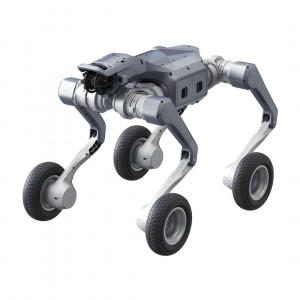
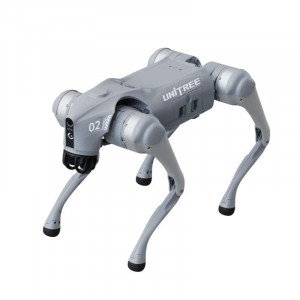
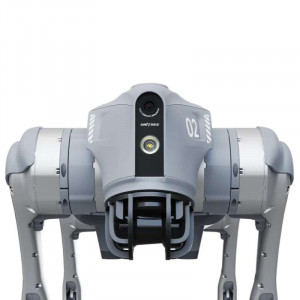
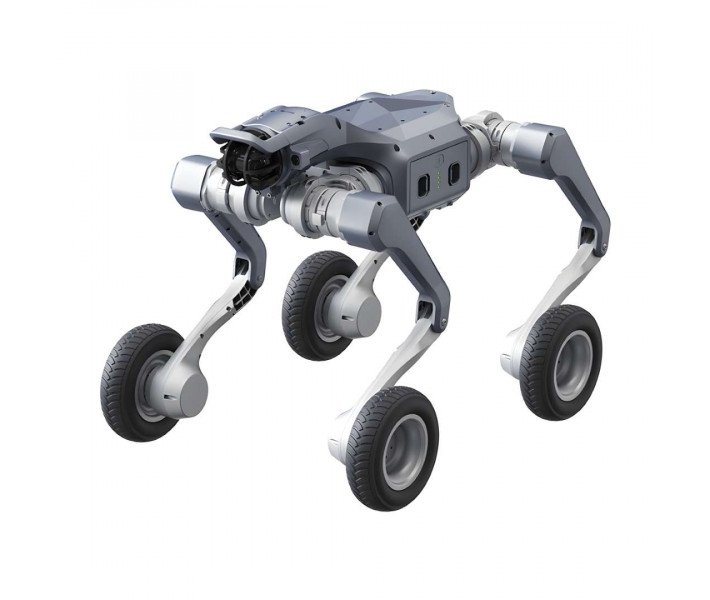
The Unitree GO2-W U1 is a quadruped wheel-legged robotic dog built for cross-terrain autonomy, advanced research, and secondary development tasks. Mounting four 7-inch pneumatic tyres on a 16-joint aluminum skeleton, the GO2-W reaches a top speed of 2.5 m/s, carries a payload of ≈8 kg (up to 12 kg), and runs for up to 3 hours on a 15 000 mAh battery, all orchestrated by a dedicated 40 TOPS NVIDIA Jetson Orin NX AI module mounted on-board.
| Maximum Speed | 2.5 m/s |
|---|---|
| Payload (MAX) | ≈8 kg (up to ~12 kg) |
| AI Computing Module | Orin NX — 40 TOPS |
| Battery Life | 1.5–3 h (15 000 mAh) |
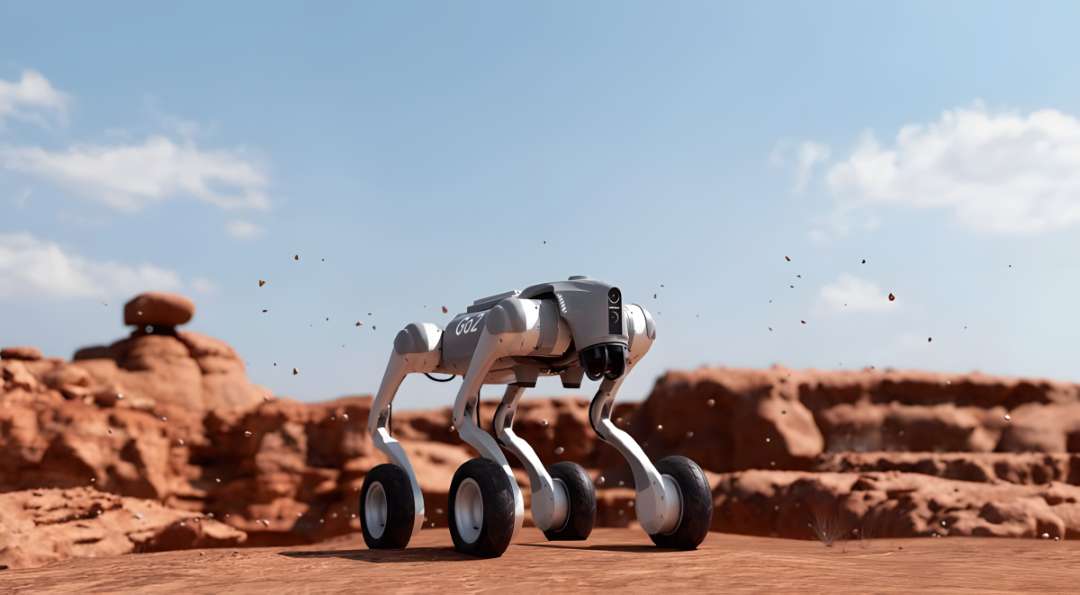
The image below shows the GO2-W operating in an extreme outdoor environment — a sun-baked red desert canyon — underscoring the platform's readiness for demanding unstructured terrain where wheeled-only or legged-only robots would struggle to maintain stability and efficiency simultaneously.
Wheel-Leg Hybrid Architecture: The Best of Both Locomotion Modes
Standard quadruped robots excel on loose or irregular ground but pay an energy penalty on smooth surfaces. Wheeled platforms roll efficiently on flat terrain but stall at kerbs, steps, and steep inclines. The GO2-W resolves this trade-off by replacing traditional feet with motorized pneumatic wheels — each leg retaining its full range of motion while the tyre at its end handles surface contact. The result: a robot that rolls swiftly across flat ground and dynamically repositions its body geometry when the terrain demands agility.
16-Joint Aluminum Skeleton: The Foundation of Hybrid Motion
Sixteen independent aluminum joint motors — the same hollow-shaft architecture proved on the standard Go2 — articulate the four legs. Maximum joint torque reaches ~45 N.m, giving the GO2-W enough leverage to negotiate steep ramps (up to 35°), absorb drop impacts below 70 cm, and maintain ground contact across uneven surfaces without losing traction. All actuators are driven by an 8-core high-performance CPU at the base-level control layer.
7-Inch Pneumatic Tyres: All-Terrain Grip Without Compromise
The pneumatic tyre choice is deliberate. Unlike rigid wheels, pneumatic rubber deforms slightly under load, increasing the contact patch on soft or granular surfaces and providing passive vibration damping that reduces shock transmission to the robot's inertial sensors. At 7 inches in diameter, the tyres clear small obstacles without requiring the legs to lift excessively, preserving speed and energy efficiency on mixed-terrain routes.
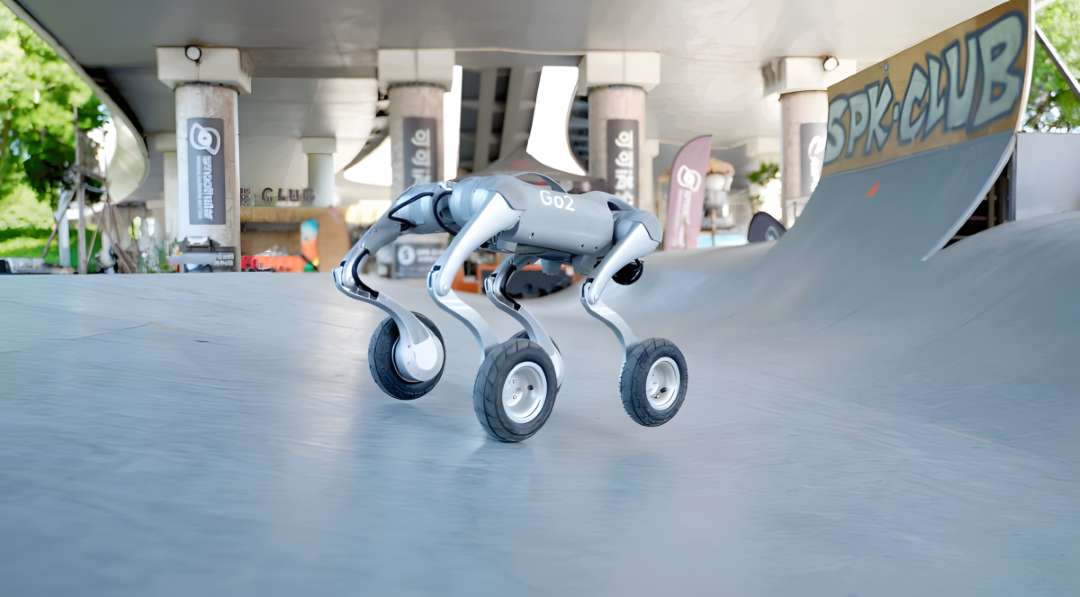
The sequence below captures the GO2-W rolling at speed across the curved ramp surface of an outdoor skatepark — an environment that combines smooth concrete, abrupt slope changes, and unpredictable transitions, all navigated without breaking stride.
Locomotion Performance: 2.5 m/s Speed with 35° Climbing Capability
At peak speed, the GO2-W covers 2.5 m/s — fast enough for patrol, inspection, and field data-collection tasks where time-on-site is constrained. But raw speed is only one dimension of mobility. The robot's motion controller continuously adjusts leg height and wheel torque distribution in response to inertial measurement unit feedback, sustaining stable locomotion across gradient changes and surface irregularities that would destabilize a rigid-body wheeled platform.
Stair Climbing and Drop Recovery
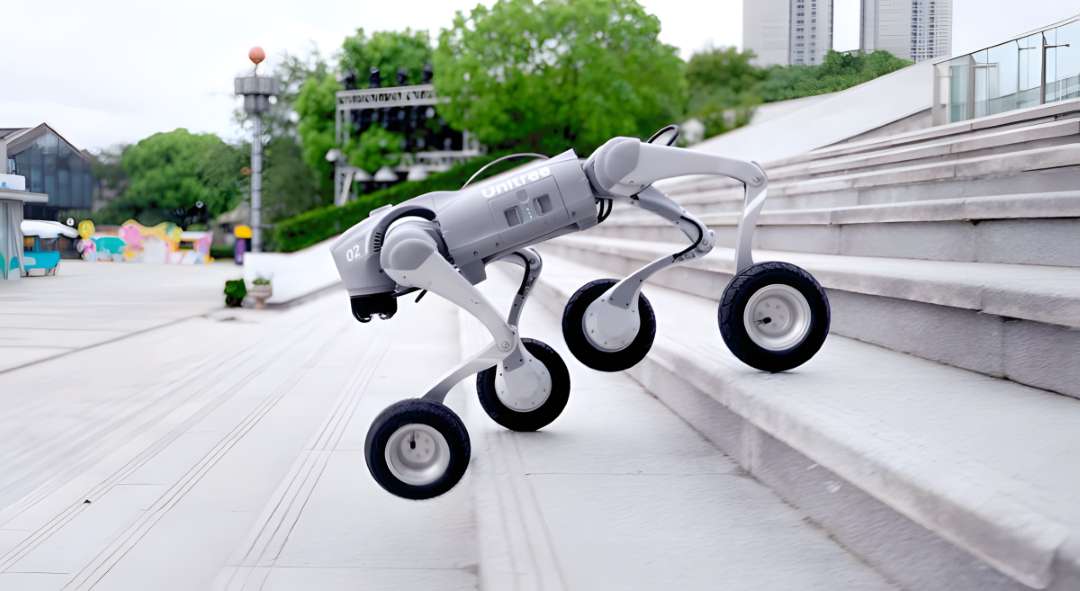
The maximum climb angle of 35° places standard staircases — typically 15°–20° — firmly within the GO2-W's operating envelope. Drop capability (impacts from heights below 70 cm) is handled by distributing the deceleration impulse across all four compliant leg joints, protecting the chassis from concentrated shock loads. The image below shows the GO2-W ascending an outdoor stone staircase, demonstrating the cooperative action of all four legs operating in a quadruped stair-climbing gait rather than the high-energy hopping pattern of earlier-generation robots.
40 TOPS Orin NX Module: On-Board AI for Autonomous Operation
The standard arithmetic module is an NVIDIA Jetson Orin NX delivering 40 TOPS of AI inference performance. This compute headroom supports real-time perception pipelines, path-planning algorithms, and machine-learning inference tasks without relying on cloud connectivity. All perception, decision-making, and motor command calculations execute locally — a critical requirement for deployments in RF-restricted environments, outdoor settings with unreliable networks, or research scenarios demanding deterministic latency.
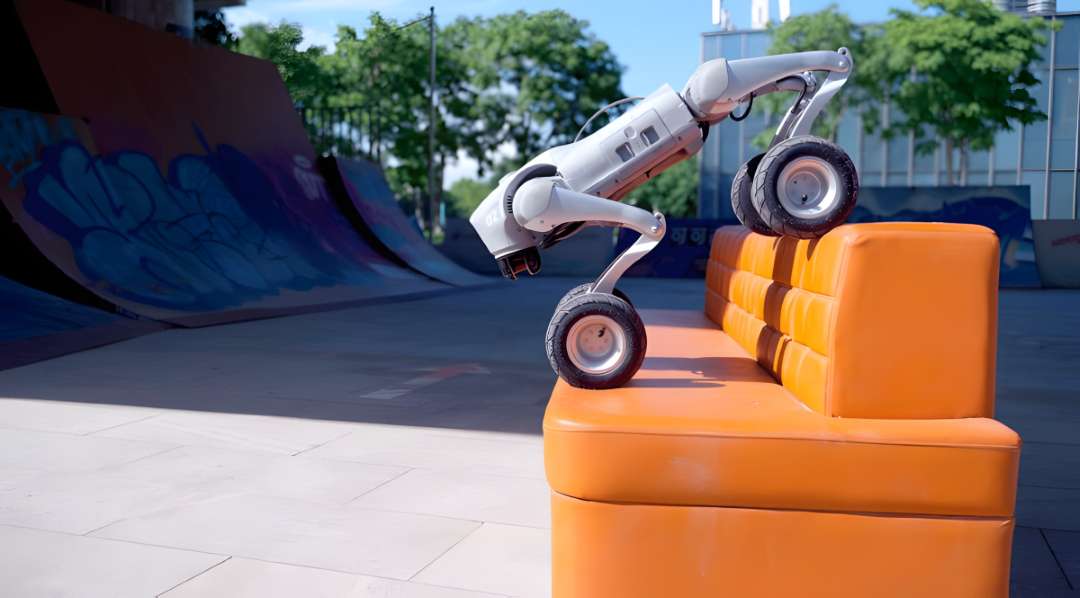
Secondary development is fully supported: the Orin NX environment is open for custom software deployment, ROS integration, and SDK extensions. The image below illustrates the platform's physical agility complementing this compute capability — the GO2-W cresting an elevated orange obstacle at the skatepark, a scenario that requires coordinated vision-based obstacle detection and real-time body pose adjustment.
Sensor Suite: Wide-Angle 3D LiDAR and HD Camera
Environmental awareness is built into the GO2-W's sensor stack from the ground up. The super-wide-angle 3D LiDAR constructs a point cloud of the surrounding environment in real time — enabling obstacle detection, terrain mapping, and autonomous navigation in scenarios where GPS-based positioning is insufficient. The HD wide-angle camera feeds visual data to the Orin NX for object recognition, visual odometry, and human-robot interaction workflows. A front lighting lamp extends operational range into low-light conditions without requiring external illumination infrastructure.
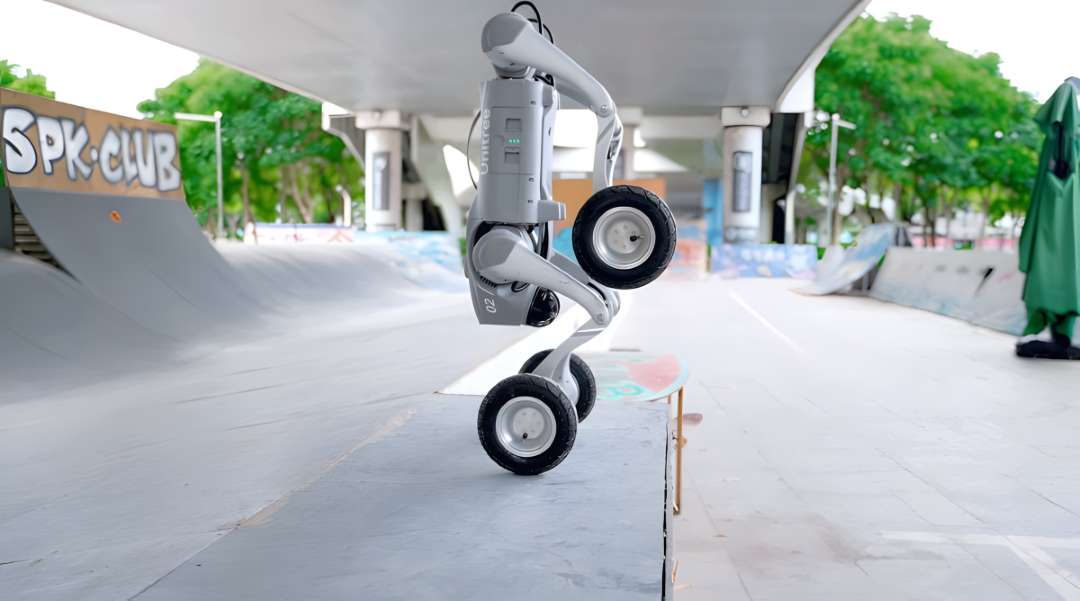
The photograph below demonstrates a capability that sets the GO2-W apart from any purely wheeled platform: dynamic two-point balance on the rear wheels only, with the front legs fully raised. This balancing behaviour — executed here at an outdoor skatepark — relies on the real-time whole-body controller managing centre-of-mass projection over the small rear-wheel contact polygon, a manoeuvre that requires both precise IMU feedback and sub-millisecond actuator response.
15 000 mAh Battery: Up to 3 Hours of Continuous Operation
The long-endurance battery pack stores 15 000 mAh at a nominal pack voltage of 33.6 V. Under typical mixed-duty conditions — combining high-speed traversal, standing perception tasks, and occasional stair-climbing — the GO2-W sustains 1.5 to 3 hours of operation per charge cycle. The included fast charger operates at 33.6 V / 9 A, restoring the pack substantially faster than standard overnight charging protocols. Intelligent OTA firmware updates deploy wirelessly via WiFi 6, keeping the motion control stack and SDK components current without requiring physical access to the robot.
Technical Specifications of the Unitree GO2-W U1
Mechanical Dimensions
| Dimensions (standing) | 70 cm × 43 cm × 50 cm |
|---|---|
| Weight (with battery) | ~18 kg |
| Supply Voltage | 33.6 V |
Performance Parameters
| Payload | ≈8 kg (MAX ~12 kg) |
|---|---|
| Maximum Speed | 0–2.5 m/s |
| Maximum Climb Drop Height | < 70 cm |
| Maximum Climb Angle | 35° |
| Basic Computing Power | 8-core high-performance CPU |
Joint Parameters
| Aluminum Knee Joint Motors | 16 |
|---|---|
| Maximum Joint Torque | ~45 N.m |
| Tyres | 7-inch pneumatic |
Sensors & Perception
| 3D LiDAR | Yes — super-wide-angle |
|---|---|
| HD Wide-angle Camera | Yes |
Features & Connectivity
| Basic Actions | Yes |
|---|---|
| Intelligent OTA Updates | Yes |
| APP Support | Yes |
| Manual Controller | Yes (included) |
| Front Lighting Lamp | Yes |
| Wireless Connectivity | WiFi 6, 4G, Bluetooth |
| Voice Function | Yes |
| Secondary Development | Yes |
Computing & AI
| Arithmetic Module | Standard — Orin NX (40 TOPS) |
|---|
Battery & Power
| Battery Type | Long endurance |
|---|---|
| Battery Capacity | 15 000 mAh |
| Endurance | 1.5–3 h |
| Charger | Fast charge — 33.6 V / 9 A |
Warranty
| Warranty Period | 24 months |
|---|
What's in the Box
- Unitree GO2-W U1 wheeled robotic dog (assembled)
- Standard arithmetic module — Orin NX 40 TOPS (installed)
- 15 000 mAh long-endurance battery
- Fast charger (33.6 V / 9 A)
- Portable manual remote controller
What is the maximum speed of the Unitree GO2-W U1?
The GO2-W U1 reaches a maximum locomotion speed of 2.5 m/s. This speed is sustained on flat and moderately inclined surfaces using the robot's wheel-leg hybrid drivetrain, which combines the rolling efficiency of 7-inch pneumatic tyres with the adaptive body posture of the 16-joint aluminum skeleton.
How much weight can the Unitree GO2-W carry?
The GO2-W U1 supports a nominal payload of approximately 8 kg, with a maximum rated payload of around 12 kg. This capacity is sufficient for sensor payloads, inspection equipment, or light cargo in field deployment scenarios.
Can the GO2-W climb stairs and overcome obstacles?
Yes. The GO2-W handles a maximum climb angle of 35°, which covers standard stair gradients and most outdoor ramps. Drop recovery capability extends to impacts from below 70 cm. The robot's whole-body controller coordinates all four legs dynamically to negotiate steps and uneven terrain without manual intervention.
What AI computing module does the GO2-W U1 include?
The GO2-W U1 ships with the standard arithmetic module: an NVIDIA Jetson Orin NX delivering 40 TOPS of AI inference performance. It supports secondary development, custom ROS packages, and on-board perception pipelines. All computation runs locally — no cloud dependency required.
How long does the GO2-W battery last, and how quickly does it charge?
The 15 000 mAh long-endurance battery delivers 1.5 to 3 hours of operation depending on activity profile — rolling at speed consumes more power than slow inspection traversal. The included fast charger operates at 33.6 V / 9 A for rapid pack recovery between deployments.
Why Choose EXPERT3D?
EXPERT3D has specialised in advanced robotics and 3D technology since 2012 — over a decade of hands-on experience selecting, integrating, and supporting professional-grade platforms across research institutions, universities, and industrial R&D teams. We provide pre-sales technical consultation tailored to your specific application, delivery coordination across Spain and the EU, and post-sale support backed by direct manufacturer contacts. The Unitree GO2-W U1 is a capable but nuanced platform: our team can help you navigate configuration options, SDK onboarding, payload integration, and network setup for your deployment environment. Contact us to discuss current availability and your project requirements.