- Stock: In Stock
- Product code: GO2W100-02
- Weight Brutto: 33.00kg

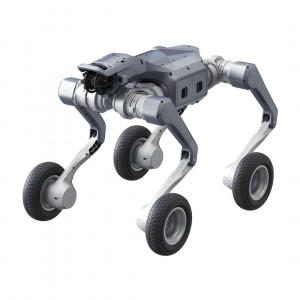
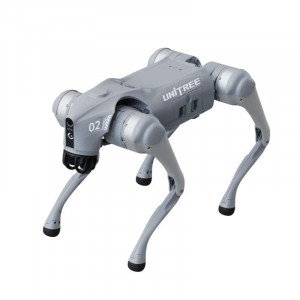
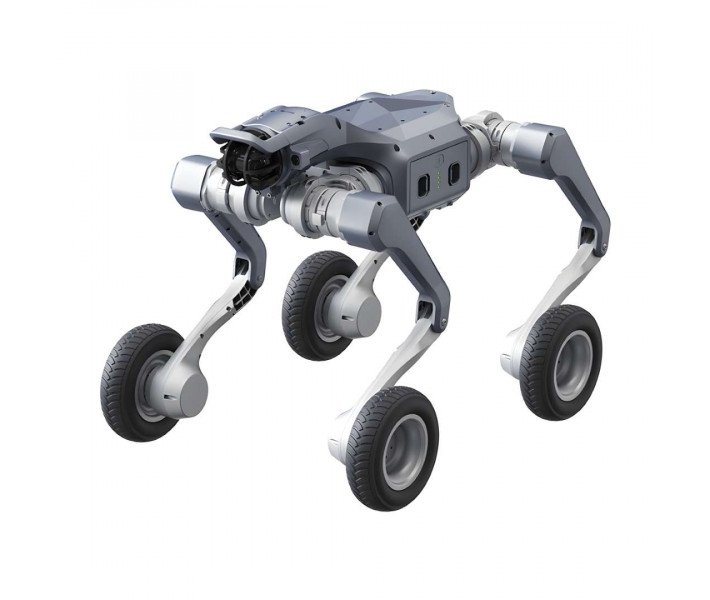
The Unitree Go2-W is a wheel-legged quadruped robot engineered for researchers, inspection engineers, and autonomous-systems developers who need a platform that rolls efficiently on flat ground and still negotiates stairs, steps, and rough terrain without switching hardware. Weighing approximately 18 kg with battery, driven by a dedicated NVIDIA Jetson Orin NX module delivering 100 TOPS of on-board AI inference, and fitted with 7-inch pneumatic tires in place of standard paw-feet, the Go2-W reaches 2.5 m/s on smooth surfaces and climbs gradients up to 35° — all from a single 15000 mAh long-duration battery.
| Maximum Speed | 2.5 m/s |
|---|---|
| Maximum Climbing Angle | 35° |
| AI Computing Module | NVIDIA Jetson Orin NX — 100 TOPS |
| Battery Life | 1.5–3 h (15000 mAh) |
The image below captures the Go2-W mid-performance at a skatepark — balanced on two front wheels in a controlled rear-wheel lift, illustrating the dynamic balance authority that the onboard motion controller maintains across every locomotion mode.
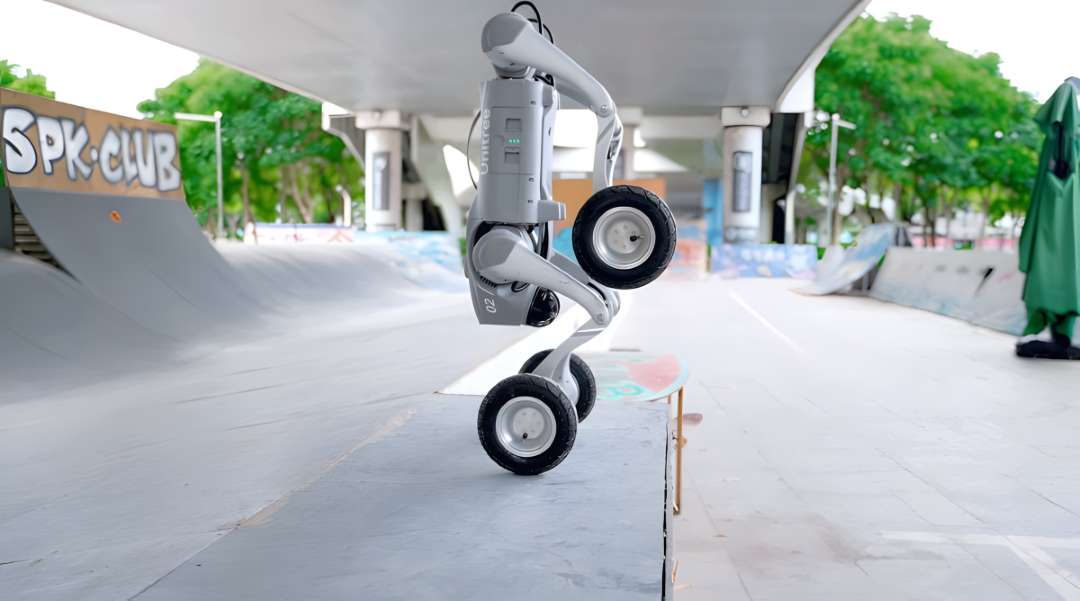
Wheel-Legged Architecture: Rolling Speed Meets Legged Agility
Conventional wheeled robots stop at a kerb. Standard legged robots waste energy on flat ground. The Go2-W resolves that contradiction by fitting each of the Go2's four articulated limbs with a 7-inch pneumatic tire instead of a rigid paw. On sealed floors, corridors, and outdoor paths the robot rolls — preserving energy and sustaining speeds up to 2.5 m/s. When terrain changes, the articulated legs lift, extend, and plant independently on each obstacle surface, executing the same kind of whole-body motion planning the base Go2 platform is known for.
16 Aluminium Joint Motors and 45 N.m Torque
Four legs, four motors per leg: 16 aluminium knee-joint actuators in total, each capable of delivering approximately 45 N.m of torque. That torque budget is what allows the 18 kg platform to sustain forward motion up a 35° ramp while the wheels maintain traction — and to absorb drop impacts up to 70 cm without drivetrain damage. Aluminium housings minimise unsprung mass at each wheel, which directly benefits the balance recovery speed when the robot transitions between rolling and stepping modes.
The sequence below shows the Go2-W demonstrating obstacle-mounting capability — climbing onto a raised orange padded surface in an outdoor skatepark environment, a challenge that simultaneously demands torque, real-time balance correction, and precise limb placement.
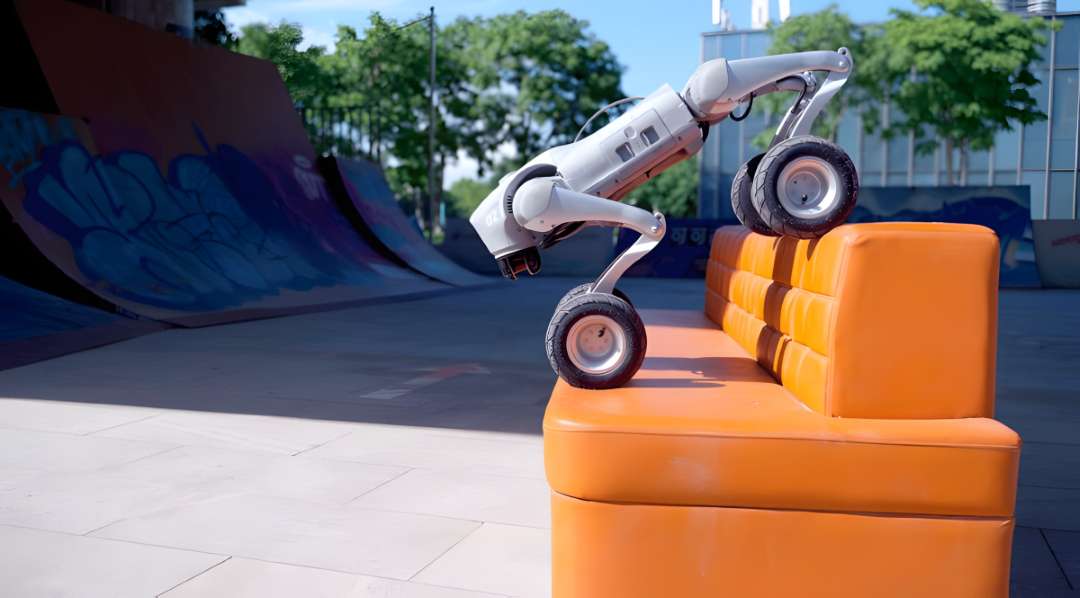
Stair Climbing: Where Wheels and Legs Cooperate
Stairs are the canonical failure mode for wheeled platforms. The Go2-W addresses this by shifting from roll mode to step mode: each leg independently raises, extends, and plants on the next tread, distributing the robot's weight across three or four contact points simultaneously. The large tire footprint also provides better grip on smooth stone treads compared to standard rubber paw tips, reducing slip risk on wet or polished surfaces. The robot's 3D LiDAR detects stair geometry in advance, allowing the controller to pre-position leg swing trajectories before the leading wheels reach the first riser.
The photograph below documents Go2-W mid-ascent on a broad stone staircase — all four wheeled limbs on separate steps, body held level, ascending without assistance.
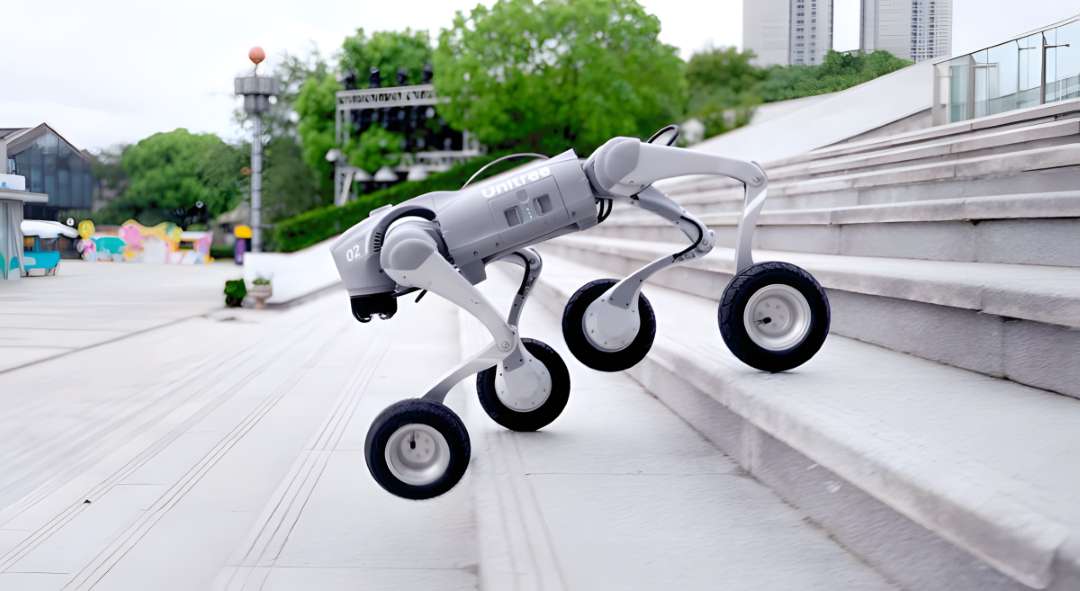
Locomotion Performance: 2.5 m/s with 35° Gradient Capability
Peak rolling speed of 2.5 m/s places the Go2-W noticeably ahead of standard legged quadruped platforms in coverage-distance-per-charge — a decisive factor for patrol, facility inspection, and autonomous logistics tasks where the robot must cover meaningful ground between recharges. The onboard motion controller handles continuous transitions between pure-roll and wheel-step gaits using real-time LiDAR and camera feedback, selecting the appropriate locomotion mode for each terrain section without operator input.
The 70 cm drop tolerance quantifies the platform's resilience when descending from raised surfaces or encountering sudden level changes — a practical limit reflecting the kinds of real-world environments the Go2-W is actually designed for, not controlled laboratory floors.
The image below captures the Go2-W at speed on a banked concrete ramp — all four tires in simultaneous contact with the curved surface, demonstrating both traction control and the low-centre-of-mass stability that the wheel-leg geometry provides at pace.
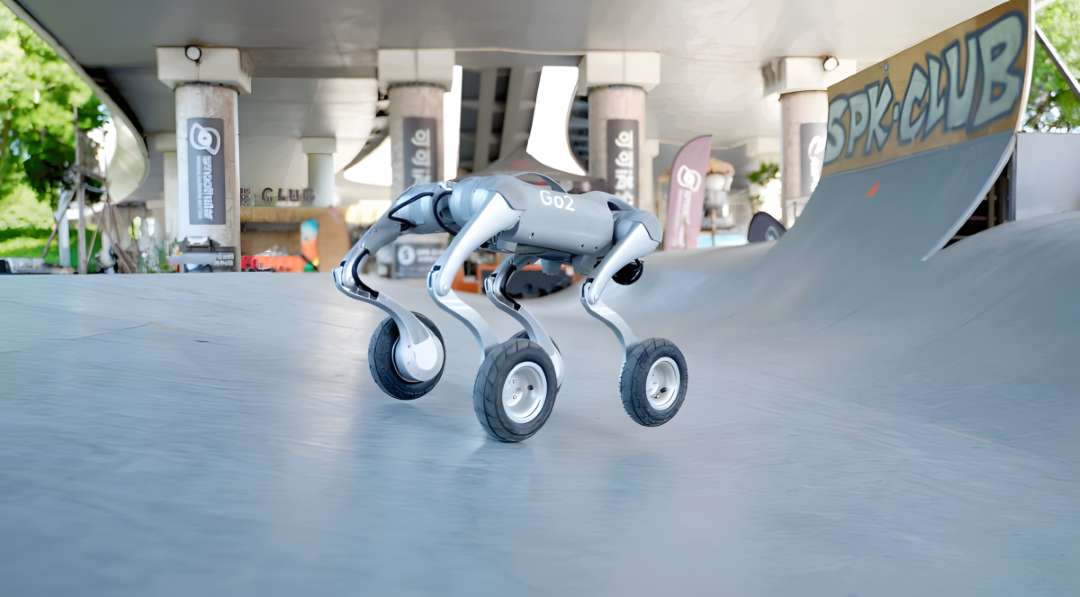
All-Terrain Autonomy: From Indoor Corridors to Open Environments
WiFi 6, 4G cellular, and Bluetooth connectivity give the Go2-W the communication flexibility to operate inside buildings on local network, in industrial yards over cellular, or fully standalone in autonomous mode. A 3 kg payload capacity accommodates an inspection sensor array, a small manipulator arm, or supplementary compute hardware without degrading locomotion. The front illumination lamp extends operational hours into low-light conditions, and the voice function enables basic verbal interaction for supervised deployment scenarios.
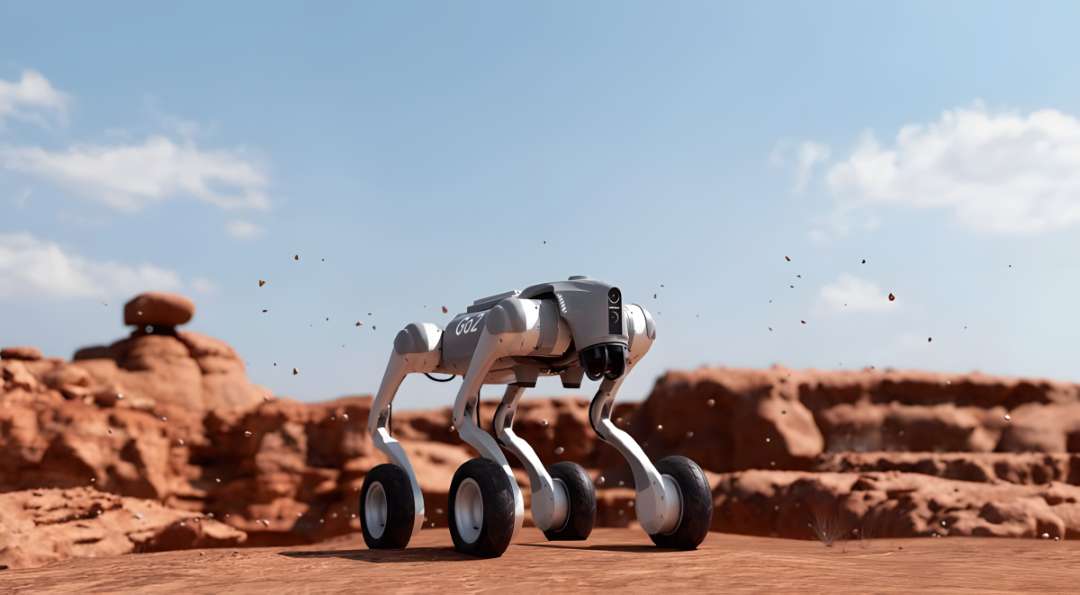
The frame below places the Go2-W in unstructured outdoor terrain — standing on exposed red rock in a canyon landscape, wheels resting on uneven, abrasive ground with no infrastructure in sight. The platform's 15000 mAh battery and sealed electronics make this kind of deployment genuinely viable rather than merely aspirational.
NVIDIA Jetson Orin NX: 100 TOPS On-Board AI
The U2 configuration pairs the Go2-W's mechanical platform with a dedicated NVIDIA Jetson Orin NX development module delivering 100 TOPS of AI inference performance. A separate 8-core high-performance CPU handles the base motion control stack, leaving the Jetson environment fully available for secondary development work — custom ROS packages, reinforcement learning policy deployment, computer vision pipelines, or multi-modal sensor fusion. Smart OTA firmware updates keep the motion control and SDK components current over-the-air, eliminating the need for physical bench connections between field deployments.
Sensors: Wide-Angle 3D LiDAR and HD Camera
Environmental awareness on the Go2-W is handled by a wide-angle 3D LiDAR providing 360° horizontal coverage for obstacle detection and simultaneous localisation and mapping, paired with a wide-angle HD camera that feeds visual data to the Jetson module for perception tasks. The integrated front illumination lamp extends the camera's effective operating envelope into low-light and night conditions — relevant for security patrol and infrastructure inspection use cases where lighting cannot be controlled.
15000 mAh Long-Duration Battery: 1.5–3 Hours per Charge
The long-duration 15000 mAh lithium battery delivers between 1.5 and 3 hours of operational autonomy, with the upper end of that range achievable on flat surfaces at moderate speeds. The 33.6 V / 9 A fast charger reduces inter-mission downtime significantly compared to standard-rate charging. APP support and the manual remote controller provide complementary control interfaces — APP for mission planning and telemetry, controller for direct manual operation in environments where real-time tactile input is preferable.
Technical Specifications of the Unitree Go2-W (100 TOPS)
Mechanical Dimensions
| Model | Go2-W U2 |
|---|---|
| Body Dimensions (L × W × H) | 700 × 430 × 500 mm |
| Weight (with battery) | ~18 kg |
| Operating Voltage | 33.6 V |
| Rolling System | 7-inch pneumatic tires (×4) |
Performance Parameters
| Payload Capacity | ~3 kg |
|---|---|
| Maximum Speed | 0–2.5 m/s |
| Maximum Drop Height | < 70 cm |
| Maximum Climbing Angle | 35° |
| Basic Computing | 8-core high-performance CPU |
Joint System
| Joint Motors | 16 aluminium knee-joint motors |
|---|---|
| Maximum Joint Torque | ~45 N.m |
Computing & AI
| Development Computing Module | NVIDIA Jetson Orin NX |
|---|---|
| AI Performance | 100 TOPS |
Sensors & Perception
| 3D LiDAR | Wide-angle 3D LiDAR |
|---|---|
| Camera | Wide-angle HD camera |
| Front Illumination | Illumination lamp (front-mounted) |
Connectivity & Interfaces
| WiFi | WiFi 6 |
|---|---|
| Cellular | 4G |
| Bluetooth | Yes |
| Voice Function | Yes |
| APP Control | Yes |
| Manual Controller | Yes (included) |
| OTA Firmware Updates | Yes — Smart OTA |
| Secondary Development | Yes (Jetson Orin NX open for custom development) |
Power & Battery
| Battery Type | Long-duration lithium battery |
|---|---|
| Battery Capacity | 15000 mAh |
| Battery Life | 1.5–3 h |
| Charger | 33.6 V / 9 A (fast charging) |
Warranty
| Warranty Period | 24 months |
|---|
What's in the Box
- Unitree Go2-W robotic dog (fully assembled, 7-inch wheels installed)
- NVIDIA Jetson Orin NX computing module (installed, 100 TOPS)
- Long-duration 15000 mAh lithium battery
- 33.6 V / 9 A fast charger
- Portable remote controller
What is the maximum speed of the Unitree Go2-W?
The Unitree Go2-W reaches a maximum rolling speed of 2.5 m/s on flat, smooth surfaces. This speed is sustained using all four 7-inch pneumatic tires in wheel mode. On inclined terrain the operating speed range decreases proportionally to the slope angle, with a maximum gradient capability of 35°.
Can the Go2-W climb stairs and negotiate obstacles?
Yes. The Go2-W transitions from wheel-rolling mode to legged stepping mode to traverse stairs, kerbs, and raised obstacles. Each of the four articulated legs operates independently, allowing the robot to place wheels on separate stair treads and distribute its 18 kg weight across multiple contact points simultaneously. The 3D LiDAR detects stair geometry ahead of the robot and informs the step-placement trajectory.
What AI computing power does the Go2-W U2 configuration provide?
The U2 variant includes a dedicated NVIDIA Jetson Orin NX development module delivering 100 TOPS of AI inference performance. This module is separate from the 8-core CPU that handles base motion control, meaning the full Jetson environment is available for custom development, ROS integration, computer vision, and reinforcement learning policy deployment — all running on-board in real time with no cloud dependency.
How long does the battery last on the Unitree Go2-W?
The long-duration 15000 mAh lithium battery provides between 1.5 and 3 hours of operation, depending on terrain type, payload, and locomotion mode. Rolling on flat surfaces at moderate speeds delivers the upper end of that range. The included 33.6 V / 9 A fast charger significantly reduces recharge time between missions.
Does the Go2-W support ROS and secondary development?
Yes. The Go2-W U2 supports secondary development through the Unitree SDK, with the NVIDIA Jetson Orin NX module open for custom software deployment. ROS-compatible packages can be loaded directly onto the Jetson environment. Smart OTA updates keep the firmware current without requiring a wired connection.
Why Choose EXPERT3D?
EXPERT3D has specialised in advanced robotics and 3D technology since 2012 — over a decade of hands-on experience selecting, deploying, and supporting professional-grade platforms across research institutions, universities, and industrial R&D teams. We provide pre-sales technical consultation, delivery coordination across Spain and Europe, and post-sale support backed by direct manufacturer contacts. The Unitree Go2-W is a complex mobile platform: our team can help you navigate configuration options, SDK onboarding, payload integration, and deployment planning for your specific environment. Contact us to discuss application requirements and current availability.