- Stock: In Stock
- Product code: GO2W-U3-MID360
- Weight Brutto: 35.00kg

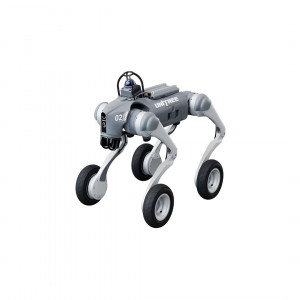
The Unitree Go2-W U3 is a wheel-legged quadruped robot engineered for autonomous navigation, outdoor inspection, and advanced robotics research. Four 7-inch pneumatic tires replace conventional paws at each leg tip while 16 articulated aluminum-alloy joint motors drive a hybrid locomotion system that reaches 2.5 m/s and clears obstacles up to 70 cm high. The U3 configuration pairs a Livox MID360 360° 3D LiDAR with an Intel RealSense D435i depth camera; a dedicated NVIDIA Jetson Orin NX module delivers 100 TOPS of on-board AI inference — all packed into an 18 kg platform ready for secondary development from day one.
| AI Computing Module | NVIDIA Jetson Orin NX — 100 TOPS |
|---|---|
| 3D LiDAR | Livox MID360 — super-wide-angle 360° |
| Max Obstacle Height | <70 cm |
| Battery Endurance | 1.5–3 h (15 000 mAh, fast charge) |
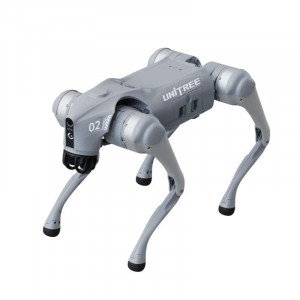
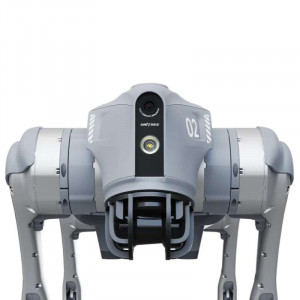
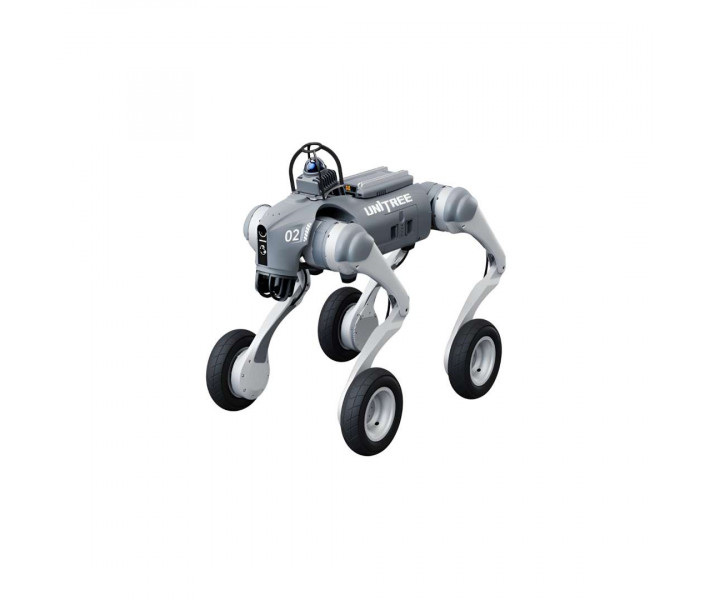
The product image below shows the complete Go2-W U3 system: the Livox MID360 LiDAR unit is visible on the saddle, alongside the compact body housing the front-facing depth camera, status LEDs, and the four-wheel articulated leg assembly.
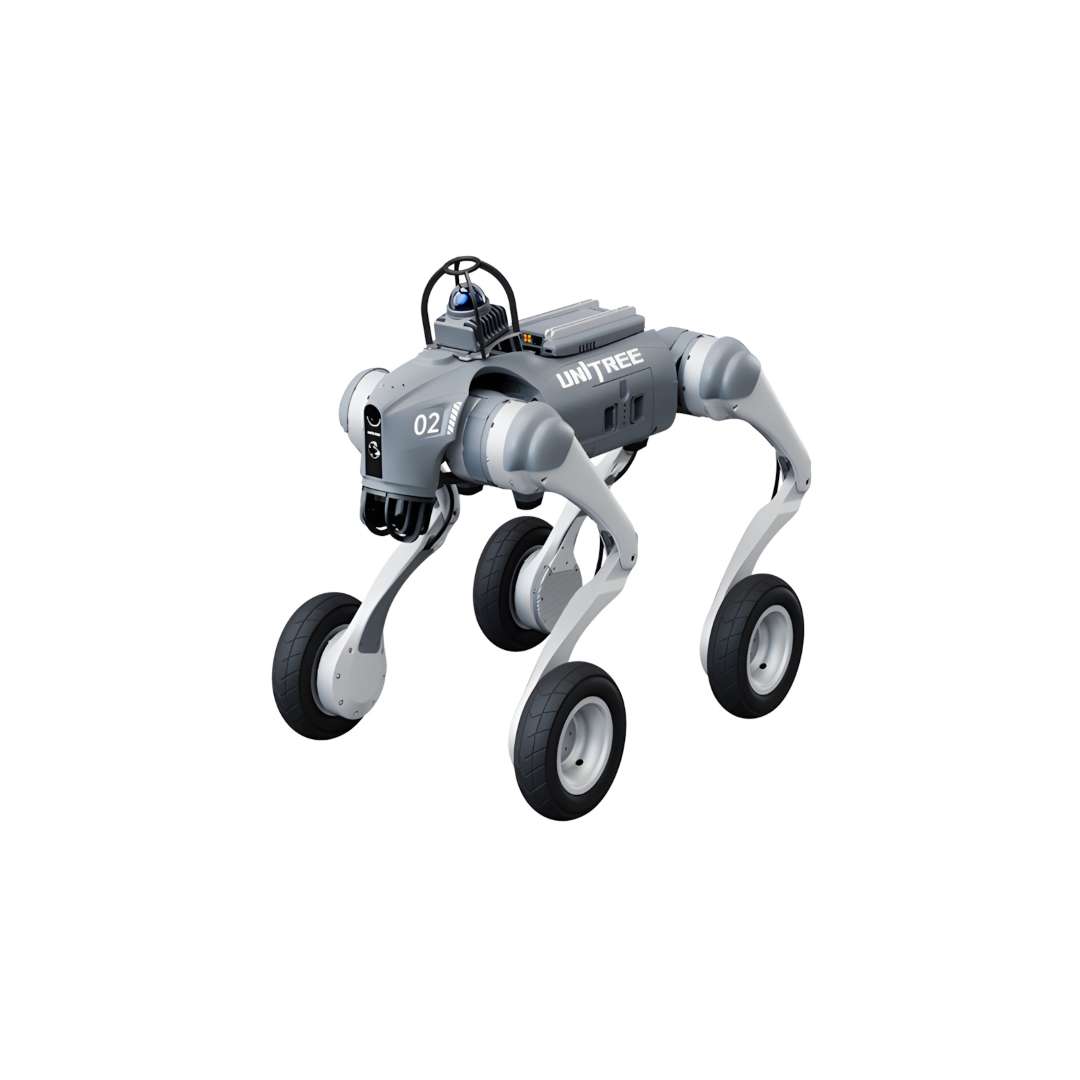
Wheel-Leg Hybrid Architecture: 16 Joints, Four Pneumatic Tires
Conventional quadruped robots force a choice between legged agility and wheeled efficiency. The Go2-W resolves that trade-off by fitting a 7-inch pneumatic tire at the distal end of each articulated leg. The result is a robot that rolls at high speed across smooth surfaces, then dynamically repositions its joints to tackle steps, inclines, and uneven terrain without halting. Sixteen aluminum-alloy joint motors drive the system, each rated at a peak torque of approximately 45 N·m — enough force to push the 18 kg platform through gravel, grass, and paved surfaces without losing balance.
Pneumatic tires absorb micro-vibrations that would destabilize solid-wheel or paw-based designs. On hard surfaces this translates to quieter, faster rolling; on loose ground it improves traction without any active suspension hardware. The balance controller compensates for the gyroscopic effects of spinning wheels in real time, as demonstrated below.
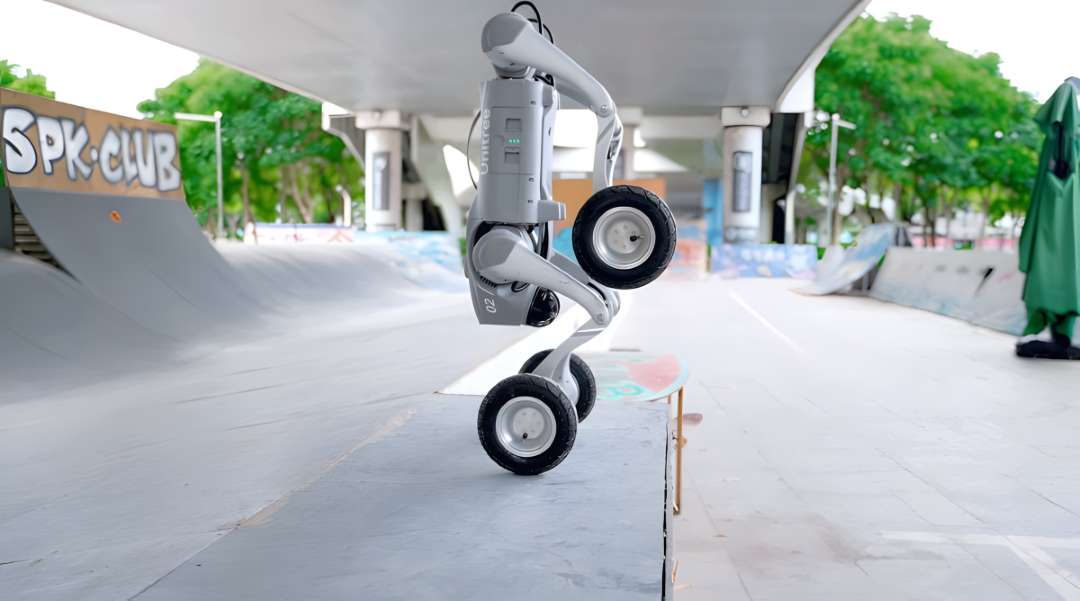
All-Terrain Obstacle Clearance: Up to 70 cm High, 35° Inclines
The Go2-W's headline terrain figure is a maximum climb height of 70 cm and a maximum climb angle of 35°. These numbers are not achieved by brute torque alone — the whole-body controller reads joint-state and IMU data continuously, adjusting all 16 motors to maintain traction as the robot transitions from wheeled rolling to leg-powered climbing. Roadside kerbs, loading-dock lips, debris fields, and urban obstacles that stop wheeled-only platforms cold are navigated without special programming.
The frame below captures the Go2-W mid-obstacle at a skatepark test environment, rear wheels bearing load while the front legs lift to clear the edge of a padded bench.
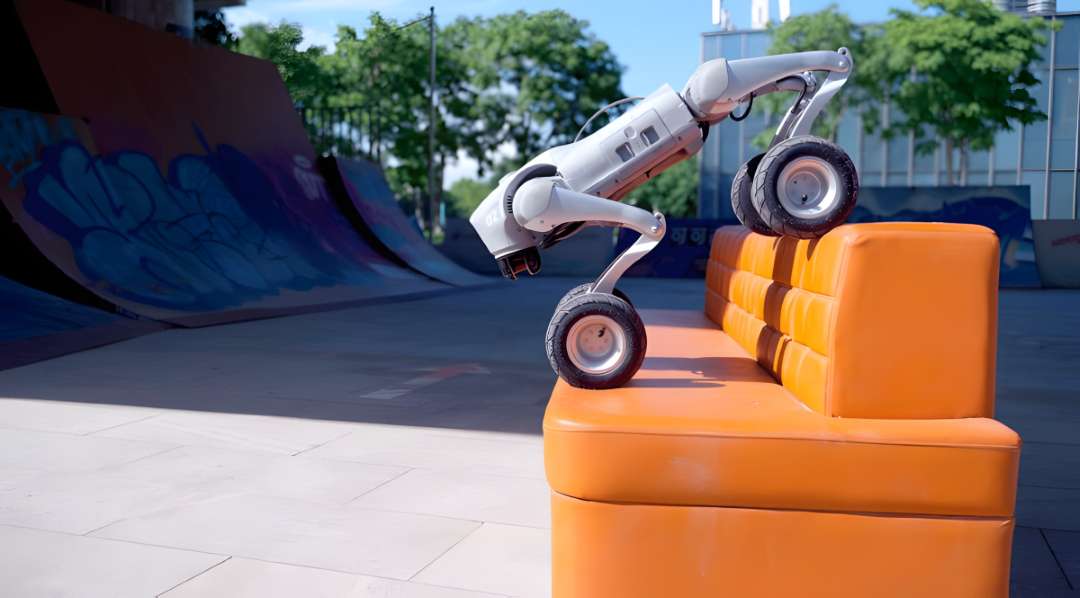
Stair Climbing in Unstructured Environments
Staircases represent the most demanding vertical challenge for wheeled robots. The Go2-W addresses this with its articulated leg geometry: each limb can extend and angle independently, allowing the robot to step each tire onto successive treads rather than attempting to roll up vertical risers. The image below shows the Go2-W ascending a flight of outdoor stone stairs — a scenario common to campus, industrial, and urban deployment contexts.
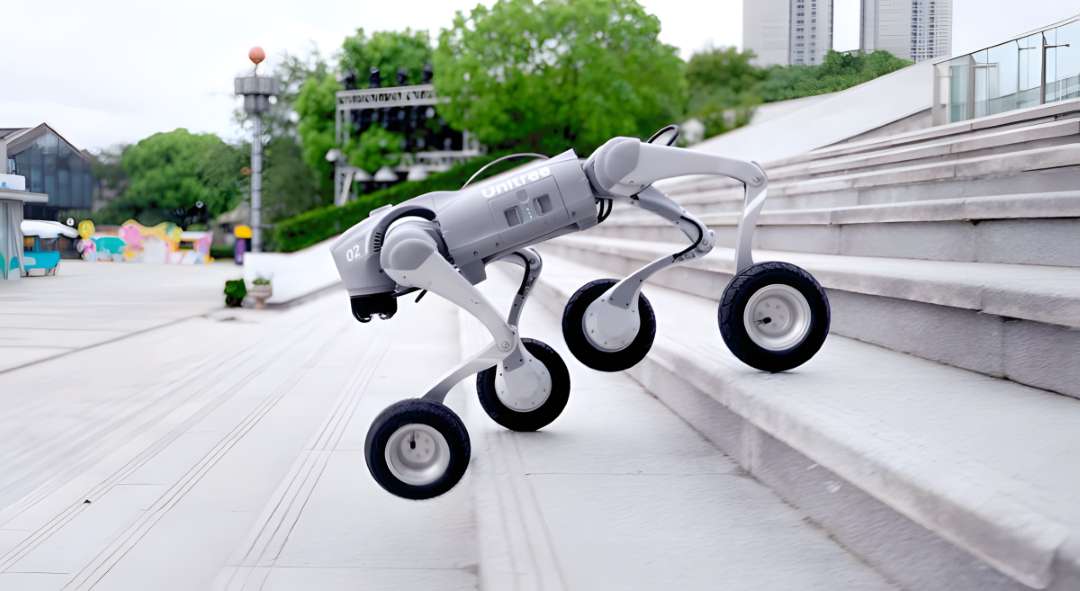
Locomotion Speed: 0–2.5 m/s Across Surfaces
On flat and inclined surfaces the Go2-W reaches a top speed of 2.5 m/s — comparable to legged-only quadrupeds, but achieved with the energy efficiency of rolling contact rather than repeated leg-strike cycles. The payload envelope of ≈8 kg (up to 12 kg maximum) allows integrators to mount additional LiDAR brackets, inspection cameras, or research sensor arrays without degrading nominal locomotion performance.
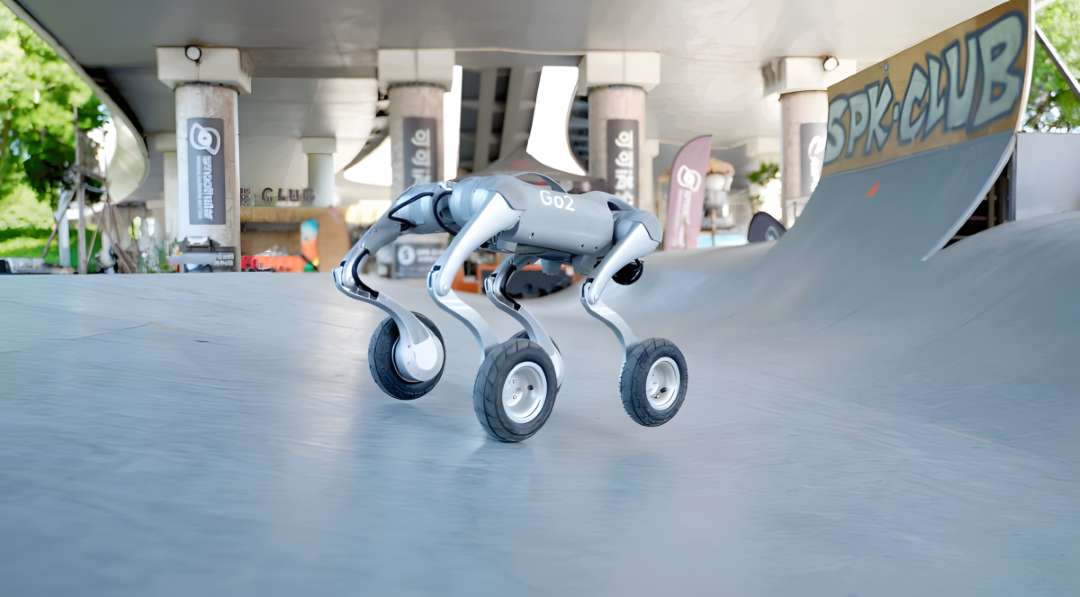
The traversal below was captured at the same skatepark venue and illustrates the stable, low-centre-of-mass rolling posture the Go2-W maintains even on curved inclined surfaces.
Perception Stack: Livox MID360 + Intel RealSense D435i + 100 TOPS
The U3 perception configuration centres on the Livox MID360 — a solid-state 3D LiDAR with a super-wide-angle field of view and a non-repetitive scan pattern that achieves denser environmental point cloud coverage than conventional spinning LiDARs at an equivalent frame rate. Point cloud data streams directly into the SLAM and navigation algorithms running on the onboard compute stack. The complementary Intel RealSense D435i depth camera handles close-range object detection, ground-plane estimation, and visual odometry augmentation — providing the short-range spatial data that LiDAR alone cannot resolve at low altitude.
The NVIDIA Jetson Orin NX development module provides 100 TOPS of AI inference backed by an 8-core high-performance CPU. Every perception, planning, and control decision executes locally in real time — no cloud dependency, no latency penalty. The open development environment supports ROS-based workloads, custom neural network deployment, and full SDK-level access for secondary development. Navigation algorithm and technical support for the MID360 stack are included in this configuration.
Connectivity, Control, and Open Development
The Go2-W U3 ships with WiFi 6, 4G cellular, and Bluetooth interfaces — a combination that allows simultaneous high-bandwidth local communication (WiFi 6 for data streaming) and wide-area remote operation (4G for field deployments without local infrastructure). The companion mobile APP covers configuration, telemetry readout, and remote control. A physical manual controller is included for direct hands-on operation and training-data collection tasks. Voice command reception is supported via the onboard audio system, and front-mounted lighting enables low-visibility operation.
Secondary development access is fully open: the Jetson Orin NX environment is reachable over the local network to deploy custom ROS packages, retrain onboard models, or extend the SDK with application-specific logic. Intelligent OTA firmware updates keep the base software current without interrupting development workflows. An optional D1 servo mechanical arm can be added for manipulation tasks.
Battery Endurance: 15 000 mAh for Extended Field Missions
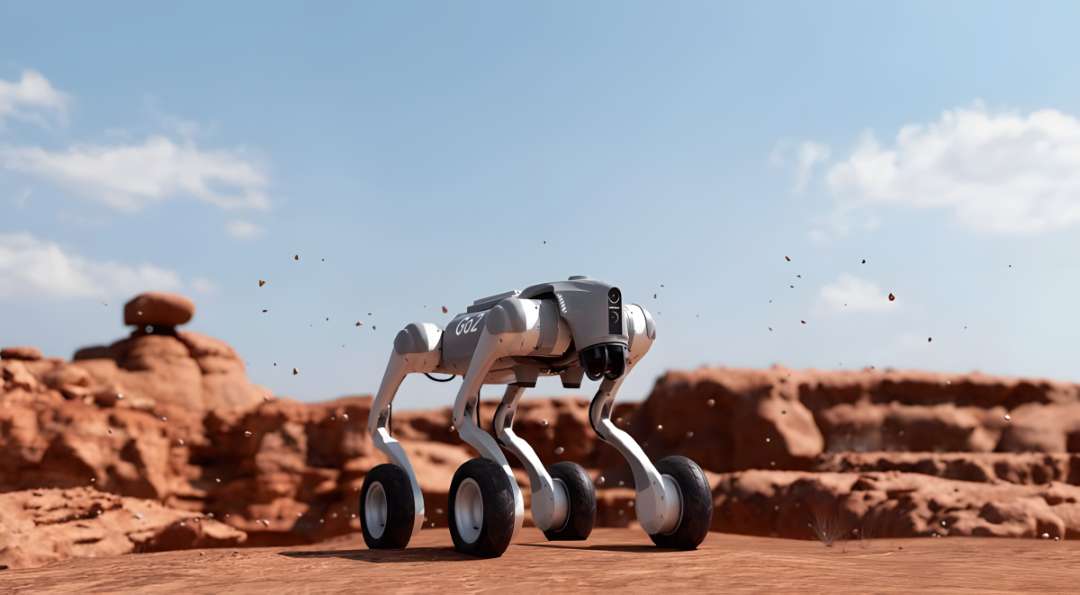
The Go2-W U3 carries a long-endurance lithium battery rated at 15 000 mAh, delivering 1.5–3 hours of operational autonomy depending on terrain demands, speed, and payload. Fast charging via the 33.6 V / 9 A charger minimises downtime between mission cycles. The image below shows the Go2-W deployed in a rugged red-rock desert environment — an illustration of the wide environmental range this platform is designed to handle.
Tech Tip: When operating the Go2-W U3 at maximum payload (12 kg) in 4G remote-control mode, expect battery endurance closer to the lower bound (1.5 h). For extended-range inspection missions, use WiFi 6 as the primary link wherever base-station infrastructure is available, and activate 4G only for long-range segments — this reduces radio power draw and extends mission time by approximately 15–20%.
Technical Specifications of the Unitree Go2-W U3 MID360
Mechanical Dimensions
| Model | Go2-W U3 MID360 |
|---|---|
| Dimensions (standing) | 70 cm × 43 cm × 50 cm |
| Weight (with battery) | ~18 kg |
Performance Parameters
| Payload | ≈8 kg (MAX ~12 kg) |
|---|---|
| Maximum Speed | 0–2.5 m/s |
| Max Climb Height | <70 cm |
| Max Climb Angle | 35° |
Joint System
| Number of Joint Motors | 16 |
|---|---|
| Max Joint Torque | ~45 N·m |
| Tire Type | 7-inch pneumatic tire |
Electrical Parameters
| Voltage | 33.6 V |
|---|
Computing & AI
| Basic Computing Power | 8-core high-performance CPU |
|---|---|
| Development Computing Module | NVIDIA Jetson Orin NX (100 TOPS) |
| AI Performance | 100 TOPS |
Sensors & Perception
| 3D LiDAR | Livox MID360 — super-wide-angle 3D LiDAR (incl. navigation algorithm + technical support) |
|---|---|
| Depth Camera | Intel RealSense D435i |
| HD Wide-Angle Camera | Yes |
Connectivity & Control
| WiFi | WiFi 6 |
|---|---|
| Cellular | 4G |
| Bluetooth | Yes |
| APP Support | Yes |
| Manual Controller | Yes (included) |
| Voice Function | Yes |
| Front Lighting | Yes |
Power & Battery
| Battery Type | Long-endurance lithium |
|---|---|
| Battery Capacity | 15 000 mAh |
| Battery Endurance | 1.5–3 h |
| Charger | Fast charge — 33.6 V / 9 A |
Software & Development
| Basic Actions | Yes |
|---|---|
| OTA Firmware Updates | Yes (intelligent OTA) |
| Secondary Development | Yes |
| Navigation Algorithm (MID360) | Included (AI algorithm + technical support) |
| Optional Arm | D1 servo mechanical arm (optional accessory) |
Warranty
| Warranty Period | 12 months |
|---|
What's in the Box
- Unitree Go2-W U3 wheeled robot dog (full assembly)
- Livox MID360 3D LiDAR (installed, with navigation algorithm and technical support)
- Intel RealSense D435i depth camera (installed)
- NVIDIA Jetson Orin NX development module (installed, with AI algorithm and technical support)
- 15 000 mAh long-endurance lithium battery
- Fast charger — 33.6 V / 9 A
- Manual controller
What is the maximum obstacle height the Go2-W U3 can climb?
The Unitree Go2-W U3 can clear obstacles up to 70 cm high and navigate inclines up to 35°. The 16-joint articulated leg system allows each wheel to independently step onto successive surfaces, enabling stair climbing, kerb negotiation, and rough terrain traversal that wheeled-only robots cannot attempt.
What LiDAR is included in the U3 MID360 configuration?
The U3 MID360 configuration includes a Livox MID360 solid-state 3D LiDAR with a super-wide-angle field of view and a non-repetitive scan pattern, bundled with a navigation algorithm and dedicated technical support. It is paired with an Intel RealSense D435i depth camera for close-range obstacle detection and visual odometry.
How much payload can the Go2-W U3 carry?
The Go2-W U3 has a nominal payload of approximately 8 kg, with a maximum of around 12 kg. Loads within the nominal range do not degrade locomotion at typical operating speeds. For custom integrations — additional sensors, the optional D1 mechanical arm, or inspection payloads — mass should be centred over the saddle to preserve balance controller margins.
How long does the battery last and what charger is used?
The 15 000 mAh long-endurance battery delivers 1.5–3 hours of operational autonomy depending on terrain, speed, and payload. The fast charger operates at 33.6 V / 9 A, minimising downtime between mission cycles. Intelligent OTA firmware updates can be applied during charging windows.
Does the Go2-W U3 support ROS and secondary development?
Yes. The NVIDIA Jetson Orin NX development module provides full secondary development access, including ROS compatibility, custom neural network deployment, and SDK-level integration. The MID360 stack ships with an AI navigation algorithm and technical support. WiFi 6 and 4G connectivity enable real-time data streaming to external workstations during development.
Why Choose EXPERT3D?
EXPERT3D has specialised in advanced robotics and 3D technology since 2012 — more than a decade of hands-on experience selecting, deploying, and supporting professional-grade platforms across research institutions, universities, and industrial R&D teams throughout Spain and Europe. We provide pre-sales technical consultation, delivery coordination, and post-sale support backed by direct manufacturer contacts. The Unitree Go2-W U3 MID360 is a platform with a rich development ecosystem: our team can help you navigate sensor integration, SDK configuration, ROS workspace setup, and custom payload design for your specific application. Contact us to discuss current availability and configuration options.